Highland Park 10yo “Viking Scars” (40%, OB, Circa 2019)

Highland Park, never has there been a distillery whose output can really inspire me the one time and make me pretty sad and disappointed the next. Especially the official bottlings. Looking back at my reviews of official releases, I have to go back to 2015 to find a very good 18yo (bottled in 2012). Still the 18yo is wonky at best, since the 18yo (bottled in 2014) didn’t even come close to the 2012 expression. And this is the second time this happened to me with two earlier editions of the 18yo some ten years before. One batch, very good, the next not so much. I’m all for batch variation like Springbank does, but Springbanks seem to be always good yet can differ quite a bit. Every batch is made with different results in mind. With Highland Park you can see they were aiming for more or less the same profile, just the quality suffered a bit.

Don’t get me wrong, I really have a soft spot for Highland Park. Heck, this is already the 17th Highland Park on these pages! It was the first Malt I encountered that really connected with me, wow, how I looked up to it. For instance, have you ever tried the 18yo wide-neck version? Just sayin’. Maybe with a change of owners, a change of management, a change in views, came some sort of downfall of the core range for me. To be honest, I haven’t been looking at Highland Park for a while now, but luckily this bottle-share with Nico came up. Maybe I’ve set myself up for another disappointment, since this is a 10yo bottled at 40% ABV. I hope Highland Park is able to put out a decent entry level Malt.

Color: Light gold.

Nose: If I would say, heather and honey, would I still be believable? But yes, for me its that and this is thus most certainly a Highland Park. Smells good, floral (sometimes even borderline soapy) and has definitely some Sherry-notes as well as some warm barley aroma’s. Warm oak and do I detect a whiff of smoke right there in the back? Vanilla with some cask toast and milk chocolate. Cloves, birch sap and smells from the fire place at Christmas. Candied yellow fruits. Besides the perfumy and quite floral notes also some minty ones appear. American oak vanilla and a nice refreshing citrus note as well. Also some sweetish ripe green apple skins. If you sniff this well, it has a nice dirty note there in the back as well. Quite a lot going on for a modern Malt at 10 years of age, one that also has been reduced so much. The smokey, fire place note is very interesting in this one. The whole works well and the well-balanced nose surely doesn’t disappoint. Very nice!

Taste: Thin, somewhat watery, waxy and paper-like. Initially sweet and heather smoky and than an ever so slightly bitter note from wood. More birch than oak though. Sappy. I have to hurry to put another sip in before everything disappears. Oooh it does smell really nice though. So this is thin with a short sweet run and some wood. Heather yes, honey, nope, the sweetness is more of the refined sugar kind to me. Quality sugar water with alcohol. Warming. Sweet with thin runny caramel and sticky toffee and some nutty notes as well. Whilst dramming, keep smelling this, because it lifts the taste. After sipping, the smoky notes in the nose get bigger and more wonderful, the smoke creeps into the taste as well. However, I fear the overall taste suffers more than a bit from the reduction I guess. The nose is very good and there are more than a few hints in the taste of this Whisky that it should be quite good at a (much) higher ABV. Since it seems a bit syrupy sweet, it sometimes drinks like it is 30% ABV. Just when going down, you know there has to be some (but not even a lot) more alcohol here than you might think. Some woody bitterness, plantlike and again a bit cardboardy. The finish is obviously short. The aftertaste is comprised of a syrupy film, toffee, wax and heathery and this light bitter woody note. Hint of milk chocolate with a floral edge. Five seconds later all is gone and Viking Scars turn out to be only superficial cuts and probably will leave no lasting marks. Not bad though, I expected worse to be honest.

As I said in the intro, I had some kind of reason to lose interest in Highland Park and somehow built up some kind of prejudice. Well this bottling sure feeds this prejudice in a way, yet there are also some leads in the smell and taste offering hope. In its defence, this is not expensive, and good smelling, but must have been targeted at a more careless consumer, who might want to use it in a Whisky and Coke. Well, I obviously don’t fit that bill (I prefer a good Rum in my ginger beer by the way, thank you very much). This bottling is most definitely not targeted at the members of HPAS (Highland Park Appreciation Society), these members turn their attention to the many single cask bottlings bottled at cask strength. I’m sure though members of HPAS have tasted this bottling and have some at home as well. Not sure if they are drinking it on a regular basis though. I have to get me a sample or a bottle of one of those single cask expressions. I’m curious about those. If you are really into Single Malt Whisky, well, you might want to skip this one or at least don’t have too high expectations for it and the nose will certainly surprise you…

Points: 82

Yet another sample from Nico, who quite liked this and I do understand why. Thanks again mate!

Kingsbarns “Dream to Dram” (46%, OB, First Fill Bourbon & First Fill STR barrique)

Happy 2021! After dry Januari, finally the moment has arrived to forget about the past year, may it never return, in no shape or form whatsoever. However, all is still not well with the world at the beginning of 2021. I hope this review reaches you in good health and sound mind. With this new year, I’ll kick off with a new dram from a new Distillery. Kingsbarns is the new distillery owned by the Wemyss-family, a name we already know as an independent bottler of Single Malts like the Bowmore “Aniseed Pastille” and the Clynelish “Cayenne Cocoa Bean“, Malts I reviewed earlier.

Kingsbarns Distillery lies approximately six miles from St. Andrews, close to the Kingsbarns Golf Links. This is not a coincidence since the distillery was the dream of former Golf Caddie Douglas Clement. Word is that clients of Douglas’ were asking for directions to the nearest distillery, for “refreshments” after a strenuous game of golf, and since there really wasn’t a distillery close by, Douglas came up with the idea of having a distillery much closer to the golf course. Douglas found a suitable site close to the Golf Links. He found the derelict East Newhall Farm that serviced Cambo House and Estate. The buildings originated from around 1800 as part of the East Newhall Farm. Owned by Thomas Erskine, the ninth Earl of Kellie, and were restored for the use as a distillery in the original style. The farm, now distillery, overlooks barley fields, what else do you need? Kingsbarns Distillery opened in November 2014 and began filling casks from March 2015.

Raising money for a distillery was too much for Douglas alone, so he looked for financial backing, eventually finding the Wemyss family. Some reports mention that Wemyss simply joined the project, where others mention Douglas was bought out by Wemyss. As far as I know, Douglas worked together with Wemyss to fulfil his dream. The Wemyss family themselves probably were interested in the project, because they already did have a Whisky business and thus know their way around, but also have a historical link with this site as well. The 7th Earl of Wemyss owned part of the Cambo Estate between 1759 and 1783.

Color: White wine

Nose: Very Malty and grassy, but also pleasant. Young and creamy with hay, cereal and citrus aroma’s. Yes. very Lowland. Somewhere between soft and fresh ‘n zesty. Young, but not really new make spirit young (so nothing like young Tomatin, which is more milky and acidic to boot). Vanilla pudding with a little bit of American oak (vanilla and some wood spice), soft wood. Sweet mint candy. Menthos and vanilla ice-cream. With some air more friendly floral notes emerge. Already quite balanced and accomplished for such a young malt, but young and simple nevertheless. The nose can be compared easily with something like Bruichladdich Organic (the vintage ones @ 50% ABV), which are around twice the age, and still those are considered to be very young. The Bruichladdich tastes much bigger though. Tiny hint of toasted oak and a winey top-note. What was STR-cask again Kato? (Shaved, Toasted en Re-charred). Nice nose, better than expected. After some more breathing a little bit of new make does show up, but not much. However once this note shows up, it never leaves again, so definitely a young expression, but that’s what we expected now, didn’t we? Perfumy and aromatic next, like a Dutch Korenwijn or Jenever. A light Whisky for springtime, an introduction.

Taste: Sweet and citrussy, floral and grassy, but also a bit (sugar) watery (with licorice) and simple. Again, this whiff of toasted cask, lemongrass and young sweet malt. The sweet note makes for an instant gratification Malt, be it a very simple one. Here the youth is even more noticeable. It definitely lacks a lot of complexity and some balls. What you taste is what you get. It doesn’t really evolve much in my glass. It’s very soft and friendly, like a soft spoken person. Humble and kind. Lowland-ish in style. Luckily, some backbone is offered by a peppery note and warm wood. Cold White Wine storage complete with a whiff of new cardboard. The higher ABV of 46%, does help to lift things a bit up, although I do believe this Malt could have done with an even higher ABV. Very short sweet finish, peppery and warming, dessert-like, with hardly any aftertaste.

The nose shows this distillate really has potential. I guess this will be very nice when it gets more years behind its belt. The Lowland quality is there, time and the people of Kingsbarns will do the rest. A Malt to start your evening with. Treat this as an introduction, a young whisky to present itself. We now know what style to expect. It is most definitely not a full blown Whisky yet, and if you buy a bottle expecting a proper aged Whisky, you’ll be disappointed. Nice one for building expectations. We’ll be watching this one to see how this develops further.

Points: 76

Thanks go out to Nico, for this sample of his Whisky.

Amrut 4yo 2009/2013 (59%, OB, Single Cask, for Europe, Charred American Virgin Oak & Port Pipe #2712, Peated Barley, 357 bottles)

What again? Yes here is another tandem Malt. After last weeks Amrut here is another one. This time not a direct comparison, there was no reason for that, but I did compare both behind the scenes, to assess which one is better and for the height of the scores. I do love Amrut. Most Amruts I have tasted are at least good, and some are better than that. Lovely stuff and definitely a different and exotic take on Single Malt Whisky. Maybe the people at Amrut don’t even know how to produce a bad Whisky, or maybe they are out there, but I haven’t encountered them yet? Who knows. Amrut is most welcome to the world of Single Malt Whisky, since they do bring something new into the fold.

In 2013 a few single cask bottlings emerged, especially bottled for Europe, but there should be versions for other markets as well, even bottled in a different year. Earlier, I already reviewed a virgin oak and first fill Bourbon barrel version and a charred American virgin oak and PX Sherry butt version. All good things come in threes, so the third version they released that year is this Charred American Virgin Oak and Port Pipe. This time the barley was peated. Amruts standard is so high, that even the “simple” and affordable peated and especially the unpeated cask strength versions turned out to be very tasty, and in hindsight the charred American virgin oak and PX Sherry butt version may have been somewhat less than perfect, still it was slightly better than the peated cask strength version. The peated cask strength version is my lowest scoring Amrut on these pages, and it still was a Whisky I liked. I will probably buy it again sometimes, just to see how it fares.

Color: Orange-brown gold. Bourbon.

Nose: Initially fruity and milky. I often have this Malt right after the Kadhambam, and it definitely has this milky quality to it. Even some expressions of Paul John tasted right before or right after this one makes that evident. Don’t worry though, in the nose the milky bit mostly wears off. I’m guessing this is from the Virgin oak. Fruity and very PX-like. Nosed blind I would have guessed PX instead of Port. Dusty, deep, dark and brooding. Some underlying heavy sweetness, like warm syrup and tarred wood. Treacle. No Indian spiciness, so for me the cask overpowered the original Malt. Mind you, this wasn’t initially matured in Bourbon casks, but rather in virgin oak casks. Red fruit lemonade. Strawberry and raspberry syrup, with still this tarry and treacle note underneath. Fire place smoke, yet hardly peaty. Not peaty at all actually. Pencil shavings and crushed dry leaves from trees. A more fresher citrussy note emerges next, as well as some faint mackerel in oil aroma. Since this was matured in a hot climate, the virgin oak works differently, compared to its Scottish counterparts. No harsh, creamy or sappy wood, we can pick up from Scottish Single Malts matured (in part) in virgin oak. Maybe here the milky bit is the way the virgin oak exerts itself? Also a floral bit now. Soft and delicate rose notes combined with sharper whiffs of smoke from the fire place. This is a winter Malt, bordering on Christmas. Certainly brings you in the mood. It’s a big Malt this. The aroma’s are big and bold and never stop giving…

Taste: Tarry wood. Spicy autumn leaves. Quite sweet and prickly (smoke). Treacle and cookies. Black coal. Carbon powder, gun powder. Big, very big. Almost a bit like Rhum Agricole mixed with a heavy Demerara Rum. Steampunk locomotive. Yes Port, but again, it is also not that far away from a heavy PX cask. Well balanced. Chocolate and Brownies. Candied cherries. Licorice and smoke, but also a green note. Oak, but not like the virgin oak we know. No vanilla notes to be honest. Red fruit syrup towards the finish, warming log fires as well. Some residual bitterness, from burnt down logs of wood. Since I got this heavy Rum note, its hard to picture it without it. This has a very long finish, very warming and a perfect aftertaste of everything mentioned before. All is here and all stays with you for a long time. Very good stuff.

Here a lot of the aroma’s are quite big and overpowering, so it is near impossible to make out the Spicy Indian Spirit. So for me maybe less typical than other expressions, but nevertheless a very tasty piece of work again. The beauty lies in the details, but here the details are masked. Luckily the result is still quite nice. There were more casks bottled like this. I bought cask #2714 as well. I’m especially curious now if that one will have this milky note as well as this one. Something we’ll find out in the future…or not…

Points: 89

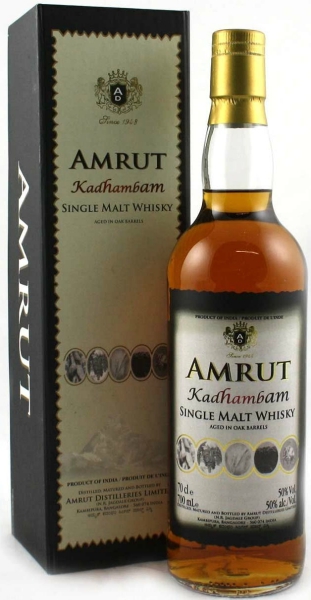
Amrut Kadhambam (50%, OB, Batch No. 6, Bourbon matured, Rum, Sherry & Brandy Finish, 2017)

If you read my reviews back about Indian Malts, you know they are quite to my liking. However, the last review I did was way back in 2019, remember those pre-Corona days? How different life was back then? So it is about time to review a few more. Today I’m having a look at another Amrut. This time Kadhambam, which is the Tamil word for mixture. Well, what they have concocted here is a mixture of different finishes. The Amrut standard Single Malt (Bourbon matured) has been further matured in casks that previously held Rum, Sherry and Brandy. Those casks are then married together to form this Single Malt.

Color: Orange gold.

Nose: Malty, somewhat less Indian spices than expected but there is still a lot here, in part masked by a lot of other aroma’s. Dusty and sweet. Toffee with nice organics. Fruity, jam-like sweetness and almonds. Vanilla and powdered orange candy. The base Bourbon matured Malt is easily discernable, so the finishes didn’t overpower the Malt. It is also definitely noticeable, that a lot of different casks were used. The Brandy bit is recognizable from my earlier experiences with Port Charlotte CC:01 which was Cognac cask matured. When I smell this with a low flow rate, let’s say 5 seconds worth of snorting (which is quite long, just try if for yourself), lots aroma’s pass by. It is soft and spicy at the same time, very fruity and appetizing. Quite late in the mix the woody bits come forward. Licorice, pencil shavings and the familiar toasted oak. Cold sweet black tea, more licorice and a slight hint of tar. This might seem like a Whisky where just a lot was thrown together, yet still it manages to reach such a high level of balance. Amazing. This turned out very nicely.

The aroma’s of this Malt are transported well. 50% ABV is a very good strength for this. 40% ABV is rather weak for a Modern Malt and 60% ABV can be quite overpowering for some. Old Malts were made differently from different barley varieties, maybe different yeast strains and the cask may have been different. Old Malt’s could be easily diluted to 40% ABV. Just look at G&M’s Longmorn from 1971. Not everything was working At 40% ABV, but a lot did, and today that percentage would be lower. I don’t think Douglas Laing bottled their Old Malt Cask Whiskies at 50% ABV by accident, although I do suspect some economics were applied as well. If you reduce Whisky (a bit), you end up with more bottles to sell. But hey, Whisky is also a business, even though for some of us it feels like a charity. So nothing wrong with the business of it all. Luckily for us aficionado’s, Douglas Laing stopped diluting at 50% ABV. A heartfelt thanks for that!

Taste: Starts sweet and fruity, but thinking back to Port Charlotte CC:01, I don’t really remember that cask giving off this kind of sweetness. Toffee, runny warm caramel, fruit syrup and jam. The perfect sweetness takes a while to move over. Indian spices, almonds and licorice, toasted oak, sweet ripe red fruits and green banana. Let it breathe, it may be a bit closed at first (especially when you’re dealing with a freshly opened bottle). Wood in the back, as well as some cold ashes from the fireplace. There is a lot happening in this Malt, so all this stuff needs a while to break free. Very well balanced with a fruity and nutty aftertaste. Tasty! The longer this stands the nuttier the taste becomes. Amazing balance. Another cracker!

The price is gradually rising over the past few years, but at today’s price-point it is still very recommended. I guess the score reflects that.

Points: 88

Talisker 10yo (45.8%, OB, L5055CM000, 2015)

I don’t think this review will need a long introduction, since this Whisky will be compared to the 10yo bottled in 2019. It’s more than likely, but not necessarily true, that this review will have a longer than normal conclusion. So the previous review was about the Talisker 10yo bottled in 2019 and right now we’ll have a go at the same expression bottled in 2015. Rack ’em up and see how they compare!

Color: Gold, slightly darker than the 2019 version, and yes caramel colored.

Nose: Quite perfumy with only a hint of peat, softer than the 2019. Paper and cardboard notes. Quite fruity and friendly. Distant peach yoghurt, dried apricots and sinaspril. The balance in this one is reached sooner. Again, seems softer than the 2019, but both seem quite similar at first glance. Diageo will be pleased (for now). Companies hate batch variation in an offering like this, which relies on consistency. Definitely softer and carries a promise that is more sweet (cocktail cherries and vanilla) and with less toasty oak notes. Vanilla powder, pencil shavings and cardboard. It looks like the woody bits from the 2019 are here too, but they are more masked by the fruity bits. Just like “the other” version, this picks up more balance when left in your glass for a while. 5 minutes will do, as will do the warmth, the love, from your hand. Keep it moving, waltzing, swirling in your glass. Fruit emerge and even some farmy notes. The 2019 expression being less soft, seems to have more of a backbone (wood), but this 2015 seems more complete overall, it just offers a bit more.

Taste: Even sweeter on entry. Much fruitier, sweeter and again friendlier. Short sting of Talisker pepper. Less wood, less toast, less woody bitterness even. It is quite waxy though. Chewy peat and some chocolate chip cookies. This can stay in the glass longer than the 2019, which grows thin and a bit out of balance. I would say that in the details, the 2015 is a summer version and the 2019 is an autumn version of Talisker 10. This 2015 is definitely the tastier version of the two, it’s tastier and downright better, and the difference is quite easy to detect as well. Aiiii. Diageo won’t like that, Talisker 10yo should always taste the same. Bugger they say and I say bollocks. Nothing wrong with a wee bit of batch variation if you ask me. Just look at the output of Springbank, although they seem to serve a completely different group of clients. Who are you, when you want your Whisky to always taste the same?

Both offerings are quite soft, and although some might say they both smell pretty similar, the difference is right in front of your nose and easily spotted, which, I have to admit, is much easier when you have the opportunity to try both at the same time (just not in one glass). The 2015 is fruitier, the 2019 has more peat and wood. (Toasted) oak, sandal wood and pencil shavings. The fruit doesn’t play a big role in the 2019, it’s not about that at all. Maybe it is simply lacking in the 2019. Which nose I prefer best depends on the mood I’m in. Neither nose is better than the other. (When tasted in the morning, I preferred the 2015, in the evening I preferred the nose of the 2019. Taste-wise the difference, like the smell, is the same, woody as opposed to fruity, and yet it is here (in the taste) that the 2015 easily eclipses the 2019. 2015 shines (like a sun) and the 2019 is a true autumn Malt, with more wood, but also more gloomy, cloudy and grey (dull). Even the empty glasses, after a whole day, show the difference easily. The final test was Mrs. Quill, she hated the nose of the 2019 (you can imagine a particular facial expression now) and said the 2015 smelled a lot better, why? It smelled sweeter and fruitier. Only afterwards I explained both are Talisker 10yo, just bottled in different years, but she didn’t hear me, already lost interest… Was it so hard to even fake an “OK” or a “Wow”? Jeeez!

Points: 86

Thanks go out to Nico for the sample!

Talisker 10yo (45.8%, OB, L9275CM003, 2019)

When talking to a good buddy of mine, Nico, one day, Talisker 10yo came up as one of those malts that is always consistent in quality, always tasty, highly affordable and really widely available. Earlier I reviewed a bottling from around 2002, which was more than pretty decent. I even tried earlier bottlings, and they could be truly stellar. So with all these memories in mind, and the statement from Nico, I just left him sitting there where he was, and ordered a current 10yo. What I got the next day was this bottle from 2019. When freshly opened, I wasn’t all that enthusiastic to be honest. It also reminded me more than a bit of the 57 North I reviewed recently. I gave Nico a sample of the 2019 10yo and he found it again to be pretty decent. He seemed to like it more than I did. I got a Talisker 10yo, bottled in 2015 sample from him in return, so guess what will be the next review…

Color: Gold, but who cares, it’s colored. (Why? they used to color the glass, so get back to that, and leave the Whisky alone).

Nose: Light peat and slightly sharp. Sweet malt with diluted toffee notes. Hints of Calvados, cookie dough and dishwater. When smelled/snorted more vigorously, toasted oak comes forward (as well as a perfumy note). I keep smelling some apple, so Calvados it is then. The nose seems a bit off-balance at first, but this is corrected with some breathing, actually reaching a quite nice level of balance. Let it settle in your glass for a few minutes. More mocha and soft toasted wood add to the balance. With this, the apply notes are shoved right to the back. Sandal wood notes emerge next, this is all going in the right direction now! Brown sugar, toasted malt and the occasional whiff of cigarette smoke. This is rapidly becoming very nice indeed. After some longer breathing, the Calvados is gone, or maybe got overpowered or masked by the rest of the aroma’s. New is a distant whiff of fireworks and even later the perfume returns (we got this already, when sniffed vigorously in the beginning).

Taste: Sweet on entry. Smoky and cask toast. Light and waxy and a little bit of bitter on the side. Slightly milky and young, similar to the recent 57º North. Some paper and some wood, but not much. Less complex than the nose. After sipping, the nose turns slightly sharper. Coffee, ashes and slightly waxy. Sweet licorice. Nutty with quite some woody bitterness. The nose needs some breathing, but don’t let it stand around for too long. That would be a mistake. It gets a bit unbalanced again and also a bit thin. This is achieved by extensive breathing, so don’t overdo it.

Sure, this Talisker 10yo is pretty decent, but miles away from the 10yo from 2002, and there are quite a few more expressions of Talisker 10yo that can be called truly stellar. But times change, barley changes, the distillery changes, demand changes, everything changes. Take all of this into account and compare this to other Whiskies of this age and what you have here is still a pretty decent dram, for a very, very affordable price. Let’s say for the price of a lottery ticket. Do you feel lucky? If not and you need some comfort, get this, chances of winning are pretty slim anyway. Your choice.

Points: 84 (Nico scored it higher)

Cragganmore 12yo (58.4%, OB, Special Release 2019, Refill American Oak, 18.000 bottles)

Why not? Yeah, why not make it a pair again and write about another Cragganmore and yes, this one is from another sample bottle. This time we’ll go for last years official special release 12yo. As mentioned in the previous review. Cragganmore can be the under the radar malt, but somehow people caught on up pretty quick with this one. Maybe not a lot was made, wait a minute! 18.000! That’s not very limited, and still it sold as hot cakes, holy mackerel, this must have been good then!

So maybe Cragganmore isn’t all that very well known, yet Diageo has released already quite a few expressions as a special release: It started in 2003 with a 29yo from 1973 (scored that one 87 back in the day). Probably one of the Cragganmore’s in my collection. They weren’t extremely expensive back then, and didn’t sell very well. These early special releases were quite often very affordable when on sale, and that happened a lot in the early days of these series. I remember I got both 36yo Glenury Royals and Quite a few Talisker 25yo’s for a very nice price. The special releases replaced the Rare Malts, remember those? 2004 saw the release of a 10yo from 1993 (scored that one 86). In 2006 a 17yo from 1988 was released. In 2010 a 21yo from 1989 was released. In 2014 a 25yo from 1988 (again) was released. In 2016 a quite expensive NAS was released. In 2019 this 12yo (year not stated) and finally (for now) this year, a year that everybody will remember (2020) a 20yo from 1999 was released. I guess we’ll see some more Cragganmore’s down the Special Release line. But first, lets have a go with last years model…

Color: Pale White Wine.

Nose: Big, sharp and alcoholic, initially not that great. Funky organic start, bad breath and somewhat unbalanced. Malty and biscuity with some metal and menthol. Unlit cigar and sandalwood. Dough and a bit bread-like. Clean (but not too much) and fresh. The wonky start clears up. Fresh ice-cold milk with a snuff of chilli powder. Quite some upfront citrus notes. Sea spray and ozonic, keeps prickling my nose. Hint of smoke? Oak, partly toasted. Fresh and likeable. Something old skool underneath, hard to put my finger on right now. Hints of sweet licorice and soft wood. Next, it is dusty and the citrus returns. The fresh ozonic/menthol smell doesn’t ware off completely, it stays behind. Weakens a bit, but is holding the fort. Complex. The longer this breathes, the better and more balanced it gets. Showing more and more complexity. Tea and farmy. Somewhat nutty. Latex paint and some rainwater. This needs a while to really open up. Amazing how this keeps developing over time. By now I’m really enthusiastic about this one. Is it too late to still get a full bottle? Truly wonderful nose.

Taste: Very big on fruit and candy, but also a bit hot. Wonderful prickly spices. Fruity, with the right amount of sweetness and after going down, it turns a bit creamy. Nice wood for balance. This is a hot malt, the high ABV exerts itself. Much sweeter and very nutty as well. Dare I say there is some heather in here (like there is in Highland Park?). Stays hot for a while. Medium finish and also the aftertaste leaves the building in a hurry. Definitely some woody bitterness and still this uncatchable note. Old skool in the taste as well. Intriguing. Lemon fresh, but also toffee thick. It has a decent sweetness and a hint of dark chocolate with a balsamic twist. Cherry liqueur and a drying, almost smoky, note. Not that sharp, prickly, smoke, but a bit more, yes, peaty, yes really, and a fatter sort of smoke with burned plastic thrown in for good measure. Wonderful spiciness and dry black tea. Toasted almonds with a woody and peaty bitterness. Quite unexpected… The plastic bit carries well into the finish, as does this bitter note. Let it breathe, it needs air!

Well what can I say, very well done Cragganmore. Nice pick Diageo. Smoky and slightly peaty, and combined with the fruity character of Cragganmore, makes for a very interesting Malt, and a very good one as well!

Points: 89

Thanks go out to Nico again, source for many samples! Cheers mate!

Cragganmore 1999-2019 (51.2%, Malts of Scotland, Bourbon Hogshead, MoS 19038, 312 bottles)

Finally a chance to review a sample of Whisky, instead of one of my own bottles I have to hurry to review before it is gone. Cragganmore it is then, which has been probably a long time since I had one. Sure, I did already do a few reviews already, but since those works of art, I probably haven’t touched a Cragganmore at all, even outside of reviewing. I do have two or three bottles at home, but never got around to opening one of those. It isn’t also one of the favourite distilleries amongst my friends. I’ll have to check with them. Somehow it also never got rid of the “under the radar” status I mentioned earlier and yet it isn’t one of the worst Whiskies either. So, what is it with Cragganmore, that makes it so invisible? Maybe it should deserve this onder-the-radar-but-very-nice status or is it a hidden gem? Time to have another go.

Color: White Wine.

Nose: Biscuity. Clean and fruity. Strong aroma. This leaps out of my glass like a happy puppy when I come home. Tail wagging! Latex paint and very soft wood throughout. Fresh and quiet now (you know the introvert type). Not a puppy any more. Vanilla and caramel, but no signs of toasted oak. Thus no heavy cask influence. The color is also witness of this. The Malt is sweet and accessible. Slight hint of rotting grass, well rotting is maybe a bit of a strong word, let’s say cut grass that has been lying around for a while. Ice cream with more floral and plant-like aroma’s. Dried autumn leaves. Also a fruity note in the back, like dried apricots and fresh hazelnuts. Do I detect a hint of smoke there in the back as well? More vanilla ice-cream, lemon sherbet and smoked and sugared lime peel. Excellent. However, the beauty lies in the details, as is often the case with Malts like this. So if you are a fan of Sherry monsters only, this is not for you. Refill Bourbon hoggie fans will know what to do with this one.

Taste: Very sweet on entry. Yes, vanilla ice-cream and lemon sherbet. Mocha, hard coffee candy (hopjes) and chocolate custard. Dare I say a hint of cannabis, or does that make me Dutch? Very tasty and very friendly. Fruity and not too sweet. Some wood in the background, like a wooden frame around the vanilla and lemon dessert notes. It’s not really bitter, but the bitter notes are quite interesting in this Malt. You have the obvious bitterness you get from oak, but here there is also this bitterness you get from lemon peel, or lets say, the white fluffy bit from the inside of the peel. This doesn’t seem very complex, especially for a 19yo or 20yo Malt. It also doesn’t show a lot of evolution, but what is there is balanced and just tastes very good. This Cragganmore is from the same class as a Signatory Vintage Glen Keith. The finish is similar to the body and than slowly fades away. Medium finish, maybe some vanilla and cannabis in the aftertaste and a woody sensation on the sides of my tongue.

Well a light colored Cragganmore, from a single not so active cask, well if this isn’t aficionado territory then what is? But here we have a perfect example of a quiet Whisky at cask strength from a good distillate with time as an ingredient. Maybe not entirely a surprise how this older refill Bourbon Hoggie performs. If the distillate is good and the cask isn’t worn out or has a bad vibe, what could go wrong? This combination always seems to give us decent Whiskies.

Points: 87

Thanks go out to Rik for the sample!

Tamdhu Dalbeallie Dram No.3 (60.7%, OB, Sherry Oak Casks, 1.000 bottles, 2020)

Well, since I already have one of these lying around, why not make it two official Tamdhu’s in a row. After the (initially) slightly disappointing 15yo, I just expected more of a Sherry monster I guess, I gather this special release should have no trouble eclipsing the 15yo. First of all, it has more oomph (higher ABV), more color (A lot darker) and with a mere 1.000 bottles produced, they probably did something special, don’t you think? So I expect a proper Sherry monster again! I’m only human, and I don’t seem to really learn from my mistakes, or so it seems, nevertheless I still do expect a Sherry monster this time.

The first edition of Dalbeallie was released in 2018 at the Spirit of Speyside Whisky Festival, and gets its name from the Dalbeallie station. Tamdhu itself opened in 1897 and the station just two years later in 1899. The railway played a key role in the supply of barley and Sherry casks for Tamdhu. The station closed in 1965, but has since been fully restored. Dalbeallie is an annual release, so editon II was released at the Spirit of Speyside Whisky Festival 2019 and our number III was released this year (2020) on-line, due to Covid-19. Every edition up ’till now, counts only 1.000 bottles.

Color: Orange brown.

Nose: Thick Sherry, with licorice, lots of wonderful fresh oak, crushed dried autumn leaves, nuts and dust (and sometimes some cardboard). Very aromatic and fresh. Old, worn down leather and also meaty. However, like the 15yo, this has a rather large fresh ‘n’ fruity acidity to it. Citrus acidity, more of the lemon and lime kind than oranges, or is it… Floral perfume and some cloves (and some oranges now?). Sometimes whiffs of ozone (like you get from ozone cleaned pools). Initially a bit closed but this is quickly “resolved” with some breathing. Thick, slightly tarry, hints of petrol and brooding, yet not syrupy. Hints of paint and gravy. Seems odd, but odd combinations work well in Whisky. Cardboard and some candied red fruit sugar gello, (or jam for short), deep down below in the nose. Nice wood notes to balance it out, fresh wood and sawdust. The wood notes emerge more and more, the longer this stands in your glass and breathes. Cigar-box sandal wood is linked to the old style perfume. Extremely balanced and a truly wonderful nose. Yes it really does smell like a Sherry monster, 2.0-style.

Taste: Big Sherry. Hot and woody. Fresh dried wood, again remembering cigar boxes. Red fruits with a shadow of sweetness (as in, you know it’s there but you can’t touch it), and definitely some cigar aromas. Cigar box, cigar a cru (the smell of an unlit cigar) and cigar ashes. Powerful wood (bitter). Full of wonderful aroma’s and tastes, yet also lightly unforgiving. Starts out fresh, (new) wood and hot, but picks up caramel and some velvety softness whilst going down. For a millisecond, this is syrupy and sweet and then the dry wood kicks in, and it kicks in good. The wood sticks to the palate. Nice wood, powerful, yet not the overpowering (mouth drying) wood you get from very old Malts. It disperses eventually, making room for cookie dough and letting through a tiny bit of the sweetness I’m sure more is in here somewhere. Extremely tasty. Wow! Just like the 15yo, this is quite fresh and somewhat acidic on top. The aforementioned wood has some cloves and a sharpish edge to it. Freshly sawn oak. A truly wonderful Malt. This is essentially a Sherry monster, but with these fresh characteristics and these more than appropriate wood notes, works very well together. Big, yes, cloying, no. Hints of menthol also pop up. In a way it is almost Christmassy.

It also reminds me a bit of the high powered 2007 Glenlivet’s from Signatory Vintage. First fill Sherry, with extremely high ABV. These Glenlivets are flooding the market since 2017. I really have to open one of those soon, to see if I remember those well. This Dalbeallie seems a wee bit softer. However, it’s really not a soft Malt, the wood is too present for that. It is still a Sherry monster though, but as I said before, in a more modern 2.0-style. Even more wood in the finish than in the body. Not drying, but somewhat soapy. Through the soapy bit (which isn’t a problem by the way) comes the first sign of some real woody bitterness. This bitterness remains for the aftertaste as well as some, almost hidden before, red fruit hard candy. Nevertheless, this is a magnificent dram.

I love it! Definitely worth the price of admittance. I got half a bottle in a bottle share with Nico. I should have gone for the whole thing. Oh well…

Points: 89.

The wood influence is quite big and this takes away a bit from the underlying red fruits and if these fruits would have had a chance to exert themselves some more, this would have been a Dram scoring in the 90’s. Still a very good Whisky!

Tamdhu 15yo (46%, OB, 24.000 bottles, 2019)

In 2011 Tamdhu was let go by the Edrington Group (The Macallan, Highland Park) and it got snapped up by Ian McLeod (Glengoyne). Since then, “Ian” came up with a new bottle design, which actually looks like something Edrington might have done. It certainly looks different from most other bottles. Its tall and very heavy, fits my hand perfectly and pours nicely. I have yet to spill a drop. I hear, not everybody likes the look of it. Personally, I rather like it. Earlier, I reviewed the first batch of the cask strength version, the rest of my reviews are solely about independent bottlings of Tamdhu. Tamdhu has always been associated with Sherry, just like The Macallan and Glendronach were, although I’m not really sure anymore about Macallan though. I don’t really know with what it’s associated with these days. Fine leather ladies’ handbags maybe? Collections of photo’s? Crystal? The bottle I’m about to review next, is also a Sherried bottling. This 15yo was first released in 2019 and the release has been matured solely in American and European oak Oloroso Sherry casks.

Color: Orange gold.

Nose: Nutty and dusty Sherry. Smells like something sugary. Lots of fresh oak as well. One side of this Tamdhu is nutty and thick, the other fresh (fresh air, salty ocean spray), fruity and slightly acidic. Hints of toasted wood and red fruits. Dusty and some old motor oil. Refined, and slightly tarry. Quite meaty as well. Earwax and yet also this whiff of fresh air, quite a lot of aroma emerges from my glass. There is a lot happening in this one. Quite complex. Hints of exhaust fumes, yeah, why not?. Sweetish, with enough wood and chocolate to balance the sweetness out. Chocolate chip cookies and vanilla powder. Sometimes tiny whiffs of sulphur. It carries some resemblance to some batches of Aberlour A’Bunadh, the more I smell this though, the less obvious that is. Also a fresher, more citrussy note making this Tamdhu less heavy and cloying in comparison to other Oloroso Sherry Whiskies. This acidity also makes this Whisky more fresh and youthful. Hard to believe this has been lying around for 15 years. 15 years is a loooong time. Wonderful nose, but it does need your attention. This is not one to smell casually.

Taste: Big, with light Sherry and more nuts than a squirrel can store. Thick yet not syrupy. It’s thick but not cloying. However this does seem to have some hidden sweetness to it. Just hidden away nicely by the wood that is present (enough). Mocha, milk chocolate and dusty Sherry notes. Spicy and prickly. Fresh menthol (complete with hints of toothpaste). Half sweet now and definitely some toffee notes emerge. Tarry cigarette ashes. This is nice. Instant gratification. The taste is simpler than the complex nose, and therefore doesn’t need the level of attention the nose needed. The taste is well balanced, nutty and likeable.

Even though this is in every way a decent Tamdhu, I have to admit I was a bit disappointed at first. Somehow I expected something more of it. This does have a lot of Sherry influence, but in no way is it a Sherry monster. I should have known better, since this isn’t all that dark to boot. I guess other Tamdhu OB’s will fill that Monster spot soon. In comes time. Over time I shed the idea of Sherry monster expectations. Tamdhu had a reputation you know? I got used to what this 15yo actually is, which is a likeable, lighter Sherry style with a complex nose. Refined, elegant and laid back. Quite good. Recommended

Points: 86