Hakushu “Heavily Peated” (48%, OB, Suntory)

I’m writing this review just after finishing The Irish Whisky Week, so in my mind I will be comparing this Hakushu to the peated Irish Connemara’s. I see that this is the first review I write about a Japanese Whisky outside of the Japanese Whisky Week, so it has been a while! Japan reminds me a bit of Ireland. Not a lot of distilleries, but bottles abundant. More exotic to the western world. Yet there is a big difference. You hardly encounter a very expensive Irish Whiskey, or it is from a bottle that was bottled B.C. Yes the occasional Bow Street bottle can cost you a pretty penny. Japanese Whisky, however do cost you an arm and a leg. Just look at the craze with Karuizawa and Hanyu for instance. Here we have a widely available NAS Japanese peated Single Malt Whisky. It’s Suntory Time!

Hakushu Heavily PeatedColor: Light gold.

Nose: Oily and fatty peat, but not really upfront. Perfumy, elegant and floral. Sweet edible flowers. Vegetal. Hai, it seems to be more about flora than peata and smoka if you ask me. When it breathes for a while it gets less oily, and more sweeter and fruity (and thinner). When you let it breathe for a while, it develops into a more smoky type of Whisky, again showing it needs air (or some drops of water). Besides this all it also gives off some greenish and vanilla like notes. Young Whisky matured in American oak. The fruitiness develops into yellow fruits, that are becoming more and more “smellable”. Smoke, check.

Taste: Sweet, very tasty, fatty and young. Distant bonfire and again warming. Nice stuff. Hai, fruity, and nice slightly bitter peat. This couldn’t have come from Scotland. Scottish Whiskies are usually peatier and combined with an underlying sweetness and ashy smoke. This Hakushu is sweet all right but it isn’t hidden, the sweetness is there from the start. What’s very nice it the combination of upfront sweetness, very light peat, nice smoke is also its floral bit. Complex in the nose, and highly drinkable. Excellent. Heavily Peated? Maybe in a Japanese kind of way.

Very drinkable, I like it, but to my amazement, again a Whisky that is hardly available, and it wasn’t cheap to boot. Absolutely a young and very good Whisky of high quality, that again seems to be unobtainable. Bugger!

Points: 87

Irish Whiskey Week – Day 7: Connemara 15yo 1992/2007 “Single Cask” (46%, OB, Cask #K92/34 4126)

Irish CloverThis will conclude our Irish Whiskey Week, a week that was lurking in the mud and only came into fruition when it was almost too late. I already published the first Tyrconnell review here and was writing the second Tyrconnell review (The Port one) when it hit me that I could make this into a Irish Whiskey Week. Irish Whiskey deserves that. In the end Ireland only has three distilleries that are “big”, Bushmills, Midleton and Cooley. No Bushmills Whiskey was reviewed here this time, Midleton was only featured with Jamesons 18yo and the rest are all really Cooley Whiskies. Even The Wild Geese are supposed to use Whiskey made by Cooley. Maybe I should have called this a Cooley Whisky Week…
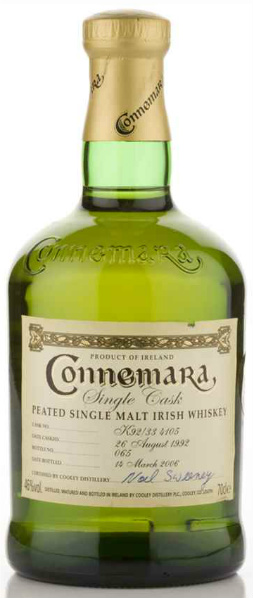
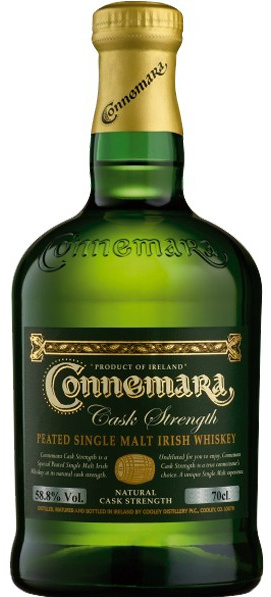
Let’s finish this week off with a hopefully nice Single Cask Connemara, or peated Cooley Whiskey if you prefer. Strange enough this and a lot (but not all) of its brothers and sister single casks were bottled at 46% ABV instead of Cask Strength. When I look around, even all these Single Cask Connemara’s are sold out, so if you happen to find one get it if you’re interested.

Connemara Single Cask (with a different cask number)

Color: Light gold

Nose: Very light peat, creamy with vanilla. I smell more smoke than peat actually. Again a very elegant peated Irish Whiskey. Clay (a fresh uncolored clay brick kids play with). Very deep, toned down wet wood. Smoked kippers. Needs some air to open up, but I really like what I smell. Behind the smoke there is also some nice sweet fruits and salty licorice and mint. Meaty.

Taste: Sweet almonds. Sugared nuts. Small hint of peat, very elegant and toned down. Warming. Great balance. Ashes and a tiny amount of wood bitterness. Definitely a very tasty whisky, a mile (not miles) away from the regular young Cask Strength version, which is a lot cleaner, but also full of aroma, with less complexity. The finish is long and goes down the throat like a syrup, slowly and warms you up nicely. It leaves you behind with salty lips. I called this more complex than the cask strength version, but in itself it is not very complex, shall we say medium complexity?

Again we have here a very good Irish Whiskey that is impossible to buy these days. Not a lot of Connemara is bottled as a single cask and I’m wondering why. It is great stuff, even when its reduced to 46% ABV. I hope more bottling will be made like this. It’s a shame it’s that scarce.

This is the end, Irish Whiskey Week is over. A final comment? I have to say that this final Connemara is very different from my beloved Redbreast 15yo, and maybe even a tad better, what lovely stuff. I was surprised at the quality of the Jameson’s 18yo and how it reminded me of the Redbreast. Another plus was the quality of the Kilbeggan 15yo blend and the quality of both Connemara’s. But the sad thing is that all the good Irish stuff is hard to come by. Kilbeggan and Connemara Single Cask are both almost impossible to come by, and that’s a shame.

Points: 88

Irish Whiskey Week – Day 6: Connemara “Cask Strength” (57.9%, OB, 2007)

Irish CloverAnd here is yet another Cooley Whiskey with another brand name. I started with The Tyrconnell Single Malt which was acquired Cooley in 1988. Tyrconnell was mothballed already in 1925. The second Cooley Whiskey was Kilbeggan, a Blended Whiskey and here is the third one:  Connemara. Connemara is the brand used by Cooley, for their peated double distilled Single Malt Whiskey. There is a fourth one and that is Greenore, a Single Grain Whiskey made from corn exclusively.

Cooley Distillery is located on the Cooley Peninsula in County Louth and it was converted in 1987 from an older potato alcohol plant into a two column still distillery by John Teeling. In 2012 Beam Inc. acquired Cooley for €71 million.However, Beam itself was taken over by Suntory Holdings in 2014 to form Beam Suntory.

Connemara Cask Strength (mine looked like this but at 57.9% ABV)Color: White wine

Nose: Lightly peated, and lightly woody. Elegant, as long as a Whisk(e)y can be called elegant. Very light and young otherwise. Soft citrus fruits, lemon sherbet. No barley or hay, but there is some lemongrass. Very clean and a little bit meaty. Dirty wood smoke, like from a fire that was not only from (wet) logs. A type of peaty Whiskey that needs a copious dinner to go with it. Nice and interesting.

Taste: Yeah, lemon sherbet again and light peat ánd smoke. Fatty and sweet and very tasty. Even though this is very high in Alcohol at 57.9% ABV, it is not extremely hot. Its creamy, with Madagascar Vanilla, not so much vanilla ice-cream, just chew on a tiny portion of the dried bean. The peat makes this Whiskey chewy and the some even trickles through into the taste. So its prickly but not hot. Excellent stuff full of upfront aroma’s.

Sure it’s young, and yes it may be overly complex. But it is well made and very tasty and dirt cheap to boot. I already had one of these before, when it was fairly new and came in a tall green glass bottle. It was more than ten years ago, and it was young and clean back then too but I still was very impressed by it. This time there seem to be more dirty food notes into the Connemara, which makes it less clean, but what remained is that I’m still impressed by this Whiskey. Definitely a contender for the Cask Strength Bang-for-your-buck award (If I would have one). I have to get me some of this again. I only hope now Jack Teeling sold Cooley the new owners continue to make this Connemara as excellent as it ever was.

Points: 86

Irish Whiskey Week – Day 4: The Wild Geese Single Malt (43%, OB)

Irish CloverDay four already of the Irish Whiskey Week, so we are more than halfway! Today we’ll have a look at The Wild Geese Single Malt Irish Whiskey. There is no age statement on the bottle. To be frank, I never heard about this one before even though they have managed to win a lot of awards and even claiming that it was voted Best Irish Whiskey. That in itself is always a statement I find pretty suspicious, especially since it is not clear at first who voted it the best Irish Whiskey around. Nobody asked me!

After some research it were the Wine & Spirits Wholesalers of America (WSWA) that voted it the best Irish Whiskey in 2010. The results of 2010 were impossible to find, but I did find the results of 2014. This year there wasn’t a best Irish Whiskey, since no Irish Whiskey was submitted. What was submitted were five Scottish Whiskies. Benriach Horizons (Double Gold and voted best Scottish Whisky), Glenrothes (unclear which expression, Gold) and three Whiskies from the Lost Distillery Company: Auchnagie, Stratheden and Gerston (all three won Silver). Well excuse me, for not taking the claim all too seriously! Oops now I don’t have any room left to tell you about The Wild Geese themselves. Oh well…

The Wild Geese Single MaltColor: Light citrussy gold, pale

Nose: Floral, light and fresh nose. Fruity too. Very fresh with citrus notes on top, lemon, lime, lemon curd, all that sort of thing. Underneath that a promise of sweetness, with lots of vanilla and a tiny hint of sappy new wood. leaps out of the glass giving at lot from the start.

Taste: Here the sappy wood is up front, hazelnuts and quickly a shot of sweetness and vanilla, then acidity and fruit, with the floral part pushed more towards the finish, again moving into the realm of washing the dishes. The citrussy-vanilla work well together, but the wood somehow is less of a good balanced component. That could have been better. The finish is warm, toffee like and has some staying power. Funny enough it seems to have a sort of gritty texture.

In the end it is light, it is Irish, therefore easily drinkable. It is nice, it is young and fresh. Not extremely expensive and well worth a go if you have a substantial collection of open bottles. It also will do a good job for novices exploring the Irish. It’s not the best Irish I have tried. I still like Redbreast 15yo (especially the L5 batch) best, but I may have mentioned that before…

Points: 79

Irish Whiskey Week – Day 2: The Tyrconnell 10yo (46%, OB, Finished in Port Cask, Circa 2007)

Irish CloverWhy not continue our Irish Whiskey Week with another Tyrconnell, but first I’ll start with my thoughts about finishing Whisk(e)y in casks that previously held(fortified) Wines.

I come from a time where every single cask that was released was good by itself, so when the first finishes emerged we were quite suspicious of them. Was the Original cask too tired to produce a well aged Whisk(e)y? Especially Port finishes were considered to be strange. The color turned slightly pink, and the Wine bit, that leaped out of the glass was pretty harsh. Now that I (and Whisky makers) understand Port better we have learned that the best kind of Port for Whisk(e)y is Tawny (or Colheita or any other form of a Tawny, or oxidized Port, like old Whites). So today finishes have become more popular. I see a lot of people raving about different kind of Sauternes finishes, Marsala finishes, PX finishes and so on. On a more personal note. In the old days I found the odd Rum finish pretty pleasing, but it seems to me Rum isn’t a first choice from the industry anymore.

The Tyrconnell 10yo Port Cask FinishColor: Light copper gold

Nose: Strong and spicy. Malty and winey, but the winey bit isn’t overpowering the whole. It really is only an (balanced) addition. Adding something new to the Tyrconnell profile. Quite some creamy, wooden depth with licorice. Fresh cut oak. Earth and clay. Fresh butter. Good stuff. Spicy and powerful.

Taste: This packs a lot more punch at 46% ABV than the standard Tyrconnell. This version is also a lot more spicy and “older”. Cask toast and licorice, and medium wooden bitterness. All kept in check. The body is well-balanced and creamy, but towards the finish a sweet and slightly sharp and acidic winey note comes to the top, that also throws the Whiskey slightly off-balance. I also get some cardboard and bitterness in the finish. It doesn’t take air so well, so drink up, don’t let it sit too long in your glass.

Since I have just recently tried the “normal” Tyrconnell, does this one resemble the other one? Well no, but that may not only be the Port finish. First of all, a huge difference is made by the 46% ABV. 6% more alcohol is quite a bit. Second, this version is 10yo, and may even hold older Whiskey in the mix. And yes there is some Port going on, but as I mentioned above, this is not overpowering. If you can get past the finish, it does resemble a Tyrconnell though, again a sign they didn’t overdo the Port. Definitely a step, or two, up from the standard version, but still it didn’t quite work for me. Still not a big fan of finishes I guess…

Points: 79

Irish Whiskey Week – Day 1: The Tyrconnell (40%, OB, Circa 2008)

Irish CloverTime for another of Master Quill’s “Weeks”. This time we’ll be doing the Irish Whiskey Week. Irish Whiskey is something I would love to love. Ireland is a beautiful country with lovely people, and in Whisk(e)y they have become something of an underdog. I already have on my lectern a very good Redbreast 15yo that was bottled in 2005, and that bottling especially, turns out to be somewhat of a cult Whiskey, but I like to have some more excellent Irish Whiskey on there, so the search starts here…

The Tyrconnell (a racehorse) was once the biggest brand of the Watt distillery which dates back to 1762. Still on the label is the year 1762 as is the name of Andrew A. Watt & Co. The modern Tyrconnell was revived by the Cooley distillery, which today is part of Beam Suntory. Cooley also revived the Kilbeggan brand name, and Beam Suntory today calls the company Kilbeggan Distilling Co., with Cooley and The Tyrconnell to be two of its brands. There are two more brands you might have heard of: Greenore (a Single Grain) and of course Kilbeggan itself. As could be read earlier Jack Teeling sold Cooley to this group and started fresh with Teeling Whiskey.

The TyrconnellLets have a look at two Tyrconnell’s, first the standard The Tyrconnell at 40% ABV with no age statement (NAS), and the next review will be about another Tyrconnell Single Malt Whiskey.

Color: Light gold

Nose: Petrol (as you can have in a good Riesling) and malt. Fruity, as in apples and pears. Dry grass and toned down lemon sherbet. Machine oil and honey. Dusty toffee. Sweet, but more from fruit sugars and honey, than from sugar itself. Very nice and also interesting nose with a little bit of pepper and toasted wood. Industrial, but I very much like that.

Taste: Sweet and malty. Some of the Industrial warm oil notes return in the taste. Petrol is here too. Malty and sugary sweet, with some air it develops into honey sweetness. It is young, yet not vibrant, slightly under-developed and for my taste a tad too sweet. Entry into the mouth is nice and oily, sweet, than a nice body shows itself, but quickly hides. Towards the end everything seems to turn into water. Extremely short finish with some woody bitterness.

Very interesting Whisky with a nice, but light, industrial revolution profile. The old owners issued quite some single cask bottlings of The Tyrconnell and I hope the new owners will do the same, hopefully at cask strength. For a NAS bottling it is quite nice, and sure shows some potential. Tweak the stuff with some older ex-Bourbon cask Whiskey (for a longer finish) and maybe up the strength a bit and in my opinion you may have a winner!

Points: 74

Inchmurrin 15yo (46%, OB, 2012)

Bottled on the 14th of november 2012, we have here an Inchmurrin which is a Single Malt Whisky made at the Loch Lomond distillery. Loch Lomond was founded in 1965 and distillation started a year later. On site there is a malt distillery as well as a grain distillery. The distillery has two copper pot stills and four stills with adjustable rectifying columns (for Single Malt production). Because of these different stills and the fact that the rectifying columns are adjustable a series of different Single Malts can be made. Today Loch Lomond produces the following Single Malts: Loch Lomond, (Old) Roshdu, Inchmoan, Craiglodge, Inchmurrin, Croftengea (heavily peated), Glen Douglas and Inchfad.

Inchmurrin 15yoSince 1993 also a Coffey still is placed for Grain Whisky production and therefore the company is able to produce a Single Blend named Loch Lomond (you’d think they were good at making up names for their products)

Color: White wine.

Nose: Extremely malty, grassy and has notes of lactic acid. How’s that for a start! We continue with cardboard and a strange kind of acidity. Vegetal and woody. Toasted wood which makes the whole rather spicy. Slight whiff of menthol. When you let it breathe a while in your glass this is actually not a bad nose, the strange funkiness that was there in the beginning dissipates, to give us a more normal nose.

Taste: Grainy, very grainy. Neutral. It tastes like a Vodka on wood. It ís a Single Malt, so what happened in those casks over all those years? Grain and wood, not a lot more actually. Freshly cut baguette with its paper bag. Hint of vanilla. It isn’t sweet and has only a hint of bitterness. Finish is uneventful, and the higher strength gives it some staying power. But nothing really special stays behind.

First of all let me say that the bottle looks very nice when you have it in front of you. Highest marks on the packaging. The Whisky itself seems almost like a Grain Whisky that was aged in a bunch of rerererefill casks, very inactive indeed. Probably the most neutral Single Malt Whisky I ever tasted. Let’s make it my 70 points benchmark.

Points: 70

The Macallan ‘Fine Oak’ 10yo (40%, OB, Circa 2010)

To be honest, I’d rather review a Macallan from the times of the old 10yo 100 proof I reviewed earlier, but instead I’m having a 10yo from the Fine Oak series. When the Fine Oak series was released some ten years ago, it was the time the real Macallan was killed off by the owners. Macallan was then a Whisky for aficionado’s and people with taste and the Fine Oak Macallan is marketed more to be hip. Maybe the change happened because there was a shortage of Sherry casks, or maybe it was a pure marketing move. Who knows, and who cares. For those of you who don’t remember, The Macallan used to be the finest Speyside Whisky around, known for heavy use of Sherry. Something Glendronach is known for now. Glendronach didn’t sell well and even closed because of the Sherry success of Macallan. So here we have a entry-level Macallan with an age statement. So let’s have a look what the legend has become.

Macallan Fine Oak 10yoColor: Light gold, with a pink hue.

Nose: Sweet and malty, hints of creamy Sherry in the distance. Cream, vanilla, lemon and sugar with that typical sherried wine-note. Hints of oak, yet very light. If you want to, you can still smell a bit of the original distillate which still is excellent. Ear-wax again, with mocha and a nutty component. Something like almond-cream. After some time, the sugary sweetness gets some help from honey. Also a powdery note enters the mix as does some cardboard.

Taste: Malty and sometimes close to new make spirit. Sweet with lots of toffee and caramel notes. A little back-bone from the oak. I taste a lot of Bourbon cask in this 10yo, and it does get some character from Sherry casks, which in my opinion aren’t all Oloroso, since typical Fino notes are here too. Maybe a plethora of different Sherry casks went into this. The sweetness is definitely a sugary sweetness. This Macallan would make an excellent filling for bonbons. It somehow would complement the taste of chocolate for me. The finish somehow is a bit unbalanced, with wood and cardboard. It splits like a hair, and is rather short to boot. After 10 years it should have been better, it still says Macallan on the label you know…

When reviewing this, should I forget about the old Macallan? Sure, this has nothing to do with The Macallan that used to be, but on the other hand, the name is still on the label and on the back label Macallan is still considered a legend. If I were to get this blind, this could have been anything.

Points: 77

Dailuaine 1999/2012 (59.3%, The House of MacDuff, The Golden Cask, Cask #CM172, 270 bottles)

Almost another year has passed since reviewing my last Dailuaine, bottled by Jürgen a.k.a. The Whisky Mercenary. This time a younger version, distilled in 1999, with a fairly light color, so probably not a very active cask.

Dailuaine 199920/12 (59.3%, The House of MacDuff, The Golden Cask, Cask #CM172, 270 bottles)Jürgen’s version was quite strong and with a cask picked by John McDougall I again have some high hopes for this Dailuaine. Let’s see if this light Dailuaine packs some punch, and does it also have some cannabis I picked up in several other Dailuaines?
Color: Light citrussy gold.

Nose: Vegetal, fern and high on malt. High alcohol too, sweet. Thin honey, toffee and hard caramel. Pretty anonymous. This cask didn’t do a lot for the spirit. One use too many I guess. Tine hint of soapy foam. A very “green” Malt, and actually not very interesting. Dull.

Taste: Malty and powdery and yes, some wood. Pretty powerful and sweet. Rustic. A Malt from the country so to speak. Lots of marzipan and very fresh and likeable. Strangely enough there is a citrussy soury note that only shows itself in the finish. I know it s the oil from orange skins! Although likeable, something is not quite right here. (The strange soury note?).

Typical high strength Whisky where the cask didn’t impair a lot, or so it seems. There maybe something wrong with this one, but nothing to worry about too much, yet this one doesn’t speak to me. Good enough for bottling it is as single cask, but personally I wouldn’t have. Tasted blind I would have thought this was a Cadenheads bottling, since they have released lots of Whiskies like this in the recent past, but they bottle a lot. The House of MacDuff bottle considerably less, so you could expect only nice picks in their range. If so, why was this one picked? Probably for its malty sweetness I guess (or the orange?). No cannabis this time though.

Points: 81

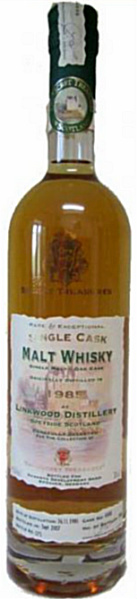
Linkwood 21yo 1985/2007 (43%, The Secret Treasures, Bourbon Cask #4548, 348 bottles)

Linkwood 21yo 1985/2007 (43%, The Secret Treasures, Bourbon Cask #4548, 348 bottles)Here we have a Linkwood bottled by a Swiss outfit bottling under the name of The Secret Treasures. Their website is quite amateurish and uninformative. Some basic information is there, but seems a bit outdated. The firm is known for some great rums, like Demarara and Guadeloupe, and apart from Whisky also bottles a Bitter (Els from herbs only found in the Eiffel region), a Gin and some fruit distillates. Their Whiskies are bottled at 43% ABV, a strength that also seems a bit outdated where single cask bottlings are concerned. Bottle looks nice though!

Color: Gold

Nose: Spicy wood, sweet with some vanilla notes. The typical smell of a Whisky coming from a Ex-Bourbon Cask, but with quite a lot of aroma. It smells big and fruity. Das pronto clay, I remember from my childhood. Nutty as well, with some flowery notes but also some candy sweetness. Mocha, tiny hint of mocha coffee. Small hint of cask toast mingled with some dry old spices. Creamy and powdery. I think you get the picture. Very balanced (after extensive breathing) and slightly salty even (dry lips). It doesn’t smell reduced, and this has hints of cannabis in the aftertaste. A big plus for this Linkwood.

Taste: Vanilla and oak. Big and slightly toasty. Small hint of cannabis (again), which is not quite unusual for this type of oak. Wax, maybe ear wax. Perfect fruity sweetness. Vanilla ice-cream with some pencil shavings and fresh almonds. Even though this is reduced to 43% it is quite hot at times, and the hotness stays around for a while. The finish itself, tastewise, is much shorter. Hints of fermentation (yeast, cow dung?) and then a bit sour. However, don’t get me wrong. This is very appetizing. Big and just nice even at this lower ABV.

Quite sweet and in part light. Nice sweet body with a hot finish that stays longer than the taste itself. To me this Whisky shows some small faults in distillation, but has way more good things to it. Initially it seems a nice Malt, with a nice smell and so forth, but the taste already shows some unbalance, nevertheless it needs some air to settle and reaches a higher balance. Nice entry, than heavy on the sweet part, and full body, but sometimes a bit hot and a medium finish at best finish. Not bad! A word of caution. This isn’t as good when freshly opened, it really needs a lot of air and patience to really shine, even this reduced Whisky, needs time.

Points: 84