Kopke Moscatel 10 Years Old

Moscatel is the Spanish and Portuguese word for a fortified wine made with the muscat grape variety. Muscat grapes are not a single grape variety, but a whole group of hundreds different grape varieties, ranging from white to almost black grapes. Muscat grapes are one of the oldest grape varieties still left, already used by the ancient Greeks. Therefore it’s not surprising a lot of different wines in large parts of the world are made with this grape variety, ranging from Moscato d’Asti in Italy to Kopke’s Moscatel from the Douro region in Portugal. Muscat wines can be dry, medium, sweet, sparkling or a desert wine (fortified). Wines made with Muscat grapes have a low acidity, and can’t be aged a lot, unless it’s fortified like this Moscatel by Kopke, which is a whopping 10 years old. By the way: Muscadelle, Muscadet and Muscardin do not belong to the Muscat family.

Kopke Moscatel 10 Years OldColor: Copper, or very dark amber.

Nose: Deep old sweetness, syrupy and reminiscent of sultanas. But it’s not only oozing promises of sweetness, but also some acidity seems to be present, which is rather uncommon for a Muscat Wine. Hot earth with a tiny, tiny hint of smoke, which gives the Moscatel a lot of character. Hints of pineapple, dry leaves, licorice and it has a little bit of a floral perfume too. Creamy. The nose is not far from some PX Sherries. Lovely.

Taste: Milk chocolate, vanilla and sultanas again. Peaches and apricot syrup. Some alcohol is showing as with cherry bonbons. The sweet (which seems to dissipate fast) and the acidity mingle well, and after the sweetness retracts, the acidity takes over, without being aggressive like lemon juice would. Where the nose promised a lot of sweetness the taste, luckily, is more balanced, due to perfect acidity, yet not very complex. Then nose is most definitely more complex than the taste is. So it’s not syrupy sweet nor does it have the consistency of a syrup, since the Moscatel is quite thin in texture. In the glass some long legs are showing, but not a lot, nor are they very thick. The finish is not too long, and has a little touch of grape skins. The taste has nothing to do with PX Sherries though 😉

Lovely stuff, easily drinkable and I’m quite curious for other Moscatel wines now. I hope to find one that has some more complexity in the taste. ABV for this Moscatel is 19%.

Points: 85

Kopke Christmas (Reserve Ruby)

Kopke logoJust in time for Christmas, or should I say, just in time for last-minute Christmas shopping, another Kopke Port. The Tawny Kopke I reviewed last, turned out to be quite good, and doesn’t break the bank, so why not try another Kopke, but this time a Ruby. They call this a ‘Reserve’ to distinguish it from more generic rubies, and considering this is for a special, festive occasion, this (young) Ruby should be quite good also, and again this is a pretty inexpensive Kopke. Should you buy this for Christmas?

Kopke Christmas Port (Reserve Ruby)Color: Ruby red, with lost of purple near the edges of the glass.

Nose: Raisins and fresh, typical Ruby if you ask me. Very fresh (fresh air) young and lively, but also promising a lot of sweets. Thick, fat and buttery with heaps of raisins, something you would expect from a PX Sherry (the raisins). The whole does not smell like a PX at all. After all this, it smells more like a “red wine”. Cheesecake, a little bit of wood and some acidity and mustiness later on, so the smell does develop a lot in the glass.

Taste: More of the same, young and fresh, sweet and sour. Distant hint of bitter wood (walnuts), but the note is not dominant. It does fit the nose, but the taste is not very complex, and does seem a bit unbalanced. In this case the sweet and the sour don’t like each other very much. And the bitterness (not only walnuts, but also earwax), well, also not completely in harmony. The fruits in this Port are more of the half-sweet black and red summer fruits, and do I detect some tannins drying my tongue? Yes. This finish is half-long, but also a bit anonymous. This Port almost seems stopped dead in its shoes in its transition from a Red Wine to a Port. It’s still too much a Red Wine.

After my comments especially those for the taste, one might think It’s not a very good Port, but that wouldn’t be true. It’s a nice Ruby Port, not extremely special, but very drinkable. I suspect this to be very young. It’s alright, but if you like your ports a bit more special, a bit more festive, and a bit more “Tawny” I would recommend the Kopke 10yo matured in wood I reviewed last some more. For me Warre’s Warrior is also slightly better and especially a more balanced, somewhat sweeter, example. ABV for this Christmas Kopke is 19,5%.

Points: 82

Kopke 10 Years Old (Matured in Wood)

Kopke logoAfter Warre’s Warrior this is just the second review of Port on Master Quill, which is quite strange since I do love my Ports. Lots of them have passed on my lectern, and only one has been reviewed op ’till now. So it’s about time to do something about that. On my lectern are a few Ports that haven’t been reviewed yet, so keep an eye out for some more Port on these pages…

Kopke 10 Years Old Port (Matured in Wood)Color: Warm, bleak red (rosé), not yet brown.
Nose: Sweet and lively, hints of acidity and freshness. Lots of red fruits, strawberry, raspberry. Cherry candy. It doesn’t smell its age (it smells younger). In the distance a little bit of wood and mint, but also some licorice. Classy nose. Very sweet with an added bonus. The influence of wood, which adds to the character and it doesn’t let the sweetness dominate (the nose).

Taste: Sweet but also enough acidity to counteract the sweetness. In fact the nose smelled a lot sweeter than this Port actually is. Lots of strawberry and raspberry again, this time with added acidity from currants. This tastes great and very likeable and harmonious. If in anything it shows its age than it is in the finish. The half-long finish is a little bit brittle, the lively fruitiness dissipates quickly, it goes from sweet to sour, to… a memory of Port (not saying it is short).

This isn’t a full-blown red Port anymore, it’s a Tawny that for me has some notes of red Port (youth?). On the taste it shows two sides of itself. Very fruity without being full on sweetness, and then a turning point into something more vague. If only the finish would have held up a bit more. But that’s nit-picking. This is a very good Kopke 10yo. It’s much better than I initially expected. Think strawberries. The Port has an ABV of 20% and was matured in small 250 liter casks. Recommended for Christmas!

Points: 87

Thanks to Richard and Esther for the bottle.

Warre’s Warrior (Reserve)

And finally a Port emerges on these pages and since it took so long, it might come as a surprise that I really like Port. I normally do not like sweet drinks, but reading back on these pages it should become clear to you, that I do like (overly) sweet Sherries like the PX’s, but also Port. Due to some issues with shelve space I do not have a lot of Sherries and Port’s open, nor should I, since both Sherry and Port shouldn’t be kept open for too long, it’s not Whisky you know.

As with lot’s of Port “houses” it has a long, very long history. Even this Warrior has a long history. Warre themselves claim that: “[Warrior] is the oldest brand of Port in the world, having been shipped continuously since the 1750’s”. The company that became Warre’s was established in 1670, but the first Warre came to the firm in 1729.
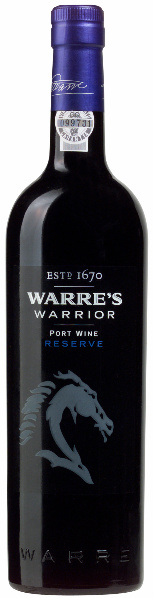
Let’s start of with Warre’s Warrior. I’d like to start with Warre since a long time ago, Warre’s Otima 10 (or 20) was my first bottle of Port ever. Warre’s Warrior comes from Quinta da Cavadinha and Quinta do Retiro Antigo from the Pinhão and Rio Torto valleys, also the home of Warre’s Vintage Port.

Color: Deep red and thick.

Nose: Very sweet and raisiny. It definitely smells like a Port to be had as a dessert, or with a dessert. For me it smells like a warm summer, mellow and toned down. I can imagine drinking this in summer, slightly chilled. It smells nice, but lacks complexity, it isn’t very pretentious, but easily drinkable.

Taste: Ahhh, very fruity and aromatic, much more of a flavor explosion than the nose suggested. Various red fruits. Sweet raspberry mostly. The nose suggested an extremely sweet Port, heavy sweetness and raisins, but on the contrary. Even though it shows long legs and smells of raisins, it doesn’t taste like that. This Warrior is fruity! Half-sweet and has a very nice balance with its (sometimes sharp, but refreshing) acidity. A little bit of oil from orange skins. Tannins play a role too, they’re drying the tongue. Last but not least, the finish, it’s short. Slightly woody too. If the finish was longer and a little bit sweeter, this would really be perfect, but as it is, it still is a steal.

Thick Ruby Port that sticks to the glass. Even though it has a lot of balance, the nose and the taste seem to be two different wines in one (ain’t that a contradiction!). It’s a surprise, but treat it as a present, since we’re getting two types of Port for the price of one, and it’s dirt cheap to boot. Due to a lot of regulation and control from the Port Institute, only Ports with a decent quality are released. This Warrior is definitely worth looking into for an inexpensive daily drinker. ABV is 20%.

Points: 83

Weingärten Weissenkirchen Wachau Smaragd 2007 Grüner Veltliner

Asparagus season isn’t over yet, so we decided to do another round. Last time around I decided to accompany the asparagus with an Austrian Riesling, but there was another Austrian wine lying around, so I decided to open another Austrian white wine. This time a Grüner Veltliner from Wachau by Domäne Wachau.

Grüner Veltliner is a white wine grape variety that stems from Savagnin and further down the line, Rotgopfler and Pinot Noir. Despite of the name Veltliner, the grape isn’t related to Roter Veltliner and Frühroter Veltliner. Most Grüner Veltliners are planted in Austria and to a lesser extent, Slovakia and the Czech republic, but more recently also in the United States and Australia. One-third of all the grapes planted in Austria is Grüner Veltliner. In Slovakia one-fifth and in the Czech republic “only” one-ninth of the planted grape varieties is Grüner Veltliner. Most Grüner Veltliners age well and accompany food excellently.

LabelEspecially in the Wachau wine region on of the following terms can be found:

  • Steinfeder: lightest version with up to 11.5% alcohol,
  • Federspiel: a slightly more powerful version with 12.5% ​​alcohol,
  • Smaragd: the most rich and powerful Grüner Veltliner with 12.5% ​​alcohol and often more. (Smaragd can be compared with the german term Spätlese, the grapes are harvested late and often ripen for a prolonged time on stainless steel or large casks). (This Smaragd is 13% ABV).

Finally, Weissenkirchen is one of Domäne Wachau‘s village-bottlings. Besides Weissenkirchen itself, it comprises of the villages of Joching, Wösendorf and St. Michael. The wines are elegant, full-bodied, fruity and quite mineral.

Color: Straw

Nose: Lemony and acidic. Smells very fresh and refreshing with whiffs of alcohol. You can already smell the balance between the sweetness and the acidity. Nosed blind this could have easily been from Alsace. Nice yellow fruits. Hints of peach and dried apricots, but also some sweat! (No that’s not a bad thing, in this wine). All in all, light and fresh, but with body.

Taste: Definitively more spicy. Fruity syrupy sweetness (high iron content). Apple treacle, raisins, tree sap with the slightest hint of licorice. Green apple skin. Some hints of wood, although this probably never came in contact with wood. Some unbalance when near the finish. Short, slightly sugary, finish. The sweetness in the finish is a bit “strange”.

Of the two Austrian wines we recently had with Asparagus, we liked the Riesling Better. Having said that, on its own, this one isn’t bad either.

Points: 81

Berger Kremstal DAC Riesling Spiegel 2008

Here in Holland the Asparagus season has started and nothing goes better with that, than a nice fresh white wine. This Berger Riesling was ogling at me for quite some time, since all Austrian wines have the Austrian flag on top, it is easily recognizable.

This Riesling (12.5% ABV), is wine from Weingut (Erich) Berger, Gedersdorf Austria. Gedersdorf is in the North-East part of the Kremstal (2200 – 2300 Ha.), next to the Danube River. Weingut Berger is one of 150 Winegut’s in Kremstal (and in fact Kremstal itself is not one, but three valleys). The region also has Three different terroirs. First, the vineyards west of the city of Krems are similar to those in the adjacent Wachau wine district. They are on a stony soil dating from prehistoric times. From these parts you can have a dry, minerally Riesling or Grüner Veltliner. Second on the south of the Krems Valley on the south bank of the Danube, small vintners in ancient villages make local wines in their own old-fashioned way. Third, to the east of Krems, towards Rohrendorf and Gedersdorf, there is löss in the vineyards which is noticeable in the wine, its softer and more lavish in style. The best wines from this region are called reserves.

Color: White wine.

Nose: perfect Riesling nose. Crisp and fresh. Lot’s of yellow fruits. Some grapefruit, banana, apple, apple skins. Definitely stoney and mineral. I really like these kinds of white wines from Alsace, Germany and Austria, and again a nose like this is perfect.

Taste: Quite simple, but great balance in the acidity and sweetness. Again apple come to the fore. Light body and medium finish. Especially the finish is quite mono-dimensional, showing almost nothing else than (sugared) lemon. This is a wine for big gulps, drinks great that way and it concentrates the flavours a bit. Easy going and very accessible. What’s not to like here. Quite good with asparagus, but I can imagine this is a great wine for easy drinking in the summer. Simple, but I like it.

This wine was especially good the second day around. It was quite closed when freshly opened and the taste wasn’t rounded out and actually quite dull. The second day around it got smoother and sweeter, and the fruits al be it very light come through some more. Not a complex wine, but very likeable and stunningly fresh, and it won’t break the bank!

Points: 83

Château Les Tresquots Médoc 2003

Very typical Bordeaux blend. This one comprises of 70% Merlot and 30% Cabernet Sauvignon. The ABV is 13.5%. The grapes were harvested by hand and the wine was put on oak casks for one year.  The grapes that grow on vines are 30 to 40 years old. grow in the heart of the Médoc region near Bégadan, where the D3 crosses the D103 (for those who were there). Saint Estèphe is just up river.

For what I read, people weren’t too happy about this one when is was younger, so it was no problem to let this lie for a couple of years. I left it for almost 10 years, but now it was time to have a look how it is doing.

2003 was a very special year for the region. The 2002 harvest was very dry and the winter that followed was cool and wet. In march it was already warm (and dry) so growth started early. The following period stayed dry which means low yields. The summer, well, heat wave! So in June, July and August, the grapes got roasted.

Color: Very dark, with deep sparkling red. Almost doesn’t let light through.

Nose: It might be heavy, according to the text above, but for me this is quite lively. Grape skin, hot earth, dry but with a lot of depth. Elderberries with some acidity. Yeast and a little hint of sterile wood. Altogether very balanced. I might be biased by now, but this oozes hot weather.

Taste: Deep, this has some tannins. Thick grape skins and plums. Lots of ripe cherries. Not the red ones but the sweetish black ones. It’s not bitter nor woody, but it does dry the mouth quite a bit. The fun is to be had taking big gulps and the effect this has on the palate. Finish is quite short and a bit anonymous. This is very much recommended with food (meat).

In the end not very complex, but with a lovely nose. And I like the shift toward the black cherries. Especially the taste is ‘simple’ but it doesn’t overpower you, nor does it have any other flaws, apart from the tannins that dry your mouth extensively. Considering early report about this wine, I can say that ageing this is a good idea.

Points: 81

Fattoria La Vialla Passito 2009

Fattoria La Vialla Passito 2009Here is another bottle from Fattoria La Vialla that found its way into my castle. Click here for the review of the NubeRosa 2010. This is exactly why I keep the draw-bridge down a lot, so things like this come my way. It was brought in to accompany dessert. This Moscato di Sicilia is a dessert wine @ 14.5% ABV. The bottle here is a 375 ml. which is a fine size for many über-sweet wines. The bottle I’m about to review is from lot 29 17082011.
Color: Copper

Nose: Sweet (obviously). Musty, but also has a distant acidic freshness to it. Gravy, with a little bit of smoke and cold tea. Some small hints of peaches. The nose is nicely balanced. Over time it becomes less sweet and maybe somewhat more acidic.

Taste: Not as syrupy or sweet as I’m used to. Again nicely balanced between the sour and the sweet. Dried apricots, but no sign of raisins. Due to the acidity, the whole is rather fresh.

It’s a dessert wine, but less sweet as one might think. Absolutely better than I thought. The whole comes across as being honest.

Points: 80

Thanks go out to Nicole for bringing the wine!

Langa Calatayud Rosado (Syrah/Cabernet Sauvignon) 2009

Bodega Hermanos Langa was founded in 1867 by Mariano Langa Gallego, and is located near the city of Calatayud in Aragón, Spain. Best known city in Aragón is Zaragoza. Today the fifth generation is at the helm of the company. Combining knowledge with respect for nature is the recipe for making good wines. The Bodega works 100% ecological. The region where the grapes grow is known as “Los Yermos”. The grapes grow on extremely dry soil that lies 600 metres above sea-level.

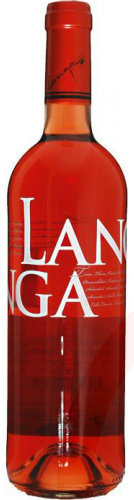
Langa Rosado 2009This is the Rosé wine Langa makes. This 2009 is made of Syrah and Cabernet Sauvignon. The newer versions are made with Merlot rather than Syrah.
Color: Ruby red rosé.

Nose: Slightly acidic and fruity, very fresh ánd warming. Lots of red fruits. Sweet raspberry, but also meaty. Not your regular extra-easy Rosé. It seems as a Rosé with character. A little hint of vanilla and wood. Nicely balanced and it smells like something you’ll drink in a few minutes (and want another bottle).

Taste: Nice. Just the right combination of sweet and sour. Again some vanilla. It’s creamy and it tastes like vanilla to me, not much, just a hint. A lot of red fruits again and very easy drinkable.

I know people think of Rosé’s to be the perfect summer wine. This is precisely that, bu in the middle of winter with typical italian food, this Rosé is perfect too. Not to complex, as the food, but a very good companion. It’s also very nice and easy when you drink this by itself, not to mention it’s quite cheap too. That’s a bg plus today with spanish wines. Now the Syrah got replaced by Merlot, I’m keen to try that one to. I hope they did that to improve the wine. Well I already like this one, so the Merlot version should be great. Recommended!

Points: 81

Heim Riesling Grand Cru Praelatenberg 2006

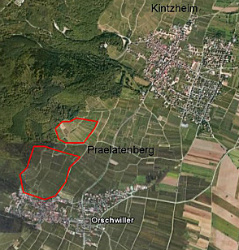
Christmas time is here again, and I needed a decent bottle of wine for Christmas dinner as a companion to sauerkraut and fish. I do like Alsace, so this time I pulled out a Grand Cru Riesling from Praelatenberg. Praelatenberg is one of 51 Alsatian Grand Crus, that got this status in the big expansion of 17 December 1992. It is located between Kintzheim and Orschwiller, and is the most southerly of the Grand Cru sites of the Bas-Rhin.

PraelatenbergAbove Praeatenberg towers the Koenigsbourg castle, built in the 12th century. The altitude of Praelatenberg slopes ranges from 250 to 350 metres and has an east-south-east orientation with a size of 18.7 Ha. The granite bedrock that underlies all Alsace vineyards is very close to the surface. The soil is heavy, covered with loose schist, and is rich with silicium. Dotted with stones rich with iron, quartz and other minerals. This helps the warming of the ground and lets water through easily.

Heim is now owned by Bestheim, a cooperation that was founded in 2000 by the merger of two smaller cooperations from the villages of Bennwihr & Westhalten, together with the house of Heim.

Color: Straw Yellow.

Nose: Very clean and citrussy. Lemon. Through the freshness and the acidity there is another layer, that at first seems sweet, but also has a creamy peachy element to it. A sort of light non-fat whipped cream of lemon and peach. Very nice. Sweet as in coffee-caramel sweets we know over here as Haagsche Hopjes. Also a slightly meaty sensation.

Taste: It starts with a nice fresh and not overly acidic lemon and chalk. Do you know those little vitamin C pills by Roter? Well, that too. Again a tiny hint of peach. Really subdued and elegant. The finish comes quick and is soon gone, what really is a shame. Always there, is that little bit of acidity that makes your mouth water, and lest not forget that added creaminess. Not very complex.

The taste maybe a bit too simple, in the nose maybe a little bit too. Still it’s a nice wine. It does have a nice balance, but overall it could have done with some added depth and complexity. Easy to drink, and should hold well when aged. ABV is 12%.

Points: 82

Picture is for the Riesling Reserve. Our Grand Cru looks similar (brown glass).