As said before this distillery was briefly opened between 1966 and 1975. As far as vintages go not a lot were released. Officially a lot of 1973’s were released. This vintage was also released by Blackadder and Duncan Taylor. Signatory Vintage released a lot of 1975’s (and one 1974). Two of these 1975’s I have reviewed on these pages earlier. Last but not least in this case, Cadenheads had some releases from the opening year 1966, but that was a long time ago in 1979 and 1980. Besides these few ‘players” not a lot of Ladyburns are to be found. Now here pops up a 1974. As far as I know, there are three 1974’s released. Cask 2607 by Signatory @ 53.9% ABV (in 2011). Cask 2604 by Dutch bottler Van Wees @ 52.1% ABV, (also in 2011), and from 2010, Cask 2608 by fellow Dutch bottler Mo Òr @ 46% ABV. It’s not hard to guess how much (or how little) this got reduced. Rumour has it, these 1974 are pretty good.
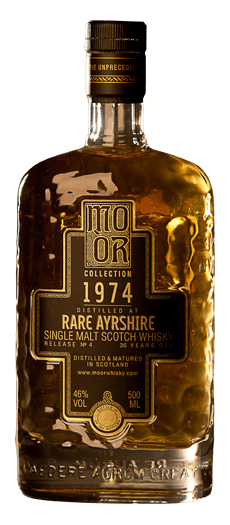 Color: Light Gold
Nose: Very aromatic. Sweet and clean. Pops out of the glass. Fruity and lively. Great combination of farmyness and fruity sweetness. On the nose it’s already a lot better than the 1975 Ladyburns I tried before. Nice wood too. Great greenish notes with gravy. If the taste will be anything like the nose, we’ll have a winner on our hands. When this get’s time to breathe the lively fruits make room for something more dark and broody. Meaty and some perfume. Very interesting.
Taste: Fresh, fruity (pineapple) and in nothing you would say this is such an old malt. Not as complex as the nose is. The initial fruits are very quickly replaced by caramelized wood. Finish is good and slightly woody. But considering it’s age you would definitively expect more wood in this.
Very likeable Ladyburn. The nose is very much better than the 1975 Signatories I tried before. Taste wise, maybe not so complex, but less woody than the Signatories. Very nice Ladyburn, one of the best that’s still around, ánd reasonably priced as well!
Points: 86
Thanks again to Henk for this sample.
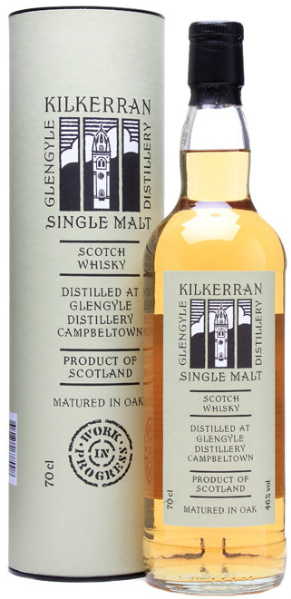 Nose: Fresh, sea air. Soapy and oily. Some smoke. The 7yo seems to me to be less fatty that the 6yo. The 7yo is more refined, but definitively from the same family as the 6yo version. Also some peat and clay. More sea freshness in this one. Lemon curd. In the nose this one has more of everything when compared to the 6yo. The 6yo is more meaty and musty.
 The other day, I reviewed a reduced
  that means this Tormore was bottled around the time previous reviewed Tormore was distilled (1996). Both Tormore’s are about the same age too. Let’s see if thís Tormore is any feminine.
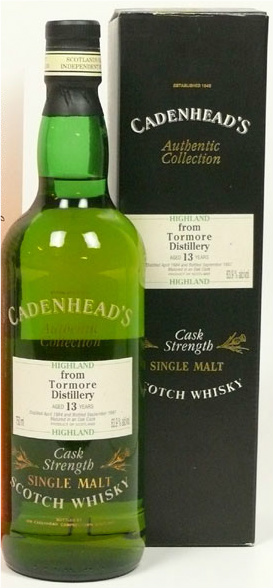 Color: White wine.
 Like with many Gordon & MacPhail bottlings, it is reduced, this time to 45% ABV. I am a fan of cask strength Whiskies, but I learned to appreciate these reduced Whiskies more. Is it age? I’m a bit held back only by the fact that not every Whisky likes to be reduced. Let’s hope it’s not the case with this one.
 Earlier I reviewed a very old independent
  Color: Orange Gold.
 Founded in 1843 by William Mathesen, but whisky was distilled on site as early as 1703 (or 1738). Glenmorangie is now known for their stills with very tall necks that ensure a very light and clean spirit that had to reach incredible heights. Glenmorangie are also known for their Dr. Bill Lumsden, a man who doesn’t fear innovation and experimentation with his grains and woods.
 The whole is pretty balanced. It’s easy noticeable that this is from light spirit. The nose is great, and the taste is very nice. The only two things that let this down is its lightness. And a Glenmorangie should be light, that’s one of their pillars. Personally I like a bit of body to it, like yesterdays
  Springbank, the strongest survivor of Campbeltown, and one of the few family owned distilleries. Once a great center for whisky, and once a region of its own, it still is, but barely.
 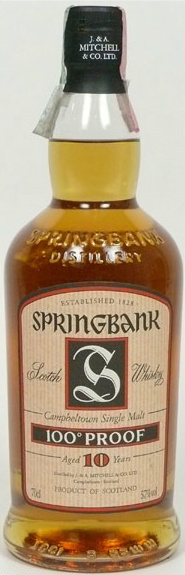 The people behind Springbank do their utmost best to let Campbeltown survive as a region. Glen Scotia is intermittently operated by the crew of Springbank, and of course Springbank themselves are responsible for Longrow, Hazelburn and Kilkerran (Glengyle Distillery). All names from a distant Campbeltown past. Founded in 1828 by the Reid family, who were married into the Mitchells. In 1837 the Mitchell’s bought the distillery. In 1897 J. & A. Mitchell Company Ltd. is founded, the company that is still on the label today. Since 1969 J. & A. Mitchell is also owner of Cadenhead’s. Between 1979 and 1987, Springbank was closed. And since 1989, production is again as it should be. Almost nobody malts themselves these days, but Springbank take the remarkable step to reopen the maltings in 1992. Springbank is a cult malt has a great following, and is by far the most popular malt on Wall Street.
 Yes it’s “Snickers” in a bottle. Slightly unbalanced by the soury woody, and peaty, finish. The finish also leaves a minty sensation on the tongue. Sweet mint as in “After Eight”.
 Clynelish is a very popular dram. There are several reasons why. First of all it’s a sister of Brora, which maybe the best malt of all. Second. Clynelish has a unique waxy personality and it’s spirit is always of high quality. It’s very hard to find one that is not up to par.
 Taste: Spicy and definitively from a sherry cask. Wood, beer and spice again. Sweet and tarry. Shortbread and gingerlike. Turkish delight and has some traits of a Riesling wine. Full bodied. Slight sour wood and licorice on the finish.
 Glengoyne then. Glengoyne got my interest because they were one of the first to specifically state, ‘unpeated malt’ on their labels. Also, I like the looks of the bottle ánd for still using Golden Promise amongst other barley’s of course. Golden Promise is somewhat of the holy grail of grains, because it is supposed to be very flavoursome. But the yield is not so good, compared to the favorites of today (which make all whiskies taste the same, to come out bluntly). So lets see if this one, and remember this is a fairly priced bottle, makes a golden promise.
 Taste: Toasted wood, but still a lot of yeast. Can’t shake the Sherry here. High proof, so it makes an impression. Although this has bold flavours, the quality of the spirit shines through. Very Ahorn syrupy sweet, and corn sweetness, that’s totally different from the Ahorn. It almost tastes like a wheater! This could be a Weller, with some sherry musty and creamy yeastyness. It’s a picture with thick broad strokes. It is thick.
 Color: Copper gold.
 Master Quill