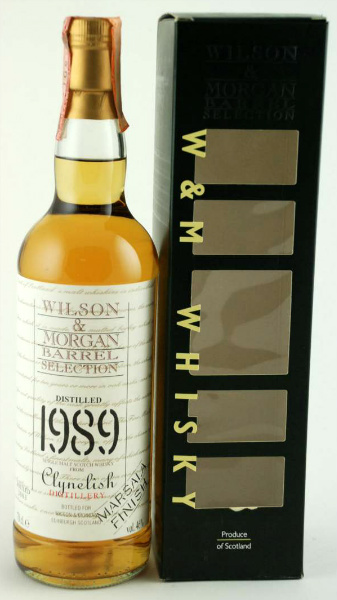
Clynelish 1989/2003 (46%, Wilson & Morgan, Barrel Selection, Marsala Finish)

This will be interesting. Experience learns me that I have tasted a lot of good Clynelishes from 1989, although one might ask oneself how far vintages work for Whisky as they do with Wine. An other interesting point is, although todays Wine finishes are quite common, back in 2003, when this was released, Wine finishes weren’t all that hip. Remember that the demand for Whisky was a lot less than it is today, so the sentiment, back then was, if it’s finished in an odd cask (not Bourbon or Sherry), than there must have been something wrong with the original Whisky. This has been finished, by the bottlers, in a cask that previously held Marsala Wine. Marsala is a fortified Wine from Sicily Italy. Marsala can be dry or sweet, and can be white or red, or something in between. Just like Sherry and Port which also comes in lots of different versions, so the word Marsala alone only narrows it down a bit what to expect. It would have been nice to know exactly what kind of Marsala was in the cask. No surprise that we have an “early” experiment with a Wine finish, since Fabio (the man behind Wilson & Morgan) is Italian and already a Wine buff before getting interested in Whisky and Rum. Remember Rum Nation? That’s also his.

By the way, there are other 1989 W&M Clynelishes around. At least one Sherry and one Bourbon expression exist as well. Just look at the bottom right corner of the front label. By the way I have tried this Bourbon expression and it wasn’t as good as other 1989 Clynelishes. Maybe the reason for finishing this one.

clynelish-1989-wm-marsala-finishColor: Gold.

Nose: Dry, restrained and not “thick”. Elegant. Well balanced. Lightly fruity and appetizing. Peaches. Nutty and dusty. Pushed way back some notes of creamy vanilla, so I’m guessing American oak, and probably the previous maturation was done in a Bourbon cask. Don’t be fooled, a lot of Sherries are matured in American oak as well, since it gives off a more creamy, vanilla feel, whereas European oak has more tannins to it. Next some spicy notes. Hints of sweetish basil. Nice one to smell and in no way does the Marsala overpower the Whisky. Fabio was on to something here, and maybe the Clynelish itself wasn’t too bad as well? Hints of dusty dark (friendly) cocoa powder. Good. Give it some time to breathe and the nose does show it has some origins in Wine, but still in a very restrained manner. Hints of Calvados even.

Taste: At first some wood, dusty and spicy but soon a wave of utter fruit passes by, although the fruity sweetness is almost nonexistent, the initial sip has definitely some sweetness to it. Nutty and nice. It has some fruity acidity though, not much but it does help the balance. Two distinct layers after which the finish sets in. A pretty good Whisky with a nicely done finish. It is a treat on entry and has a nice balanced body. The finish has some moderate staying power, and is easily the weakest point of this Malt. It doesn’t have enough length, and is actually not very complex. luckily the rest of the experience is very positive, so definitely a malt one can enjoy. I guess this experiment can be called a success.

The middle has some heat to it so the 46% ABV seems appropriate. I can be easily disappointed when a Whisky has been reduced too much, but I’m also easy in admitting that reductions often work out. In this case I’m not wondering how a cask strength version would have been. I’m happy as it is.

Points: 86

Tomatin 14yo “Port Casks” (46%, OB, Tawny Port Pipes Finish, 2016)

I come from a time when Distilleries started experimenting with other casks than the usual Bourbon and Sherry casks. When Whiskies finished in Wine casks, Port casks and Rum casks popped up in the market, I actually preferred the Rum cask versions the most. I didn’t particularly like the Wine and Port finishes. It’s not because I couldn’t keep up with the pace of change, because today there are lots of these finishes around that are pretty good, but when I taste back the first examples they still are not-so-good. Port was an easy choice for distillers and blenders I guess, since it is related to Sherry and both are fortified Wines. However Sherry casks and Port casks yield very different Whiskies.

I guess the early versions were finished in casks that previously held Ruby Port. Young and bold stuff, which made for a very raw and harsh Whisky, especially when finished for too long. The U.K. loves Vintage Port which are excellent Ruby Ports, 2 years old, so the obvious starting point for experimentation with finishing. Today we see more and more Port finishes done in Port Pipes that previously held Tawny Port. Tawny Ports are older Ports, that turn (reddish) brown from oxidation. For this 14yo expression Tomatin first matured the Whisky in Bourbon barrels and for the finish they used Port Pipes that previously held Tawny port for 50 years! The 14yo Tomatin was first introduced in 2014, a replacement for the 15yo, which came from Bourbon casks only. Tomatin also discontinued the 25yo which also was from Bourbon casks only. In 2016 we saw a complete revamp of the design, so this review is for the “new”14yo, number four in the core range preceded by the “Legacy”, the 12yo and a Cask Strength version without an age statement (We’ll get to that one later).

Tomatin 14yo Port Casks 2016Color: Gold with a pinkish hue.

Nose: Musty and definitely recognizable as a Port finish. It is quite obvious to say the least. Also the color gave it away. You don’t get this pinkish hue, from caramel coloring, and wine finishes smell differently, however it also reminds me a bit of a Jenever fully matured in a Bordeaux cask. Apart from the typical fruity Portiness there is an unusual hay-like aroma, like Grappa has, it is different from your usual Whisky. In the back there is also a more creamy, vanilla note, softening the whole up. Nice soft wood as well. Although the finish is quite strong, it isn’t overpowering, and the Whisky remains balanced. Nevertheless, the finish ís strong enough not to let Tomatin’s signature tropical fruitiness through.

Taste: Sweet and fruity. Chewy. Here the finish isn’t as strong at first like in the nose. Here it starts with sweet and creamy Bourbon cask notes, but the Port quickly exerts itself. I don’t know yet if the burnt note I get, comes from toasted oak, or from the Port pipes (or both). A fruity acidity lies on top, so less balance here than on the nose. Hints of paper (not cardboard, which is heavier and less likeable). The whole is quite creamy and friendly. Well made and quite bold to let the Port finish speak its mind. Creamy, fruity, slightly burnt and some nice wood. That sums it up. Medium finish.

This is daily drinker material. Something I would reach for quite often. Sure you can analyze it to death, but why should you. I already did that for you. Not very expensive and fun to drink and definitely different from most other expressions in the shops today.

Points: 84 (same score as the previous version)

Glenturret 2002/2015 (43%, Gordon & MacPhial, The MacPhail’s Collection, First Fill Sherry Puncheons)

After all these years time for another first on these pages. This is the first review of Glenturret. Glenturret is the oldest still working distillery of Scotland. It started operation in 1775 and was originally called Hosh. Like most others, never working throughout all these years. Todays owners are the Edrington Group. A group formed in 1996, that knows how to market Whisky and make money of it. Just have a look at some other distilleries owned by the Edrington Group: Names like Macallan and Highland Park. Both are (very) highly marketed and very much in the spotlight. Edrington is also the brand owner of Scotland’s favourite blend Famous Grouse, and that has to be marketed well, so in comes the Famous Grouse Experience built at…the Glenturret Distillery, since Glenturret finds its way into this blend. So Glenturret is considered the spiritual home of Famous Grouse and therefore has a raison d’être. Finally Glenrothes is a distillery owned by The Edrington Group, although the brand “Glenrothes” is owned by Berry Bros. & Rudd (as is Cutty Sark, another Blended Whisky). Finally, The Edrington Group is also 50% owner of the North British grain distillery, the other 50% is owned by Diageo.

In the recent past Bunnahabhain, Glenglassaugh, Glengoyne and Tamdhu were also a distilleries owned by the Edrington Group, but probably considered to hard to build up these brands to the extend of the other brands, so all were sold off. Glengoyne (2003) and Tamdhu (2011) to Ian MacLeod. Bunnahabhain, together with the Black Bottle Blended Whisky brand to Burn Stewart in 2003, and Glenglassaugh (2008) to a private group of investors, who subsequently sold it to Billy Walker of Benriach in 2013. Billy then sold all of his distilleries (Benriach, Glendronach and Glenglassaugh) to Brown-Forman (Jack Daniel’s) in 2016. Can you hear the Carousel Waltz?

glenturret-gm-2002Color: Full gold.

Nose: Yup, this is from Sherry casks alright. Quite different from the usual young Whisky drawn from Bourbon casks. Nice, creamy and dusty. Fruity, fresh ripe fruits and lots of candied fruits as well. Sweet peach yoghurt mixed in with the smell of new tires. Although no promise of any real sweetness yet, it does come across as syrupy. Vanilla, cloves with some pencil shavings and a nice (this time) fruity acidity even though it isn’t completely integrated with the rest of the aroma’s. Smells quite good actually. Apart from all this, it is quite perfumy as well. A slight burning note. Not really burned wood or toasted cask, no, the burned note seems to be integrated into the smell of new tires I mentioned above. I wouldn’t say unusual, but quite interesting, and I don’t mean interesting in a way to not say it isn’t any good, because it is, it’s very appealing and complex. I like it very much, it smells really good. I hope it tastes even better, if so, where can I order a case of this? But, lets not get ahead of ourselves, lets taste it first…

Taste: Wow, very sweet on entry. Syrupy and creamy all right. Butter candy and vanilla. The burning note and the tire note are in here as well, and I have to say right from the start, this doesn’t disappoint at all. Burned toast. Next a sugary and nutty note, alas a bit of a watery, sugary nutty note. Maybe this has seen a little bit too much reduction? Distant banana with creamy vanilla. Sweet fruity yoghurt again. This aromatic part is so big, that the more astringent woody notes you should almost always pick up, since Whisky is matured in wood, only shows in the finish. You can feel it in the back of your mouth. No bitterness whatsoever though and the finish itself has more than enough staying power, but when its gone, its gone, you’ll need to take another sip.

Sure Ferrari’s are amongst the nicest cars to drive, but sometimes you can have a lot of fun with a small cheap car as well. It’s the same with Whisky, Sure I get a lot, and I mean a lot, from a 1972 Brora, but sometimes you can have an equal lot of fun with an inexpensive Whisky from a distillery that doesn’t have a big name like Macallan of Highland Park, so in comes this Glenturret.

I’m wondering if, somewhere in the future, we will see a cask strength version of a similar 2002 Sherried Glenturret. That would be really interesting, I mean, good!

After writing this review I did a direct H2H comparison with the Gordon & MacPhail Teaninich I reviewed last. When tasting both Whiskies on different days you will remember them differently as in a direct comparison. H2H allows you to find differences and sometimes even aroma’s you would never get otherwise. For instance, when smelling the Teaninich right after the Glenturret, I’m amazed the Teaninich almost smells like a Rum at first. Waxy and thick. Something I never got when tasting it solo. Tasting it, it is definitely a Whisky, although big, bold and waxy. The Glenturret is much more refined and elegant.

Points: 85

The Balvenie 12yo “Doublewood” (40%, OB, Circa 2004)

It has been 15 months since I last reviewed a Balvenie on these pages, and how convenient now, that is was also a 12yo Doublewood. However, the previous review was about a Doublewood bottled in 2014 and here we have an example of the same Whisky, the only difference being, that was bottled a decade earlier, 2004. You never know, but I think I know which one will be better…

the-balvenie-12yo-doublewood-2004Color: Orange gold.

Nose: Spicy Sherry notes, bursting with aroma. Deep honeyed layers somewhat reminiscent of Bourbon. Nice oaky feel, combined with some hints of vanilla, warm butter, hot gravy, cardboard and paper. Vegetal and slightly dusty. Definitely some sweet barley notes underneath, accompanied by soe sweet/acid red fruit notes. Candied cherries, waxy red apple skins and meaty Sherry. Very much Sherry driven but the underlying Bourbon notes are a good match as well. Excellent big nose, with all aroma’s well integrated. wow. This brings back memories from when I first started to drink Single Malt Whisky. One thing is certain, the entry-level Whiskies form a decade ago were different from (the same) entry-level Whiskies of today.

Taste: The start is creamy and buttery. Pudding and custard. Next come the drier woody bits. Sawdust and oak. Slightly warming but also a bit too thin.The wood gives it a bitter edge. The Sherry aroma’s must be rather heavy since they come a bit late to the party. And here they are. Somewhat dark and brooding and slightly syrupy. But no doom and gloom, because on top there is a fresher and more acidic fruity note as well. Hints of warm apple sauce, which is very much different from the apple skins I got in the nose. Waxy with hints of Calvados. Towards the finish it starts to break down a bit. The waxy sweetness stays behind the longest, as, for a while, does the bitter edge (pencil shavings), but the distinct aroma’s merge first and then fade away…

Wonderful stuff brought down a bit by the 40% ABV. Should have been higher. Nevertheless, you don’t hear me complaining because it is big enough to overcome the 40% ABV. Very nice stuff especially the start. It tastes best right upon entry. It’s still going strong when it develops in your mouth, but loses grip a bit when finishing. At least a medium finish, but the overall aroma stays behind for quite a while with a nice and warming quality to it.

Points: 84

Lagavulin 8yo (48%, OB, Refill American Oak, Limited Edition, 20.000 bottles, 2016)

Here at Master Quill, we love Lagavulin. In fact if you like your peated Whiskies, then it is really hard to find a bad Lagavulin. It has always been a Single Malt of very high quality and rather rare to encounter as an independent bottling, although there are quite a few out there. Another amazing fact is that the “regular” 16yo is still very, very good, and very, very, affordable. Well done Diageo. For now, because when they start tinkering with Lagavulin 16yo, or delete the Talisker 10yo, well, that wouldn’t be so good now would it.

We all know, the Whisky marked changed quite a bit the last few years, it the demand! It’s therefore harder to put out well aged Malts for a price, older Whisky drinkers are used to. In come the NAS (No Age Statement) bottlings with funny names. Like for instance Talisker Skye (the island it hails from), Talisker (Dark) Storm (it is windy on the Isle of Skye), Talisker Port Ruighe (Pronounced as Port Ree, as in Portree, the largest town on Skye), Talisker 57 North (the location on the map) and Talisker Neist Point (a local lighthouse).

With Lagavulin, Diageo didn’t really venture into NAS territory, instead they released this 8yo. Sure still young like many other NAS bottlings, but this time we, the consumer, get to know its age. For one we now know there isn’t any three year old Whisky in this expression, because all the others must have it. No, this time we are not being conned and we are now more than happy to pay for a relatively young Whisky and feel quite good with it. Yup, put on an age statement, even if its 5yo (Benromach) or this 8yo, and everybody’s happy. I’m sure this Lagavulin got a break from the drinking public, whereas the Taliskers mentioned above were criticized to the bone. I for one like age statements, but do not necesseraly dislike NAS bottlings. However, not knowing whats in it, makes me more hesitant in buying them without tasting it first. With an 8yo, you somehow know what to expect…

Lagavulin 8yoColor: Pale straw. Very light.

Nose: Sweetish laid-back peat. Nice spicy feel to it, in part made up of burnt wood, or even better, burning wood. Usually young peated Whiskies tend to be quite heavy on the phenols, but this one smells quite nice and almost elegant. Ashes and candy. Slow development. Hints of rubber, crushed apples turning brown and some distant cigarette smoke. It also has a slightly acidic fruity note. Unripe pineapple and green apple skins. Fresh wood and fern, with mocha tones. Milk chocolate and . It wants to be warming but hardly is. It is a Lagavulin alright, in many ways a lighter version of the 12yo cask strength expression. Sure some might say it’s lighter in style, maybe slightly under-developed, or less complex, but when you spend some time with it, smelling it, it actually is wonderful stuff. Well balanced. Love it.

Taste: Sweet and fruity. To sweet and fruity? Bubblegum, well didn’t expect that. I didn’t expect it to taste like this after thát nose. Very nutty. Almonds and hazelnuts ground to a pulp. Where is the peat? Ahh there it is. Well definitely not a heavy hitting high phenol young peated Whisky. Nope. We can call this very fruity by Lagavulin standards. With some air I get hints of new make spirit. Not the spirity part, but the barley part of it. This one really doesn’t improve giving it a lot of time to aireate in the glass. It shows more imperfections that way, showing, it isn’t really finished yet or even some exposing flaws in the “design”. The finish is medium at best, but shorter than it should have been. How did it get so light, friendly and simple? High drinkability, but in this case even at 48% ABV isn’t enough. It is a very nice one to drink, but the weakness lets it down a bit, or is it too simple, and maybe that lets it down a bit. Maybe both, the truth often lies in the middle, or were my expectations a bit to high.

Beforehand I wanted to compare this one with the 1995 European oak version, but I think it’s better compared to the Wilson and Morgan Caol Ila, also a young peated Whisky.  Smelling the Caol Ila right after the Lagavulin, it seems to have some exhaust fume notes and clay. Garage, new car. Notes I didn’t pick up on when reviewing it. An unusual and very interesting note, just like the petrol taste in good Rieslings. I now love this Caol Ila even more. Smelling the Lagavulin after the Caol Ila, the Lagavulin shows more barley, bread and cocoa, and definitely more youth. I guess lots of the casks weren’t very active anymore. The Lagavulin is even lighter in colour than the Caol Ila. Although the Lagavulin is slightly higher in ABV the difference is noticeable. The Caol Ila is slightly nuttier with nice fruity notes. It tastes well matured and a bit beyond the 9yo it has under its belt. In this direct comparison, I like the Caol Ila better.

I have bought a few of these Lagavulin 8yo’s on good faith and even though I’m a bit surprised how it turned out, I’m not altogether unhappy with it. It still is pretty decent, but it’s not what I expected it to be, and it may still have to find its place in the bigger scheme of things, but let me say this, the 1995 I mentioned above is way better!

Points: 84

Heartfelt thanks go out to Nico for letting me have a sample.

Tomatin 12yo (43%, OB, Bourbon and Sherry Casks, 2016)

Not so long ago, I reviewed four twelve-year olds from Tomatin’s Cuatro Series. Whisky that started out in Bourbon casks but then were transferred for a finish into four different kinds of Sherry; Fino, Manzanilla, Oloroso and Pedro Ximénez. A longer while back, I also reviewed the entry-level 12yo, calling it the new look bottle, built around the color of the distillery. Black, white and the red of the doors. That design was introduced in 2009 and now, in 2016, The company is changing the design again. This is the even newer look from Tomatin. Newly shaped bottle and a new logo, depicting a hogshead. Nope, not the cask, the head of a hog. I love it when people have humor. With the change came also the change in ABV. The old expression I reviewed was 40%, although 43% versions did exist. This new one is bottled at 43% ABV. I’m not sure yet if I like this new design. Although the old bottle themselves look pretty standard. I did like the color scheme of them. This 12yo for instance, looks like it was made for lumberjacks with a green camouflage label. By the way, the gold lettering on the label is hardly readable so bring your reading glasses when visiting your place of choice for buying Whisky…

Tomatin 12yo (40%, OB, Bourbon and Sherry Casks)Color: Light gold.

Nose: Creamy, creamy wood, leafy and definitely similar stuff to the previous 12yo. Sweet vanilla underneath and quite some funky, slightly acidic Sherry on top. LActic acid, toffee and caramel with a hint of raisins. Waxy and quite some woody aromas complete with toasted oak. It also has a powdery quality to it and I even get the occasional whiff of Beer. Even though it doesn’t seem to be pleasantly fruity and accessible at first, it does have a lot going for it. The nose balances out when it gets the chance to breathe for a while. With time, even a floral note emerges and finally some of the typical Tomatin tropical fruits as well. I don’t have the old 12yo around anymore, but if memory serves me well, this new edition seems to be slightly better balanced and seems to be of higher quality as well.

Taste: Sherry comes first. Funky and musty, but less so than the nose promised. Quite sweet and fruity. Funky Sherry and a little bit of burnt oak. Candy sweetness, caramel sweetness with some cocktail cherries. Creamy again. However, the sweetness subsides under the influence of the woody backbone, which also gives it a slight bitter edge. Drying it out a bit. Next, some more creamy vanilla and cookie dough aroma’s, although the Sherry part has the upper hand. This is quite an interesting entry-level Malt. There is definitely quality here and you get a lot for what they ask you to pay for it. The taste may be simpler than the nose, but quite big and nice nevertheless.

If you are willing to give this Malt some time to breathe you’ll be rewarded with a pretty good Whisky at a more than fair price. Sure, the Legend is even less expensive, but for that, you get a much younger Malt with less depth. I would go for this one instead…

Points: 83

Same score actually as the “older expression”, but I do prefer this newer expression over the previous one.

Thanks for the Whisky Erik!

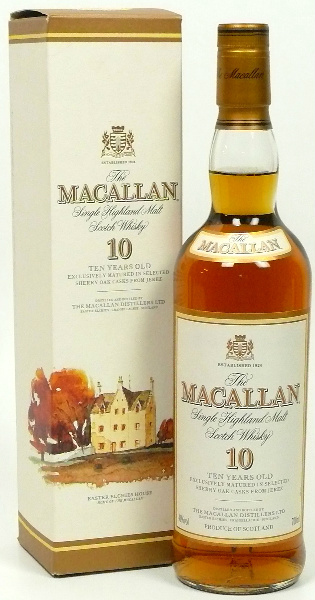
The Macallan 10yo (40%, OB, Circa 2003)

We move back a decade or so to visit one of our old friends. One of the most standard bottlings of that time, the original Macallan 10yo. It had an age statement back then and was diluted to 40% ABV. It was the time, no fan of Macallan or otherwise, was aware of the dark clouds that were forming up ahead. Finally the storm broke and we were given the Fine Oak series. So for me the downfall in quality started with bottlings issued in the newly designed bottlings like the “Fine Oak” series. However, if memory serves me well, in 2002 they started releasing some sort of NAS called the “Elegancia”, preparing us for a softer and smoother experience, moving away from the true Sherry experience of the true Macallan. Not truly a NAS by the way, since it did carry a vintage, like Elegancia 1991. Nevertheless, after the Fine Oaks I really didn’t look back. I was so disappointed. I turned my attention towards Longmorn instead. Back then a lot of it was around and at fair prices to boot. The standard 15yo was pretty good, although the introduction of the 16yo made me rise my eyebrows a bit. Better looking bottle, but the Whisky was less interesting. No, may independent released some pretty stellar Longmorns, so I needn’t look back at Macallan. Of course I did try some of the newer bottlings, but I was never convinced moving back towards the Macallan. Only the future can tell us.

Macallan 10yo (40%, OB, Circa 2003)Color: Dark orange gold.

Nose: Wow, very aromatic. Heaps of Sherry. Extremely fruity, Cherries, apples and banana. Simply wonderful. Already from the start a nice backbone of (new) Oak and a promise of toffee’d sweetness. Warm runny caramel. A lot is happening from the start and it only needs little time to reach a nice balance. This is how I remember drinking Whisky a decade ago, without even giving it much thought then. Stuff like this would be around forever, wouldn’t it? Damn, why is it so hard to make something like this today? Ice cream, vanilla, caramel, laced with apples. Sugared apples and a splash of plain and simple refined sugar-water. Fruity, but not only apples. Sugared cherries and hints of mango and passion fruit. A tropical mix that could have been an older Tomatin. Resembles Tomatin 25yo a bit. Thick and cloying at first, but give it some time to breathe and the whole gets thinner. I wouldn’t say it dies out on us, but it does get a bit more restrained. Balances out. Every time I smell this I get hints of well made Calvados. It becomes fresher. More waxy apple skin aroma’s emerge. When you look for it, there are hints of toasted cask. Hints that are more upfront in older good Ex-Sherry cask matured Whiskies.

Taste: Simpler. Starts out soft and sweet, but not as complex as the nose. Tropical fruits and runny caramel again. Is is youth? Probably not. Is it reduction? I guess so. Sweet and on entry, sometimes like someones bad breath mixed with cardboard, what? Relax, it’s not that bad actually. This time around definitely some toasted cask in the mix, which does wonders for the balance. It gives the fruity and fresh Whisky a nice backbone. Slightly bitter oak, slightly burned as well. New sappy wood aroma is also present, although it is highly unlikely new wood was used, but you never know don’t you. The wood is sappy and sometimes a bit harsh and upfront. It’s the “burned” sensation however, that stays well into the finish. Also a nice and rich nuttiness appears towards the finish, combined with the cardboard we found earlier. For a 40% ABV Whisky this has a pretty lengthy finish, but no, it’s not long.

Tasting it now, in 2016, this is high quality by todays standard. Remember this was the simplest of Macallans some ten years ago. Sure, Italy had their official 7yo, since they like young and fresh Whiskies. Hard to believe not so long ago this was entry-level stuff. Today this would have been packaged in a shiny box that costs more than the  Whisky itself did ten years ago. You don’t want to know even how much it would cost today. Looking at auction prices, I would say every time, you get a fair deal when you want to buy one like these. Go for it. They don’t make them like this anymore.

Points: 85

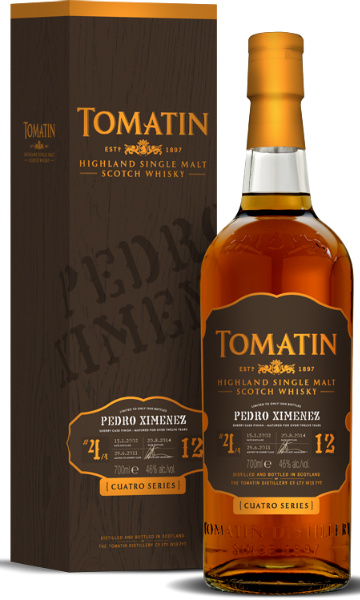
Tomatin 12yo 2002/2014 “Pedro Ximénez Sherry” (46%, OB, Cuatro Series #4, 3 years Pedro Ximénez Sherry Finish, 1.500 bottles)

The fourth and final installment of the Cuatro series is the one finished in Pedro Ximénez (PX) Sherry casks. Understandably the last one of the series, since PX is a very dark and sweet dessert Sherry. The grape variety itself is white, getting its color of drying in the sun. We started out light (in color, not aromatics) with the Fino and Manzanilla expressions. Examples of Sherries that age under flor (which keeps oxygen at bay). The third expression was the Oloroso one. Oloroso is a Sherry that ages without flor and thus prone to react with oxygen. So finally the PX. Even darker than Oloroso and also very sweet as opposed to most other kinds of Sherry. Historically, Oloroso casks were always the most popular casks for ageing Whisky. Back in the day, one was sure the Oloroso butt (or puncheon) was made of european oak, giving off some more tannins than the American oak that is so popular with Sherry Bodega’s today. American oak gives off a more vanilla like and creamy aroma. Today, PX has become quite fashionable as well, for ageing Whisky, since it gives off a lot of color and a sweetish aroma. However, the sweetness does not always come through though.

Tomatin Cuatro Pedro XiménezColor: Gold, more or less the same as the Oloroso expression, ever so slightly darker.

Nose: Thick and a very rich nose. Hints of burned wood and even some tar and coal. Nice, and right from the start a better balanced nose than the Oloroso expression. Underneath, thick, creamy and chewy, like crème brûlée. If you smell it vigorously, you can recognize the PX. On top lies a nice acidic winey note as well, adding to the complexity of the Whisky. All well-balanced here. A nice grassy note emerges, aided by some fruits. Nice overripe red and yellow fruits, but also a very distinct aroma of unripe bananas, biscuits and vitamin C pills (another acidic note). An Autumn Whisky, just for the moment the leaves start to fall. Wonderfully rich and elegant nose, better than the nose of the Oloroso expression. I hope it tastes better too!

Taste: Big. A lot from the nose comes back in the taste. Slightly tarry, burnt wood again, with hints of vanilla and butter. Burnt sugar, yet not sweet sugar. All of the (acidic) fruity notes are there, but here, even some hints of white grapes show themselves. Add to that a typically Dutch coffee bon-bon called Haagsche Hopjes, and you’ll get the picture. Nutty. Hazelnuts and even fatty peanuts. The body and the finish are not thick, chewy and cloying like a true PX Sherry, but the aroma’s are there. A somewhat Beer-like finish. The different “burnt” notes; the tar, the wood and the sugar, are on the rise, so if you don’t like that, don’t get this one. It starts out elegant, but ends a bit raw and bold.

And there you have it. The whole Cuatro range explored. Was it worth it? Yes! A very nice learing experience. Do you, and I, as consumers need the whole set of four? Yes, we do if you want to share the experience with lots of others. Four bottles of study material from the Tomatin University Distillery. Do you need a whole box to drink by yourself? No, not really.

For this end piece I did a proper H2H2H2H. Yes, that means I have four drams in front of me. Comparing the Fino to the Manzanilla is interesting, but for a drinking Whisky both are too similar. Especially on the nose. If you only want one, I would opt for the Fino expression, since it tastes slightly better. Oloroso, supposedly the best Sherry cask for Whisky, was in this case a bit disappointing. Smelled less aromatic than the first two, but otherwise surprisingly similar. Not the same but certainly very well related. On the taste it is somewhat unbalanced especially toward the finish. I would pass on that one. Finally the PX does show poise, and yes it does start a bit sweeter on entry compared to the other three. It’s well-balanced, and definitely the one to pick over the Oloroso expression. But, and there is a but, the PX does show a lot of burnt notes you’ll have to like, although those notes are more and more obvious in the Oloroso expression as well. In the end, I would take two, The Fino and the PX, Both are very tasty and somewhat different from each other, but not as much as expected beforehand. If I had to pick one, I would definitely go for the Fino, which for me is the best of the bunch.

Points: 85

Tomatin 12yo 2002/2014 “Oloroso Sherry” (46%, OB, Cuatro Series #3, 3 years Oloroso Sherry Finish, 1.500 bottles)

Number three is the Oloroso finished one. Hands down the most popular Sherry in the Whisky industry. Somehow casks that once held Oloroso Sherries produce the best Whiskies that (once) graced the face of the earth, even though the Sherry itself isn’t seen as the best there is in the (fortified) Wine world. Oloroso Sherry is produced by oxidative ageing, meaning, there is more contact with air than the previous two expressions that age under flor. The forming of flor is suppressed by adding alcohol from distilled Wine, thus prohibiting flor to form. This oxidative ageing produces a darker more nutty Sherry which is not sweet. Dark sweet Sherry will be the topic of the next Sherry finished Tomatin. Let’s see if our precious Oloroso finish also manages to fetch the best results in the cuatro series. Up untill now the “Fino” expression managed to get the highest score so, 85 is the score to beat.

Tomatin Cuatro OlorosoColor: Gold, but slightly darker than the previous two.

Nose: Funky and dusty. Slightly acidic. New wood and raisins. Yes its nutty. Quite complex and lovely. New wood and toasted wood, slightly tarry. Spicy wood and slightly herbal. Vanilla, creamy and fruity, although new, fresh oak is always right up front. Very aromatic. Loose, unlit cigarette tobacco mixed in with the new wood aroma and licorice. Actually this smells like coming from a red wine cask. It’s sharply defined, fresh and slightly acidic. Tannins and spicy. Slightly dusty and smoky. Very nice stuff if you give it time to develop in your glass. Mocha and tar (again). Nice.

Taste: Sweet and funky on entry. Nutty with a fruity acidity, and very aromatic. If you ask me, easily recognizable as a true Oloroso. Tasting the nuttiness brings out the nuttiness in the nose as well. Milk chocolate and a sharp spiciness. Wait a minute. Where is the Tomatin in this? Where are my tropical fruits? Quite the finish ‘eh? Yup, a bit overpowering. Heaps of fruity acidity now. Red wine (finish). The new (peppery) wood from the nose comes to the fore right before the finish. Luckily it doesn’t dominate it. Breaks down a bit in the finish, which is a shame really. A hot sensation stays behind, with wood and the acidity with the longest staying power. Big and raw, but also lacking a bit in complexity as well as in elegance both the Fino and the Manzanilla expressions showed.

This one is big, but not the best balanced one. This one has its moments, but also has its flaws. Its nice, but not the best one up ’till now. Maybe the Oloroso Sherries and/or the casks they were matured in aren’t what they used to be? On the other hand, what still is…

Points: 83

Tomatin 12yo 2002/2014 “Manzanilla Sherry” (46%, OB, Cuatro Series #2, 3 years Manzanilla Sherry Finish, 1.500 bottles)

On with #2. The second installment is the Manzanilla Finished one. Quite the logical #2, since Manzanilla is also a type of Fino Sherry. Manzanilla is made in the town of Sanlúcar de Barrameda in Andalusia. Just like Fino, it is a very dry and pale kind of Sherry. The region is less hot and more humid, so the flor here is even thicker, giving an even better protection against oxygen. Manzanilla’s are therefore even fresher than their Fino-brothers. Manzanilla’s also have a somewhat salty feel to them. The Sherry ages near the sea, but should that allow for a more salty liquid? In Spain, Manzanilla means camomile tea. The Sherry is named as such, since the aroma’s are thought of resembling camomile. So salt and camomile are the things to look for in a Manzanilla Sherry, but are they also the things to look for in this Whisky?

Tomatin Cuatro II - ManzanillaColor: Gold.

Nose: Starts immediately less funky than the Fino. It also doesn’t need a lot of time to breathe, to settle, its ready for consumption right of the bat. Subtler and more restrained. Hints of burning wood and toasted cask. Dry grass, vegetal and dry warm barley. Easier than the Fino and seems less complex as well. Sweetish and again full on aromatics. Just not as thick and cloying. Smells nice. Fruity, and quite similar to the Fino expression. Tropical, ripe, sweet and aromatic fruit, which is typical for the Tomatin spirit. Dried apricots, but also a hint of bicycle tire. If you ask me, no traces of camomile in the nose. Salty? Nope again.

Taste: Sweet and boasts a fruity start. Chewy toffee. Fruity, yes, but this time slightly fresher and more acidic. Fresh green apple skin and white pepper. Not (as) hoppy as the Fino, but there are some fruity Beer aroma’s to be found towards the end of the body. The wood moves into the realm of pencil shavings. I don’t get the camomile one might expect, nor do I find it salty, although I do have slightly salty lips. Quite a simple expression. Likable, but simple. Maybe next time they should finish this for a while longer, although this finish carries just enough bitterness for me.

Slightly more approachable than the Fino, but with that also slightly less “special”. Sure, you have to work the Fino a bit, and its start can be a bit of a scare, but when it opens up, lots is happening, especially on the nose. Yes the Fino has definitely the better and more complex nose of the two. In the taste both are closer to each other. The Manzanilla expression actually doesn’t show as much development in the glass as the Fino. It is immediately clear what you have in your glass. This one is more of a daily drinker. No faults, but also no ooohs and ahhhs as well. Good, but not as special as the Fino. However, I do feel that these casks that once held Sherries that aged under flor, show a lot of potential for ageing and finishing Whiskies, and especially the tropical fruit spirit of Tomatin.

Points: 84