Havana Club “Selección De Maestros” (45%, Cuba)

Havana Club is the story of José Arechabala y Aldama (Don José). In 1862 the 15yo José moved from Spain to Cuba, and in 1878 he founded the La Vizcaya Rum company in Cárdenas. He changed the name of the company to his own in 1921 and left his son-in-law José Arechabala y Sainz to run the company. In 1923 José passed away and the second José was killed just a year later by kidnappers. Gabriel Malet y Rodriguez took over, but he died already in 1926 to be succeded by Don José’s nephew José Fermín Iturrioz y Llaguno (Josechu). Under Josechu, the Havana Club brand came to be in 1934. Like so many businesses the company was nationalized on the first of january 1960, and the family moved back to Spain and the US. After nationalization, the government changed the name of the distillery into Havana Club. The Cuban government started selling Havana Club Rum in 1972 in Eastern Europe. In 1977 a new factory went into production in Santa Cruz del Norte and a second factory was opened in 2007 in San José. In 1993 the Cuban government signed a deal with Pernod Ricard, where the latter would take upon itself to “sell” Havana Club to the consumer all over the world except for the US, because Bacardi already sells a brand of Rum called Havana Club (made in Puerto Rico) in the US since 1994, after buying the name and recipe from the Arechabala family. Pernod Ricard and Bacardi, both Giants in the drinks business, are fighting over the brand and its use in the US in court ever since…

Havana Club Selección De Maestros (45%, OB, Cuba)Color: Full gold, toffee.

Nose: Just like the Cubay 10yo, this is full on aroma. Again a Rum that jumps at you from the glass, so don’t pour yourself too much at once. Somewhat less creamy and soft, but sharper and seems to have a more pronounced wood nose. A treat to nose, well-balanced but again not the most complex stuff in the world. It’s probably just the Cuban style I guess. Hints of mocha, milk chocolate and hazelnuts. Wood becomes more and more dominant. Pencil shavings and fresh succulent oak, but also a sharp dry oaky smell which transgressed into a more paper and dry leafy note. So lots of oak in the nose. Raw in a good way.

Taste: Yup oak again, but only for a short while. The sweet constituents are quick to take over. Sugar water, and creamy toffee. Quite warming and good length. This has some serious staying power for a Cuban Rum, which is supposed to be light. Quite creamy and some caramel, in a way I like my Havana Cigars. Compared tot the Cubay 10yo, this has 5% more ABV and it shows. Good length and good delivery. Fruity black tea. Overall this isn’t a very complex Rum, but it does have something of a bite and again is very drinkable and loveable. Wood. The pencil shavings from the nose stays behind for the aftertaste.

Definitely in the same style as the Cubay 10yo, but for me it even has more simplicity, which in this case is not necessarily a bad thing. Remember the Cubay has something I liked and couldn’t put my finger on? Well I still haven’t found out what it is, but this Havana Club I like as well. Overall quite nice and drinkable. I love the slightly higher ABV. On the other hand, it’s also a bit raw, good raw, and lacks a bit of complexity and development, which in this case I don’t mind. A bit young, and definitely a lot of fresh oak, but for me this one surpasses the Cubay 10yo in balance. Nice and tasty stuff but maybe a wee bit too expensive.

Points: 83

Cubay 10yo “Reserva Especial” (40%, Cuba)

Ron Cubay was founded in 1964 in Santo Domingo, which is some 25o km’s to the east of Havana. The Cubay rum is produced in the Cuba Ron distillery, which also produces… yes you’ve guessed it: Havana Club. Cigar lovers will already recognize the marketing plan similar to that of Cohiba, and later, the Trinidad brand. The Ron Cubay brand was intended for domestic consumption only. But soon after taking a course in marketing and dare I say it: capitalism (I’m just kidding), it became apparent it was time to export the next Cuban brand, so the Ron Cubay was first exported only five years ago, in 2010. I just don’t know if the Cubay brand was shrouded in the same kind of mystery as Cohiba and especially Trinidad (as Fidel’s private brand).

The full range of Ron Cubay consists of five variants of which only three are exported. The 3yo “Carta Blanca” (a White Rum), the 7yo “Anejo” and the 10yo “Reserva Especial”. They found the 4yo “Carta Dorada” and the 5yo Anejo Suave” a bit obsolete and settled for the 3yo, the 7yo and 10yo. Ron Cubay is produced with Cuban molasses from sugar cane. In Cuba it is illegal to use imported molasses for making Cuban Rum. Cubay is distilled with a column still. The 10yo I’m about to taste is fully matured in American white oak casks of different sizes and levels of char.

Cubay 10yo Reserva EspecialColor: Orange gold, toffee.

Nose: Aromatic and sweet, creamy and buttery. This flies out of my glass. Citrussy and fresh. Hints of oranges and fermented apple-juice. Light black tea with a splash of lemon. Vanilla latex paint. All of this is mixed with quite some wood, but in no way is the wood overpowering. Its soft and soothing, sometimes meaty and only gives a spicy backbone. Mixed in with the wood, some aged Calvados and honeyed sugar-water. So the apply part is growing. Altogether fruity and if you want it, there is some florality as well. Great balance. A lovely nose.

Taste: Fruity and very appetizing. Toffee and hard coffee candy. Some wood upfront, but even less than in the nose. Quite warming, and when the first sip goes down a more dry woody residue stays behind in my mouth. Woody and licorice. Again not overpowering. The start of the body is the best part for me, quite some vanilla combined with a tasty fruitiness. The development into the finish is eventful. Something is happening. The finish has medium length, with a hint of walnut bitterness, and has a tendency to fall apart a bit into the wood spice and an acidic fruity part. This is much less pronounced than in the Abuelo 12yo, where the acidic fruity part bothered me a bit. Sugar water again, and after a while it’s gone. The aftertaste shows this has been in wood for 10 years. I would say the bitterness is slightly hoppy now. More pronounced and velvety and less fatty than the initial walnut bitterness.

Nice stuff and dangerously drinkable. Especially in the taste not overly complex, but just tasty. Although this has quite some aromatics it has the strength of the scent of a flower, so I’m not sure if you should use this as a mixer. I know for sure it will do well as a nipper. I can’t put my finger on it yet, but I really like it. Recommended.

Points: 82

Four Roses “Single Barrel” (43%, OB, H294D, 2003, 70 cl)

After the Four Roses in disguise, called Bulleit, let’s compare it to a true Four Roses (with a similar profile). In 2012 I reviewed the current 50% ABV version of the Four Roses Single Barrel and I refered to this discontinued 43% ABV. version, calling it: “Too weak, very light and too floral and girlie for my taste”. At the time of writing I thought I finished the bottle, but as luck would have it, I found a box of archive sample bottles filled with different Bourbons I used to have. I guess it pays to save something for later! So many years later, let’s find out if this 43% ABV version is as hideous as I seem to remember it! By the way, this one is said to be 8yo and was bottled on 12 April 2003.

Four Roses Single BarrelColor: Orange gold.

Nose: Yup it’s the floral rye again. Lilac and Lily of the valley. Easily recognizable and even more pronounced than the new 50% ABV version, the only bottle I had, I forgot to fill up an archive sample of, so no direct comparison is possible, only from memory and notes. Fruity and floral, it’s almost a perfume. Powdered vanilla and coffee creamer. Almonds and fresh cookie dough. With air dusty wood comes into the fold. Elegant and perfumy. Not a lot of wood actually. Well integrated. A lot of honey is starting to emerge too as well as some turkish Delight and licorice, and anise. Don’t like how the honey and floral aroma’s turn out together. Add to that a slightly acidic fruit note, and you’ve lost me a bit. No notes of toasted cask. It comes across as a designed Bourbon. A Four Roses for people who wear a bow-tie, not for rugged lumberjacks. It is actually a Bourbon for the metro man. Although it’s not quite clear what I am, this is my least favorite Four Roses expression to date, but wait, I still have to taste it again after all those years. The nose is something I don’t always like, although I do recognize the quality.

Taste: Paper and wood, pencils (cedar). Quite a lot of waxy notes. Lightly sweet, but the sweetness washes away with the added water to be replaced with some sour, and slightly bitter oak. Honey and creamy sweetness, but here these two do a better job at integrating with each other. A bit weak on entry and not so long a finish, built around the paper and weak woody note, especially when compared to its stronger brother. Good aftertaste though, nice aroma’s return and a great creaminess is added to the aftertaste. Nice delayed effect. The aftertaste even seems stronger than the finish itself, nicer too. The move to 50% ABV was a good move. Alright, this isn’t my least favorite Four Roses anymore. Now it is the “Yellow Label”…

Even though I prefer the 50% ABV “Single Barrel”over this one. Both are well made and do resemble each other. This 43% ABV has some exaggerated floral Rye and doesn’t combine all that good with the honey and fruity notes. The 50% ABV is the same, but for me is better balanced. Having said that, this may be a tad more special, more unique, so it is definitely worth seeking out.

Points: 83

Bulleit 6yo “Frontier Whiskey” (40%, OB, Circa 2010)

Bulleit is a brand owned by Diageo. Diageo is the biggest drinks company in the world and they are known for loving to make a buck. Nothing wrong with that. Making booze is not a charity you know. In 1983 sensible economics made Diageo close a lot of distilleries in Scotland, and Diageo are also the ones who closed the legendary Stitzel-Weller distillery, their only distillery in the US, correct me if I’m wrong. Why then put out a Bourbon Brand? Economics, getting a foot in the door? The regret closing Stitzel-Weller? Who cares what the reasons are. They decided to put out a brand of Bourbon and had it made by Four Roses. The mashbill contains around 28% Rye, which is right in the middle of Four Roses’ own B (35% Rye) and E (20% Rye) mashbills. And at Four Roses they know what they are doing. By the way, The old Stitzel-Weller distillery is now a centre for promoting Bulleit.

Bulleit BourbonColor: Light orange gold.

Nose: For me, Rye Whiskies always smell a bit floral, even though they (should) have a taste with a bite. I don’t know how to describe it differently. This isn’t a Rye Whiskey, but it does smell like it, sort of. High Rye mashbill it is. Dusty, floral and vegetable. Buttery with dry leather. Delayed mint. Funky stuff like crushed beetle and cold dishwater. Old honey and do I detect a wee whiff of urine in there? Well, don’t be fooled, this smells rather nice, but we already know, Four Roses know what they are doing, but i might have said that already. Powdery and dry with some charcoal. Well balanced, especially considering its age.

Taste: Smoother than the nose led me to believe. Slight dryness, but also quite sweet. Sugar water. Funky rural toffee and a bit of leather. Some toasted oak, but the focus lies more on the toast then the oak. Nevertheless, the oak is there, but it’s hardly woody at all. Creamy, but a bit too thin. I believe 40% ABV. is a bit too low. Spicy and chewy Rye. Light, but good. Medium to short finish, with a slight bitter edge towards the aftertaste. I do believe the distillate to be promising, but it is a bit killed by the low ABV.

I didn’t like it when I first opened it, but I warmed up to it now. I remember I didn’t like the pronounced florality of it, and it may have been slightly soapy when it was freshly opened. In the end Four Roses make a pretty good Whisky, even if they do it for Diageo. I would ditch the 40% ABV version and get the 45% ABV version if you have the chance, but it isn’t available in all markets.

Points: 81

Glenfarclas 21yo (43%, OB, Circa 2006)

Following up on the 15yo I reviewed last, here is the 21yo Glenfarclas from the standard range that was around in 2006. Trying the 15yo I was in a way amazed how the feel was “different” from the more modern malts that are around today. There seems to be an old way funkiness to that Malt. I’m quite curious now, how this 21yo will do.

Glenfarclas 21yo (43%, OB, Circa 2006)Color: Full gold.

Nose: Funky and somewhat waxy and sweet. A different profile from the 15yo. Lighter in color and fuller in a different kind of way. It almost smells chewy! Maybe more Bourbon aged Whisky went into this 21yo. Smells funky and organic. It’s like being licked by a dog which earlier licked some spilled honey (don’t ask). I love it. Hints of wood, and especially sawdust. Chocolate and some acidic fruits. This is more a creamy and woody Glenfarclas. Dusty vanilla pudding. It’s almost like his is more fruity than it shows. It just doesn’t come out of the liquid for us to smell. Encapsulated by some ice-cream notes. Great nose, and it has not a lot of the florality the 15yo had.

Taste: This starts with cardboard we know from the 15yo, and a lovely dried apricot fruitiness as well as some Calvados. Definitely lower in ABV than the 15yo. Waxy and before the wood comes this persistent cardboard and paper note, I don’t particularly care about. The finish is accompanied by the same burnt note the 15yo has, but in a softer more gentle way. Just like the 15yo, again not overly complex. Extremely drinkable. This is a Whisky I fear will be gone soon. By the way, this one does have a bit of soap in the finish, as well as in the aftertaste, which also carries some bitterness.

Although this starts well, the finish and aftertaste let it down a bit. Again a very specific Glenfarclas, and just like the 15yo, it’s hard to imagine they still can make it like this. I really have to get me a new version of one of those “standard” Glenfarclasses, or is it Glenfarcli? If you ask me I’d probably go for the 25yo, although the 17yo is also a fan favorite. But, you also might want to consider this one, which fits the same profile and I liked it very much.

Points: 84

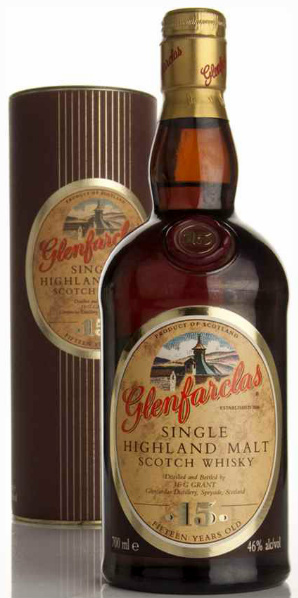
Glenfarclas 15yo (46%, OB, Circa 2006)

Almost three and a half years ago I reviewed it’s older brother from the same series, the 25yo. Rummaging through samples stored (read: misplaced) all over the place, I found this 15yo, as well as the 21yo, which I will review next. These two are samples of the standard range Glenfarclas from more or less ten years ago. Today the label look different, although the dumpy bottle stayed. So without further ado, I give you Glenfarclas 15yo.

Glenfarclas 25yo (43%, OB, Circa 2006)Color: Orange gold.

Nose: Dusty and dry, hints of Wine and Sherry. Creamy with vanilla and some nice soft oak. A perfumed woody wind seems to emanate from my glass. The perfumy, jasmine tea, bit seems more powerful with air, up to the point you could almost wear it. Next a cardboardy note joins the slightly minty florality. It smells nice, not “wrong” as most soapy notes often do. Quite some depth. Notes of roasted beef, covered in black pepper as well as toasted oak. Wow, the diversity of aroma’s the Sherry has given this Whisky is amazing. I’ll call this “oriental”.

Taste: Starts with oak and wood, with a smooth and slippery mouthfeel. Some burned oak and cardboard again. Luckily the cardboardy notes don’t ruin this Whisky at all. Warming, fruity and aromatic. Not heavy, cloying of full of raisins. Nope this Sherry is more lively and fruity. This one is bottled at 46% ABV, where as the 21 and the 25yo are 43% ABV. The slightly higher strength hold it up beautifully. Beer-like finish, some burnt notes. The Sherry returns in the aftertaste, but the charcoal, burnt wood notes never leave. Not overly complex.

Well, one thing is for shure, they don’t make them like this anymore. Although this was bottled almost 10 years ago, I can’t imagine the current 15yo will taste, and smell, anything like this. But I could be wrong. I hope I’ll get the chance to try some more recent bottlings of “standard” Glenfarclas (apart from the 21yo I’ll review next).

Points: 83

Borgoe 15yo “Single Barrel” (40%, Suriname)

After the pride of the SAB company why not move on and have a look at their Grande Dame. Where the 8yo was released in 2006 to commemorate the 40th anniversary of SAB, this 15yo “Single Barrel” was released in 2011 to commemorate the 45th anniversary. Maybe next november we’ll see the next anniversary bottling, a 20yo maybe? The 8yo and the 15yo thus are specials, but there is also a more standard range Borgoe. The first one of those is called the Borgoe ’82 “The Jubilee Blend”, the second is called the Borgoe “Extra”  and the third and last one is the Borgoe 5yo “Vintage”. By the way, all White Rums made by SAB have different brand names, so Borgoe only exists as a Golden (or Dark) Rum, whichever word you prefer. Borgoe uses both simultaneously.

Borgoe 15yoColor: Orange gold.

Nose: Very funky smelling. Still caramel and toffee, but there is a lot more going on. Very nutty. Organic clay. After the fatty and creamy introduction, Wood and deep sugared fruits. Honey with dark brown banana skin. This is completely different from the 8yo, not just an older version of it. I’m not completely sure everything is as it should be , but whatever it is, I love it. Fresh cigar box wood. Pencil shavings and dust. Just like the 8yo, the aroma’s it started with take a back-seat and it turns more dry. Smells like a worthy super premium Rum to me.

Taste: It starts out with the simple sugary sweetness, like the 8yo, as well as the fresh woody bit. After that, everything changes and it becomes incomparable to the 8yo. Where the 8yo went down in a hurry, this 15yo sticks to your throat and takes a long time to get down, developing along the way. Perfect balance between the nose and the taste. Again the thick creamy and nutty aroma. Tiny hint of burnt wood bitterness, but that only aids the wonderful taste. Excellent length in the wonderful tasting finish and a good aftertaste. Some tiny acidic wood note appears in the aftertaste, but that is hardly a problem, when so much other aroma’s keep lingering on. This one is far from tasting “thin” even when it shares the low ABV of the 8yo: 40%.

One thing strikes me as odd. The website mentions: “Our own master blender created this special Rum along with the best Rum makers of the Caribbean” and on the back label it states: “The golden rum was selected from each single barrel by our master blender and blended to ultimate perfection”. So several Rum professionals created this Rum or only their master blender? How can this be from a single barrel and be blended? Did they blend the Rum, put it back into a barrel, marrying it and then bottling it from a single barrel? Strange…

Twice the age of the 8yo, twice the price of the 8yo but also twice the taste of the 8yo. Definitely worth the money, if you can find it, because it seems quite hard to get lately.

Points: 86

Borgoe 8yo “Grand Reserve” (40%, Suriname)

Borgoe is one of a few (Rum) brands of Suriname Alcoholic Beverages (SAB for short). Other Rum’s made by SAB are Mariënburg and Black Cat. Both are White Rums. SAB is foremost a producer of Rum, but also some Vodka is made. Besides this, SAB also functions as an importer of several foreign “alcoholic beverages”. SAB was founded in 1966, but its predecessor was founded in 1882 as the “Suikeronderneming Mariënburg” and today is one of the most succesful enterprises of the country. To commemorate its 40th year of existence, the 8yo Borgoe was released in 2006. Borgoe 8yo has fully aged in American oak barrels straight from Kentucky.

Borgoe 8yo Grand Reserve (40%, OB, Suriname)Color: Orange gold.

Nose: Nicely sugared, hints of fruit and full on aroma, that leaps out of my glass. Lively and leathery. Sunny and happy, this want to be drunk (pun intended). Heavy fruit syrup and elegant wood. The heavy nose is not always sweet, It has its dry spells. After a while, the wood starts to play a bigger role, but foremost a sort of vanilla powder, locked into the woody backbone is present. Wet warm cotton with a meaty twist to it. Powdered coffee creamer. Sometimes the heavy aroma retreats and it allows some notes of black tea and licorice to escape from the glass. When this happens, the fruit takes a back-seat as well and a more floral note appears, honeysuckle, so not typically flowery-floral. Sawdust, new wood, not particularly an oak aroma though, and a tiny hint of ashes. Even though I used many words up ’till now to describe the nose, I wouldn’t say it’s as complex as it seems. Medium complexity it is then, but, there is evolution in the nose. The sweetness retreats even more, the “wood”, played its part and now a more plant-like aroma emerges. Dried and fresh. It’s a more overall feel, so hard to pin anything down, although lavas seems to be one of them, as well as italian laurel (licorice). Funky.

Taste: Caramel, wood, burnt sugar and toffee, but the sweetness speeds down my throat, and a more watery episode follows. In that watery, and thus, thin episode, the licorice from the nose pops up. Sugar water with toffee aided by a wooded note, nothing more really. The nose presents itself as syrupy and heavy, but the taste and especially the mouthfeel is not. Definitely getting more oaky now, but not fat succulent old oak, but a younger type of oak, young, fresh and slightly acidic. Tree sap. Quite a short finish, also slightly unbalanced. Overall it tastes nice, but quickly gone. The, slightly bitter, Italian laurel licorice really shines in the aftertaste.

Tasty stuff that could have been more like a Pussers or Demerara style of Rum, judging by the nose alone. It isn’t, and maybe it shouldn’t. Where in Demerara the nose, the taste and the body are heavy, here it comes across as too much reduced, where some aroma’s even seem to be stripped, thus missing some complexity. I can’t explain that. The watery part is obvious, but missing something from the body is a first for me. Still, it’s a nice sipper, easy-going and easy drinkable. Although it looks like a premium Rum, it drinks like a daily drinker, a sipper, not a mixer. But for the money I expected a more complex Rum. Nevertheless, good stuff, so no cause for alarm, although I feel SAB can still improve on this Borgoe Grand Reserve, and turn it into a really good Rum.

Points: 80

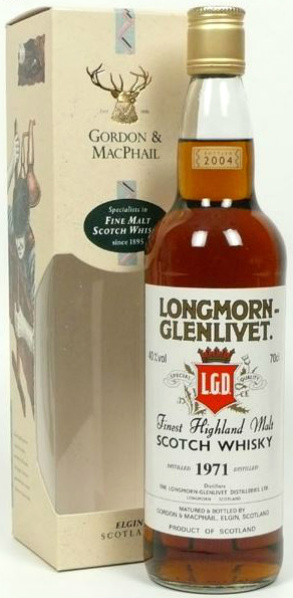
Longmorn 1971/2004 (40%, Gordon & MacPhail, Distillery Label, JD/AII)

The old Jameson opened my eyes for old bottles. Not true actually. I’ve known it all along. I just needed a kick in the bee-hind, to open some more, before I one day, kick the bucket. Luckily I had a birthday two months ago, and that is always a good reason to pick a nice one from the collection and “because you’re worth it…”. Of course, “Thursday” is also a good reason in my book. 1971 is quite a legendary year for Longmorn. At Longmorn nobody will concur, because they haven’t done anything different in the years before and since 1971. However, there somehow are a lot, very good sherried, and otherwise matured, Longmorns from around 1971. I particularly love the 1971 from Scott’s Selection, although true Longmornado’s tell me there a many better ones. Great!

Longmorn 1971/2004 (40%, Gordon & MacPhail, Distillery Label, JD/AII)Color: orange gold.

Nose: Waxy. Old black fruits and just like the Jameson I reviewed last a bit of steam. Buttery and beautiful Sherry and black coal. It doesn’t leap out of the glass and I believe that is due to the reduction to 40%. I’m not worried yet, because these old distillates can handle a lot of water. Today’s Malts do need a higher strength. Nevertheless it seems the nose suffered a bit in power. Maybe this is one for a Cognac copita (the big balloon glass). Luckily I have a whole bottle of this, so I can experiment a bit. Slightly tarry but right after that a fresh note of faint menthol/mint. Way down deep into the nose some licorice pops up, well hidden in the dark fruitiness. Again, a wonderful old bottle.

Taste: Sweetish black tea, and again pretty fruity. Raspberry hard candy, and some cherries. The whole is quite soft, so again, maybe this was reduced too much. It’s great as it is, but I can’t shed the feeling, a lot was taken away from this Malt as well. Now it’s too damn drinkable, so I don’t think this will last me a long time. I’m sorry the body isn’t a bit bigger. I’m accepting this now and I move on. This is great stuff extremely well-balanced. A nice nuttiness comes to the fore and then even some honey. Hurray for air, breathing and developing Whisky. Great combination of fruit and the hints of tar and black coal. Tiny hint of burnt Sugar towards the end. The finish could be longer, but we’re rewarded with a wonderful aftertaste. It even reminds me a bit of some Rhum Agricole in the finish. Be patient and give it time to breathe. It opens up. wow!

I’m a sucker for Sherried Longmorns from the second half of the sixties through the first half of the seventies. These Whiskies are so good. Sure there are a lot of Longmorns around that are better than this one, but there are not a lot of Whiskies better than Longmorns like this. Give it time to breathe, it will open up and become bigger than it initially was.

Points: 91

This one is dedicated to David Urquhard (1952-2015) who passed away on 30 November 2015, aged 63.

John Jameson & Son 7yo “Three Star Pure Old Pot Still” (43%, Bow St. Distillery, Dublin Whiskey, 75 cl, Circa 1965)

Who would have thought I’d still have an ace up my sleeve considering Jameson’s? The title seems a bit of a mouth full, but when you are identifying old bottles like these, you have to identify minute differences on the labels to carefully date them. I don’t know when exactly they started to use this exact label, but I do know the last year they used it was in 1968. So “circa 1965” is a carefull guess.

The Bourbon world has adopted the old “Stitzel-Weller” distillery as the ultimate Bourbon heaven on earth. Similarly, the Irish have the old “Bow Street” distillery that was/is situated in Dublin. The Bow Street distillery started working in 1780 with John Jameson acting as General manager. John bought the distillery in 1805. The distillery was eventually was closed in 1971. Since 1997 it is opened again, but alas only as a “tourist” attraction.

John Jameson & Son 7yo Three Star Pure Old Pot Still (43%, Bow St. Distillery, Dublin Whiskey, 75 cl, Circa 1965)Color: Light gold.

Nose: Extremely fruity steam punk kind of Whisky. Hints of old paint. Even if I would have tried this blind, you know when you have an old Whisky on your hands. I’ve said it before and I’ll say it again; They don’t make them like this anymore, and the other Jameson reviews just prove that. Wonderful old dried fruit intertwined with almonds and wax. It really smells of steam and coal and a bit of old engines. Warm machine oil and vanilla. Very appetizing. When you let it breathe the fruit gets less pronounced and a more dusty creaminess starts to emerge. A dustiness which seems to be coming from wood. A wonderful experience.

Taste: Quite different. It starts with old newspaper and luckily the waxy fruitiness hold it up. Still, somewhat lighter than the nose. The nose is special and quite “thick” this is less so. paper and wood but both are light and well-balanced with the rest of the aroma’s. Slightly warm apply note comes next. Those of you who are regular Calvados drinkers will recognize this apply note, and now that I recognize it, it’s there in the nose too. Hints of caramel and slightly burned caramel emerge, which is noticeable on the tongue. Not everything stays behind for the finish, but still a nice, but short finish, but we are left with a nice aftertaste. Good, but not as special as the nose was. The nose really oozes with times long gone.

The current Jameson and this Jameson are both tasted early in the morning before breakfast. The current Jameson is a nice aperitif. It’s niceness is in the detail, which is much easier to pick up in the morning, than in the evening, when you have just eaten and your palate is tired. The current Jameson has lost much of it charm when I tried it in the evening, after finishing the previous review. Tasting this, I fear this one will be better in the morning too…

Points: 87