Bruichladdich 10yo (46%, OB, 2003)

Earlier I reviewed the most recent, standard range, Bruichladdich from the Dumpy OB era: the Scottish Barley bottling. Today we’ll have a look at the one that started it all for the previous owners. A short recap is in order I guess. In 1994 Bruichladdich was closed (again) since not a lot of Malt Whisky was needed back then. In 2000 Bruichladdich was taken over by a group of people fronted by Mark Reinier (of Murray McDavid), who in turn, asked Jim McEwan to take on the post of master distiller and (progressive) production director. Who would have thought Jim to ever leave the Bowmore building. In 2001 Bruichladdich was reassembled, without making it a computer driven modern distillery and without disturbing the Victorian bits as well. If memory serves me correctly, by 2001, three bottles were released as some sort of core range. A 10yo (this one), a 15yo and a 20yo. So this 2003 bottling, is one of the next batches after that. Yes no NAS bottles back then yet!

Bruichladdich 10yo 2003Color: Light gold.

Nose: Light, sweet barley. Extremely dusty. Paper. Dishwater citrus, but also perfumy wood, otherwise not a lot of wood noticeable. Pretty fruity. Thick sugared yellow fruits. Some pineapple and papaya with a slight hint of mint and cardboard. Somehow it smells sugary with hints of toffee and caramel. No peat.

Taste: Paper and a sweet woody note. Also something metallic. Perfumy too. It tastes almost the same as it smells. A bit hot on entry, but quickly dissipating the heat. Citrus fresh, but not of the dishwater kind. Rhubarb and again some caramel, which moves into toffee towards the finish. Hints of mocha and wood. Some woody bitterness helps the Whisky along. To my amazement, the dishwater component returns.

The current entry-level Bruichladdich is the NAS Scottish Barley and as luck would have it, I still have that one here too! The Scottish Barley has a lot of butter on the nose, but the fruit reminds me of the 10yo (but only the fruit). Definitely a younger Whisky. More raw and closer to new make spirit. It even has a tiny amount of smoke (and a wee bit of peat and oil, since it resembles Springbank a bit), which is nice. Tastewise the NAS is even simpler than the 10yo, more on barley and lacks some of the off notes of the 10yo.

I was never a fan of the 10yo, and after more than ten years, I still don’t like it that much. The Scottish Barley however, reminds me of Springbank, and even though it is simpler, less complex, in this case I prefer the NAS over the 10yo. (The “Yellow Submarine” I had next, was definitely better than both)

Points: 78

Bunnahabhain 35yo 1976/2012 (48.8%, The Whisky Mercenary, 80 bottles)

500I almost missed it, but this is already the 500th post on masterquill.com. Three and a half years have passed since the moment I wanted to see with my own eyes how a blog was made, so I never intended to continue after the first few reviews. The next few months no new posts were written, but after a while I picked it up again, never to let it go again. It’s too much fun to do, and it still is. It is a never-ending quest for the nicest of drinks that are available on the planet. So much more to discover.

I don’t have to post every day, but I try to have something up every other day. Once in a while I let it be, due to sickness (a.k.a. the nose doesn’t work properly), WiFi-less vacation or other reasons, and I don’t feel bad about it, so it doesn’t feel like something I must do. I have no plans of getting bored with it, or plans to retire after a while. There are so much more drinks around, and so much more to explore and learn, that I fear I will never get bored with it at all. Still, you never know, there have been others I loved to read that have stopped (and some have continued after a while). Here’s to the next 500. Let’s take it one step at a time.

Bunnahabhain 35yo 1976/2012 (48.8%, The Whisky Mercenary, 80 bottles)Time for the 500th post then. I had to pick something special, so why not a nice and old Bunnahabhain. Islay is hot, and so are the picks of Jürgen Vromans. Our beloved Belgian independent bottler. Nothing wrong with his nose, so I have high hopes for this 35yo Bunna. Cheers!

Color: Light gold.

Nose: Soft vanilla and wood, Definitely slowly matured on a slightly active cask. Some sweetness and a tiny hint of what seems to be a sort of waxy peat. light old elegant wood. Hints of chalk and a nice restrained fruitiness (yellow fruits). Old dried out paint dust and a great deep vegetal note. Excellent wood, creamy wood almost. Nothings really sticks out. It all is light and elegant and held back. Tread tenderly with this one. Old skool with excellent balance. Lovely. Should have come with a label in Paisley motif.

Taste: Quite spicy with a burst of sweetness coming from a dried licorice twig. Otherwise the Whisky has a great dry/sweet balance to it. Dry on the nose and dry on the mouth too, with some nice sweet and fatty touches to it. Creamy wax. Vanilla and half-dried pudding. Again a delicious fruity taste, again yellow fruit, mixed with a hint of sweetish black tea. Well integrated woody notes with just a small amount of woody bitterness.

This is a lovely old Whisky, well worth its initial Retail price. Jürgen picked a wonderful old and delicate or even fragile Bunnahabhain. Wonderful stuff. No heavy hitter and lots of nice details. Good balance with decent complexity. I should have gotten me one of these when I had the chance…

Points: 90

Isle Of Jura 13yo 1989/2002 (46%, Murray McDavid, MM 1564)

Here is the third and final bottle in our trilogy of Murray McDavid bottlings. Don’t worry there will be more. After the Rhoshu and the Glendullan, this time we will have a look at a (Isle of) Jura. Both of its fellow Murray McDavid bottlings have proven themselves to be reasonable Whiskies and not so long ago I reviewed a very good Jura as well. So we’ll start this review with high hopes…

Isle Of Jura 13yo 1989/2002 (46%, Murray McDavid, MM 1564)Color: Light gold.

Nose: Sweet malts, but also lightly spicy, frankincense, with lots of vegetal and waxy notes. Highly fruity. Sugared apples, with even some licorice and cinnamon, and some sweet red berries. Reminds me a bit of Calvados. This is a very appetizing nose. Vanilla and dusty, yet not dry. Full of aroma, and warm sugar-water. When smelled to vigorously, a note of paper emerges as well as a tiny hint of old, worn out jasmine soap, a bar you find in the back of granny’s closet, amongst the over sized… well, you know what I’m talking about. Actually this does smell like a Whisky not from these times, but more from the era of black coal. Granny’s era. Sweet and lively. Fruity without a lot of wood. Nice complexity and ditto balance. Lovely.

Taste: Sweet, thin apple water and bitter apple skins. Here the wood does show itself with quite the wood and bitter sap notes. With hints of charred oak. A bitterness we are quite familiar with, reminding me of some nuts. Remember the thin brown skins on walnuts and hazelnuts? If you can get past the bitterness there is a fruity lightness behind it. Malts again and some hay on a summer’s day. Lacks the complexity of the nose though. The finish is another of its weak points. Too short and a bit mono-dimensional. Lacks development from the body, well into the finish. The aftertaste makes you wonder if you haven’t drunk an I.P.A. earlier, for its slight hoppy bitterness left behind in your mouth.

Not a highly drinkable dram, it’s simple, and a wee bit too bitter for a daily drinker. The nose makes you a promise of something special. The nose is actually pretty stunning, and I’m really, really sorry, I can’t say the same for its taste.

Points: 82

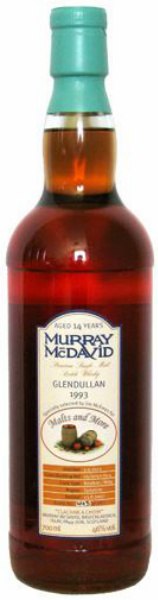
Glendullan 14yo 1993/2007 (46%, Murray McDavid, for Malts and More, Bourbon/Rioja Tempranillo, Cask #05/0052, 493 bottles)

After the Murray McDavid Rhosdhu, here is the second of three bottlings by Murray McDavid. This time we’ll have a look at Glendullan. The Edradours I reviewed last had their first appearance on Master Quill, and now we can cross off Glendullan as well. Here we have a fine example, where Murray McDavid were taking the independent bottler. Specializing in Wine cask finishes. In the early 2000’s Wine finishes were snuffed at, since most of them were overdone and the Original Whisky was probably dull (pun intended). It was just the industry trying Wine finishing out and learning on the go. They still have to wait many years to find out where their experiment were taking then. This particular Glendullan started its life as a regular Whisky aged in Bourbon casks (most likely a Hogshead).  After a while the contents were transferred into a wine cask. Tempranillo te be precise. Tempranillo is a red grape most common to Spanish Wines like Rioja.

Glendullan itself is a distillery owned by Diageo. A bottle of Glendullan is not the most common find of all distilleries, especially considering Glendullan is one of the largest distilleries Diageo owns.

GlendullanColor: Dark gold, slightly orange.

Nose: Spicy wood and a slightly acidic winey note. Very spicy oak, slightly burnt. Nutmeg, and herbal as well. Some faint odd acidic citrussy dishwater aromas. Applesauce, de Querville Calvados! Quite dusty and old smelling, like an old Whisky aged in a Bourbon cask. Behind that a more restrained fruity note, but again acidic fruit combined with hard candy versions of that fruit with added cherry and raspberry candy flavours. Almond pastry, cinnamon and nougat. It’s not quite a replacement for a Sherry aged Whisky, but not bad nevertheless. The Wine turned out very soft on the nose. I do get some grape skin, but from white grapes, not red. In the end, all aroma’s are built upon a wealth of wood, but no, it’s not woody. Needs a lot of air (time) to develop, but in the end it will not disappoint.

Taste: Fruity lemonade and warming. Citrussy again and to a lesser extent so are the apples. Present, but not so much in the Calvados way. Also grenadine and quite a lot of licorice. Old rotting wood. The kind that has been submerged for a long time in a forest. Quite thick. Some raisins. Lots of influence of the wine cask. Maybe a bit too much? The Bourbon casked Whisky isn’t really recognizable anymore. Is that bad? Nope not really. This is still a nice tasting Whisky. Less complex than the nose, but overall quite pleasing. It doesn’t show its best bits right from the start. Pour it and leave it for a while.

Quite stunning what Murray McDavid have achieved with Tempranillo. No wonder Tomatin has gone that way lately too. Complex stuff, with a stunning nose, with quite some development.

Points: 85

Rhosdhu 12yo 1996/2008 (46%, Murray McDavid, Bourbon Cask, 2.000 bottles)

Murray McDavidNext we are going to have a look at three bottlings by Murray McDavid. Murray McDavid was founded in 1996 by Mark Reynier, Simon Coughlin, and Gordon Wright, naming it after Mark’s grandparents, Harriet Murray and Jock McDavid. The motto “Clachan a Choin” translates as “the bollocks of the dog”, so yes, the logo has a dog in it. Besides being an independent bottler, maybe their biggest claim to fame was acquiring Bruichladdich Distillery in the year 2k. In 2000 the distillery was still mothballed, but Mark and his mates quickly turned it into a working distillery. Less than 12 years later in the summer of 2012, Bruichladdich was sold to Rémy Cointreau UK Limited, as well as the independent bottler Murray McDavid. Rémy Cointreau didn’t know what to do with the bottler, so less than a year later they sold it to Aceo Ltd, a supplier of casked whisky and distillery services like cask storage, bottling and labelling.
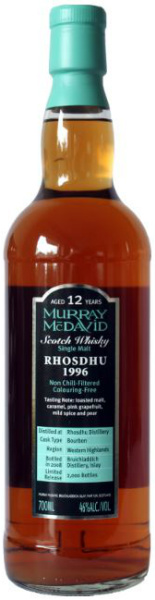
So the first of three bottlings from Murray McDavid will be a rendition of a Loch Lomond Whisky: Rhosdhu.

Rhosdhu 12yo 1996/2008 (46%, Murray McDavid, Bourbon Cask, 2.000 bottles)Color: Gold.

Nose: Spicy and briny. Funky, with some prickling cigarette smoke. Lots of grain, but also some traits I get from Rhum (of the Agricole kind) and Bourbon itself. Actually more like a Rye Whiskey. A dry and sweet fruitiness mostly. Definite cask toast. Vanilla and tangerine. Lots of saw dust and dare I say it (again), cardboard. It smells like an old (sweet) Single Grain, at the fraction of the cost. Dry powdery and again (citrus) fruity. Give it some air, and boy, does this need some air, and it’s even tarry sometimes.

Taste: Again quite grainy and fruity. A bit raw but therefore it needs the fruity sweetness it has. Vanilla powder and smelling like an old vanilla pod. Noticeable paper and cardboard again, but in no way is this disturbing in this one. Slightly weak in the finish, but otherwise a decent Whisky, helped by quite an active cask. Some acidity enters the fold when it’s time for the finale. The finale has great depth, with a toffee and caramel sweetness. Part of this caramel is even slightly burnt. The sweetness is just right, helped along by the leafy and spicy backbone.

I remember this when freshly opened and it didn’t do too much for me then (79 Points). This time around, with some more oxidation, this turned out nicely. This is a Whisky that needs a lot of air and really benefits from the heat of your hand. Keep it in the palm of your hand, don’t hold it by the stem. Knowing its secret, and if it was available today I would most certainly buy it. If you have it, remember how to treat it. Heat and air will do the trick.

Points: 83

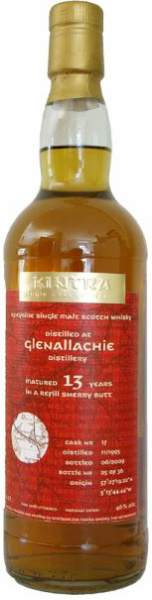
Glenallachie 13yo 1995/2009 (46%, Kintra, Refill Sherry Butt #17, 36 bottles)

Rummaging through the unsorted part of my sample collection I found this Kintra from 2009. Another Glenallachie and that’s great! Kintra’s big cheese, Erik started releasing Kintra Whiskies in 2009 so this is one of the first bottlings, and who knows, maybe even the very first. 2009 saw the release of a 1996 Ben Nevis, a 1997 Clynelish, a 1984 Macduff and in June, this 1995 Glenallachie.

A mind boggling amount of 36 bottles were released of this Glenallachie, so this is a collector’s item for sure! I don’t think this was from a small cask, probably only part of a cask, just like the Ledaig he bottled in 2010.
Color: Gold.

Nose: Fatty and fruity. Some butter and wood smelling like jasmine. Thus quite floral and spicy. Fresh air. Hints of white pepper and again and again this florality whiffs by. Pencil shavings come next. A lovely nose. Nice added depth from the Sherry cask, not only giving it some mustiness, but also some fruit. When smelled more vigorously, whiffs of toned down peppermint pass by, but also some hay, dry raisins and cardboard. If I would hazard a guess, I would say Fino Sherry?

Taste: Spicy first but quickly turning into sugar water sweetness. Dare I say it has some peat to it? The spice and the sweet balance each other out, so it’s not overly sweet. Warming going down. Hints of milk chocolate and a slightly burnt note. Still, lovely stuff, but also a bit unbalanced. Highly drinkable and enjoyable nevertheless. The sweetness makes way for a more woody, and acidic, dryness towards the finish. The finish itself is of medium length and pleasant, but doesn’t leave a great aftertaste, since especially a weak wood and cardboard note stays behind for a short while.

This is one of those highly drinkable Whiskies, where the weakest link is the finish, and especially the aftertaste. To get past that you tend to take another sip, and yet another sip, and yet another, so you’ll finish your glass rather quickly and after that you ask yourself where has the bottle gone? Maybe not my favourite Kintra bottling, but still very good and entertaining.

Points: 84

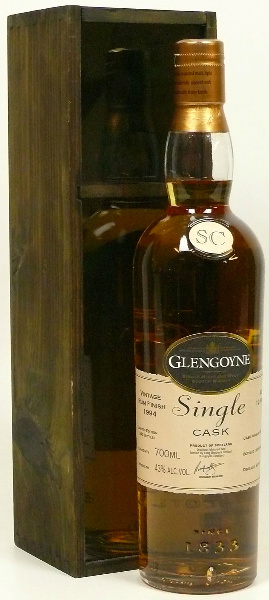
Glengoyne 12yo 1994/2006 (43%, OB, SC, Rum Finish, Cask #909310, 348 bottles)

Just like the 10yo Edradour I just reviewed, Glengoyne also has a 1994 vintage, which was used for a lot of different cask finishes. Claret, Madeira, Manzanilla, Muscatel, Cornalin and a lot of Rum finishes were released between 2005 and 2008. Some were bottled at cask strength, and some were reduced to 43% ABV. All the other Rum finishes have a cask number of 5 digits, so this one was probably cask #90931. Maybe they have added an additional “0” to distinguish this bottling from the rest since this is the only one that has been reduced. Maybe an administrative mistake was made…

Glengoyne 12yo 1994/2006 (43%, OB, SC, Rum Finish, Cask #909310, 348 bottles)Color: Gold.

Nose: Excellent full-on Rum smell. Spicy, fatty dirty. I’m guessing high ester Rum. Jamaican? Hard to tell. Sugar cane and very leafy. For some this may be finished too long, but I’m not one of them. I love the synergy between Rum casks and Single Malt Whisky, but I may have said that before. Extremely deep. What a nice combination of smells. Wonderful depth and a wealth of complexity with lavas and balsamic vinegar. Where did that come from? The Whisky, The Rum or the wood? If it’s the wood, the wood turns to a more cleaner oaky note. Fresh windy forest and some warm butter on toast (not burnt). Even a slightly soapy note.

Taste: Well this is less complex than the nose is. Where the nose explodes with aroma, the taste is much simpler. Most definitely a sweet Whisky. Sugar water and yes, some nice leafy wood influence. Paper and floral cardboard, whatever that is. The taste is built around some different wood flavours, sugared tropical fruit, dried orange skim and cold black tea. The finish is quite long, but again pretty simple a bit bitter and buttery.

Not so long ago I reviewed a few Rum finished Whiskies and I said I have always liked them. This one is no different. Fantastic nose, and the taste is good. However, this one is not a daily drinker. For that it is too fatty and sweet.

Points: 84 (but with a 90’s nose, if you like Rum)

Thanks go out to René for providing the sample (a while back).

Linkwood 18yo 1991/2010 (52.9%, Bladnoch Forum, Hogshead #10346, 252 bottles)

Another Linkwood then. Linkwood is quite a difficult distillery for me. Somehow I don’t seem to like Linkwood that much, and I don’t buy any of Linkwood without tasting it first. This one I did buy blind. First of all I like Raymond Armstrong (the former owner of Bladnoch Distillery) and just like Dutch independent bottlers The Ultimate were/are able to bottle some great Whisky at very fair prices. Luckily a lot of my tasting is done blind, so it’s not the name that makes for a lower score. Don’t get me wrong, I did come across some good Linkwoods as well. So with an open mind let’s have a got at this 18yo Linkwood.

Linkwood 18yo 19912010 (52.9%, Bladnoch Forum, Hogshead #10346, 252 bottles)Color: Light gold.

Nose: Acetone, unmistakable. Nail polish remover. Lots of sappy leaves too. Quite nutty as well. Well not dull isn’t it. This spirit jumps right out of my glass. The acetone seems to “remove” itself, but it’s just me not smelling it anymore since it tries to anesthetize me. Put it away for a minute and smell it again, and you’ll be hit in the head again. Even though some might like it, it most definitely is flawed. Nice wood underneath it all. Coffee, cloves and some mocha-cream. Hazelnut pastry. Vanilla, hints of lemon and even a bit perfumy after a while. If you factor out the solvent, this is quite a bold body from a highly active and spicy cask. Quite nice but with a rather unusual defect. No I don’t hate it. Maybe this needs to oxidize a bit?

Taste: For a brief moment there is a solvent. It is quite hot, but the solvent (not ethanol) is quickly replaced by a more woody and leafy aroma. Woody and nutty. Sweet, with a lot of vanilla. Even though the solvent part seems to dissipate for a while, the whole stays quite hot and overpowering, just as it did with the nose. Freshly painted wood and freshly sawn, not entirely dry, oak. The feeling something other than Whisky is going down my throat. Medium finish.

In a way this was difficult to score (but not really). First of all I liked it maybe a bit more than I scored it, but I don’t think this isn’t one to finish quickly. Quality wise this couldn’t score very high since it has some obvious flaws, not exactly from the middle cut maybe? (although hard to imagine).

Points: 79

Linkwood 13yo 1990/2003 (43%, Jack Wiebers Whisky World, Castle Collection, Cask #1922, 120 bottles)

This time we will have a look at a Linkwood from the rather obscure Castle Collection by one of Germany’s finest: Jack Wiebers Whisky World. Not a lot of pictures can be found of any bottle from this series. I still have the Linkwood bottle, but it is rather empty, so not so nice for a picture. Alas no true picture of this particular Linkwood. Most Whiskies for this series were reduced to 43%, although the odd cask strength version does exist. Besides reduction it doesn’t seem to me, that the whole cask was bottled. Usually only around 105 to 120 bottles are bottled per bottling. Yes I did that on purpose. It’s rather hot today.

Castle CollectionColor: Light gold.

Nose: Spicy oak and vanilla. We know already what that means don’t we? Next aroma is quite meaty. Diluted gravy combined with a salty caramel or toffee note, Just like the previous Linkwood this has some sort of herbal smelling wood. This also has a freshness that borders on ozone. Have you ever been in an ozone cleaned pool? Right after that the Whisky becomes more floral and retains its freshness. Creamy, powdery, not spectacular but at least very decent and reliable.

Taste: Light, very light, slightly alcoholic and fatty. Still meaty though and right after that some water diluted licorice. The wood turns slightly acidic and even a bit bitter. A kind of bitterness that is not welcome every time around, if you ask me, especially when combined with a floral note. But hey, that’s Whisky. It’s spirit aged in wood, and sometimes the wood impairs wonderful flavours to the spirit and sometimes not so great. Vanilla and watered down, molten vanilla ice cream and flower-water. Spicy and herbal again. Simple, so not a big body on this one. Short finish too. For me a bit too light and weak, but I’m not convinced it would be better after less reduction, or even at cask strength.

This Linkwood is pretty simple and straightforward and it is sold that way in a reasonably priced series and reduced to 43% ABV, to cut the cost even more. Not great, even with this nice nose, but not bad either. I imagine this to be emptied in one evening over a game of poker. It beats a lot of overpriced NAS bottlings of today though.

Points: 78

Edradour 23yo 1983/2006 (52.1%, OB, Port Cask Finish, Cask #06/0554, 743 bottles)

Since Edradour is owned by Andrew Symington, this might as well have been a Signatory Vintage bottling. Lots and lots of Edradour have also been bottled as Signatory Vintage bottlings. 1983 is the oldest vintage of Edradour ever bottled by one of the owners, apart from two 1973 bottlings of which one was bottled by Andrew himself in 2003 (as an official Edradour). By the way, all the 1983 bottlings are Port Cask Finishes. Onder the flag of Signatory Vintage, Andrew bottled one 1968 Edradour and a small batch of 1976 bottlings, so the 1983 might not be the oldest Vintage after all.

Edradour 23yo 19832006 (52.1%, OB, Port Cask Finish, Cask #060554, 743 bottles)Color: Full Gold.

Nose: Dusty, flour and dry. Seems Sherried. Vanilla and cream. Powdered coffee creamer. Spicy oak. Spicy and fruity, but still with some hints of integrated wood. Cold butter, right out of the fridge and the fatty smell you get from a cold BBQ one month after its last use. So old fat and hints of burned stuff. Next are the first whiffs of baking white bread. Mixed with the odour of printed newspaper. Leafy and fresh. Small hints of (dark) chocolate with cherry liqueur, but not entirely black. This even has tiny hint of tar, giving the whole some depth. Not bad at all.

Taste: Much more fruity than the nose was. Creamy vanilla pudding with a red fruit acidic aftertaste. After that some bitter tree sap and bitter oak. The oak isn’t overpowering, but it’s there in broad strokes, making up the body of the Whisky. Quite complex wood, so it doesn’t come across as a young Whisky, which it in fact isn’t. Some hidden, fruity sweetness and again the paper of newspapers. Nice and well-integrated oaky bitters in the finish. It’s signature is carved in wood.

To sum things up. This is a wood driven old vintage Edradour finished in a Port pipe. The finish is done sparsely, since it isn’t an overpowering typical Port Finished Whisky. Nice, but not something I would go out of may way for to get it. Let’s call it an experience.

Points: 83