This was staring me in the eye for a while now, and since this is my favorite Lowland distillery, no, one of my favorite distilleries of them all, it is time to try out a very old Linlithgow. Well Linlithgow’s on the label, but it is better known as Saint Magdalene.
 What could be more appetizing to you than the fact that the site of St. Magdalene in Linlithgow, West Lothian, housed a Lepper Colony in the 12th century, or that the water didn’t come from an ancient super pure melted snow mineral water source, but from the Union canal nearby. But enough facts. If you want more, have a look at Tomas Karlsson’s site.
Founded in 1798 and closed like many (good) others in 1983. The distillery is no more and there are no casks maturing there anymore, only people. It’s an apartment building now. What a shame. Didn’t they know then, it was this good, am I wrong, or isn’t it about the quality anymore…
Color: Light Gold.
Nose: Malty. Light citrus freshness and seems very clean at first. It doesn’t take long for a lot more to show up. Grass on a hot day. Dust and hay. It has a touch of floral sweetness to it. Given some time, there is a new depth to this. Or a “growing” depth you see in Hitchcock’s Vertigo. Oily, fatty, toffee, licorice and hot tar (all in tiny amounts). No wood. Very special.
 Taste: Thick, grassy and medium sweet. Dried apricots and apple skins. It isn’t the same as the nose (for me the nose was not fruity), but it complements it very well. Again there is almost no wood. It’s there really, but it is hidden well and transports the body. You can taste the balancing spiciness or distant bitterness (again, hidden well) and the sourness in the finish is from the oak too. Great balance.
For some people these whiskies are to light, or more of an acquired taste, but if you work on this a bit, it will be really rewarding.
It’s a first for me, but this is one, I’d recommend, you enjoy in absolute silence and by yourself. Almost any other Single Malt is best shared with friends, but this is a private one, maybe because the beauty lies in the details. But that’s not all. This has a lot to give and it doesn’t give it all at once. Again time is a friend here. I’m quite stunned also that this is a 31yo and that it’s from 1970, because it can come across much younger. For me it resembles some of the 1982 expressions also bottled by Douglas Laing. I’m a fan!
Points: 91
 After reviewing one of the most popular official releases by Springbank, the
  Later some mint and furniture wax. Nice throat coating finish.
 Well here is an example of the mother of all Single Malts. No it’s not the oldest distillery in Scotland, nor is it the first in anything. The oldest being Ferintosh at Ryefield (from 1689). The oldest still working distillery is Glenturret (1775). But once there was a time a lot of others added the “Glenlivet” to their own name to benefit from the success, and the known quality of Glenlivet, and who doesn’t know Glenlivet? Started in 1817 and ‘founded’ in 1824 when George Smith was one of the first to obtain a licence for his distilling. All of his illicit distilling neighbours, wanted him dead for it. Traitor!
  In 1845 George leased Minmore farm, which he bought in 1858. Minmore was renamed Glenlivet a year later and is the site of the current distillery. Funnily enough, Cadenheads also state the name “Minmore” on their Glenlivet offerings. George died in 1871. Long live George and to his health we raise the glass with this Berry Brothers & Rudd Glenlivet. Slainthe George.
 La Guillotine, a heavy beer, is made by
 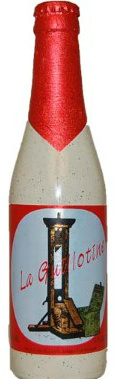 Color: Orange Gold with lots and lots of yeast.
 The wine is a Bianco di Toscana and is 11,5% ABV from Subbiano Italy. Even the bottling date is on the bottle: 16 november 2011. The grapes for this wine are: 50% Trebbiano Toscano, 20% Pinot Nero, 15% Sauvignon Blanc and 15% Vermentino.
  It’s a white wine with a pink hue over it, that comes from the Pinot Nero and carbonates slightly.
 Some time ago I reviewed
 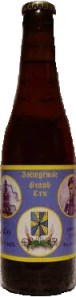 Color: Murky gravy-brown.
 Yes! Another example from the distillery that took its water from the Penwapple Reservoir, yes say it again, the Penwapple Reservoir. This time one of the many sister casks from the last year of operation, bottled by Signatory.
 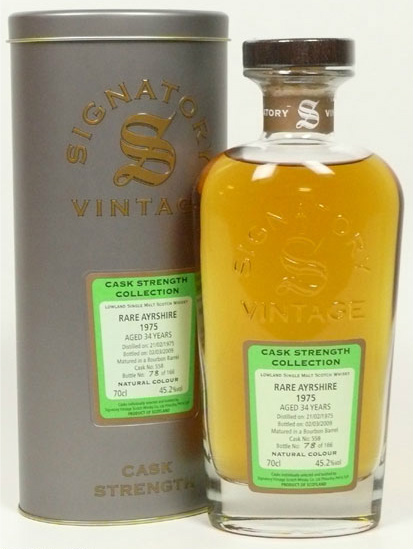 Color: Gold (slightly lighter than barrel #562)
 Ladyburn wasn’t long around. Opened in 1966 and already closed in 1975. It was built by W. Grant & Sons within their Girvan grain distillery complex. Not completely uncommon in those days, since there were more malt distilleries on a grain distillery site. Glen Flagler was added to the Moffat site and Ben Wyvis was added to Invergordon. All three didn’t last long and are pretty scarce these days. These Rare Ayrshire’s are still around, but there will be a time soon, they will not, and prices will soar. So is this worth your money? Lets see…
 Well officially there is no Ladyburn on the label, still it isn’t hard to guess what this must be. Out of the blue Signatory started to bottle a lot of casks from Ladyburn. Which is always nice since the place shut down in 1975 and whiskies from Ladyburn are getting more and more rare.
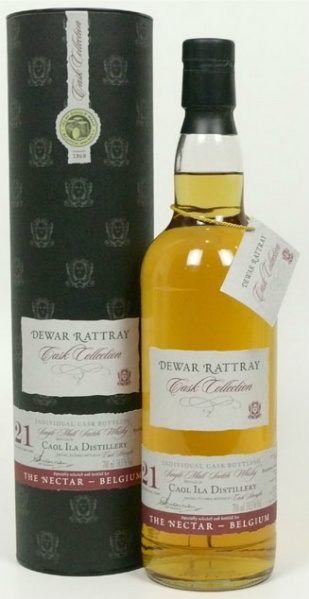 This whisky was distilled on December 12th 1984 and bottled 21 years later on September 6th, 2006, and was bottled for Belgian outfit, The Nectar.
 Well, after all those old, sometimes priceless, but always hard to get, independent bottles I reviewed recently, it’s now time for something more easy to get. A standard bottle, even sold, in some countries, in your local supermarket, at reasonable prices to boot. Add to that, it’s usually decent quality, so this is a bang-for-your-buck type of malt.
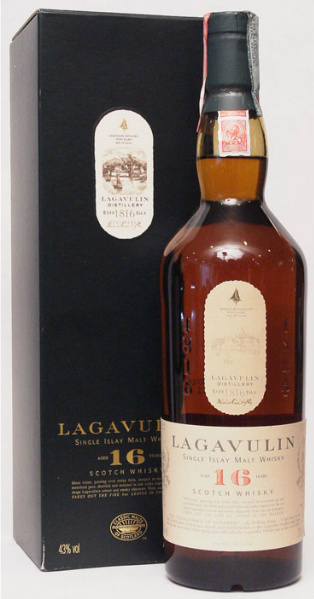 Many stories surround these Lagavulins. First of all that, when the royal warrant disappeared from the label, the quality went down. In fact the quality was dwindling even before that. Last year or maybe in 2010 I heard that the quality level is picking up again. This year I hear again that the recent bottlings are not as good as they were once before. So lot of debate about this one, and considering the interest, we know this is a popular one.
 So Lagavulin 16yo isn’t what it used to be, but how does it do on its own, not compared to the older ones? Well that’s another story, even today it’s a pretty special dram, that still scores pretty high, but I like the
  Master Quill