Glencadam 10yo (46%, OB, 2008)

Glencadam is a rather unknown Single Malt and this 10yo is marketed as ‘The Rather Delicate’. Never before has a Glencadam been featured on these pages. Did that happen for a reason, or have I missed out on something? The 10yo we’ll be reviewing here, was first released in 2008. Yes, this is the first batch of this new 10yo. This 10yo has seen no colouring nor has it been chillfiltered ánd it has been bottled at 46% ABV. So a lot has been done to make this the best it can be.

Glencadam was founded in 1825 and since than it has changed hands many times. Dark clouds formed above the distillery when in 2000 the distillery was mothballed by its owner Allied Domecq, wanting to close it for good. Luckily in 2003 the distillery was sold to Angus Dundee Distillers. On the premises of the distillery there is also a blending and bottling facility, as well as five dunnage warehouses. The majority of ageing casks are ex-Bourbon casks. Obviously also some Sherry casks are there, and the third flavour of choice are Port pipes. Glencadam fills its casks at the unusual high strength of 68% ABV.

Glencadam 10yoColor: White wine

Nose: Floral and fruity sweetness. Full of aroma. Quite a surprise (I’m trying this right after the “neutral” Inchmurrin 15yo). Creamy vanilla, honey and fruity, stewed apples, and warm apple sauce. The nose has a rum like quality, but also a nice fruity acidity to it. Lime maybe. Quite complex and full of aroma, I didn’t expect much, but this sure delivers some goods!

Taste: Sweet and nutty, almonds. Very creamy and actually very nice. Vanilla ice-cream but again with a fresher acidic citrussy touch. Did I already mention this has a lot of apples in the taste too? Well, there is! Again it also has a little rum-like quality to it. Clay and sweet and spicy vanilla from probably first fill Bourbon casks.

I wasn’t expecting this. Full aroma, nice body and an interesting bouquet of flavours thrown together. Well made stuff and a nice addition to the list of standard 10yo’s. The label states “The Rather Delicate” but that was probably written by a copywriter with a cold or someone who looked only at the color of this Whisky. I disagree. It is a nice creamy, fruity (apples and lime) Single Malt full of flavor. Not light nor delicate. If they call this delicate I’m really intrigued to try the rest of the series. Nice!

Points: 85

Irish Whiskey Week – Day 2: The Tyrconnell 10yo (46%, OB, Finished in Port Cask, Circa 2007)

Irish CloverWhy not continue our Irish Whiskey Week with another Tyrconnell, but first I’ll start with my thoughts about finishing Whisk(e)y in casks that previously held(fortified) Wines.

I come from a time where every single cask that was released was good by itself, so when the first finishes emerged we were quite suspicious of them. Was the Original cask too tired to produce a well aged Whisk(e)y? Especially Port finishes were considered to be strange. The color turned slightly pink, and the Wine bit, that leaped out of the glass was pretty harsh. Now that I (and Whisky makers) understand Port better we have learned that the best kind of Port for Whisk(e)y is Tawny (or Colheita or any other form of a Tawny, or oxidized Port, like old Whites). So today finishes have become more popular. I see a lot of people raving about different kind of Sauternes finishes, Marsala finishes, PX finishes and so on. On a more personal note. In the old days I found the odd Rum finish pretty pleasing, but it seems to me Rum isn’t a first choice from the industry anymore.

The Tyrconnell 10yo Port Cask FinishColor: Light copper gold

Nose: Strong and spicy. Malty and winey, but the winey bit isn’t overpowering the whole. It really is only an (balanced) addition. Adding something new to the Tyrconnell profile. Quite some creamy, wooden depth with licorice. Fresh cut oak. Earth and clay. Fresh butter. Good stuff. Spicy and powerful.

Taste: This packs a lot more punch at 46% ABV than the standard Tyrconnell. This version is also a lot more spicy and “older”. Cask toast and licorice, and medium wooden bitterness. All kept in check. The body is well-balanced and creamy, but towards the finish a sweet and slightly sharp and acidic winey note comes to the top, that also throws the Whiskey slightly off-balance. I also get some cardboard and bitterness in the finish. It doesn’t take air so well, so drink up, don’t let it sit too long in your glass.

Since I have just recently tried the “normal” Tyrconnell, does this one resemble the other one? Well no, but that may not only be the Port finish. First of all, a huge difference is made by the 46% ABV. 6% more alcohol is quite a bit. Second, this version is 10yo, and may even hold older Whiskey in the mix. And yes there is some Port going on, but as I mentioned above, this is not overpowering. If you can get past the finish, it does resemble a Tyrconnell though, again a sign they didn’t overdo the Port. Definitely a step, or two, up from the standard version, but still it didn’t quite work for me. Still not a big fan of finishes I guess…

Points: 79

The Macallan ‘Fine Oak’ 10yo (40%, OB, Circa 2010)

To be honest, I’d rather review a Macallan from the times of the old 10yo 100 proof I reviewed earlier, but instead I’m having a 10yo from the Fine Oak series. When the Fine Oak series was released some ten years ago, it was the time the real Macallan was killed off by the owners. Macallan was then a Whisky for aficionado’s and people with taste and the Fine Oak Macallan is marketed more to be hip. Maybe the change happened because there was a shortage of Sherry casks, or maybe it was a pure marketing move. Who knows, and who cares. For those of you who don’t remember, The Macallan used to be the finest Speyside Whisky around, known for heavy use of Sherry. Something Glendronach is known for now. Glendronach didn’t sell well and even closed because of the Sherry success of Macallan. So here we have a entry-level Macallan with an age statement. So let’s have a look what the legend has become.

Macallan Fine Oak 10yoColor: Light gold, with a pink hue.

Nose: Sweet and malty, hints of creamy Sherry in the distance. Cream, vanilla, lemon and sugar with that typical sherried wine-note. Hints of oak, yet very light. If you want to, you can still smell a bit of the original distillate which still is excellent. Ear-wax again, with mocha and a nutty component. Something like almond-cream. After some time, the sugary sweetness gets some help from honey. Also a powdery note enters the mix as does some cardboard.

Taste: Malty and sometimes close to new make spirit. Sweet with lots of toffee and caramel notes. A little back-bone from the oak. I taste a lot of Bourbon cask in this 10yo, and it does get some character from Sherry casks, which in my opinion aren’t all Oloroso, since typical Fino notes are here too. Maybe a plethora of different Sherry casks went into this. The sweetness is definitely a sugary sweetness. This Macallan would make an excellent filling for bonbons. It somehow would complement the taste of chocolate for me. The finish somehow is a bit unbalanced, with wood and cardboard. It splits like a hair, and is rather short to boot. After 10 years it should have been better, it still says Macallan on the label you know…

When reviewing this, should I forget about the old Macallan? Sure, this has nothing to do with The Macallan that used to be, but on the other hand, the name is still on the label and on the back label Macallan is still considered a legend. If I were to get this blind, this could have been anything.

Points: 77

Springbank 10yo (46%, OB, 10/342)

Why not try another Springbank. This one does have an age statement. It’s 10 years old. Just like the “CV” I reviewed earlier, this one was bottled (late) in 2010.

Springbank 10yo (46%, OB)Color: Pale orange gold.

Nose: Clay and spicy. Fruity, creamy and nutty, almonds. Toasted wood. Smallest hint of coal and old dried orange peel. Compared with the CV this definitely has seen some ex-Sherry casks. Nice nose with lots more balance than the CV. Here we also have a papery note. Not only fruity, but also floral, more of everything and a lot extra. Floral part smells a bit like soap, and after that the fruitiness shines through. Lovely.

Taste: Clay, balanced and pretty sweet, with a small woody bite. Nutty again and definitely some peat. Good stuff this is, maybe a bit too heavy on the sugared fruits. Definitely sweeter than I expected. Toffee and cream, and where the nose and the CV have some rough edges, this 10yo if far more polished. Velvety. Good stuff, but I would have liked this even better if the taste matched the nose a bit more. Hints of petrol, we’re moving in the right direction again. Sweet and sweat. Lovely.

Unique stuff and there is nothing like Springbank. Yes this may not be for everybody, so if you are the regular hotel bar drinker or are only into Glenlivet, Glenfiddich, Glenmorangie and Balvenie, this may not be for you. You might not like this, but if you aren’t, this is something special. You must try Springbank. Maybe not the best expression, but for this price and with this heritage you can’t go wrong. Probably one of the best 10yo around (with the Benromach 10yo).

Points: 85

Kopke Moscatel 10 Years Old

Moscatel is the Spanish and Portuguese word for a fortified wine made with the muscat grape variety. Muscat grapes are not a single grape variety, but a whole group of hundreds different grape varieties, ranging from white to almost black grapes. Muscat grapes are one of the oldest grape varieties still left, already used by the ancient Greeks. Therefore it’s not surprising a lot of different wines in large parts of the world are made with this grape variety, ranging from Moscato d’Asti in Italy to Kopke’s Moscatel from the Douro region in Portugal. Muscat wines can be dry, medium, sweet, sparkling or a desert wine (fortified). Wines made with Muscat grapes have a low acidity, and can’t be aged a lot, unless it’s fortified like this Moscatel by Kopke, which is a whopping 10 years old. By the way: Muscadelle, Muscadet and Muscardin do not belong to the Muscat family.

Kopke Moscatel 10 Years OldColor: Copper, or very dark amber.

Nose: Deep old sweetness, syrupy and reminiscent of sultanas. But it’s not only oozing promises of sweetness, but also some acidity seems to be present, which is rather uncommon for a Muscat Wine. Hot earth with a tiny, tiny hint of smoke, which gives the Moscatel a lot of character. Hints of pineapple, dry leaves, licorice and it has a little bit of a floral perfume too. Creamy. The nose is not far from some PX Sherries. Lovely.

Taste: Milk chocolate, vanilla and sultanas again. Peaches and apricot syrup. Some alcohol is showing as with cherry bonbons. The sweet (which seems to dissipate fast) and the acidity mingle well, and after the sweetness retracts, the acidity takes over, without being aggressive like lemon juice would. Where the nose promised a lot of sweetness the taste, luckily, is more balanced, due to perfect acidity, yet not very complex. Then nose is most definitely more complex than the taste is. So it’s not syrupy sweet nor does it have the consistency of a syrup, since the Moscatel is quite thin in texture. In the glass some long legs are showing, but not a lot, nor are they very thick. The finish is not too long, and has a little touch of grape skins. The taste has nothing to do with PX Sherries though 😉

Lovely stuff, easily drinkable and I’m quite curious for other Moscatel wines now. I hope to find one that has some more complexity in the taste. ABV for this Moscatel is 19%.

Points: 85

Kopke 10 Years Old (Matured in Wood)

Kopke logoAfter Warre’s Warrior this is just the second review of Port on Master Quill, which is quite strange since I do love my Ports. Lots of them have passed on my lectern, and only one has been reviewed op ’till now. So it’s about time to do something about that. On my lectern are a few Ports that haven’t been reviewed yet, so keep an eye out for some more Port on these pages…

Kopke 10 Years Old Port (Matured in Wood)Color: Warm, bleak red (rosé), not yet brown.

Nose: Sweet and lively, hints of acidity and freshness. Lots of red fruits, strawberry, raspberry. Cherry candy. It doesn’t smell its age (it smells younger). In the distance a little bit of wood and mint, but also some licorice. Classy nose. Very sweet with an added bonus. The influence of wood, which adds to the character and it doesn’t let the sweetness dominate (the nose).

Taste: Sweet but also enough acidity to counteract the sweetness. In fact the nose smelled a lot sweeter than this Port actually is. Lots of strawberry and raspberry again, this time with added acidity from currants. This tastes great and very likeable and harmonious. If in anything it shows its age than it is in the finish. The half-long finish is a little bit brittle, the lively fruitiness dissipates quickly, it goes from sweet to sour, to… a memory of Port (not saying it is short).

This isn’t a full-blown red Port anymore, it’s a Tawny that for me has some notes of red Port (youth?). On the taste it shows two sides of itself. Very fruity without being full on sweetness, and then a turning point into something more vague. If only the finish would have held up a bit more. But that’s nit-picking. This is a very good Kopke 10yo. It’s much better than I initially expected. Think strawberries. The Port has an ABV of 20% and was matured in small 250 liter casks. Recommended for Christmas!

Points: 87

Thanks to Richard and Esther for the bottle.

Bowmore Week – Day 4: Bowmore 10yo “The Devils Cask” (56.9%, OB, Small Batch Release, First Fill Sherry Casks, 6.000 bottles, 2013)

Bowmore WeekThis year the little brother of the four sisters Tempest was born. Both the Tempest’s and the Devil’s Casks are small batch releases, and hopefully are with us to stay. Each batch of the tempest counts at least 12.000 bottles and of this first Devil’s Casks only a measly 6.000 bottles were made.
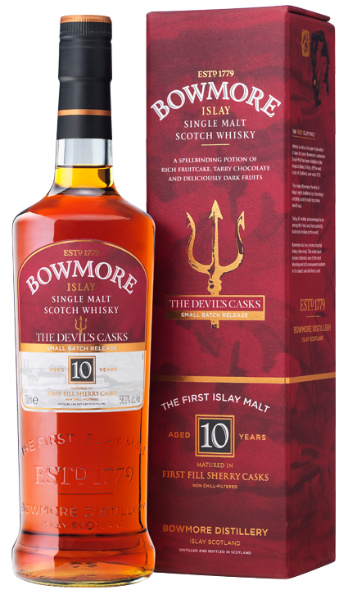
The story behind this release can be read on the Bowmore website: Legend has it that the devil once visited the church in Bowmore. Now if you’ve ever seen it,you’ll know that the church is circular, built that way (so it’s said) so there would be no corner in which the devil could hide. The local congregation spotted the devil and chased him down through the village, into the gates of Bowmore Distillery. Here, the warehousemen were filling casks and loading them aboard the paddle steamer, The Maid of Islay. Gates and doors locked tight shut, every inch of the distillery was searched, but to no avail. As legend goes, the devil escaped in a cask of Bowmore bound for the mainland.

Bowmore The Devil's CasksColor: Copper brown.

Nose: Dusty dull Sherry nose. Lots of tar and some wood. Deep underlying fruits. Cherries and blackberries. Fresh air, steam, coal and tar. This just goes to show how well Bowmore does with the right sherry casks. Again slightly perfumy and floral, without the FWP. FWP is something that suits the profile of Bowmore and is part of it’s identity. The problem Bowmore had in the past is that it had way too much FWP. Today it is brought back to an amount where it add to the spirit. I love the cola, tar and toast that goes with this young Bowmore, since this is something only encountered in old stuff from the 60’s and 70’s (and before). Loving this, because a lot of the nose shows hints of stuff that could be found only in old Whiskies.

Taste: Tarry and woody, with some bitterness. Darkest chocolate, ashes and pretty sweet actually. It somehow has a dry top layer, with wood and ashes, tar and chocolate, but it’s not completely dry, since underneath there lies this bed of sweetness. Well balanced stuff. Again tar, ashes and coal. Great profile. I like that.

Well, this for sure became a cult Whisky overnight. The 6000 bottles sold out in something like three minutes. Lots of people bought cases of this. Rachel Barrie strrrrrrikes again 🙂 Let’s hope there will be a batch 2 and if so, it will be just as good albeit slightly different probably. Would I pay a silly 350 Euro’s for it as can be seen on Ebay, nope, I wouldn’t because for that kind of money there still are some old bottles of Bowmore to be had, that are equally great as this one is…

Bowmore is now definitly something to look out for (again)!

Points: 89

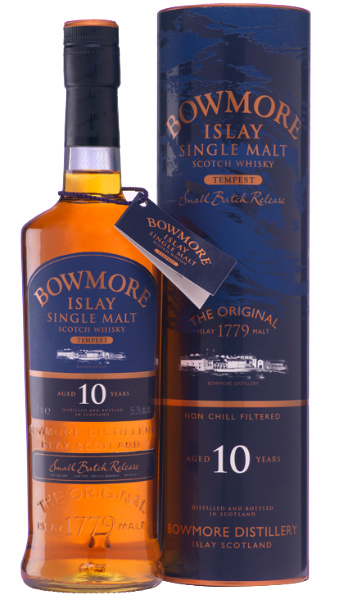
Bowmore Week – Day 3: Bowmore 10yo “Tempest” (55.3%, OB, Small Batch Release No. 1, First Fill Bourbon Casks, 12.000 bottles, 2009)

Bowmore WeekYes it’s time for peat! After the introduction to Bowmore by Bowmore themselves: The 12yo and the 14yo by indie bottlers Cadenhead, it is now time to pump up the volume! Here we have a 10yo by Bowmore themselves again, but this time with an ABV of 55.3%. This Bowmore Tempest was introduced in 2009 in their small batch range, that by now has seen four releases (one annually) of this Tempest made from First Fill Bourbon Cask that were laid down at the Vaults No.1, you know the warehouse were the waves are beating on the walls! Since there now are four releases of the Tempest, this first batch has become something of a cult Whisky, but not as “culty” as another recent small batch release by Bowmore: ‘The Devil’s Casks’, another 10yo, but this time matured in First Fill Sherry Casks (Oloroso Butts).

Bowmore Tempest Batch 1Color: Gold

Nose: Clean, woody profile. Cigarette smoke. Beautiful integrated cask toast. Quality and powerful stuff. As with the first two Bowmores from this Bowmore Week a slightly perfumy profile without the much feared FWP. But wait, there’s a lot more happening here. Custard, vanilla and crème brûlée (as stated on the back label). A small hint of warm tar and even later ashes. All this take over the initial sharpness of the dry oak and cigarette smoke.

Taste: Very sweet, ice-cream vanilla and again a wee bit of pepper and a great creamy, vanilla, crème brûlée finish. Small hints of (toasted) wood. This has a full and round body. Very nice Tempest indeed. It does fit the profile I “get” from the Cadenheads Small Batch 14yo, I reviewed yesterday though, so I think I understand where the Bourbon Bowmores are going these days. Nice stuff, likeable, easy and not too complex. Fruits, candied fruits. Apricots with vanilla yoghurt. Sour wood and a peppery finish.

This first batch became somewhat of a cult whisky. It’s really good. and therefore the 12.000 bottles are pretty much sold out. To this day four batches of this exist.

This looks like an annual thing. Since this is released in batches I really don’t understand the need for coloring, especially when all batches differ a bit in color, but still I believe all are colored. Bowmore is picking itself up. It surpassed the FWP-problem. Got the wonderful Rachel Barrie, who I believe is doing a great job at Bowmore (and some other distilleries).

Points: 87

Ardbeg 10yo 1993/2004 (57.3%, Cadenhead, Refill Bourbon Hogshead, 252 bottles)

Wow, unbelievable, this is just my second Ardbeg review on these pages! I have this distillery up there with the greats, so what happened? This is an Ardbeg from 1993 bottled by independent bottlers Cadenhead’s. This is most definitely not the first Cadenhead’s on these pages, no it’s actually already the tenth, so for more information about Cadenhead’s, please have a look at all the other reviews of Cadenhead’s bottlings.

Color: White wine.

Nose: Sweet and mellow peat. Smells older than it actually is. Very nice, refined and balanced. Vegetal. Lemon sherbet. Fatty and smoky. Definitely citrus fruits this one, and some tropical fruits too. Not an in-your-face Islay monster, but with a lot of Islay character. Freshly cut peat. After a wee bit of breathing, some butter emerges, and it picks up a bit in oomph. More oily and smoky, ans even the citrus (lemon) is more dominant. The peat on the other hand recedes even more. Breathing adds something fishy and some vanilla to the mix. Somewhat more sea influence.

Taste: Sweet, sweet and light young peat. The smoke comes later. Nice effect. Hardly any wood. Whereas the nose showed me some light (old) peat, on the palate this Whisky does show its youth. Just as in the nose, very restrained lively and fruity Ardbeg, again not a kick in the head. With some air and time, it even gets a wee bit floral and ashy and slightly more pungent.

The offset and the body are nice and full, or round, if you prefer. The tastes fit together and show a more elegant side of Ardbeg. Towards the finish it does start to break down a bit. I said a bit. For an Ardbeg the finish is rather short and again light at first, but breathing lengthens the finish (and adds a little woody bitterness, finally). Typical Islay, not typical Ardbeg is you ask me. Probably not a very active cask, since there isn’t any wood detectable, nor has it picked up a lot op color.  It reminds me of an Ardbeg Bond Reserve I still have, so I’ll review that shortly (also from Cadenhead’s).

Summa summarum, nice Ardbeg that needs to breathe!

Points: 86

Dunedin “Double Wood” 10yo (40%, OB, 6y American Oak, 4y French Oak, ex-New Zealand Red Wine barrels, Blended Whisky)

Here at Master Quill, when writing about whisky, we foremost are keeping up busy with the Scottish version of the tipple. However in the early 19th century lots of Scots moved across the world and settled in New Zealand. Finding a lot of Scottish (Whisky) heritage in New Zealand is not all that unusual. Even today a lot of small or micro-distilleries do pop up in the country. (like Southern, Hokonui and Thomson, to name but a few).

This time we’ll concentrate on the biggest and best known of the New Zealand Whisky producers, al be it under a lot of different names, and also under quite some different management.

In December 1969 the Baker family started distillation in Dunedin (on the south Island, to the south of Oamaru). They named their distillery “Willowbank”. The Whisky was released under their Wilson’s brand name since 1974. By 1974 The distillery was named after it’s Whisky “Wilson Distillery”. In 1981 the giant Seagram’s bought the distillery. Seagrams made a “minor” contribution by replacing the copper necked stainless steel stills for more traditional whole copper stills. Seagram’s released their Whisky as Lammerlaw. Lammerlaw being a nearby mountain range, but also the source of water for Whisky production. The distillery was mothballed in 1995 and Seagram’s sold the distillery to Foster’s in 1997, who had it untill 2002. The two copper stills and the four column grain still were eventually sold to Fiji to distill rum, but the gin still remained in New Zealand. It is now located in pieces at the McCashin’s Brewery in Nelson, and may be used again in the future.

First Warren Preston bought the Distillery and some 600 ageing casks of amongst others Lammerlaw Malt Whisky and starting a firm called The New Zealand Malt Whisky Company (NZMWC). The Casks were laid down in Oamaru. Some 150 of those casks were bottled (under the Milfort brand name, but also Blended Whisky under the Preston’s brand name). Alas NZMWC went bankrupt and in 2010 the Forward looking entrepreneur Greg Ramsay (leading a consortium of investors) took over and renamed the firm The New Zealand Whisky Company (NZWC). Mr. Ramsay bought the last 450 casks of Whisky of which half were Lammerlaw Malt Whisky (18 to 24yo) and the other half Wilson’s Whisky (at least 12yo). By 2012 some 90 casks were bottled for the current range, so by now only 360 casks are left. In the grand scheme of things and the good promotion for the Whisky being carried out, I guess that the whole stock will be sold by the end of 2016. So be quick, because, this New Zealand whisky is rapidly becoming extinct!

Plans are to build a new distillery (or two). Obvious choices for new sites are Oamaru, but also Dunedin. Less obvious choices would be Auckland and Nelson, both Auckland and Nelson showed more interest than Oamaru and Dunedin in being the home of a new New Zealand Whisky distillery.

Color: Red copper.

Nose: Fresh and woody at first, and a little bit winey, well that’s a surprise! Spicy and a little bit of sweet, toffee-like wood. It does have a sweet side to it, but overall pretty dark, with already hints of grain whisky. Maybe some cask toast and influences (tannins) from the wine. Spicy Syrah? Next, the grain whisky starts to play its part. This is spicy and definitely smells like a volcanic red wine, so I got even some terroir in this (Syrah again). That’s not completely strange since the Red Wine finish was done for a whopping 4 years, whereas others finish their whiskies for mere months. (I understand that there also is, or was, a 15yo Double Wood that was finished for 10 whole years in Wine casks!) This one is dark and brooding after the initial freshness right out of the bottle. Very appetizing.

Taste: Less woody than one might think, half-sweet cookie dough and nicely fruity. Slightly acidic at first, but quickly taken over by the sweet red fruits. Not even a lot of Wine to this, so the 4 years in Wine barrels didn’t do the Whisky any harm. Maybe the grain balances the Whisky out? That said, it doesn’t mean the wine didn’t impair a lot of taste onto the Whisky, because it did (sweet fruits, red fruits, plums, Merlot?), especially after some breathing. The Whisky just doesn’t taste like Wine, although some markers are definitely there. Seems to me that the 70/30 ratio of malt and grain is pretty much spot on. Nice and half-long, warming and sweetish finish, with some hints of oak. Very well made, likeable and drinkable blend.

Yes, this is a blended Whisky, the NZWC itself calls it a Master Blended Whisky. With 70% Single Malt this really is a sort of super premium luxury blend. Stuff that the Scots these days put into expensive crystal decanters. Nice aroma’s and pretty different and bold. For the Whisky it is, this is bottled at the right ABV. Recommended!

Points: 84 Points

Thanks go out to Cyril and Greg for the Whiskies and the additional info!