Glenmorangie 10yo “Traditional 100 Proof” (57.2%, OB, 1 Litre, 2005)

Next up an oldie from 2005. A cask strength Glenmorangie. We don’t see many of them these days, especially one that isn’t touched by any special cask. The back label mentions that this unchillfiltered Whisky came straight from the cask made from mountain oak. So what kind of wood is this? My guess is American Oak from the Ozark Mountains, Arkansas USA. Hinting that this is a 10yo Glenmorangie fully matured in Bourbon casks and bottled at cask strength. Nothing more and nothing less. My most avid readers will know that I am not a very big fan of Glenmorangie but got quite a surprise when I reviewed a recent 18yo

Glenmorangie Traditional 100 ProofColor: Light gold.

Nose: Aromatic and spicy yet closed, or maybe there isn’t a lot going on? Vanilla and typical bourbon cask notes. Slightly soapy and fresh and obviously high in alcohol. Vegetal and woody. It almost smells like it looks. It does smell a bit of sackcloth and oak. Dusty and powdery. Not very complex.

Taste: Sweet. Vanilla and pudding. Sweet alcohol. Mocha and vanilla pudding. Hints of Cappuccino and vanilla ice-cream. A woody bite, almost cigarette like, but also a short-lived fruity sweetness. Sugared raspberries and half-ripe forest strawberries. Thick toffee to hold it all together. Nice coffee-ish finish. Well balanced. This reminds me a bit of a young Bladnoch. That one has more butter, is softer and is a bit more vegetal, but that may very well be the only difference.

At first, a simple Whisky, but it grows on you. Give it time to breathe and it develops nicely. Nevertheless, this is actually an example of why I didn’t like Glenmorangie back in the day. (Let’s say, 10 years ago). It looks great, promises a lot, but this particular Whisky is simple and un-rewarding on the nose. It may very well be the reason I stopped buying Glenmorangie for a whole decade. The taste is a lot better though. I only picked up the fruity bits, when tasting this in the morning before breakfast. Last night after a very tiresome day, I didn’t pick up on the raspberry and strawberry at all.

The recent and “extremely rare” 18yo I tasted a while back, somewhat restored my faith in Glenmorangie and made me buy that very 18yo. Today, and tomorrow can be different, you can get three of those 18yo’s for the price of this cask strength Glenmorangie. A no brainer if you ask me.

Points: 83

Glentauchers 8yo 2005/2013 (46%, Dewar Rattray, For the Specialist’s Choice The Netherlands, Sherry Puncheon #900389, 403 bottles)

We are now in the middle of the rise of NAS Whiskies and very soon most Whiskies in our regular shops will have a names instead of a number or a vintage even. Whiskies that do have an age statement will be confined to airports and other travel retail outlets. But that’s only one of a few possible futures. What will happen to the Independent bottlers? Will they have a way to survive. Today many of them are capable of releasing pretty good Whiskies, although mediocrity is creeping into their products as well. How long will casks of Whisky be available to them? Are we going to see only affordable yet young Whisky from them as we already see with NAS Whiskies from the distilleries themselves. After the Ledaig I reviewed last, here we have another young Whisky coming from a Sherry cask. Glentauchers this time. Earlier I reviewed an older Glentauchers. also from a Sherry cask that was pretty good to say the least…

Glentauchers 8yo 2005/2013 (46%, Dewar Rattray, For the Specialist's Choice The Netherlands, Sherry Puncheon #900389, 403 bottles)Color: Full gold.

Nose: Sherried, creamy and fresh. Herbal and woody. Nice creamy oak, yes creamy oak. Fruity candy. Very likeable. Powdered. Quite a lot of vanilla. It really smells like a Sherry cask made with American oak.

Taste: Creamy and funky Sherry. Real acidic fruitiness right from the start. The creaminess and fruitiness don’t necessarily mix together well, especially when a paper-like note appears. In time that strange mixture passes and reveals more sweetness with the vanilla coming back here too. Paper and cardboard make up the finish, but not by itself. Notes from wood, mocha, Cappuchino, cigar box and creamy vanilla are also here to stay but mainly the fruity acidity returns with a vengeance. Whisky candy. Do you know those fruity gello’s in dark chocolate. That kind of fruity acidity contrasted by sweet dark chocolate. Accept this and you’ll be ok. Interesting stuff.

Although this has some flaws, it is also highly drinkable. This may not fetch the highest score, but it most certainly is nice to drink. Don’t analyze this to death, just grab it for the fun of it. Make it your daily drinker. I often rant a bit about reducing Whiskies, because sometimes the reduction makes the Whisky thin and watery. This time however I will hold my tongue, since I don’t feel reduction hurt the final product. It is good like this. I’ll stop now and pour myself another dram.

Points: 84

Longrow 14yo 1990/2005 (56.9%, SMWS, 114.5, “Smoked Sausages and Curry”)

So how was your Christmas? Here at Master Quill we are getting ready for the end of the year. Christmas is hardly over and in a few days’ time we’re seeing off 2014 and welcoming 2015. But we’re not there yet. Lets have a look first at a very nice Longrow. Two firsts on these pages. After two and a half years of writing still hardly any ground covered! Here is the first Longrow, or “Distillery #114” and the first review of a bottling that was released by The Scotch Malt Whisky Society (SMWS).

Longrow 14yo 1990/2005 '114.5'(56.9%, SMWS, Smoked Sausages and Curry)Color: Full gold.

Nose: Nice fatty, sweet and truly perfect dirty peat, with malt shining through (if you let it breathe for a while). Oranges and animalesk. A breath of fresh air. Sherry, toffee and lots of clay. Does it smell meaty or is the title forcing me to smell it? Smoked sausages? I don’t know. I smell a lot of clay. Just died down bonfire, right before it gets cold. The sweet spiciness might as well be curry, hot (temperature) and mild (in spices, ginger foremost). Very high quality. Coastal with smoke, Sherry and clay. No wood. Wonderful!

Taste: Sweet and smoky, yes bonfire again, a hearth in a stately old house with mohogany furniture (without the wax, that is). Peppery, earthy peat and licorice, bordering on bitter licorice. Fruity, red and black fruits, with fruity sweetness under the hints of ashes and mint. Also sometimes a fruity acidity wanders through the spirit. Chewy smoked toffee and nutty. Highly aromatic, almost thick. Nice thick Sherry and caramel. Sometimes soapy. Nicely peated in the finish. Excellent and warming stuff this! A cracker. The finish is big and ashy, with tiny hints of red fruit sweets. The hard ones.

This bottle was used in the Campbeltown tasting I did with my Whisky club ‘Het Genietschap‘, together with the Kintra Glen Scotia I reviewed earlier. I really liked that one, but this one is much, much better! What a wonderful malt to share with friends. This really is a stunner. Excellent Longrow. For this review I’ve tasted this Malt two times. Once in the morning, before breakfast, and one time late in the evening. The difference is unmistakable. It is remarkable how much more tiny notes, or details, if you prefer, one can pick up in the morning. The score is from the morning session.

Points: 91

Tamdhu 8yo 2005/2013 (59.6%, The Ultimate, Sherry Butt #347, 724 bottles)

The people who choose the casks really aren’t crazy. They obviously taste a lot, as they have released already some 500+ different bottlings, and many more probably have been rejected. Looking at the history of The Ultimate, most bottlings up untill 2005 were bottled at 43% ABV, and after that at 46% ABV. Sometimes however, a cask strength Whisky is released. Sometimes as a ‘Rare Reserve’ release, sometimes because a Whisky just doesn’t respond well to water and sometimes, being the Whisky lovers they are, they leave a Whisky be. It’s already good and it would be a shame to reduce it, let’s just bottle it.

In the recent past this was true for a lot of Islay Whiskies, like Bowmore, Laphroaig and some others, but more recently, a couple of bottlings of “other” Whiskies have surfaced at cask strength, which for me fall in the category of being a stunner in their own right, let’s not fiddle with it. One of those are the sherried Longmorn’s (17yo) of which, up untill now, six casks have been released, two of those I already reviewed: cask #72315 (the first) and cask #72319 (the third). It turns out there is another series that flew under my radar for a while: very young sherried Tamdhu’s. There are six of those as well. Five from 2004 (6yo, 7yo and 8yo) and one from 2005 (another 8yo), that was released last. Let’s review the latter one: the 2005, 8yo, from cask #347.

Tamdhu 8yo 20052013 (59.6%, The Ultimate, Sherry Butt #347, 724 bottles)Color: Pale gold.

Nose: Very full, buttery and spicy. lots of wood aroma’s, sawdust, pencil shavings with a little bit of cask toast, and quite alcoholic. What a stunning nose for such a young Whisky. Wild vanilla in peppered pudding. Musty and some deep licorice from the Sherry and toasted wood. Maybe not the most complex nose, but hey, it isn’t even ten years old, but it is very appealing. I can’t stop smelling this. The sweetish, toffee and butter notes leave the glass and the wood remains. The spicy and peppery wood is omnipresent in this bottling, so if this would have been bottled some years later, it probably “wood” have been too much. Now the wood gives a lot of character to the nose, without dominating. Good call.

Taste: Nice full body full on wood and caramel, toffee. Pepper and spice. Butter and salt. It’s in utter balance since the nose and the taste are a complete match. The taste itself is a bit unbalanced (huh?) because the wood gives off some sour oak which makes the body a bit less sweet than expected and this type of Whisky does need some sugars in the mix. Because of the same reasons, the finish isn’t as long as expected, nor does it leave a specific taste in your mouth (but it does leave a little bit of woody bitterness and butter). It should have been more cloying. All the wood that can be smelled and tasted predicted a lot of dryness even though some sweetness is present. Maybe this should have been bottled even sooner? Who would imagine that! Quite hot at nearly 60% ABV.

So it’s lacking some sugars, there is a lot of wood, so isn’t it any good? On the contrary. What remains is a very good young Tamdhu, that isn’t super complex, but does have a lot of character and I most definitely like this very much. I’m lucky to have stumbled on this, and could still buy it. Recommended!

Merry Christmas everybody!

Points: 87

Undisclosed Distillery 7yo 2005/2012 (51.6%, Kintra, 3rd Confidential Cask, Sherry Butt #900161, 143 bottles)

Still sad Master Quill’s Bowmore Week is over? Don’t worry there will be more weeks and there will be more Bowmores. Not worth crying over spilled Whisky, so no better way than getting right up that horse and moving on. From my stash I picked this “Confidential Cask” bottled by Erik Molenaar a.k.a. Kintra. This is already his third Confidential Cask, a Single Malt Whisky by an undisclosed distillery a.k.a. a “Bastard Malt”. Erik is bound by agreement not to disclose the distillery nor talk about it, so I haven’t bothered asking him. There are rumours though this could be a Glenmorangie since in this series the map on the label points out where the distillery lies or where it’s water source is, and looking at this map, Glenmorangie seems to be the distillery (or Balblair for that matter), still Glenmorangie is geographically more correct. So forget about Bowmore for the time being and let’s have a look at this mystery malt.

Undisclosed Distillery 7yo 2005/2012 (51.6%, Kintra, 3rd Confidential Cask, Sherry Butt #900161, 143 bottles)Color: Gold, with a slight pinkish hue.

Nose: Malty, with toffee. Cookie dough, yoghurt and vanilla ice-cream. Slightly woody and a hint of “sourness”. Flinty, like fireworks, again, only a hint. Very much, young yet creamy. Old rainwater and dust, and the Sherry gave off some pleasant funkiness to the Whisky.

Taste: A bit hot, woody sourness, hints of red fruit and raisins and quite some wood after only seven years. Especially when it had some time to breathe the wood plays a great role, without being dominant. On the palate this Whisky seems a little bit disjointed and the finish is all about wood and a strange kind of sourness (like stale beer). Throughout the whole experience a little bit of bitterness from the wood is present. On another level there is some sweet creaminess to it and on yet another level, there is the fruit from the Sherry.

As said before, this is rumoured to be Glenmorangie (or even Balblair). Especially if its Glenmorangie, I can understand why Erik chose to bottle it, because indie Glenmorangies are very rare. Even if you don’t have to possibility to print the distillery on the label, people who want to know will somehow find out, or think so, will take an interest. We don’t know what this is. All we know is that this is a young whisky, that doesn’t seem to be finished yet. On the palate the flavors haven’t “married” yet. Definitely not my favorite Kintra bottling.

Points: 77

Tobermory 32yo 1972/2005 (50.1%, OB, Green Label, Oloroso Sherry Finish, 912 bottles)

This is the first Tobermory on these pages and the Whisky itself comes from the Island of Mull. This distillery was founded already in 1798 and was originally called Tobermory. Tobermory closed in 1930 and was turned into a power station. It stayed closed as a distillery, untill it reopened in 1972, but this time as Ledaig. Ledaig’s history, from its reopening was a rocky one, with a lot of buying and selling of the distillery with production stops to match. The current owner is Burn Stewart (which itself is/was owned by an insurance company (since 2002), that again was rescued by the government of Trinidad & Tobago in 2010. You don’t want to know…)

Back to Tobermory (or Ledaig). Ledaig was sold to Burn Stewart in 1993, and they decided to give back its original name: Tobermory. In 2005 Tobermory issued three 32yo from 1972. These were Oloroso Sherry finished Whiskies. One with a black label, one with a red label and this green label reviewed here. Purists mention an additional brown labeled version for sale at the distillery. Also 32yo and 1972, but “put on bottle” in 2010, so it must have been kept in stainless steel tanks of on glass from 2005 to 2010 to stop further ageing. Not a lot is known about this bottle…

Color: Brown

Nose: Tarry with lots of red and black fruits. Peat, asphalt and lemonade. Honey. Very appetizing. Coal smoke and steam. This is a true vintage steam locomotive. A little bit of plum with a lot of burned sugar. Toasted wood, burned wood (when turned cold again) and burned paper. Cookie dough. Later it gets dryer and more dusty. Incense. There are a lot of associations with burned stuff, but still, all that doesn’t overpower the whisky. The fruityness makes for great balance. This is truly one of these malts that oozes the days of yesteryear and really they don’t make them like this anymore…

Taste: Strong and again steam locomotive. The taste matches the nose perfectly. Thick sherry with some licorice. It’s fruity, red fruit and the fruit part is fresh and lively. Over this fruit steam and coal again. Hard (red) candied fruit. Quite nice is that the finish is only a little bit bitter. Warming. Wood and tar. The only beef I have with this Green label as opposed to the other two is that the taste is not that balanced and coherent. It doesn’t gel completely and with time it sometimes seems thinner than the other two.

Of the three, this is the least interesting one. In my humble opinion, the Red label Tobermory 32yo is the best, but the black follows in its footsteps quite well. Between the two it’s a matter of taste. Still, if the other ones aren’t available, do get this one in stead, because you’re up for a nice journey, and this one is pretty good by itself! All three of these whiskies may not be perfect, but they are classics in their own right and they do deserve a place in the Whisky hall of Fame!

Points: 88

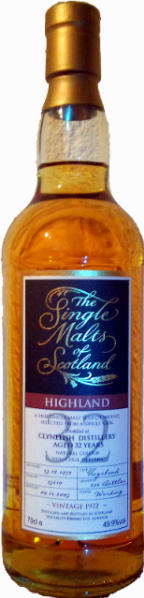
Clynelish 32yo 1972/2005 (49.9%, The Single Malts of Scotland, Hogshead #15619, 226 bottles)

Looking back, I see that two of the last four posts are old Clynelishes. One from 1974 and one from 1973. What could beat that? Well maybe another old Clynelish? Why? Because we can! And this time we’ll do a 1972! Exactly 1972, the year in which the adjacent (old) Clynelish distillery (a.k.a. Brora) reached the stellar quality we all (should) know by now. If you don’t know Brora 1972 by now, prepare to dish out some serious cash to do so, but then again, you might be a Sheik? Clynelish 32yo 1972/2005 (49.9%, The Single Malts of Scotland, Hogshead #15619, 226 bottles)But that’s Brora, here we have a 1972 Clynelish, so it’s distillate from the then newly built distillery next to Brora…
Color: Light Gold

Nose: Old once (painted) wood. The whole nose has a nice oldness to it. A smell you don’t encounter in more modern malts. Lots of woody caramels. The whole nose has some similarities to the 1973 I reviewed some days ago. This one is more leafy though, and less waxy. It’s not only sweets and woods. Pencil shavings and fresh air. Quite clean. Apple skins, nuts and some flowers. Freesia maybe?

Taste: Wood and a thin kind of waxiness. half sweet and a spicy bite of wood (do I detect a hint of smoke?). The wood doesn’t dominate. Also some hints from the animal kingdom. Something along the lines of a sweating horse. Again the added leafiness. Dry leaves and cold and wet black tea leaves. The body is medium to full, but with a lot of character. Orange skins. The finish is longer than I thought, but also thinner due to the lack of the big sweetness and waxiness a lot of Clynelishes have. Having said that I do like this one. It oozes Whisky from times long gone…

Brora’s from 1972 are special amongst others by the use of peat. This Clynelish lacks that peat. The cask itself didn’t do a lot for the whisky, apart from giving some woody traits to the Whisky. Wood, vanillin, that sort of things. This does allow us to have a glimpse at the distillate of Clynelish.

Points: 90

Bruichladdich 14yo 1991/2005 “Yellow Submarine” (46%, OB, WMD II)

WMD stands for Whisky of Mass Distinction. A name one would find on a Frankie Goes To Hollywood 12″ in the eighties. Two years earlier the first WMD was released (a 19yo from 1984) and had a rocket on the label. This second “weapon” is a Yellow Submarine. Most of us would have thought of the Beatles, but this time it about another submarine. One owned by the Royal Navy of Great Britain.

Islay Fisherman Baker was at sea to check his lobster baskets, when he saw a yellow object floating just under the surface of the water. Which first seemed a buoy seemed to be a 2 metres long radio-controlled mine detector from the Royal Navy. When Fisherman Baker called the coastguard informing them that he spotted a submarine with markings from the Royal Navy, they told him to he was drunk, not very uncommon on such an Island. Still fisherman Baker wouldn’t budge and the coast guard called the Royal Navy, but they denied it’s existence!

Just days later the Royal Navy admitted they had lost HMS Penzance (The Yellow Submarine) in a drill. But just after 6 months they decided to pick the thing up> They sailed out at night, to arrive very early in the morning, not to draw a lot of attention to the operation. But the people of Islay are no fools, so half the Island was present at the beach. 12.000 bottles of Yellow Submarine were made and the Royal Navy got six to commemorate the incident. Later the French manufacturer of the Sub ordered another 1000 bottles of this edition for marketing purposes…

Color: Light Gold.

Nose: Woody and smoky. Quite estery and fruity as well. Clay and wet earth. Chewy (in the nose?). In a way candied and wine-treated (it is ACE’d in Rioja Casks, well that’s very Obvious in the nose). The wine finish takes the nose hostage, never to let go, whatever ransom you’re prepared to pay. Is that a bad thing, no not really it is likeable in the nose. I just hope is does the palate some justice. Creamy milk pudding. Powdery perfumed wood. Fresh.

Taste: a bit harsh and winey from the start, but it seems balanced. Wood and milk chocolate pudding. Creamy. Also a little bit from the wood and a wave of sugary sweetness. The palate is very nice, but also very simple. Probably a good idea to reduce this to 46% ABV, because now we have a very drinkable whisky. Nothing overly special though, with also an unspectacular finish, but it definitely is all right!

Well this most definitely is a Rioja finish. The Rioja is all over the place. It draws all attention to itself. Although wine finishes almost every time ring my alarm bells, this is not bad. Alas the maker doesn’t state what kind of Rioja it was red, white or rosé, although rosé would be pretty uncommon, most probable would be red. Most used grape variety in Rioja is the Temperanillo grape, remember the Temperanillo casks used by Tomatin?

Points: 85

Glenfarclas 1994/2005 (46%, OB, for Switzerland, Cask #3979, 402 bottles)

First of all, the picture below is a picture of a similar bottle that was bottled at Cask Strength for Switzerland a year later. The picture is for cask #4726. Glenfarclas is great, it’s family run and most of the make is going into Single Malts, so no room for error, everything must be good. Second, it’s at its best as a Sherried Whisky and even in these times the Grants are able to make a very good Sherried Whisky. The self-proclaimed kings of the Sherried Whisky, namely The Macallan, gave up on this practice. For reasons only the marketing department will know. Good luck to them, Glenfarclas may very well be Speyside’s finest!

Color: Lively orange brown (like a Bourbon)

Nose: Nice creamy Sherry with quite some wood, of which more than half smells like new oak. Cappuccino or Tiramisu. Meaty like gravy. The longer you nose it the dryer it gets. Spicy, lavas and white pepper. Cardboard and ice cream. The wood is pretty raw as opposed to elegant. It’s new untreated wood (maybe some toast). Still I wouldn’t call this overly oaked. A sort of rural Sherried Whisky.

Taste: Initially it’s syrupy sweet that coats your mouth. When that coating is removed from your mouth by the alcohol, just as in the nose, a lot of wood emerges. Dried leaves. Apart from the wood, there is diluted licorice, with added bitterness. For the bold body this has , you could even say that the finish is rather mild. Also the wood makes the finish a bit sour and not of perfect balance. Nice coffee in here too. It does dry your mouth quite a bit, o there definitively is some wood influence. No sulphur.

Actually this is quite good. It’s not complex, but it does have character. It’s a nice young Sherried Whisky. It’s a bit on the edge considering the wood that’s in it, but I still do like it. It’s not over the top.

The best way is to drink it quickly after you pour it, since the mouth coating sweetness hides the wood a bit and makes it less dry and bitter, it gets when you take your time with it. When you are a quick sipper, than the score is even higher than mentioned below 🙂

Points: 86

Chateau Saint-Paul 2005 Haut-Médoc

I used to drink a lot of reds and for the last six years or so I love to drink a lot of whites. Alsace was probably what set that off. But as you might have guessed, being the frequent reader you are, I drink foremost Scottish Single Malts nowadays. But it’s not all Scotch that lights our world, so I’ll definitely have to try some different things here too. This time the first red wine on Master Quill.

Haut-Médoc is the large southern part of the Médoc district of Bordeaux in the south-west of France. The famous wines from this region are Margaux, Pauillac, Saint-Estephe and Saint-Julien. You might have heard of those.

The wine of choice for today is Chateau Saint-Paul of the 2005 vintage. Saint-Paul is a Cru Bourgeois from the Haut-Médoc (St. Seurin de Cadourne). 2005 was a good year for Haut-Médoc, as it was for the whole of the Bordeaux region. The soil is mostly gravel, chalk and clay. The wine is made of 50% Cabernet Sauvignon, 48% Merlot and 5% Cabernet Franc. ABV is 13%.

Color: Ruby red.

Nose: Meaty and sour. Red and dark fruits, berries, black currants and blackberries. Plums maybe? Dust and moist dirt. Floral. In fact it tasted quite thick and sweet (raisins), which it probably is not, still it reminds me a bit of sniffing a ruby port.

Taste: It has depth and is a little sour and powdery. Definitely some wood in here too. Wet leaves, but not earthy. Elderberries, but not bitter. Good tannins which do not take over the wine, still you’ll know from your tongue. It isn’t overly complex, but is has good balance and is a very nice wine to drink. Medium body and medium to long finish.

This one is at it’s best decanted for an hour or so, maybe two. When I tasted this from the just opened bottle, it was quite closed, but a few hours later it showed a lot more. So age this maybe a little longer, decant it properly, then this will be at it’s best.

Points: 85