Plantation Guyana 1999 (45%, Old Reserve, 2009, Guyana)

Walk into a spirits shop which sell quite a few Rum’s, you have a big chance to find at least a shelf worth of Plantation Rums. I don’t know if this is true in all the corners of the world, but here in Europe it is. There are several reasons for this. They look quite interesting, quite a lot of Rum producing countries are available, and the price is quite nice. Especially if you are a novice it ticks all the boxes you care about. Having tried some of those, I can also say that they seem to be not bad.

Who is Plantation? Plantation is the Rum brand of Cognac Ferrand. Cognac Ferrand being the mother company that has quite a few brands in its portfolio. If you punch in Cognac Ferrand in your browser, you are quickly transferred to Maison Ferrand and there you can see that Ferrand is definitely more than Cognac alone. Back to Plantation Rum then. Plantation buys casks of Rum and ages them where they have found them. At the end of maturation, the casks are transferred to France, where they receive a second maturation for up to 18 months in small oak casks. Although it is not said that the cask previously held Cognac, we do assume that’s the case most of the time.

Here, we’ll be looking at one of the vintage releases from the Plantation Old Reserve. This particular example comes from Guyana, but according to the website there are six more Old Reserves available: Barbados, Grenada, Jamaica, Nicaragua, Panama and Trinidad. I don’t know if they discontinued some versions, but I do have a St. Lucia version as well. All are vintage releases, so there are multiple vintages available. I have tried several of the vintages of the Jamaican version and found that not only is there some batch variation between the vintages, but also that there can be more than one batch of only one vintage. Jamaica 2000 comes to mind…
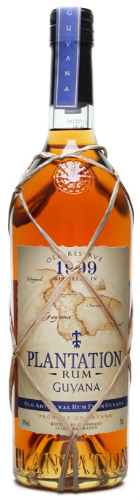
Plantation Guyana 1999Color: Full Gold

Nose: Big, fatty and yet not entirely Demerara (yet). Initially, and momentarily, it has this high ester quality and funkiness like a Jamaican Rum, but in a slightly different way. With some more breathing this becomes more like a Demerara and the funkiness disappears completely, or is this my nose getting used to it? Quite fruity and has a very mild acidity to it. Is this the Cognac? Yes, maybe. The slightly off-acidity reminds me a bit of standing in the produce section of an outdoor market in the cold. Hmmm, never saw that before in a tasting note, Crazy Quill. Since these bottlings have seen wood that previously held Cognac, I’m guessing, that must be its origin. Slightly dusty with some paper-like qualities and yes some wood obviously. Hot oak. Old oak planks, yet freshly sawn. Soft. Hints of orange juice (the acidity mentioned above) and maybe banana (it does have a deeper layer, close to concentrated banana aroma). Dry soft wood and old toned down sawdust. yes, its dusty. Black, slightly sweet, tea and hints of licorice. The fruity notes start to integrate better after prolonged breathing and move back a bit, giving way to a more thicker, nutty, funky and waxy toffee character. Ok, letting this breathe seems to be the crux.

Taste: Wood, nutty, fruity and extremely syrupy (syrupy, not necessarily only sweet) at first. Yellow fruits on light syrup, so not thick or cloying. Sugar and burnt sugar (nice) and more nutty notes. A bit hot. Chewy and tasty, in a complex way. It’s not typically toffee of caramel, more like a combination of earwax and toffee. Slightly bitter. It’s in there but its more complex than that. Fresh oak notes and some licorice. Now its (sweetish) Demerara. The second Cognac cask maturation suits the original Rum. Wax with bitter notes of burnt sugar and burnt wood. The body is thick and in your face, but towards the finish that loses ground. It breaks down a bit in the finish, which otherwise has quite some length to it. It feels like a cloaking effect of added sugar. Nice note of almond in the aftertaste and the more breathing, the bigger the licorice note. Not bad, but Demerara can be better, but you will be hurting your wallet these days to try some really good ones. At this price point, it might be hard to find a better deal, but definitely not impossible. Even the El Dorado range of the 12yo, the 15yo and the 21yo do come to mind. Which also has some sugar added, but probably to a lesser extent than the Plantations.

This Plantation offering is in no way perfect, does have a good drinkability, and seems fairly priced. Good ABV as well (at 45%). Not every Plantation Old Reserve is bottled at 45% ABV though. This is an older bottle, from, April 9, 2009 (laser printed on the bottle), and has a slightly different look from current bottlings, which have a thicker glass base and a different icon on the shoulder. It’s also slightly higher in ABV (45% ABV). I fear that subsequent releases may be a bit sweeter than this one, I have already tasted some of them, and 42% ABV. might be the new strength.

Points: 84


Amrut 4yo 2009/2013 (60%, OB, Single Cask, for Europe, Virgin Oak & First Fill Bourbon Barrel #3445, 172 bottles)

Maybe Amrut is a true Malternative, because it’s another Malt Whisky. If you love Scottish Single Malts best, why look at other distillates? They are just different. Other distillates can broaden your horizon, but will not replace your Single Malt that has become too expensive. For instance look outside of Scotland.

Looking back I seem to like Amrut. This is now the third review, and after the Intermediate Sherry (87 points) and the Portonova (88 points), this is something of a speciality. Maybe I should take that back. Most Amruts are in fact specialities. Something out of the box is often done. Maturing on two continents, or blending many different casks together, to name but a few of things Amrut does.

This time a single cask bottling. Often, you will have a Whisky that has matured in a first fill or second fill Bourbon cask, barrel or hogshead, but no, Amrut had to do it differently. This particular example was first matured in charred virgin oak and then transferred into a first fill Bourbon barrel. Barrels being the original casks Bourbon matures in, where hogsheads are remade casks from the staves of barrels. Hogsheads are bigger than barrels. Most barrels are shipped in staves anyway.

There is some additional useful information on the label as well. I like that. In the four years this Whisky has been maturing, 42% has evaporated over time, as compared to around 8% in that evaporates is Scotland over the same period of time. By the way, unpeated (six row) Indian barley was used.

Amrut Single Cask #3445Color: Gold.

Nose: The first whiff that enters my nose is of virgin oak. Creamy sawdust and vanilla. Although only four years old, at the fast forward maturation rate, this can be called a woody Whisky. The typical American oak notes are here, but I actually miss the typical Amrut spiciness. Amrut is indian, and Indian Whisky should be a bit exotic, not just another copy of Scottish Whisky. This Amrut does hide it Indian. After some vigorous movement in the glass and some patience, there is exotic spice emerging and apart from that the Whisky becomes a bit dusty.

Taste: Initially hot and then an explosion of sweet Vanilla. When the thick vanilla, travels down, quite some (virgin) oak, emerges here in the taste as well. So we have wood and vanilla. What else? Over the top vanilla combined with hot butter. Just as with the nose this needs air to show some exotic spices. Luckily it’s Indian-ness is here at last. Spicy hot sawdust from Massaranduba. A very hard tropical wood. It’s so hard in fact that you can’t cut it without the saw charring the wood. This slightly sour odour is very similar to the spiciness of this Whisky, especially in the taste of it.

I mentioned decanting Whisky before. This Amrut is one that needs a lot of air as well to fully blossom. This is still a pretty full bottle, but already there is a difference to the first taste of the freshly opened bottle. I will score it now (after lots of air in the glass), but I feel this will grow even better and more balanced over time. This may very well be an example of a Whisky where the last drop from the bottle will be the best drop.

Points: 88

The initial score was 86 points, but as I expected, this got only better over time. The bottle is gone now, but the last third scored an easy 88 Points. Again lesson learned. Give it time to breathe…

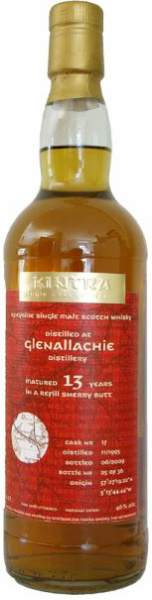
Glenallachie 13yo 1995/2009 (46%, Kintra, Refill Sherry Butt #17, 36 bottles)

Rummaging through the unsorted part of my sample collection I found this Kintra from 2009. Another Glenallachie and that’s great! Kintra’s big cheese, Erik started releasing Kintra Whiskies in 2009 so this is one of the first bottlings, and who knows, maybe even the very first. 2009 saw the release of a 1996 Ben Nevis, a 1997 Clynelish, a 1984 Macduff and in June, this 1995 Glenallachie.

A mind boggling amount of 36 bottles were released of this Glenallachie, so this is a collector’s item for sure! I don’t think this was from a small cask, probably only part of a cask, just like the Ledaig he bottled in 2010.

Color: Gold.

Nose: Fatty and fruity. Some butter and wood smelling like jasmine. Thus quite floral and spicy. Fresh air. Hints of white pepper and again and again this florality whiffs by. Pencil shavings come next. A lovely nose. Nice added depth from the Sherry cask, not only giving it some mustiness, but also some fruit. When smelled more vigorously, whiffs of toned down peppermint pass by, but also some hay, dry raisins and cardboard. If I would hazard a guess, I would say Fino Sherry?

Taste: Spicy first but quickly turning into sugar water sweetness. Dare I say it has some peat to it? The spice and the sweet balance each other out, so it’s not overly sweet. Warming going down. Hints of milk chocolate and a slightly burnt note. Still, lovely stuff, but also a bit unbalanced. Highly drinkable and enjoyable nevertheless. The sweetness makes way for a more woody, and acidic, dryness towards the finish. The finish itself is of medium length and pleasant, but doesn’t leave a great aftertaste, since especially a weak wood and cardboard note stays behind for a short while.

This is one of those highly drinkable Whiskies, where the weakest link is the finish, and especially the aftertaste. To get past that you tend to take another sip, and yet another sip, and yet another, so you’ll finish your glass rather quickly and after that you ask yourself where has the bottle gone? Maybe not my favourite Kintra bottling, but still very good and entertaining.

Points: 84

Chichibu 3yo 2009/2013 (53.5%, OB, Ichiro’s Malt, Chibidaru, Quarter Cask, 3900 bottles)

Chichibu is the first new Japanese distillery since the seventies, built near the city of the same name by Ichiro Akuto. Akuto started building the distillery in 2005 and in 2008 the first spirit ran off the stills. But 2005 is not the start of this story. No, this story starts in Chichibu in 1626 when the Akuto family started brewing Sake. In 1941 Ichiro’s grandfather, Isouji Akuto, built another distillery near the town of Hanyu, for making Sake and Shochu. Five years later a licence was obtained for distilling Whisky, initially a continuous still essentially making Grain Whisky. This still was eventually replaced by a copper still.

In 1980 Ichiro’s father, Yutaka Akuto, started to make Single Malt Whisky instead of the more common Blended Japanese Whisky (Scottish Malt Whisky blended with Japanese Grain Whisky). In 1983 the first spirit became Whisky but by 2000 Hanyu stopped making Whisky due to the severe lack of profitability. Ichiro, who worked at Suntory at the time, was brought in to save the company. He had to sell Hanyu to do just that. Hanyu was dismantled in 2004, but Ichiro bought the remaining Whisky stock as well as the distilling equipment. The equipment is still stored at Chichibu, but was never used since Ichiro´s new distillery was fitted with new equipment.

Chichibu Chibidaru 2009/2013Color: Full gold.

Nose: Fresh entry, elegant and flowery. Toned down, dried Jasmin leaves (tea and soap). Slight hint of powdery and spicy oak, alcohol and quite fruity. Pear and a hint of menthol and red fruit jello. Old dried ginger and sawdust. It smells pretty mature and complex for a 3yo Single Malt.

Taste: Quite woody, good aroma and even a bit sweet. Vegetal and much less fruity than the nose. It tastes even less complex than the nose, and with this it shows its youth. It’s easy to “see” that this one does needs its higher strength. Creamy vanilla, some candied yellow fruits enter the mix after (a lot of) air. Fabulous creamy custard paper pudding aftertaste with proper length. Lovely stuff especially considering its age.

This is an excellent 3yo Japanese Whisky, but it will only show its full potential if you let it breathe a lot. This is the kind of bottle you open and leave in the closet for a week or two without its cork. In the glass just let it sit around for half an hour before you even nose it. This needs air.

Now all the Karuizawa’s and Yamazakis are gone and Nikka struggles to release even a Whisky with an age statement I give you a glimpse of the future of Japanese Whisky. This is high quality stuff with massive potential, but as long as Ichiro is releasing Malts at barely the minimum age, that taste as well as this, it will tie us over as we wait for the Japanese Whisky to mature. My only fear will be that when a Whisky will reach its adulthood, it will be extremely expensive as the Karuizawa’s and the Yamazaki’s of today.

Points: 87

The Michael Jackson Special Blend (43%, Whisky Magazine & Berry Bros. & Rudd, 1.000 bottles, 2009)

The late Michael Jackson, born 27th of March, 1942, was a writer who was mainly known for writing about Beer and later in his career about Whisky. Like many Whisky aficionado’s or anoraks, his Malt Whisky Companion was my first book on the topic. Michael JacksonNot a lot of books like that existed back then, and it opened a world for me. I almost wore the book out. In hindsight I liked his book on Belgian Beers better, due to its thorough research and obvious love and passion for the subject. The Whisky Companion itself started to gather some dust since a lot of the scores in the book weren’t very realistic to say the least. Just look at the scores for the Macallan Traveller Series to name but four. In 2009, the Whisky Magazine and Berry Bros & Rudd blended the remains of his collection of open bottles together and other Whisky was added to “correct” the result. A proportion of the profits raised with this bottling was donated to The Parkinson’s Disease Society, an illness Michael suffered from, for more than a decade.
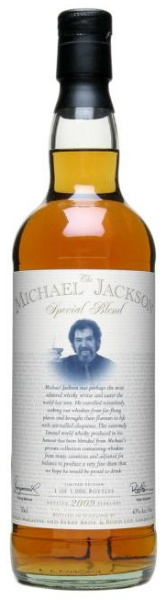
The Michael Jackson Special BlendColor: Dark Gold.

Nose: Funky Sherry, quite dark and brooding. Sweet tea, wax and lots of cask toast and (burnt) caramel. Slightly rotting apples and other creamy fruits. Hints of smoke and rubber tires. Quite special and waxy. Lots of wood, caramel and toffee, but also a fresher, more fruity side. Sweet grain. I have to say I quite like the way this smells. This must have some pretty high quality and old components. Vanilla with pencil shavings and slightly animalesk (probably a non-existent word). Meaty and flowery. It seems endless. Very nice nose.

Taste: Spicy and woody, licorice, but also quite sweet. Very aromatic. Right off the bat, a tad too low in ABV. This probably would have been better at 46% ABV if possible. I guess the sweetness comes from some younger (grain) whisky used to balance the whole out. Pretty fruity but also hints of paper and cardboard. Spicy and a bit dusty. Hints of mint from toothpaste. Very easily drinkable. Toffee and almonds. Very distinct nuttiness. Well balanced, but it is the kind of balance usually achieved with caramel coloring, it seems that way, but it doesn’t have to be true. Overall not very complex, medium (beer like) finish that is a bit bitter, but still quite nice and drinkable.

This is a piece of history. Especially the nose shows that some pretty awesome Whisky was put into this blend. I’m glad it is a decent dram, because Mr. Jackson deserves a farewell with a Whisky like this. Not for collecting but Whisky made for drinking. In a way Michael is sharing a dram with friends for the last time. Michael died of a heart attack on the 30th of August 2007.

points: 79

Pampero Aniversario Reserva Exclusiva (40%, Circa 2009, Venezuela)

Nearly summer, but already quite a lot of sunny days. Add to that that I live besides a lake, makes for an almost carribean feel. Well, no white sandy beaches, no palm trees, and not really crystal clear water, but you can’t have it all can’t you? Not so long ago I reviewed a trio of Rums, which I haven’t done for a while then and I must admit, I had quite a lot of fun with them. So why not do it again? Lets start with a Rum most Rum aficionado’s know very well. Pampero Aniversario. If you don’t recognize the picture below, this Rum is sold in a leather pouch, which also comes in handy when wiping moisture off of your windscreen.

Pampero AniversarioColor: Dark brown.

Nose: When you see the (dark) color of this Rum, you expect a lot nosing this for the first time, but it actually smells sweet, but also very elegant and middle of the roadish. It sounds worse than I actually mean. Reminds me a bit of Abuelo 7yo (which is sharper) and the 18yo Panamanian Rum from Rum Nation (which is less sweet). Light, fresh and fragrant. Hints of cinnamon and thick brown sugar. Lightly acidic fruit and cola. New leather and butterscotch.

Taste: Quite thin and for a brief moment sugary sweet, acidic, cola again. (Slightly burnt) brown sugar, but alas a bit thin (as in watery) and a bit too simple. It is even drier than expected. Hints of bitterness from wood and slightly burnt caramel. Creamy toffee with hints of vanilla. All flavours are well integrated. Short finish, which leaves you only with the burnt aftertaste.

The color alone made for great expectations. Alas the Rum itself is rather light. I can’t help but feel this has a lot more potential than it is allowed to show, so that everybody will like it. Just smell the Rum deeply, let it breathe a lot, its very complex, well balanced and nice. Taste wise a lot simpler and lighter, with a short finish. This Rum has a profile with lots of competitors. I already mentioned Abuelo from Panama, but also Diplomatico from Venezuela itself or Zacapa 23 from Diageo themselves.

Points: 79

Laphroaig Week – Day 6: Laphroaig 21yo 1987/2009 (50%, Douglas Laing, Old Malt Cask, Refill Hogshead, DL REF 4855, 439 bottles)

Laphroaig SignPenultimate day of Master Quill’s Laphroaig week and just as yesterday, another Douglas Laing Laphroaig. Seeing a pattern here? So which one will finish this series off tomorrow?

As luck would have it, we have another 1987 Douglas Laing today. Judging by the looks of it, probably a very different one. Yesterday’s Laphroaig was pretty pale at best, but this one boasts a nice and healthy colour. It’s like summer and winter, Jekyll and Hyde, night and day, Sherry and Bourbon. Still something strikes me as odd here. The label states this is from a Hogshead, but even with the slightest of reductions to 50%, this still yielded 439 bottles. Surely this was a Butt or a Puncheon, or was is a big hoggie?

Laphroaig 21yo 1987/2009 (50%, Douglas Laing, Old Malt Cask, Refill Hogshead, DL REF 4855, 439 bottles)Color: Copper brown

Nose: Nice chocolaty Sherry. Sea wind at night, but in summer, so a chilly night after a warm Sunny day. Clay and very toned down peat. Sugared onion. Not very expressive. This one is a bit shy, even considering it’s heritage. It doesn’t leap out of the glass at you. Sherry influence is quite obvious, but it’s not very peaty just like yesterdays 1987. Smoke? Hardly. Cold black tea and some meaty notes, dried meat and almost cold gravy. Nice and restrained. All the aroma’s do fit well together. Not fruity.

Taste: Sweet with burnt sugar. Definitely a more bonfire aroma. Powdered sugar and some wood. Late licorice, just as yesterdays 1987 Laphroaig. Wood stripped of old paint, of which the dust is still flying in the air. The slightly burned note stays on throughout and makes it into the finish. When working on it, it does show some fruit, but not much. No fresh fruits, but something dried like dates and raisins. PX-Sherry? All in all elegant stuff, but with dirt under its fingernails. Not without flaws in its character too.

This is the second 1987 Douglas Laing Laphroaig and there are similarities and there are differences. Both expressions aren’t very expressive and are toned down. No heavy hitting peat and not much smoke (if any) a Laphroaig light so to speak. This 2009 bottling has the added Sherry, and by the taste of it, this wasn’t a top (PX) Sherry cask or it may have been a treated cask. I somehow can’t imagine this to have aged its whole life in the same cask. Having said that the combination of the two does work somehow.

Points: 87

Glenlivet 21yo (43%, Gordon & MacPhail, Licenced Bottling, 2009, JI/JFEF)

After all those official bottlings on these pages, here is a sort of semi-official Glenlivet (without the “the”). This is a nice 21yo Glenlivet, bottled by Gordon & MacPhail in 2009. Please check out the codes printed on the glass, since these licensed bottlings are bottled quite often, and bottling years are interesting since there always is some batch variation. The code on this bottle is JI/JFEF, where JI stands for 2009. More recent bottles have even a bottling date printed on them, so now it’s even easier to know which version you have.

Glenlivet 21yo G&M, 2009Color: Lively orange gold

Nose: Yeasty, waxy, dusty and smells like old Whisky, which is nice. Very fruity. Toned down sugared fruits, mostly yellow, apricots for certain, with a touch of very ripe and sweet tangerine skins (the soft ones oozing with juice). Creamy vanilla and very likeable, not a lot of wood after 21 years. I have never smelled a Glenlivet from Glenlivet themselves, unless it was an old bottling, but this one is from late eighties distillate. (I did the math). I like it very much, although you can smell that this has been reduced, which usually is not so good. Light. Still, the liveliness and fruitiness and the smell of years long gone, makes this an excellent Whisky. Wait a minute, what about how it tastes?

Taste: Waxy and fruity, yes! A little bit of sweet vanilla ice cream with fresh papaya sauce over it. This time around there is most definitely some wood, and maybe some toast or smoke. In this case that’s a good thing because otherwise it just would be too light through reduction. The lightness is also noticeable by the rather short finish, which has a bitter edge from oak.

I don’t know why exactly, because it has been watered down to much and usually I don’t care a lot for woody bitterness in the finish, but for me this one works! I like it, I have one, and if that one would be empty, I would go for another one. This makes me happy, and I’m going to drink the whole sample. Nice! It is twenty-one years old, and considering the price it costs, this seems to me to be a must have. Alas these licensed bottlings from Gordon & MacPhail are getting rather rare these days, with the last version bottled in 2012. Go and find one.

Points: 87


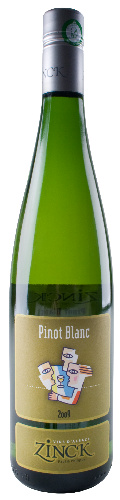
Paul & Philippe Zinck Pinot Blanc 2009

And suddenly the sun came out! Nice temperature so I felt like a nice light and refreshing wine. I have a batch of Pinot Blancs lying around for the white asparagus season, but thought I would give this one a try by itself, for me you never can go wrong with an Alsatian Wine. This Pinot Blanc is made by Domaine Zinck from Eguisheim, Alsace, France. Zinck have four great Grand Crus: Eichberg, Pfersigberg, Goldert and Rangen. The last two I also know from Zind-Humbrecht. Spectacular stuff. This Pinot Blanc is from the “Portrait” line of wines and are made as an introduction to Wine. We call that entry-level. Zinck Pinot Blanc

Color: light yellow with a slight green tint, medium viscosity

Nose: Flowery and half sweet. Meaty and buttery with hints of earth. Quite a “thick” and aromatic nose (lots of yellow fruits), seems sweet at first. Vegetal and herbal, maybe sage. Coastal (the terroir is silty), and fruity, melon-style.

Taste: Syrupy sweet. The acidity is in check. The sweetness and the acidity somehow doesn’t seem to be well married together. Something not quite right and I can not put my finger on it. The fruity melons are here too, and just like the nose, “thick”. Quite some bitterness too, that stays well into the finish. Where it shouldn’t be. Chewy and behind it all sweeter than it appears to be.

Pinot Blanc is not Alsace’s favourite grape variety, and I guess this wine shows why. It is recommended with food, asparagus. Don’t have that here at the moment, but I’ve tried it with a salad, OK and with spicy chicken legs, that was quite good actually. Since the wine is quite thick the Pinot Blanc managed the spicy chicken well. Easily drinkable. I personally didn’t like this as much as a lot of other wines from the region, but it does seem to fare better with food than on its own. Well just a matter of taste really, since my wife did love this on its own and is more than happy to drink the rest of the bottles that are in the cellar.

Points: 77

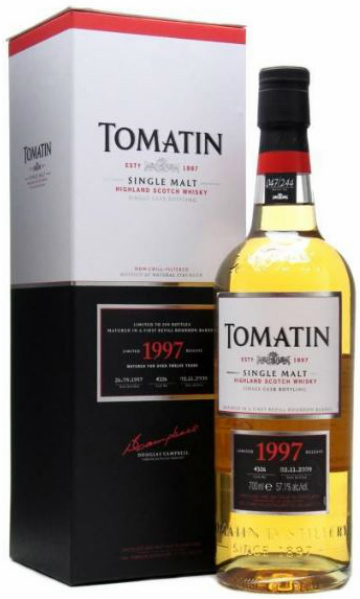
Tomatin 12yo 1997/2009 (57.1%, OB, First Refill Bourbon Barrel #4326, 244 bottles)

Here is another Tomatin, the tenth already if I’m not mistaken, but this time no obscure independent bottling, but an official bottling, yet not from standard range, but a limited release. Some sort of official bootleg so to speak. I hear this particular bottling was distributed in western Europe and Japan. Tomatins from the standard range that are from ex-Bourbon casks are quickly disappearing. The 25yo is no longer with us and who knows what will happen with the 15yo, the only true Bourbon casked Tomatin left.

Here we have a Tomatin that is 12 years old and comes from a refill Bourbon Barrel. You can’t get them more original than this, nor is the cask tampered with in a sense that the barrel is rebuilt as a Hogshead, nor has the distillery character been changed by (part) maturation in ex-Sherry casks or even by a first fill Bourbon Barrel. To sum things up, this is an official bootleg that probably will show a lot of distillery character. A real natural Whisky.

Tomatin 12yo 1997/2009 (57.1%, OB, First Refill Bourbon Barrel #4326, 244 bottles)Color: White wine.

Nose: Spicy wood, sweet and lots of vegetal notes. Alcohol. Vanilla and wood and a little bit of white pepper, but more is going on here. Slightly fruity and tiny hints of licorice and mushrooms. All in all a very clean nose.

Taste: Sweet at first, with again spices and white pepper. Even with this high alcohol content, it seems very smooth and even the finish is half long only. Warming and fatty. In the back of the mouth the alcohol has some acetone notes to it. But above all its zesty and shows signs of lemon. Lemon curd is stated on the back label and that’s what it is. The vanilla pod transforms into creamy ice-cream. Good balance.

Having just opened the bottle it seemed to be very closed and even a little bit unforgiving, but some five months of breathing did the Whisky a lot of good. Again an example of a Whisky that is closed and needs some time to really “wake up”. Just like me I suppose.

This Whisky is actually all about the details, and all details are tiny and restraint. Due to its high alcohol content, no-one will pick this up first, but when it’s tasted after a few other Whiskies, the subtleties are gone. Definitely use this as an aperitif, or when you are planning to have only one dram. If you stick to these “rules” you will be rewarded. I like it.

Points: 86