 New Lochnagar was founded in 1845. New Lochnagar? Yes. First Lochnagar was built in 1823, and burnt down by “the competition” just three years later. The distillery was rebuilt, only to burn down again in 1841. So the distillery was rebuilt again in 1845 as New Lochnagar. Lochnagar became Royal in 1848 (it lies very close to Balmoral Castle). No more fires burning down the house, but still a lot of construction going on. In 1906 the distillery was rebuilt yet again and in 1963 completely renewed.
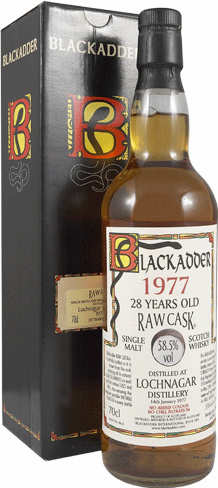 Here we will try an independent Lochnagar, again a Blackadder Raw Cask with cask sediment in the bottle. This time no powdered char, but only small chunks of charred wood.
Color: Full Gold
Nose: Fresh, sea spray wich changes quickly into a damp wine cellar. Very spicy wood and vanilla. Resembles the sweet smell of a bourbon, high on rye. Mocha with a hint of ground coffee. Varnish and fresh mint leaves (not bruised). This smells like it will be very sweet. Very nice nose.
Taste: Strong and sweet, but luckily not as sweet the nose predicted. Butter caramels and the varnish is here again. The whole is very full bodied. Wood with Aspirin (wow, that’s a first). Nutty and ashy. The finish is drier than in the beginning, but still sweet enough to mask a lot of the wood. It doesn’t taste like it, but underneath it’s pretty woody. The dry finish ends in a little bitterness that reveals this woodyness.
In the end a quite nice Lochnagar. The finish is dryer and has some bitterness that seems a bit off compared with the sweetness from the beginning. Maybe not a 90+ scoring malt, but definitively a very interesting Lochnagar if you want a complete collection. Still, with these flaws in the finish I have a little soft spot for this Lochnagar, since the nose and the initial taste are really great.
Points: 88
p.s. This one is at the time of writing still available in Russia for 534 Euro’s
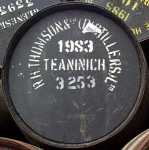 Teaninich isn’t amongst those superstars of Single Malt Whiskies around, but it has a fanatical following with certain enthusiasts. Well I’m one of them. Almost every time I taste a Teaninich, blind or not, this always tickles my fancy. I connect with it. It suits my palate. Dare we say: “For reasons not even science can wholly explain…”
  Teaninich was founded in 1817. In 1970, yes a small jump in time, a whole new six still ‘distillery’ was built alongside the current one, consisting of four stills. The new one was called the A-side (The old stuff was therefore called the B-Side). They worked together as one distillery. In 1984 the old distillery was mothballed, and 15 years later, demolished.
 Founded in 1843 by William Mathesen, but whisky was distilled on site as early as 1703 (or 1738). Glenmorangie is now known for their stills with very tall necks that ensure a very light and clean spirit that had to reach incredible heights. Glenmorangie are also known for their Dr. Bill Lumsden, a man who doesn’t fear innovation and experimentation with his grains and woods.
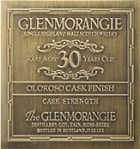 The whole is pretty balanced. It’s easy noticeable that this is from light spirit. The nose is great, and the taste is very nice. The only two things that let this down is its lightness. And a Glenmorangie should be light, that’s one of their pillars. Personally I like a bit of body to it, like yesterdays
  Clynelish is a very popular dram. There are several reasons why. First of all it’s a sister of Brora, which maybe the best malt of all. Second. Clynelish has a unique waxy personality and it’s spirit is always of high quality. It’s very hard to find one that is not up to par.
 Taste: Spicy and definitively from a sherry cask. Wood, beer and spice again. Sweet and tarry. Shortbread and gingerlike. Turkish delight and has some traits of a Riesling wine. Full bodied. Slight sour wood and licorice on the finish.
 Glengoyne then. Glengoyne got my interest because they were one of the first to specifically state, ‘unpeated malt’ on their labels. Also, I like the looks of the bottle ánd for still using Golden Promise amongst other barley’s of course. Golden Promise is somewhat of the holy grail of grains, because it is supposed to be very flavoursome. But the yield is not so good, compared to the favorites of today (which make all whiskies taste the same, to come out bluntly). So lets see if this one, and remember this is a fairly priced bottle, makes a golden promise.
 Taste: Toasted wood, but still a lot of yeast. Can’t shake the Sherry here. High proof, so it makes an impression. Although this has bold flavours, the quality of the spirit shines through. Very Ahorn syrupy sweet, and corn sweetness, that’s totally different from the Ahorn. It almost tastes like a wheater! This could be a Weller, with some sherry musty and creamy yeastyness. It’s a picture with thick broad strokes. It is thick.
 When the moment comes these are really sold out, those boycotters will shoot themselves in the foot, especially when looking at whiskies issued today and what you can get these days for 250 Euro’s.
 Taste: Sweet and ashy and endless depth. Great latent sweetness. Burnt toast. Very nice peat. Clay and milk chocolate. Cow dung (Yummie). Licorice, black and white powder. Just fantastic. Slightly sour wood in the finish but that fazes out, and the fantastic Brora returns to keep on lingering in your mouth. The taste it leaves in your mouth is very nice. Long finish.
 Color: White wine, light gold.
 I once had a similar bottle of Tormore that was even stronger and older (13yo, 63.9%, 85 Points). There were many things wrong with it, like a very metallic taste, but still I had a lot of fun with it, when ‘enjoyed’ at the right moment. I found myself another bottle before it completely vanished of the face of the earth.
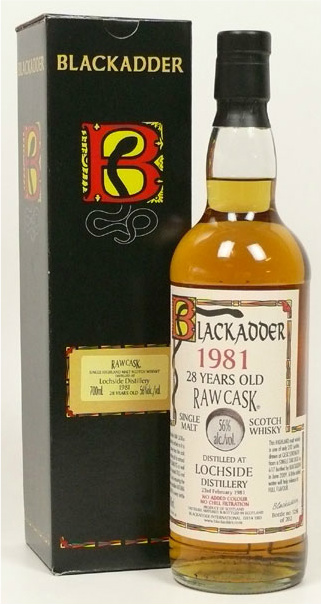 One from the (in)famous Raw Cask series. A lot of ‘stories’ are told about this one. For instance that Blackadder just throw any toasted cask trash they can get their hands on in there during bottling. That would be a shame wouldn’t it? Blackadder are also the people who bring us bottlings from the Aberdeen Distillers series and the Clydesdale series in the dumpy bottles.
 Taste: Wow, full body and spicy, Vanilla with apricot sauce. Nice! Yeah, this is it. Slightly beer like bitterness in the finish ánd black pepper. Alcoholic cherry bon-bon. Blueberry juice and creamy vanilla. Yes this has it all. When the bottle was opened at the Genietschap
  Color: Full Gold with a hint of copper.
 Master Quill