 Tormore. One of those distilleries, you don’t hear about too much. Tormore was founded in 1958 by Long John International, and distilling started in 1960. It was the first distillery that was built after the Pattison crash of 1898, and thus the first to be built in the 20th century. Today Pernod Ricard is the owner of Tormore and is already the fourth owner in its short history. Tormore was originally built with 4 stills and in 1972 that amount was doubled.
  In 1984 the heating system for the stills was converted, so that it could be heated with… woodchips to heat the stills. Officially only a 10yo was released, later replaced by the current 12yo. For a short while also a 5yo and a 15yo existed. So mostly independent bottlers issue Tormore Single Malt today. Still, over the years not a lot was issued this way, nor does it usually score very high. I guess it’s time to have a look into Tormore. First a Tormore bottled by Dutch bottlers Mo Òr, who’s Macduff and Miltonduff started this blog to boot.
 Color: White wine
Nose: Nutty and soapy. Smells very floral. Fresh and exuberant. Sour spring fruits. Creamy and a bit sweaty as well. Toffee. I can imagine why they bought this cask. It seems to me this is a happy and positive Whisky. Absolutely a young Whisky. Very likable. Maybe they should sell this in a spray as an eau de toilette.
Taste: Creamy and nutty. Very simple and seems younger than it actually is. Again very likeable and sweet. Vanilla ice cream and some caramel, and mint. No extremes in this. Hardly any wood. There is some wood noticeable in the finish. Hints of Belgian beer in the finish. Hops. Given some time in the glass, some spiciness does come through. Short finish though.
There seems to be a nice and unpretending balance to this. For me it’s very feminine. It’s easy and has a lot of fruits and flowers going on. Not a typical Tormore though, it doesn’t resemble the other Tormore’s I know, which were more industrial, or even metallic. This is nothing like that, this is organic summer garden. Biological Whisky maybe? Give it some time to breathe, it will enhance the character a little, by shedding its initial sourness.
Points: 83
Thanks go out to Henk for handing me this sample.
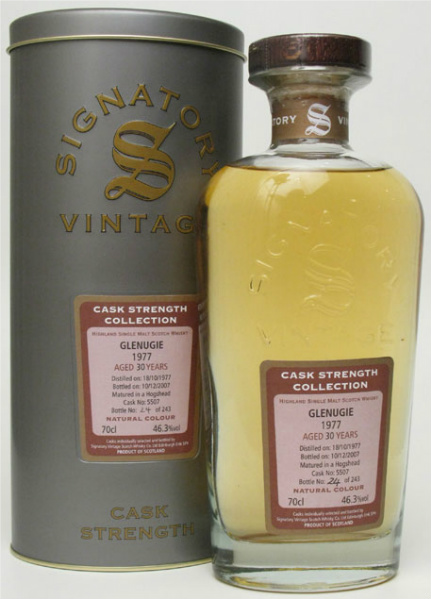 Color: White wine.
 Color: Full Gold
 Like with many Gordon & MacPhail bottlings, it is reduced, this time to 45% ABV. I am a fan of cask strength Whiskies, but I learned to appreciate these reduced Whiskies more. Is it age? I’m a bit held back only by the fact that not every Whisky likes to be reduced. Let’s hope it’s not the case with this one.
 New Lochnagar was founded in 1845. New Lochnagar? Yes. First Lochnagar was built in 1823, and burnt down by “the competition” just three years later. The distillery was rebuilt, only to burn down again in 1841. So the distillery was rebuilt again in 1845 as New Lochnagar. Lochnagar became Royal in 1848 (it lies very close to Balmoral Castle). No more fires burning down the house, but still a lot of construction going on. In 1906 the distillery was rebuilt yet again and in 1963 completely renewed.
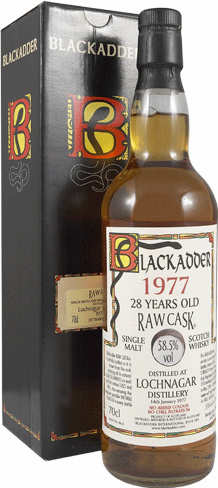 Here we will try an independent Lochnagar, again a Blackadder Raw Cask with cask sediment in the bottle. This time no powdered char, but only small chunks of charred wood.
 Balmenach was licensed in 1824, but existed much longer as an illicit farm distillery called Balminoch. Not earlier than 1992 the first official bottling is released, a 12yo Flora and Fauna. Not long after this United Distillers (now: Diageo) sold Balmenach to Inver House Distillers, with wich came an end to the Flora and Fauna bottling.
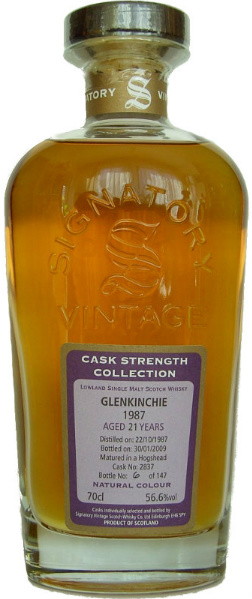 Glenkinchie, a rarely seen Lowland distillery within the ranges of independent bottlers. Founded in 1837, Glenkinchie is foremost known for the closure of Rosebank. When Diageo set up their range of classic malts they chose Glenkinchie over Rosebank. As you might know, Rosebank is known to have a huge following, so this decision wasn’t welcomed at all. Now Rosebank is no more, we’ll have to see if this Glenkinchie is worth your money. Instead of a regular Diageo bottling, let’s try an independent one.
 I did some rummaging in my boxes with samples and found another Glen Grant. Well I actually found several of them, but I just chose this one. You know Glen Grant, the place that was the first distillery that was illuminated without burning fuel by themselves. This time we have a Glen Grant bottled in the Old Malt Cask series by Douglas Laing. Again in the new tall bottle, just like the
  Color: (Light) gold.
 Interesting about Benriach is that a lot of experiments were done there during the seventies (and eighties). Tests with peat, new oak etc. Lot’s of those experiments are released today.
 Enjoyable, recommendable and very fruity. It could have gained triple A status if it would have some added bits that would counterpart the fruit. It is good/great, but lacks some complexity you would have expected of such an old malt.
 Now we move on to Inchgower, since it’s Inchgower that’s inside of the bottle. If you want to see how Raymonds operation looks like, and how this particular Inchgower was bottled, here is a
  Master Quill