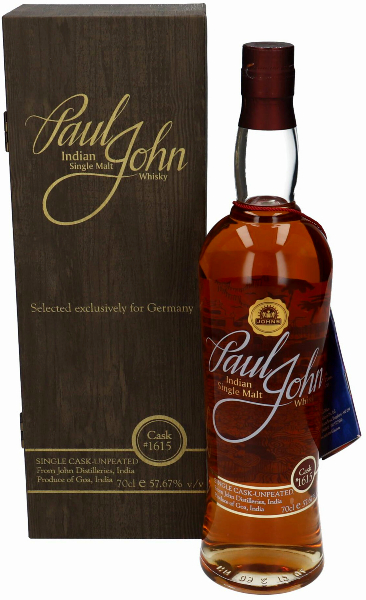
Paul John (57.67%, OB, Single Cask #1615, for Germany, 216 bottles, 2016)

As said in the previous review, I tend to have a pair of open bottles of Paul John on my lectern. At the moment cask #4914 (peated) as well as this unpeated #1615 are on there. Both bottled for the German market. After the peated expression, lets mow turn our attention to the unpeated expression. In the previous review I have remarked that the peated expressions seem to be better and thus score higher. Unpeated cask #1051 scored relatively low with 84 points and low and behold, now the peated cask #4914 from the previous review scores mid eighties as well. 85 points is lower than its predecessors. This is how the universe tends to work. I’m now betting on this cask #1615 getting a score, very high in the eighties, to bring balance in said universe. Not much more to add to the intro at this point, all has been said, so why not cut this intro short for once and dive right into this unpeated Paul John.
Color: Slightly orange gold.

Nose: Fruity and very appetizing. Right out of the gate a fruity, nutty and friendly dram. Malts, sweet malt actually. Lots of unexpected fruit notes, still have to wrap my head around all these fruits. All yellow fruits. Now I get hints of grapes and Alsatian über aromatic Gewurztraminer. Wow, how’s that for yet another take on a single cask Paul John. Ripe yellow fruits, bananas from Jamaican Rum. Cask #1615 turns out to be quite the funky puppy. Wet cardboard and dust. Quite a change is happening now to the body of this Malt. Dry wood with more fruit and vanilla. Fruity ice-cream. Instant gratification, not a lot of layering or complexity. This one puts all its wonderful smelling cards on the table right away.

Taste: Very tasty right out of the gate. Fruity like the nose with nice, slightly prickly oak. Nutty, somewhat vegetal and with a slightly sweet deepness. Warming. Very well balanced. Amazing actually how all these Paul John single casks can differ so much, and remember all are coming from first fill Bourbon casks. Unpeated yes, but there is something about this one. Maybe toasted oak, maybe the oak had lots of residual sugars, like a hint of smoky, sugary oak. Although the fruit dominates this Malt, the wood definitely plays a wonderful role as well. Paul John always claim to be tropical, well if you want a tropical Paul John, this is it. It’s the most tropical I’ve had to date. Very fruity but with a paper or cardboard edge to it, turning into a more bitter wood note, as well as some pencil shavings in the finish. Quite dry. This would have benefited if some of the fruity sweetness would have made it into the finish more, as well as into the aftertaste. In no way is this young smelling or unfinished. Maybe if this had aged some more, it might have gained somewhat more complexity, but it might also have picked up some more wood and bitterness and it also has more than enough of this, so maybe it is at its best as it is.

Points: 88

As a casual sipper I definitely preferred this unpeated cask #1615 to the peated cask #4914. With other sets of open Paul Johns I had in the past, it is often the other way around. Also I’d like to mention that casual sipping is much different from analyzing, because in the case of the latter, the Whisky is getting much much more attention. When analyzing, the Whisky is the focal point whereas with casual sipping the center of attention might be a film, a book or an interesting conversation, to name but a few distractions. This shift in attention also changes your perception of the Whisky at hand more than you might think.

Since this turns out to be yet another high scoring Paul John, and since I still have a wee dram of peated cask #745 left, lets compare these two for a moment. Wow, smelling cask #745 (again, the darker of the two) after cask #1615 makes it truly amazing. Holy moly what a winner cask #745 truly is on the nose. And what a nice pair to smell. The peated one has the Paul John plastic note, and this unpeated one does not. cask #745 has peat, clay, rubber and plastic, all traits cask #1615 does not have (obviously). cask #745 is a way more fuller and aromatic Whisky, more industrial and much bigger (and it has horseradish in the aftertaste). It unhinges slightly in the finish though, and that is probably why cask #777 scored a point more than cask #745. Both cask #1615 and cask #745 taste entirely different. So again, 89 points for cask #745 still stands (again) and the way cask #1615 finishes and all things considered, 88 points is correct amount of points for this one as well. Mind you, all this scoring stuff is highly personal, so I urge you all to make up your own mind if you get the chance to taste the Whiskies you read about, and don’t follow what anybody says blindly. Over and out for now!

Paul John (59.2%, OB, Single Cask #4914, for Germany, Peated, 138 bottles, 2017)

For a long time now I have been opening two Paul John bottles at once. One peated and one unpeated, once a mix of both. Very often single cask offerings, simply because they interest me the most and beauty lies in the details. As far as know, all the single cask offerings I came across are ex-Bourbon casks, so no Sherry or Port stuff here. As many aficionados or anoraks know, Paul John appeared on my radar because of the wonderful tornado that is Shilton Alameida, currently of Tel Aviv outfit Milk & Honey. If you ever visit a good Whisky Festival go over and visit Shilton! Paul John does not seem to bottle a lot of single casks anymore, so most of the reviews that will appear on these pages in the future are bottles from my stash. These older single cask offerings will disappear more and more from retail shelves although they still do appear in auctions with decent hammer prices. Decent from the buyers perspective that is.

I’ve had plenty of Paul Johns open, and thus Paul John is no scarcity on these pages, with even several independent offerings from Malts of Scotland and Cadenheads. However the focus now lies on Officially released Single Casks and as has been the case earlier, I will review one peated and one unpeated expression. Until now, three unpeated OB expressions have been reviewed earlier (scores between brackets): cask #1444 (89), cask #1906 (87) and cask #1051 (84). Two peated OB expressions have been reviewed earlier: cask #745 (89) and cask #777 (90). As can be seen the peated expressions right now seem to be “better” than the unpeated ones. So lets see how the next pair will turn out. Let’s start with the peated expression: cask #4914.

Color: light, middle gold.

Nose: Initially quite malty, with fatty, smoky vegetal notes of peat. Clean and smoky, bonfire style. Light (and deep), yet also very balanced, fragrant and laid back. Ever so slightly meaty, more gravy-like actually. Slightly fruity with hints of warm plastic and distant vanilla. Soft wood and fresh almonds. Pencil shavings later on in the mix, and I might add, these are the shavings of a very old pencil. Its warming, fresh and clean at the same time. The nose has a pudding-like quality to it and is actually very nice, not raw or harsh in any way, nor is the smoke sharp. If the taste is anything like the nose is we’ll have yet another peated winner from Paul John. Its almost like a breath of fresh air. Seaside, a strong and windy day kind-a fresh air, mixed in with some minty notes and horse radish, that’s how fresh this smells. This smells different from all other Paul Johns I had before. Much cleaner, and this time around, when sniffed “blind”, I probably wouldn’t have guessed this is Indian Whisky. I struggle to find the six-row barley in this one, its there, but less apparent than in most other ones. Still an amazing Whisky considering it still must be a young spirit, although we know by now how ageing works in the Goan climate.

Taste: Quite an unexpected start after smelling this one for a while. It starts sweet and nothing in the nose prepared me for that. Sweet and fruity and the almonds from the nose are present as well. First sip is very warming going down. Sweet with vanilla and slightly bitter wood. Very tasty, yet also a bit thin and a lot less complex than the nose was. The balance seems slightly off towards the finish, since not everything you taste seems to fit together perfectly. The wood becomes more paper-like, as well as slightly acidic, but not in a fruity way at all. It’s the acid you get from oak. You can almost smell this acidity in freshly cut oak. So the start and most of the body are more than OK, it’s the finish and especially the aftertaste where things start to go slightly wrong. It is layered, but in this case the layers won’t stick to each other. A sort of unpleasant tension is happening between the layers. I have plastic in the finish, and if I smell it right after that, the nose shows this plastic edge as well. Plastic is not uncommon for Paul John, but it usually isn’t a problem. It is actually a bit of a shame the palate can’t keep up with the nose, especially since the nose promised so much, and this is not even a heavy hitter, so go figure. Hey don’t get me wrong, this is still a tasty Whisky, but it certainly does have its flaws. The wood is slightly too bitter, and it goes downhill in the finish and the aftertaste. It loses its sweetness and fruitiness, to be replaced by acidic wood. Easy to pick up on when one’s somewhat experienced with Paul John.

As luck would have it, I still had a sample lying around from cask #745, the liquid of which is quite a bit darker, way more creamy and pleasant and way more balanced. Yeah, cask #745 is really good stuff. Based an a quick comparison on the nose, cask #745 is the clear winner. It has a lot more going on for it. It’s quite a big difference as well for two bottles you would expect to be similar. To sum things up, not all single casks are created equal. If you come across one, you might want to pass up on unpeated cask #1051 and thus this peated cask #4914, both are sub-par compared to the rest, yet still not bad. On the palate, cask #745 is also much better, bigger and way more balanced. The peat is different and more special as well. It also has some off-notes, but these work well with in stead of working against the Whisky, and only adds to the experience.

Do I regret getting #4914? No, not at all. After a few of those single casks, one might think all are quite similar and also might get a bit boring. However cask #4914 is still a good one, and trying it is still a great experience because of the different feel it has, and it also shows me how good #745 really is. By the way, cask #745 also has the same plastic note as cask #4914, and is much better. See, off-notes aren’t necessarily bad, they can work. This review has again been quite educational, and when these two bottles are gone, I will more than happily replace them with two other single casks, one peated and one unpeated. I guess the 89 points for cask #745 still stand, although 90 points would feel good as well.

Points: 85

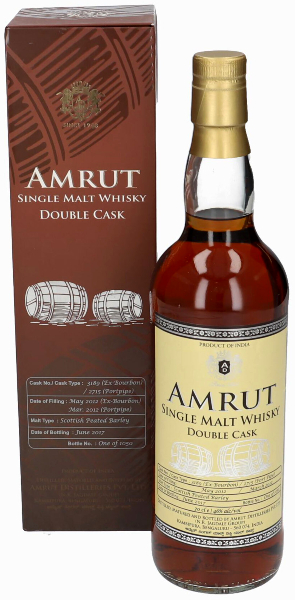
Amrut Double Cask 5yo 2012/2017 (46%, OB, Bourbon Cask #3189, Port Pipe #2716, Scottish Peated Barley, 1050 bottles)

Amrut Double Cask. In this case, Amrut just married two different casks together and reduced them to 46% ABV. In 2010 the first Double cask was released, marrying two Bourbon casks together, ehhhh, where is the fun in that? Later in 2016 and 2017 two more batches (both in two expressions) were released that seem to be a lot more exciting: batch 2, marrying Bourbon with PX (using unpeated Indian barley) and batch 3, marrying Bourbon with Port (using peated Scottish barley, most likely of the Aberdeen kind.), so I expect both later batches to differ quite a bit. I’m quite sad actually, because Double Cask seems to be a concept with many possible permutations, and I thought there would be a lot more batches than only these three. For completists here are the three batches/five expressions of Amrut Double Cask:

  • Batch 1 (2010-02-27): 2002-07-25 (Bourbon #2273) / 2003-02-27 (Bourbon #2874),
    The original Double Cask (7yo), 306 bottles
  • Batch 2 (2016, August): 2009, June (Bourbon #3451) / 2010, May (PX #3802),
    Unpeated Indian Barley (6yo), ??? bottles
  • Batch 2 (2016, August): 2009, June (Bourbon #3452) / 2010, May (PX #3803),
    Unpeated Indian Barley (6yo), 800 bottles
  • Batch 3 (2017, June): 2012, May (Bourbon #3189) / 2012, March (Port Pipe #2716),
    Scottish Peated Barley (5yo), 1050 bottles
  • Batch 3 (2017, June): 2012, May (Bourbon #3190) / 2012, March (Port Pipe #2717),
    Scottish Peated Barley (5yo), 900 bottles

Color: Dark orange brown.

Nose: Starts with peat and iodine. Very big and definitely bold. Animalesk, the acidic note of crushed beetle (don’t ask) and miscellaneous organics. Cola. Maybe too early to say, but I don’t think reduction to 46% ABV hurt this Whisky at all. Clean and tight. Port yes, but very much playing second fiddle behind the peat, adding a dimension and not really upfront or overpowering. Otherwise, as said, very fresh and tight. Definitely a winter type of affair. Because of the lack of Indian Six-row barley, this Amrut really misses its exoticness. If this was done with Indian barley, it would be highly unlikely this Whisky would come across as a winter-Whisky. So in that respect quite an unusual affair (for an Indian Whisky). I guess the other version, the 2016 one, that has been done with PX and unpeated Indian barley will be entirely different, probably back into the exotic realm. Next up some fatty clay and smoke. Scottish autumn at the bank of a river (with clay). Chocolate powder (Droste or Dutch Windmill) and warm plastic. Mocha and the tiniest hint of vanilla. Yeah, but all in all, this is yet another great smelling Amrut. As often with Whiskies that came into contact with Port casks, the nose is somewhat less complex. After the peat subsides a bit over time in my glass, the Port is able to show the fruitiness it is able to give to this Whisky. Good stuff. After a day or two, the empty glass smells of a lot of peat and a wee bit of polyester. I have smelled that before, but not in an Indian Whisky.

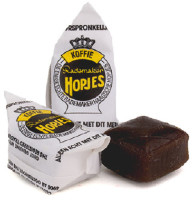
Taste: Starts thin. Where the nose was thick, bold and big, this thin texture comes a bit as a surprise, making me wonder how the unreduced Whisky would have been. Starts with berry like fruits, ripe red fruit and a lot of almonds. Nice. Its like eating unsalted roasted almonds with sweet dried cranberries. The almonds also have a lot of staying-power, and linger for a long time in my mouth. With the fruit comes also a nice sweetness. Just like the nose, not very complex. Cola here again. The cola, the fruits and the almonds put together, remind me of Cherry Coke. Needless to say this tastes highly drinkable. Haagsche Hopjes, a Dutch hard coffee candy. Well isn’t this turning into a treat? Very nice. With a taste like this, who needs complexity? In the end, this one is on the palate still a wee bit too thin. Could have done with slightly more points on the ABV-scale, 50% seems about right, but this is just a minor gripe. I haven’t tasted this at 50%, so I really don’t know if it would have been better. The finish and the aftertaste retain quite a lot of fruity sweetness. To be hones it could have done with slightly less of it. Highly drinkable every time, but not one keep pouring one after the other. If your glass is empty refill it with another Amrut. I’ll finish this like I started, really sad there aren’t any more Amrut Double-casks around. Please Amrut do some more, surprise us. I’ll even forgive you if you keep them at 46% ABV, for continuity purposes.

Well, well, well, Scottish Peated Barley. For me the strength of an Indian Whisky lies in the specialness, the “exoticness” of Indian six row barley, setting it apart from other Whiskies and carving more than only a niche for itself. A type of Whisky I really do like myself, if I may say so. There are already a lot of Amruts and Paul Johns on these pages, and also Indri is knocking at the Indian Whisky door with quite the drum-roll. Up ’till now I tried three expressions of Indri, and all are winners in my book. With this Amrut Double Cask however, don’t expect an Indian Whisky because the whole comes closer to a Scottish peated Whisky than any Indian Whisky. So in fact, what we have here is a Whisky with a bit of an identity crisis, and from now on, don’t underestimate the power and the character of Indian six-row barley.

Points: 86

Paul John (59.7%, OB, Single Cask #1444, 2014)

While we’re at it, why not continue with yet another Paul John. In the previous two reviews we first had an Amrut finished in cask that previously held peated Whisky and the second Whisky, a Cadenhead Paul John, consists for 40% of Peated Whisky. This time around, we’ll be looking into a single cask of Paul John, a totally unpeated one. Personally I believe Paul John in its peated variant is often at its best. However, like I claimed in the review of the Cadenhead Paul John, there are very good unpeated expressions as well, so lets see if #1444 is one of them.

Color: Light copper gold.

Nose: Very nice entry, with Paul John’s trademark horseradish. A good Springbank has cocos, and a good Paul John has horseradish. Dusty horseradish in this case, like dried out horseradish cream (from a jar). Prickly and spicy, with trace amounts of smoke and floral soap. Appetizing. Cola flavoured wood, and a zesty oak flavour. Appealing in this zesty soda kind of way. Maybe they should carbonate this particular expression of Paul John? The wood now turns a bit vegetal, somewhat virgin, although it is highly unlikely this came from a virgin oak cask. Cold tea. Complex. This has pencil shavings which is also quite normal for a Paul John, but much less than other unpeated expressions, which is a good thing in my book, since that aroma can often dominate the Whisky, masking the complexity it might have and thus resulting in a lower score. So it seems this is a better balanced unpeated single cask than the ones reviewed earlier. The nose benefits hugely from sipping, showing yet more layers. Wow. Sometimes I smell some creamy fruits from an Alsatian Gewürztraminer (not the lychee by the way). How is that for complexity.

Taste: Wood, mocha, ashes and horseradish toffee. Prickly (white pepper?) and somewhat sweet. Again showing great balance. The next wave concentrates more around the sweet bit, now showing a ripe fruitiness. Yet also quite some wood without ever getting bitter. Hints of virgin oak again, but also some dusty old dried out leather books. Classy. A slight lemony acidity (lemon meringue) at the end of the body and well into the finish, which is nice, nutty and long. Walnuts without the bitter skin, the flesh of walnuts only, so to speak. Warming finish and thus this nutty and woody aftertaste with again quite some length.

I have to say this is a very nice dram, and may very well be the best of the unpeated Paul John’s I tried up ’till now. Just compare this one to the other unpeated official single casks: #1906 (87 points) and #1051 (84 points). Great balance and it all works together quite nicely. The aromas in the nose are nice, as well as on the palate, and both the nose and the taste fit together well. Nice finish and a good lengthy aftertaste. Very good example this one, definitely my favourite of the unpeated ones. Funny really, all these single casks look alike especially because a lot of information is lacking. What kind of cask it is, how many bottles, distillation year and so on. So they all look the same, they seem to come all from Bourbon barrels, but the difference between the different casks can still be really great.

Points: 89

Paul John 6yo 2011/2018 (56.6%, Cadenhead, Bourbon Hogshead & Bourbon Barrel, 564 bottles)

Since the last review was of an Amrut Indian Whisky finished in a cask that held peated Whisky, why not review another Indian Whisky I have on my lectern that came into contact with peat. Here we have a Cadenhead’s bottling of a Whisky that originally came from three casks that previously held peated Whisky and two casks that held unpeated Whisky. Since Indian Whisky, due to the local climate, suffers from a lot of evaporation, all this Whisky was vatted together and then transferred to only one hogshead and one barrel. My guess would be 5 years of maturation in India and one year in Scotland. Both casks were dumped together and then bottled. The label doesn’t say anything about a marrying period before bottling, there probably was, we only don’t know how long that was.

Color: Copper gold.

Nose: Slightly peaty and quite fruity (especially in the beginning). Sharp fresh air with a hint of horseradish, which is quite common for a Paul John. Some leather, wood (pencil shavings, yes) and sweet licorice. Bonfire and smoke. Somewhat creamy, nutty and green as well. Vegetal. Cold chimney and it seems a bit salty. Salty custard. Dry vanilla powder and molten ice-cream. Smells tasty and compared to the Blackadder Amrut, a bit more modern (distant hint of warm plastic) and less, definitely less complex, not a lot of evolution as well, but there is some. It reaches a certain point, and stays there. The aforementioned Amrut was putting out layer after layer, but needed a lot of time to do so. This Paul John shows its colours right away. It’s not a very big Malt but the experience I have with it now, when analysing, is the same as when casually nipping it, which is a good thing. Well, again quite a good balance. I have nothing to complain about in this department for the last few reviews, good! Yes. this is again a very nice nose. A wonderful Malt to smell. The two unpeated casks did bring the peat down a little bit, without adding to much of the nutty and waxy pencil shavings note, most unpeated Paul John’s have in abundance. Sometimes exactly this can be overwhelming, which is why I prefer peated Paul Johns yet there are examples of good unpeated expressions as well. No off notes whatsoever. Good stuff.

Taste: Nutty and peaty. Sugared fruits (pineapple) without being too sweet. Some bitter oak and hops, both with staying power on my tongue. Still, very nice on entry. Different than expected considering the nose. Here the pencil shavings have more to say than it had in the nose. Where on entry it was pleasant, now that the body starts to develop inside your mouth, a lack in balance starts to be apparent, making it less pleasant. Ice-cream combined with a funky organic note as well as some burnt plastic. Where the nose was already not all too complex, the taste is even less complex and less balanced to boot. There is something not quite right when balancing the acidic notes with the bitterness this has on offer. Nice almond-like finish though and also quite warming, but it also has a quite short aftertaste, with a bit of bitterness, cinnamon, horseradish and plastic again. Definitely not for novices, I would say. Drink this in big gulps, and nip it often to counter the somewhat short finish. Thus, definitely one for a more experienced drinker. The bitterness stays behind on my tongue for longer than the actual aftertaste. Drying it out a bit.

In the end, this still is a nice Paul John, with an interesting history to it, and an interesting palate, (plastic) warts and all. Alas it’s definitely not the best you can get, but nevertheless a good one. Good, but not great.

Points: 86

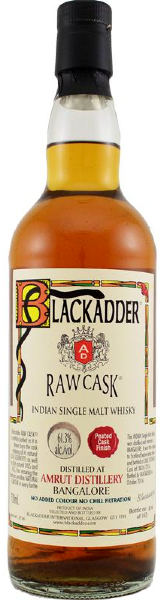
Amrut (61.3%, Blackadder, Raw Cask, Peated Cask Finish, BA26/2016, 165 bottles, 2016)

This isn’t the first Amrut on these pages, (it’s the ninth), nor is it the first Blackadder (it’s the fifth). Looking at Blackadder, this Amrut finds itself in good company with a 26yo Port Ellen, a 28yo Royal Lochnagar, a 28yo Lochside and a 40yo Glenfarclas. All scoring 88 or 91 points. I don’t think this Amrut is as old as these other ones. After 26 years an Amrut cask would probably be empty, all evaporated in the hot and humid local climate. So, this is not the first Amrut on these pages, but it most certainly is the first one bottled by an independent bottler, and somehow this bottler felt the need to finish this Whisky in a peated cask, or did Amrut already do that themselves? Was the original cask a bit tired, the Whisky a bit bland and/or did the Whisky need something of a booster, or did it just seem to be a neat experiment, a great idea? Well there is only one way to find out, and have a go at it ourselves and see if it’s any good. By the way, if you see some black cask sediment on the bottom of your bottle, don’t bring the bottle back to your retailer, it’s supposed to be there, hence the name Raw Cask.

Color: Copper gold (with black dandruff, the bigger chunks of cask sediment are still in the bottle).
Nose: Buttery with vanilla. Creamy, pudding-like, big and bold. Citrus freshness and some nice fresh oak mixed with some fresh air, sometimes even a bit sweet smelling. After the Ledaig, yet another well balanced nose, just much less peated. Green, black tea and somewhat floral with only the tiniest hint of peat, typical Indian barley smell, you can also get from a Paul John, (reminiscent of nutty pencil shavings). Definitely no smoke, but there is a dusty and dry side to it, even though this has this sweetish and chewy cream note. Crème brûlée and some licorice. The green notes are moving into the realm of wood, tree sap with a hint of pencil shavings. Somewhat spicy, as well as spices you get from a nice (oak aged) Chardonnay. Nice whiff of eucalyptus you can smell in a sauna (I only picked up on this after sipping) and unlit Cuban cigar notes. If you put some time into it, it is actually an excellent smelling Malt. It just needs quite some time and air. A nose built around green wood and the many guises of cream. Not a very complex nose at first, but a very nice one indeed, and near perfect after half an hour or so. Works well outside. The fresher the air it gets to breathe, the bigger the reward.

Taste: Sweet, fruity, nutty and somewhat waxy and yes, peaty it is this time. Sweet, wet wood, licorice and white pepper. Cold cigarette ashes and sweet fatty smoke. Menthos and a distant hint of hard red fruit (raspberry) candy. At times quite spicy and almost hot. Still creamy, although masked. Toffee. Behind this is some acidic fruit. Not only citrus, but also some acidity from (red) berries. Some white pepper. Long finish (in the wood realm again) and a nice similar aftertaste, now with a slight bitter (and soapy) edge to it. The perception of bitterness was different from one day to the other. All in all, slightly less balanced than the nose. After a few drams, I managed to anaesthetize the roof of my mouth a bit, so this really is a 60%+ ABV Malt in the end.

Yet another example of a Whisky that needs your attention to “get” everything it has. So maybe this is, in a way, a delicate Malt. For instance, the previously reviewed Ledaig, well, that one doesn’t need your attention. That one will make sure it will get your attention, by leaping out of your glass, and coming after you(r nose). Yup, the beauty of this Amrut lies in the details and the time you are willing to give it. Just leave it in your glass, move it around a bit, take the occasional sip, and only then you will find out what it’s got. I think this is wonderful stuff, but when carelessly sipping it, I didn’t think all that much of it to be honest (and alas I drammed right through most of this bottle that way). So beware how you treat it (and thus yourself). I don’t know why this was finished in a peated cask, but it clearly worked. Kudo’s!

Points: 89

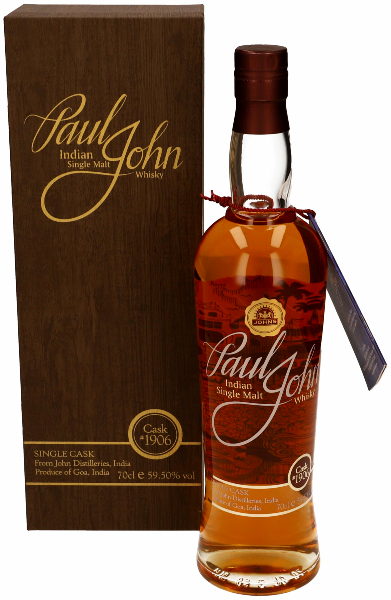
Paul John (59.5%, Single Cask #1906, 210 bottles, 2015)

In the previous review we delved into Paul John single cask #1051, although that particular one turned out to be a tad wonky. So I just had to compare it to another Paul John unpeated single cask. I still have some samples lying around from the golden Shilton Almeida era, probably the most passionate brand ambassador out there, and amongst others, certainly one of the best. Still baffled Paul John let him go, and since Shilton left the company, I don’t see a lot happening on-line yet at Paul John headquarters. Shilton moved on from the Goan sun to the sun that bakes Tel Aviv. One of Shilton’s samples is of cask #1906, like #1051, hailing from the same glorious year that was 2015. For most people certainly a better year than the virus infested, war ridden years we are living through these days.

Color: Gold.

Nose: Super fruity at first, and different from cask #1051. This just leaps out of my glass, with a nice sweet, fruity and surprisingly, flinty toasted cask notes, reminding me a bit of Pouilly Fumé. This cask also has more complexity to it, with a nice floral note as well as some lemon detergent, giving it more cleanliness, dûh, and freshness, even though it might sound horrible to some. Waxy and paper-like, meaty even, dry meat, beef jerky. No, this one is definitely more appetizing than #1051. More complex as well. The pencil shavings are here too, but much more toned down. The pencil shavings are overshadowed by the fruitiness, which is nice. Very nice spicy wood, just the right amount. Fresh butter. Well balanced stuff. This is from a 75% full sample, so this had a lot of time to interact with some air. To be honest, the cold dishwater is also recognizable, just less heavy handed and it has less of it than cask #1051 had. After some more air in my glass, the pencil shavings component does become more apparent, but it never gets to the same level as it does in #1051. The woody bit is more spicy, and evolves a little. More herbal and green. With this one, all seems to fall right in its place, much more balanced. Nice fruity nose, something that is lacking from #1051. A pleasant experience, as well as a pleasant surprise (after #1051). The Pouilly Fumé bit in the nose, makes this one extra special, since that flinty note works so well for this Malt.

Taste: sweet and waxy, (including a distinct paper or cardboard note), with an even bigger (red pepper?) sting to it. Distant mocha and milk chocolate. Quite some ripe yellow fruits. Wow, excellent. #1051 seems gloomy compared to this. #1051 is more like a winter Whisky, and shows nothing of the tropical shores of Goa. Quite some wax in this one again, as well as some soapy detergent. More wax than I expected and the woody bitterness is helped along by the wax. Less bitter than #1051. Appetizing stuff this one, with again quite a lot of influence from the wood. Next some more fruit, fresh, not over-ripe yellow fruit and some fresh citrus for zestiness and likeability. Also the acidity of red berries. Giving it an extra layer over #1051. In the finish some soft notes of anise and sweet licorice. Again not a big aftertaste, more like a lingering warmth, with a wee soft bitterness.

Well, in this review I compared this #1906 all the time to #1051 which I reviewed right before this one, so there isn’t a lot more to comment about here really. To sum things up: #1906 is a way more friendly example, more fruity, and the gloomy bits that overpower #1051 are here as well, just less of it. #1906 is also better balanced, and just better overall. Having tasted quite some Paul John single cask offerings, I would recommend you to pass on #1051, because there are a lot of better examples around, #1906 is just one of them, and #1906 isn’t even one of the very best, close, but not quite. Final observation: personally, I like the peated single cask offerings of Paul John even more than the unpeated ones. The peating levels are not very high, but highly effective and very tasty.

Points: 87

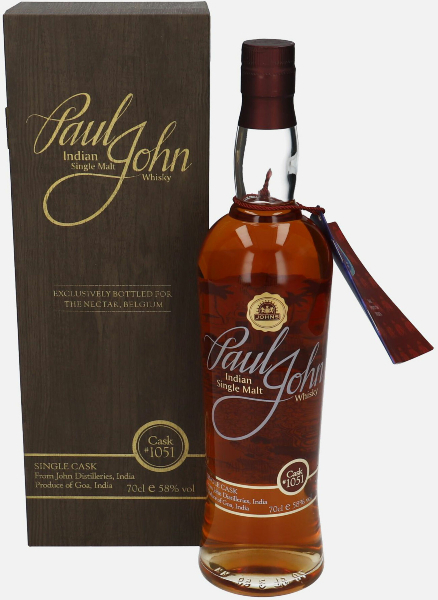
Paul John (58%, Single Cask #1051, for The Nectar Belgium, 2015)

Last year I wrote a review of the Malts of Scotland Paul John #15066, another unpeated example of a Paul John single cask Whisky. When I emptied that bottle, it got replaced by this official bottling from single cask #1051 picked by Mario G., and bottled for The Nectar in Belgium. I normally write my reviews of a half full/half empty bottle. You know the drill about optimists and pessimists. Most of the time, Whiskies need some time or air to reach their best, so it is actually a big no-no to review a freshly opened bottle. However, this time around, I’m writing this review from a nearly empty bottle, but I have been following the development of this bottle very sharply, and I do remember all the stages this Whisky went through over time. All this, because in this particular case, this actually was at its best right after the bottle was freshly opened. I was really happy with it, let’s say the first half of the bottle, and when I brought it with me for a tasting of my whisky club, the comments were not all that positive. Yes, it may have suffered a bit by the preceding Whiskies in the line-up, but when tasting it back a few days later, I also thought it wasn’t as good as it was earlier. I left a few drams in the bottle and let it sit for a while before reviewing it now. I will make an honest review, based on all its stages and not only about the last bit I have left at this point. I haven’t tasted it yet, this last bit, so let’s see what time did to it this time.

Color: Gold.

Nose: Buttery, woody and waxy. Quite nutty as well. The wood is fresh and lively at first with a nice spicy feel to it. Sweet smelling, fruity, with big notes of pencil shavings. Pencil shavings is what this Whisky always had over time, big time. Barley notes with cold dish water and dry grass. Do I detect the tiniest hint of clear glue? It still is quite simple in its approach, but what you get, smells good, yet also for some, maybe a bit dull. Dusty, now turning a bit meaty (gravy actually) and glue like, before the pencil shavings come back. Still overall a good nose, with the fruity bit taking a back seat. It’s still there but not really overpowering. Simple yet appetizing. It’s simpleness is also evident in the lack of development, over the course of time in my glass there isn’t really anything changing. This is one for first impressions and not one that must grow on you. Even though these are the last drops of the bottle, it smells nice and seems to have kept its quality. It’s good, but not a stellar smelling expression, with the main focus on cold dishwater (and barley) and especially the pencil shavings.

Taste: Sweet and very nutty on entry, with a nice (red pepper?) sting to it. After the first sweet wave comes a more fresh and acidic wave. Here is the cold dishwater again. All this is quickly surpassed by medium bitter and spicy oak and pencil shavings. Slightly minty as well, since it has a slight cooling effect on the middle of my tongue. I don’t remember from earlier tastings, the amount of bitterness it is showing now. The bitterness is somewhere in-between oak and the oils from the skin of oranges, without really being all that orange-y. You know what I mean. Luckily the bitterness is smack in the middle of the body and less pronounced in the finish. Warming going down with a more toffee-like and friendly finish, yet still a lot of wood of the pencil shavings kind. Finish and aftertaste have less staying power than expected, although quite warming. It just fades away.

When freshly opened this really was a very promising unpeated Paul John. Time and air however, didn’t do this Malt a lot of good. The freshly opened bottle showed a pleasant nose and rounded out taste, balanced and tasty. Over time the Malt got ripped apart a bit, thus showing less balance. This never has been a very complex Malt to boot. Based on the freshly opened bottle, I understand and support Mario for selecting it. I just learned over time, this wasn’t Paul John’s best offering. I understand the comments it got from the guys from the club, because in a way this is a delicate expression, even though it has a big body. This won’t do well in a flight, sandwiched between other Malts, also because it is different from most others. It doesn’t know too well how to mingle. When having only this one and focussing on it and analysing it, it is clear to me, that this is more than a decent Malt, even though I feel it was better when the bottle was freshly opened. It did suffer in the balance department over time and with air.

Points: 84

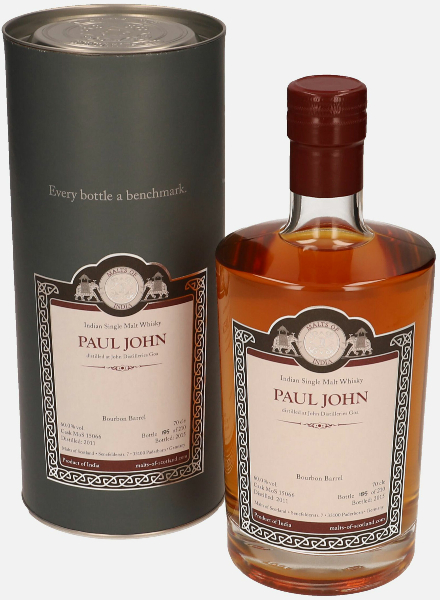
Paul John 2011/2015 (60%, Malts of Scotland, Bourbon Barrel MoS 15066, 210 bottles)

In the previous post I mentioned that I always have two Paul John Malts open, as well as two offerings from Amrut. I’ve grown quite a fondness for Single Malt Whiskies from India. I’m sure that when more room comes available for open bottles, India will be the first to get more room on my lectern. The previous post was about the peated official Paul John single cask #745 I currently have open, and it’s a stunner again, after #777, and now we’ll have a go at another unpeated one. This time I chose one, bottled by German independent outfit Malts of Scotland (and in this case: Malts of India, really, it says so on the label). This is not the first Malts of Scotland’s Paul John on these pages though, in 2018, I reviewed a different cask, MoS 15068, that matured longer and contained peated Whisky, and again yet another stunner. Both Malts of Scotland and Paul John need no further introduction, so lets move on to the tasting.

Color: Full gold.

Nose: Malty and biscuity. Cookie dough with fresh citrus notes, occasionally sweet mint, and quickly taken over by more woody and dusty notes. This one smells a bit younger and simpler than #745 and #777, lacking some age maybe and the added bonus of peat. This is a back to basics kind of a smell. Since the peat is not here, there is more room for this Malt, or the Paul John distillate in particular, to show its more floral side (borderline men’s cologne). The wood is, well woody and waxy, and somewhat spicy, but not your typical Indian or exotic spiciness though, but a kind of spiciness that can be had in a Scottish Malt as well. Let’s say spices coming from the wood. So, kind of heavy, but the rest is fresh, floral and friendly. The sun is shining in this one even though the “heavy” bit can dominate at times. This is definitely a less complex Paul John, but a Paul John nevertheless, very recognizable. At first I thought this was maybe a closed Malt and given time it would develop some more, but no this is more or less it. Not bad, but simpler.

Taste: Initially sweet and fruity. Wax and ear wax. The sweetness is quite quickly pushed aside. A little sting from wood, some woody acidity as well. This must have been quite an active cask and maybe it aged right under the roof in hot surroundings. Quite some woody bitterness now. Big and hidden sweetness now, with a lot of wood spices. Barley (sugar) and biscuity. Soapy feel on my tongue. But even for this quite young Paul John, this is still remarkably balanced and very tasty. Again dangerously easy to drink, even though it is wood driven and bottled at 60% ABV. Quite hot going down, this sure is a 60% Malt. The finish is more of the same, wood, wax and to a lesser extent, some fruit in the aftertaste. Quite some bitterness stays behind in the middle of my tongue. I’ve spent some time with this Malt, again thinking it might be somewhat closed, but no, again it is what it is and for me it is quite a simple expression dominated by a few big aroma’s mentioned above.

So there you have it, all in all a simpler take on a Paul John single cask, quite young and dominated by wood. The wood gave off quite some bitterness, that I believe they couldn’t even leave it ageing for longer even if they wanted to, before the bitterness would be taking over, and dominating this Malt. As it is now, the bitterness is still acceptable, but definitely present. Luckily there are some other dominating factors in the Malt as well, not to let the bitterness rule. So still, a good, rather young and simple Malt. I say young, but coming from India this has nothing to do with the aroma’s of new make spirit, so don’t you worry ’bout a thing! This is still a good Malt and I’ve spent many happy moments with it, especially when it’s sunny.

Points: 86

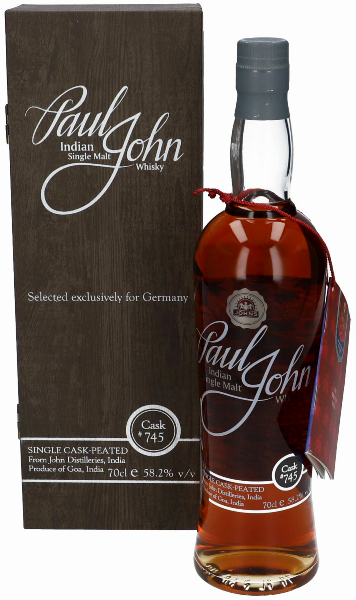
Paul John (58.2%, Single Cask #745, for Germany, Peated, 2016)

On an average day, I have two open Paul John bottlings on my lectern, if possible one peated and one not peated. Recently I reviewed the two bottles I had open at that time. The official peated cask #777 and an unpeated 6yo Cadenhead’s bottling. Both are gone now, and have since been replaced. Today we are going to have a look at the peated replacement bottle. This one is another official single cask release and even better, it looks like a sister cask of #777. Why would you do that? I hear you ask. Isn’t there a risk that it’s more of the same? A similar cask, with the same distillate in it? Well first things first. #777 was so good (it scored 90 Points), that there is definitely no risk in opening another one of those beauties, even if it is exactly the same (which I doubt). Second, as many Whisky producers and bottlers already tried to show for a few times now, (remember Gordon & MacPhail’s “Wood makes the Whisky” campaign?). Wood makes the Whisky, and no two casks are alike, just have a look at my reviews of Gordon & MacPhail’s Ledaig cask #464 and cask #465. Both the same distillate, the only difference being the cask itself (and what it previously held). So I’m confident the differences between #745 and #777 will be easy to spot and maybe even greater that one would expect.

Color: Orange golden brown.

Nose: Initially fresh and friendly. Lots of honey, oranges and a lot of prepared horseradish (Chrzan). May seem strange, but I get this every time and its here right from the start. Nice clean wood and sometimes fresh sawdust, which changes into more wet wood pulled from a prolonged stay in a pond. More prepared horseradish and ear wax. Fresh, fruity and also some candied fruits. More honey, wax and wood. Licorice. Fatty, organic and perfumy. J.M Rhum from Martinique. Extremely aromatic, complex and right from the start balanced and big. There is so much happening, that the wood has been pushed back quite a bit, I can’t image the wood is that soft, hidden under all these aroma’s. More floral than peaty, with some smoke. Fireplace on a cold winter’s evening, Christmas, but also the smell of horseradish incense sticks, as if they would exist), but not much. Deep smell of waxy almonds, toffee and clay. Smells like a rural house this, a house thoroughly in use, with wave after wave of smells passing by. Furniture smells, smells of preparing food, smells from the fields outside (including the clay), whiffs of a perfumed woman passing by, whiffs of cold dish water, whiffs of funky organic bad breath and warm, almost melting plastic (polyester!) and the smell of the dusty insides of a warm old TV. The plastic/polyester, once smelled, will be around and can’t be un-smelled. What an amazing smell this Malt has. Smells released in many layers, amazing complexity. Tiny hint of smoke trickles in from outside, but the even sharper element in this nose is still the prepared horseradish. You know salted caramel? Well, this one is more horseradished caramel. I like that, since I don’t encounter horseradish a lot in Whisky. More honey, toffee and vanilla powder. It certainly has excellent balance, and layer upon layer of complexity. Very good expression again, I like it very much. It is a wonderful Malt to smell, but beware, it can anaesthetize your nose for some time, since the smell is so wonderful and complex you’ll be smelling this for a long time before tasting. After numbing down your nose, further smelling is futile, after which it is better to have a taste…

Taste: Well, more wood here, and most definitely waxy, nutty and sweet. More of the Rhum Agricole notes as well. Sometimes, yet not always, a hint of cola early in the taste. There is this certain (slightly unbalanced) acidity to it. Smoked toffee and caramel are here, spread thinly, but where is the honey? Well? Undistinguishable sugared ripe fruits. Faint orange skin oil, grapefruit meat. Toffee, corn flakes and quite some licorice, and lots and lots of ashes (cigarettes in an ashtray, the day after). Syrupy sweet, runny caramel. Waxy and fruity. Waxy fruit and ear-wax. This is a bit of a strange puppy, because this has plenty of tastes originating from fire, but they really aren’t from peat and smoke this time. Dry, cured, salty and smoky meat. Cigar smoke and smells I have only encountered in a Sauna. This one is quite ashy. Is there something like waxy cigarette ashes? A quite nice sweetness makes the Malt bigger. Is it fruity underneath? Thus, again a big Malt. Now, more smoke than peat in the nose. No horseradish (well, maybe…). Must have some hidden wood now, because it carries some bitterness. There is so much happening, that even this medium size bitterness isn’t half bad. After extensive sipping, the Horseradish is even more obvious on the nose. I encourage the people of Poland to try this Malt with their excellent szynka, and let me know if the chrzan notes match up. Ashes here too, dominating the aftertaste. Liquid smoke, still not peaty though. The finish is waxy and woody. The aftertaste is warming and somewhat stinging. Smoke and wood spices, somewhat less friendly, but bolder, towards the end. Polyester returns in the aftertaste. Very interesting Malt with a finish of medium length.

This is definitely the most complex Malt I have smelled in a long, long time. This has many layers and many different and unique smells. The empty glass smells of Honey and wait for it, an electrical fire and iodine, something I didn’t pick up on, when smelling the Whisky whilst reviewing.

In comparison, the recently reviewed cask #777 is way more friendly. It’s a dessert in itself. If you compare this to the Swayze brothers, #777 is Patrick and #745 is Don. They both share a lot of genes and it is easy to see that both are brothers. Just #777 is more “beautiful” and #745 is more “rough”, less polished. Maybe it’s even deeper. Even though both Whiskies share a lot of the same markers, #777 just outshines #745, although for some #745 has many amazing bits as well. #777 seems better balanced and more “perfect”. Softer and friendlier. #745 has more power, and a lot more complexity and an amazing layering of smells. The peat comes through better in #777 and it’s heavenly, especially in combination with the Malt’s sweetness. #745 has more honey, wood and waxiness coming through, but it also has a lot of unique aroma’s. Some elements are just bigger and more exaggerated in comparison to #777. I can imagine that over half of the time one would prefer #777 over #745, but definitely not every time, sometimes bigger is just better. Yes, with #745 we have another belter, I repeat, another belter from India on our hands. Life is good.

Points: 89