Octomore 5yo “Edition 02.1 / 2_140” (62.5%, Bruichladdich, Ochdamh-mor, American Oak, 140 ppm, 15.000 bottles, 2009)

After the sweet and weak Glenfiddich, time for a potential beast. This Octomore, the brainchild of Jim McEwan was, when it was released, the most heavily peated Whisky in the world. Today we look a little bit differently at 140 ppm, since Octomore 06.3 is peated to a level of 258 ppm! Octomore 06.3 is a lovely Whisky and shows quite some fruits and the peat doesn’t even seem that heavy as it sounds. But time to rewind a bit and have a look at Octomore 02.1 that was already released in 2009. The first Octomore that was released is known to the world as 01.1, peated to a level of  131 ppm and bottled in 2008. The first ever Octomore distilled by Jim has never been released, but a small group of people had the chance to try it at the Whisky Show 2015 in London earlier this month, and Jim has probably brought it with him elsewhere too. The first ever Octomore was distilled in 2002 and peated to a level of 80.4 ppm. Filled into a first fill Oloroso butt and bottled at 62.3% ABV. I didn’t take notes since I was listening to Jim, but managed to score it 91 Points.
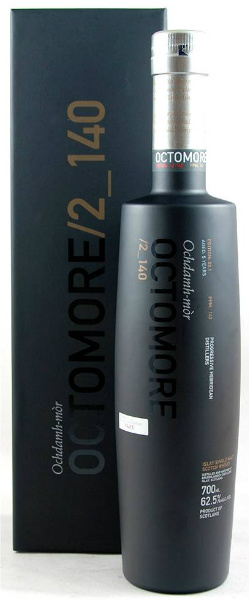
Octomore Edition 02.1 / 2_140 (62.5%, Bruichladdich, Ochdamh-mor, American Oak, 140 ppm, 15.000 bottles)Color: Very light gold.

Nose: Fatty peat and hints of red fruits, mostly berries. Peated barley and slightly medicinal, iodine. Smoky. Actually this smells like a lot of Whiskies from Islay do. In nothing you get that it is more than heavily peated. When you let it breathe for a while, a more (yellow fruity) sweetness emerges. Altogether for this to reach a more balanced state, you must give it some time. More meaty, smoky, tarry and salty aroma’s emerge. Burning off dry plants. Licorice, sweet wood and smoke in the mist. Wait even longer and hints of menthol and lemon can be smelled. the whole gets even softer. Old furniture and even creamy. Vanilla Ice cream with pepper and salt. Old paint and some nuttiness emerge late. Cotton candy. If you handle it well, if you are patient with it and use a glass that can handle air well, you’ll be rewarded. Wonderful nose which keeps on giving and giving.

Taste: Again  very creamy. Peppery and lots of it. Peppery attack with lots of licorice and sweet wood. Matches the nose perfectly. Quite sweet, but the rest of the aroma’s are pretty “there” as well so it handles the sweetness perfectly. Hints of old wood integrated with the licorice. Lots in common with Port Charlotte (obviously). Taste is very balanced, but less complex than the nose. It will be great to see Octomore (and Port Charlotte) mature.

Excellent example of a Whisky you have to work hard for, to be rewarded. It needs a lot of time and air to be at it’s best and show you all it’s got. Use the wrong glass or being impatient with it, will degrade this to nothing special at all. This is a wonderful yet modern spirit, which already is great if you know where to look. Lots of potential. The aroma’s are so big it even hides the high strength. I didn’t try it with water, but I’m sure it will take water well. Pour yourself a dram and then drink something else first, come back to this later.

Points: 87
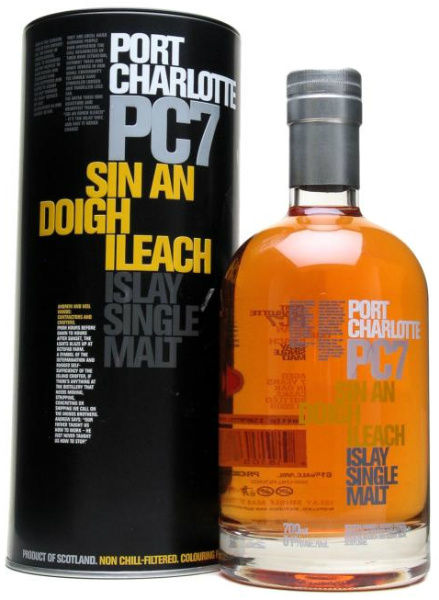
Port Charlotte 7yo 2001/2008 PC7 “Sin An Doigh Ileach” (61%, OB, 24.000 bottles)

Since 2006 with the release of PC5, once a year a PC edition is released. All distilled in the first year of distillation. As we know by now, the first distillation of Port Charlotte was done on the 29th of May 2001. In 2007 we saw the release of PC6 and in 2008 we saw the release of PC7, which we’ll review here. At this moment, I don’t have any more PC editions around, but it would be nice to follow the evolution of PC’s someday…

Port Charlotte PC7Color: Full gold.

Nose: Funky and meaty. Can this be Sherry influence? Pudding. Pencil shavings and mild fatty peat. Very creamy with small hints of banana. Nice interaction between the wood and vanilla. Cold black tea. Perfumed tea mixed with breaths of fresh air. Hints of sweetish yellow fruit yoghurt, what? Peach, passion fruit & maracuja. Heaps and heaps of aroma carried by a menthol/mint concoction. Hints of, wood, hay, ashes and again licorice like the An Turas Mor I reviewed last. Again good stuff to nose.

Taste: Powerful ABV yet not as warming as the An Turas Mor. It’s ABV does dry out the throat a bit. Creamy. It’s all there again. Lets call this vanilla pudding, shall we? Vanilla pudding with salt and pepper, that is. The way the peat comes across in Port Charlottes, makes them very tasty. Aloe Vera lemonade and hints of florality. Nicely integrated wood. Here we have some more wood to function as a backbone. Vegetal notes whiff in and out and the wood is somewhat floral. Slightly salty. Latex paint and mocha. Hardly any bitterness at all. Port Charlotte is growing more and more complex. Still its quite youthful and that shows in the weaker finish compared to other Islay Whiskies. But don’t worry, there is a lot going on before the finish.

Really nice distillate Port Charlotte. Well made stuff.

Points: 88

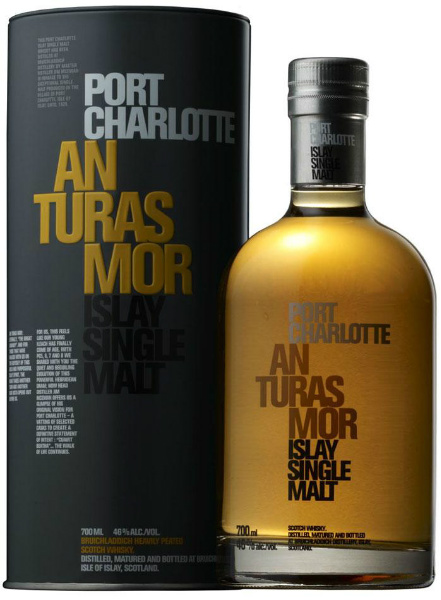
Port Charlotte “An Turas Mor” (46%, OB, American Oak Casks)

In 2000 Murray McDavid bought Bruichladdich for £6.500.000 (from Jim Beam, current owners of Bowmore and Laphroaig). After acquiring the distillery guess what was the first distillate made? Yes! Port Charlotte, not the unpeated Bruichladdich itself. The guys behind Murray McDavid are no fools. We all know Mark and Jim to be very shrewd guys. So the first stuff they wanted to make with their new distillery was peated Whisky. On the 29th of May 2001, the first Port Charlotte was made. The first Bruichladdich under new ownership was somewhat later distilled in July. (2001 which was also the year the first newly bottled Bruichladdich was released; the 10yo I just reviewed, the 15yo and the 20yo). Finally on the 23rd of October 2002 the first Octomore was distilled.

Port Charlotte "An Turas Mor" (46%, OB, American Oak Casks)Color: Pale gold.

Nose: Mild, fatty vegetal peat, with butter and vanilla, pepper and salt. It smells like lavas was one of the plants that makes up the peat. Quite soft and unobtrusive. Some smoke and a tiny hint of burnt plastic and traces of soap. Sappy licorice twig. Wood lying around in the forest. Fresh (air) and un-complex. Dry kippers with hints of tar. Dusty vanilla and some paper. Nice to smell. The nose is worth the price of admission.

Taste: Sweet and peat. Sugar water with slightly bitter peat. Sweet licorice and black and white powder (yes, licorice again). Slightly warming. Licorice and licorice twig. Very tasty (the sweetness helps it along), but not very complex, but who cares when it’s so drinkable. Reduced, brooding peat that resembles coffee a bit. After a decent body, comes alas a sort of weak finish. A finish full of paper, barley, hints of soap and sweet licorice, but I guess we can blame its youth for that.

Lots of young Whisky is noticeable in An Turas Mor, but it shows a lot of potential though. This will become a great peated Islay Whisky when it becomes of age. I feel that Port Charlotte is a sweet Whisky that can be high on aroma, but struggles a bit with its length when it’s young. Highly drinkable, likeable and definitely worth its money. Get it, it’s not as expensive as the PC’s.

Points: 84

Bruichladdich 10yo (46%, OB, 2003)

Earlier I reviewed the most recent, standard range, Bruichladdich from the Dumpy OB era: the Scottish Barley bottling. Today we’ll have a look at the one that started it all for the previous owners. A short recap is in order I guess. In 1994 Bruichladdich was closed (again) since not a lot of Malt Whisky was needed back then. In 2000 Bruichladdich was taken over by a group of people fronted by Mark Reinier (of Murray McDavid), who in turn, asked Jim McEwan to take on the post of master distiller and (progressive) production director. Who would have thought Jim to ever leave the Bowmore building. In 2001 Bruichladdich was reassembled, without making it a computer driven modern distillery and without disturbing the Victorian bits as well. If memory serves me correctly, by 2001, three bottles were released as some sort of core range. A 10yo (this one), a 15yo and a 20yo. So this 2003 bottling, is one of the next batches after that. Yes no NAS bottles back then yet!

Bruichladdich 10yo 2003Color: Light gold.

Nose: Light, sweet barley. Extremely dusty. Paper. Dishwater citrus, but also perfumy wood, otherwise not a lot of wood noticeable. Pretty fruity. Thick sugared yellow fruits. Some pineapple and papaya with a slight hint of mint and cardboard. Somehow it smells sugary with hints of toffee and caramel. No peat.

Taste: Paper and a sweet woody note. Also something metallic. Perfumy too. It tastes almost the same as it smells. A bit hot on entry, but quickly dissipating the heat. Citrus fresh, but not of the dishwater kind. Rhubarb and again some caramel, which moves into toffee towards the finish. Hints of mocha and wood. Some woody bitterness helps the Whisky along. To my amazement, the dishwater component returns.

The current entry-level Bruichladdich is the NAS Scottish Barley and as luck would have it, I still have that one here too! The Scottish Barley has a lot of butter on the nose, but the fruit reminds me of the 10yo (but only the fruit). Definitely a younger Whisky. More raw and closer to new make spirit. It even has a tiny amount of smoke (and a wee bit of peat and oil, since it resembles Springbank a bit), which is nice. Tastewise the NAS is even simpler than the 10yo, more on barley and lacks some of the off notes of the 10yo.

I was never a fan of the 10yo, and after more than ten years, I still don’t like it that much. The Scottish Barley however, reminds me of Springbank, and even though it is simpler, less complex, in this case I prefer the NAS over the 10yo. (The “Yellow Submarine” I had next, was definitely better than both)

Points: 78

Bunnahabhain 35yo 1976/2012 (48.8%, The Whisky Mercenary, 80 bottles)

500I almost missed it, but this is already the 500th post on masterquill.com. Three and a half years have passed since the moment I wanted to see with my own eyes how a blog was made, so I never intended to continue after the first few reviews. The next few months no new posts were written, but after a while I picked it up again, never to let it go again. It’s too much fun to do, and it still is. It is a never-ending quest for the nicest of drinks that are available on the planet. So much more to discover.

I don’t have to post every day, but I try to have something up every other day. Once in a while I let it be, due to sickness (a.k.a. the nose doesn’t work properly), WiFi-less vacation or other reasons, and I don’t feel bad about it, so it doesn’t feel like something I must do. I have no plans of getting bored with it, or plans to retire after a while. There are so much more drinks around, and so much more to explore and learn, that I fear I will never get bored with it at all. Still, you never know, there have been others I loved to read that have stopped (and some have continued after a while). Here’s to the next 500. Let’s take it one step at a time.

Bunnahabhain 35yo 1976/2012 (48.8%, The Whisky Mercenary, 80 bottles)Time for the 500th post then. I had to pick something special, so why not a nice and old Bunnahabhain. Islay is hot, and so are the picks of Jürgen Vromans. Our beloved Belgian independent bottler. Nothing wrong with his nose, so I have high hopes for this 35yo Bunna. Cheers!

Color: Light gold.

Nose: Soft vanilla and wood, Definitely slowly matured on a slightly active cask. Some sweetness and a tiny hint of what seems to be a sort of waxy peat. light old elegant wood. Hints of chalk and a nice restrained fruitiness (yellow fruits). Old dried out paint dust and a great deep vegetal note. Excellent wood, creamy wood almost. Nothings really sticks out. It all is light and elegant and held back. Tread tenderly with this one. Old skool with excellent balance. Lovely. Should have come with a label in Paisley motif.

Taste: Quite spicy with a burst of sweetness coming from a dried licorice twig. Otherwise the Whisky has a great dry/sweet balance to it. Dry on the nose and dry on the mouth too, with some nice sweet and fatty touches to it. Creamy wax. Vanilla and half-dried pudding. Again a delicious fruity taste, again yellow fruit, mixed with a hint of sweetish black tea. Well integrated woody notes with just a small amount of woody bitterness.

This is a lovely old Whisky, well worth its initial Retail price. Jürgen picked a wonderful old and delicate or even fragile Bunnahabhain. Wonderful stuff. No heavy hitter and lots of nice details. Good balance with decent complexity. I should have gotten me one of these when I had the chance…

Points: 90

Bruichladdich Classic Laddie Scottish Barley (50%, OB, 2014)

In the more recent past when Bruichladdich had different ownership, a lot of bottlings saw the light of day and a lot of bottlings comprised the standard range. Now that the distillery has changed hands and tries to be a fashion accessory, the stanf=dard range is reduced to only two NAS bottlings. Scottish Barley and Islay Barley. If my memory serves me well, all standard bottlings with an age statement have been dropped.

In 2013, this same Whisky was released with a somewhat different “label”. The first release had big lettering for “Scottish Barley”, whereas the 2014 release I’m about to try, has “Classic Laddie” in big lettering. I have tasted the 2013 version and scored that one 85 points. Let’s see if this newer version is equally as good.

Bruichladdich The Classic Laddie Scottish Barley 2014Color: Light gold.

Nose: Well this is a nose that screams Barley. Very young smelling and even has some Bladnoch-butter. Fatty, with a citrussy edge. Hints of new make spirit, and given some time to breathe, a more bread like, coffee and milk chocolate note appears. The whole is quite soft. Wet. fresh wood. Virgin oak. Nevertheless it is also recognizable as a Bruichladdich. It does remind me sometimes of the Cadenhead Bruichladdich 17yo I reviewed earlier.

Taste: Soft paper like wood and an extremely creamy taste. Coffee with a lot of milk. Chocolate milkshake. When the higher ABV flows down my throat a short flash of hotness flies by, but also dissipates quickly. Cream with a hint of ashes. Bourbon and vanilla, but also dark chocolate and a faint fruity note. Cherry liqueur bon-bon? Virgin oak again. Lots of barley (and sugar?) in the finish. Barley, oak and cream are the three words that describe this Whisky best I guess.

As consumers we are compensated. We get less ageing and less complexity, but we get more ABV. 50% to be precise.

Here we go again, another NAS bottling that will split the Whisky world in two. Definitely a young, crude and uncomplex Whisky, but at the same time a nice and designed sophisticated soft taste that a lot of people will like. The Bruichladdich spirit is a good spirit, but this spirit didn’t get a whole lot of time to develop. It’s like a child asked to drive a bus. Some would even say that this isn’t really Single Malt Whisky. If someone had invented this about a 1000 years ago, he or she, may have called it Barley Wine. Not bad, but not my NAS of choice.

Points: 81

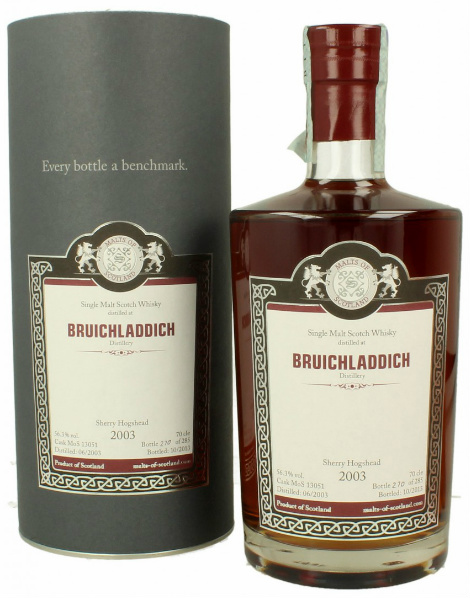
Bruichladdich 10yo 2003/2013 (56.3%, Malts of Scotland, First Fill Sherry Hogshead, MoS 13051, 285 bottles)

Almost two years ago I reviewed a Glen Keith bottled by Paderborner outfit Malts of Scotland. Being an indie with quite a reputation it took me quite a while to review another bottling of theirs. A sample of this very Bruichladdich was bestowed upon me by the former owner of this very cask. MoS renames the cask numbers so we do not know the original cask number. I hate it when Thomas does that, just like Bert does with his Asta Morris bottlings. Something to hide guys? Well nothing more to say really, (I’m a bit distracted by some nice live music by Primus), so let get on with it…

Bruichladdich 10yo 2003/2013 (56.3%, Malts of Scotland, Sherry Hogshead, MoS 13051, 285 bottles)Color: Orange brown.

Nose: Mellow Sherry of the Oloroso kind. Soft wood, dry forest plants like fern and slightly sulphury. Freshly baked bread. Chocolate, brown sugar, honey and fruity acidity from red fruits and berries. Vanillin and a distant bonfire in the woods. Wet earth and mocha. Raisins. Nice and pretty laid back. Mint in the finish (when warm).

Taste: The fruity acidity from the nose. Waxed chocolate sprinkles, cola and some wood. Again some sulphur, but not a lot. Extremely warming. The acidity stays on well into the finish and deep into the finish the sulphur gets more room to play, but still it is not a lot and never overpowering. It’s in the background carrying the aroma along with black tea leaves and a hint of woody bitterness. Not a very long finish though. Reminds me a (more than a) bit of the Bunnahabhain and to a lesser extent of a Bruichladdich I reviewed earlier. A quieter version of both I guess.

I have to say this one needed warming up. Even at room temperature I found it pretty closed, but when I held it in my hand for a while it showed a lot more of itself. Honey in the body and mint in the finish for instance. When I finished it, I poured myself a fresh dram, and again, very closed. This is an example of a closed and dry heavily Sherried expression as opposed to a fruity one. Bottled at the right time. Ready for another strange remark? The empty glass smells better than the full glass…

Points: 85

Thanx Andy!

Caol Ila 21yo 1981/2002 (58.2%, Signatory Vintage, Cask #465, 364 bottles)

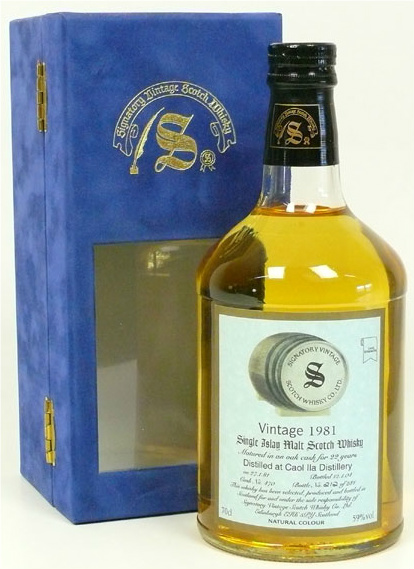
Just recently I reviewed a 21yo Caol Ila from Signatory Vintage Cask #467. When rummaging through some sample bottles I collected over the years one of its sister casks popped up. This time it is Cask #465. How’s that for luck. And as luck would have it, I still have a wee bit of cask #467 left, so a comparison can’t be avoided. Again no picture available for this particular cask, seems to me this is very obscure stuff. I’ll use the ol’ picture of cask #470 again. So without further ado…

Caol Ila 22yo 1981/2004 (59.0%, Signatory Vintage, Cask #470, 281 bottles)Color: Light gold. The color of this one is ever so slightly lighter than cask #467.

Nose: Grassy and vegetal. Citrussy. Fresh and actually young smelling. Even the wood smells sappy. Powdery. Hints of soft, fatty, and creamy smoke. Appetizing. Milk chocolate (with sugared citrus in it) and a tiny hint of latte. All very friendly smelling, and although this is not a heavily peated Caol Ila it is very attractive. Good balance.

Taste: Sweet and fruity. prickly smoke with some late development in the licorice department. Light licorice. also a tiny hint of cannabis, so probably a lot was allocated to the Netherlands. Alcohol and again a small hint of coffee and fern. Milk chocolate again. Small amount of woody bitterness starts the finish and lingers on the back of my tongue. Not the most expressive of Caol Ila’s but quite nice in its own way. Not a very long finish. The high strength is obvious on the tongue, but not a lot of aroma is left in my throat. It’s not what you would expect from a Caol Ila like this, but when you let that go, it’s pretty rewarding.

Comparing the two, the noses of the two are obviously pretty similar. Cask #465 has the better nose, more balance to it. Aroma’s seem to fit together better and has more depth and complexity. Still the difference is not great. The taste is very similar too. Cask #467 seems to be somewhat more raw at first, and less balanced.After a while it is also softer and sweeter in the finish. Cask #465 is for me the better pick of the two, with even a slightly better finish, so overall it performs better. Still they are really twins and the differences are in the details and easier to pick up on when doing a H2H.

Points: 86

Thanks go out to my mate Michel for providing this sample (a long time ago).

Laphroaig Week – Day 7: Laphroaig 16yo 1988/2004 (52.5%, Douglas Laing, for The Whisky Shop, 614 bottles)

Laphroaig SignWell, weeks are only seven days so they are bound to be over very quickly over. Today is the seventh day so I hope to finish this Laphroaig Week over with a bang, but you never know. This particular Laphroaig was selected by the Whisky Shop from the stocks of Douglas Laing in the dumpy green bottle, Whisky geeks love so much. In the early days it was a mark of excellent quality, or maybe they just bottled it like this because it was bottled at cask strength. Obviously this Laphroaig is from a cask that once held SHerry, just look at the sheer amount of bottles yielded at cask strength. Great! I love the combination of (extreme) Laphroaig and Sherry…

Laphroaig 16yo 1988/2004 (52.5%, Douglas Laing, for The Whisky Shop, 614 bottles)Color: Copper gold.

Nose: Tar, salty licorice and raisins. Extremely brooding. Thickly clad Sherry, musty and funky. Intertwined some red berries and other aromatic red fruits like ripe little forest strawberries. This kind of Sherry-ness we’ve encountered before in a bottle of Scapa I have. Whiffs of freshly cut oak planks and oriental spices. Cardamom and saffron spring to mind. Nice whiffs of dusty dryness and sawdust from very old dry wood as opposed to fresh sappy oak. White pepper and dried out Marmite with black coal. The tar reminds me of a warm road. It’s not a thick tarry note, but just enough to add to the wonderful complexity of this Malt. The peat shines towards the end. What wonderful stuff this is. One of great complexity and balance.

Taste: Tarry with the typical ashes and licorice I also found in the Laphroaig I reviewed on day 5. Hefty Sherry, big body. Sweet and creamy, but not as fruity as the nose suggested. Noticeable is a slight fruity acidic undercurrent, that is almost hidden away. This is something I usually get from very old bottles, so its more than welcome here. This fruity undercurrent doesn’t show itself after a fresh pour. This needs time to develop, so this Whisky comes with an operating manual. Tar and coal. Steam locomotive. The Sherry plays a big role and gives of some nice subdued fruity notes, but the Laphroaig underneath is doing well too, with some great peat. This comes together nicely!

Laphroaig came through and never disappointed. Some conclusions you might ask? Well all in all Laphroaig is a pretty good Whisky. It is still one of the greats, but not as good as it once was, but which distillery truly is? None of these seven reminded me of the stellar old 10yo’s of yesteryear. Neither the 10yo @ 43% ABV nor the Cask Strength versions, but then again I didn’t review any 10yo in the Laphroaig Week now did I? The 15yo was a great malt from its day, different from the 10yo’s. The 18yo is decent but for me not as good as the 15yo. Simpler I would say. The An Cuan Mòr was is a well crafted surprise, which I can heartily recommend from the modern range of Laphroaigs. The independents did manage to get their hands on some great sherried Laphroaigs, although very good sometimes it is Obvious why some casks did find their way on the open market. Sulphur! Still I liked the Kintra expression. Douglas Laing also were represented here with some nice Sherried versions and an odd one that had all its aces up its sleeve. You had to work for gratification. The Laphroaig Week is over. A sad moment, but I hope to review a lot more Laphroaigs on these pages. Hope you liked it.

Points: 90

Laphroaig Week – Day 6: Laphroaig 21yo 1987/2009 (50%, Douglas Laing, Old Malt Cask, Refill Hogshead, DL REF 4855, 439 bottles)

Laphroaig SignPenultimate day of Master Quill’s Laphroaig week and just as yesterday, another Douglas Laing Laphroaig. Seeing a pattern here? So which one will finish this series off tomorrow?

As luck would have it, we have another 1987 Douglas Laing today. Judging by the looks of it, probably a very different one. Yesterday’s Laphroaig was pretty pale at best, but this one boasts a nice and healthy colour. It’s like summer and winter, Jekyll and Hyde, night and day, Sherry and Bourbon. Still something strikes me as odd here. The label states this is from a Hogshead, but even with the slightest of reductions to 50%, this still yielded 439 bottles. Surely this was a Butt or a Puncheon, or was is a big hoggie?

Laphroaig 21yo 1987/2009 (50%, Douglas Laing, Old Malt Cask, Refill Hogshead, DL REF 4855, 439 bottles)Color: Copper brown

Nose: Nice chocolaty Sherry. Sea wind at night, but in summer, so a chilly night after a warm Sunny day. Clay and very toned down peat. Sugared onion. Not very expressive. This one is a bit shy, even considering it’s heritage. It doesn’t leap out of the glass at you. Sherry influence is quite obvious, but it’s not very peaty just like yesterdays 1987. Smoke? Hardly. Cold black tea and some meaty notes, dried meat and almost cold gravy. Nice and restrained. All the aroma’s do fit well together. Not fruity.

Taste: Sweet with burnt sugar. Definitely a more bonfire aroma. Powdered sugar and some wood. Late licorice, just as yesterdays 1987 Laphroaig. Wood stripped of old paint, of which the dust is still flying in the air. The slightly burned note stays on throughout and makes it into the finish. When working on it, it does show some fruit, but not much. No fresh fruits, but something dried like dates and raisins. PX-Sherry? All in all elegant stuff, but with dirt under its fingernails. Not without flaws in its character too.

This is the second 1987 Douglas Laing Laphroaig and there are similarities and there are differences. Both expressions aren’t very expressive and are toned down. No heavy hitting peat and not much smoke (if any) a Laphroaig light so to speak. This 2009 bottling has the added Sherry, and by the taste of it, this wasn’t a top (PX) Sherry cask or it may have been a treated cask. I somehow can’t imagine this to have aged its whole life in the same cask. Having said that the combination of the two does work somehow.

Points: 87