Bladnoch Vinaya (46.7%, OB, Classic Collection, 1st Fill Sherry & 1st Fill Bourbon casks, 2021)

Only the third review of a Bladnoch on these pages, I actually thought there would be more. I guess the first review of the 8yo Beltie Label was a true learning experience to get to know Bladnoch. Bladnoch had a bit of a reputation and that particular bottle when freshly opened just confirmed this reputation. If I’m not mistaken the 8yo fully came out of the production when Raymond Armstrong was the owner. He produced mostly between 2000 and 2009. However, the more I tried it and the more air went into the bottle, that’s when the magic started happening.

Fast forward all these years (since 2012) and now Bladnoch is one of those “obscure” Malts that I really like. Between that review and the next, Bladnoch Distillery changed hands, and the second review (in 2021) was the official 10yo bottled in 2018 by the new owner David Prior. David’s Bladnoch started production in 2017. Comparing both reviews you can clearly see I warmed up completely to Bladnoch. When I finished the 10yo I replaced it with the Vinaya, which is a NAS Bladnoch, again from the new owners, to see how I would feel about another young Bladnoch like the 8yo, now that I’ve become fond of Bladnoch. Would the Vinaya have a similar false start like the 8yo Beltie, or is it more like a NAS version of the 10yo I mentioned earlier. First of all the difference, apart from the age statement, is that Vinaya has in part matured in Oloroso Sherry casks, where the 10yo matured solely in Bourbon casks. Vinaya uses older casks from Raymond’s Bladnoch blended together with (probably 4yo) Whisky from David’s Bladnoch.
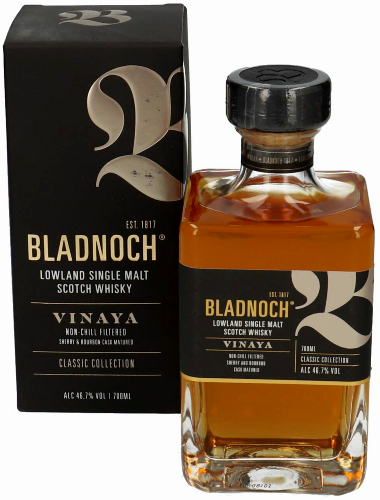
Color: Gold.

Nose: Malty, pleasant, with slight notes of diluted Red Wine, which is also noticeable as an added acidic note. Also candied lemon seems present. Fruity overall. Fruit syrup. Since we know that this has some young Whisky in the fold, I’m happy to report that there is no sign of new make spirit or anything that resembles that. Creamy notes from American oak also some notes of toasted oak. It has a slight “bite” to it, which is very nice in combination with the thick fruity aromas. Yet again a big smelling Lowland style Malt from Bladnoch. Lowlanders are often grassy and hay like (and so they should, its their heritage), yet Bladnoch in general are pretty creamy and Vanilla-like, and all of this in a big way. Maybe that’s why I always liked St. Magdalene (Closed) en thus Bladnoch (Very much alive again). So the nose is big, big on the traits of a Whisky matured in Bourbon casks. Bourbon definitely plays a larger part in the profile of this Whisky than the Sherry does. Quite surprising, since the Sherry casks are first fill as well. Candied pineapple, (yellow) fruity aroma’s emerge. Hints of paper as well as traces of burning paper, Wine again and warm butter. Dust and the wood of an old dried out cask. Pretty mature smelling for a NAS-Whisky. Very good nose this NAS-er has. Hints of old style Malt, which is a surprise considering the composition of this NAS. I foresee great potential in Bladnoch’s new production, which as mentioned above, started just in 2017.

Taste: Just like the nose this starts Malty. Warm super-ripe fruit mixed in with a lot of cardboard (Malt) and some young wood. Here the wood provides a “bite”. Warm apple compote in a soggy cardboard box. Yes, definitely a fruity Malt, just with this wood/cardboard edge to it, probably from the Malt of the younger production. Next sip, more of the cream and vanilla, as well as some sweetness, astringent wood and distant nuttiness. In a way dull, in a sort of basic Malt kind of way that is. Simple, without a lot of development (by the way, the nose does develop more than you would expect). Present also, luckily, this acidic note from the nose, only less so. The whole is definitely a lot simpler than the nose promised. Not very expressive to be honest, yet what you do get is nice. Dull is a fitting word, not to be confused with boring, although I can imagine some of you aficionados that are not (yet) into “back-to-basics” (again) would call this boring. Still, it is fatty, creamy. Not entirely sure this Whisky is 100% balanced though. I get the Sherry influence, but it doesn’t seem to be perfectly integrated. Medium to short finish (hey, it’s a NAS), again with this slight unbalance to it, somewhat paper-like. The aftertaste is slightly creamy with wood and warming, with something new: hints of gout de petrol. I wonder how much of the new production is in this and how it is on its own. By the way, don’t let this sit in your glass for too long, a fresh pour tastes the best.

An excellent nose for an NAS-Whisky, yet somewhat less thrilling to taste. It’s good, yet not spectacular. But hey, it isn’t very expensive now isn’t it? Definitely worth a go, I would say. Daily drinker kind of stuff. Personally I’m not a daily drinker, far from it, but if I would be, this will definitely be on the list, especially amongst others with a different profile. Sometimes one doesn’t feel like getting a peated Whisky or a Sherry-bomb, but something like this (lets call this a Bourbon+ profile, “+” for the added Sherry influence), is always good. I never grow tired of this back-to basics profile. I’m not sure the 10yo and 11yo Bourbon versions still are available, but I would recommend both over this one. The score might not reflect it entirely, but this is a fun Whisky nevertheless, so no regrets, worth the price of admission for sure.

Points: 84

Ailsa Bay Release 1.2 Sweet Smoke (48.9%, OB, 022 PPPM, 019 SPPM, 2018)

“No other Malt is made with this much science” as said by Stuart Watts, Distillery Manager. Well that’s a first. Single Malt Whisky used to surround itself with romanticism, traditionality and age statements, with people making the stuff, oozing with skills passed on from generation to generation to generation. In the old days it was all handy work and thus skill, so if a Whisky was good it was really excellent, yet also some absolute misses occurred. Today, all seems to be computer controlled and science driven. Good for overall quality, and obviously not forgetting about getting the highest yield from the barley as possible. It also seems that the highs of yesteryear aren’t really there anymore, and I haven’t really encountered any terrible misses as well. So, we now live in a different, flattened out, era, or so it seems.

Ailsa Bay opened with 8 stills in 2007 and is owned by William Grant & Sons, a company we better know as the owners of Glenfiddich and The Balvenie, as well as Kininvie and the Girvan grain distillery. Already in 2013 the distillery was expanded greatly with another 8 stills, all 16 stills similar to that of The Balvenie. The condensers of one pair of stills are made of stainless steel, to make it possible to have more sulfur in the spirit. Usually distillers want to avoid sulfur, that’s why copper is used. Just like Kininvie before it, Ailsa Bay was needed to provide Single Malt Whisky for the many Blends of William Grant & Sons, since the output of Glenfiddich and especially The Balvenie is more and more used for Single Malt alone. Hence commissioning stills in the style of The Balvenie. In 2016 the original Ailsa Bay was released as a Single Malt (021 PPPM and 011 SPPM) and the one we are about to review was the second release from 2018 and that’s more or less it, nothing more has been released as Ailsa Bay. Sure William Grant & Sons also released Ailsa Bay Whisky as Aerstone in 2018 (a land cask version and a sea cask version), dirt cheap and bottled at 40%. Not particularly in a hurry to buy those though, and there are also a few independents that have some Ailsa Bay, often tea-spooned, hence some fantasy names as Ardmillan, Dalrymple and Drumblade. Maybe not entirely fantasy, probably names of hill, water sources etc. etc.

Color: Light Gold.

Nose: Sweet, funky, perfumy, vegetal peat. Wood fire in winter. Cozy and appetizing peat combined with an acidic (almost fruity) note. Quite some smoke as well. Tiny hint of lemon dishwater liquid. This is a good and rather modern smelling peat smell due to the combination of peat with wood fire. Very clean and of medium sharpness, due to the smoky bit. For me peat is usually a more rounded out and earthy smell, and smoke is usually a bit sharper. Nice fresh oak and sandalwood smell come next, as well as a more fire-like a garden bonfire. More vegetal and on the nose definitely more about peat and smoke than it is sweet. If you smell this one carefully, there is also a floral bit (and in my mind also a salty bit), yet not like fresh flowers, more like flowers in peat, if this was possible obviously, without them rotting away to be a part of peat. This is the first Ailsa Bay I’ve had, but based on the nose alone, I’m impressed. It feels like A.I. managed to produce this Whisky, a feeling based on the “science” statement on the label. After a while the peat is still here, softer and more earthy, and the slight sharpness of the smoke dissipated to leave room for a more, sweeter apple compote-like smell as well as some dry, salty and smoked meat. Hints of plastic anyone? Yes even though peaty, this is an elegant and well made Whisky, at least the nose is great, lets have a taste to confirm my suspicion.

Taste: It starts sweet and chewy, but the sweetness, combined right out of the gate with peat, and definitely also with some smoke and acidic fruit. Not apples though as on the nose. Chewy at first (toffee and caramel, check), yet also turning a bit thin. Warming going down. Sappy woody bitterness, wood and smoke. However the perception of this bitterness depends on the moment, and the taster. The second time around, tasting this for this review, I wasn’t picking up as much bitterness as I did the first time. Alas we people are faulty, subjective. I expected the sweetness to be more fruit-like, but it resembled sugar diluted in warm water more. That one wasn’t all that complex as well, but it did show great balance. Hints of mint. Some diluted citrussy and pear-like aromas emerge, hindered a bit by these bitter notes on the side of my tongue. From the wood maybe, but more likely from the peat. F.i. Laphroaig is underneath the peat actually quite a sweet Whisky, but I don’t feel this Ailsa Bay is all that sweet underneath, so 019 SPPM is probably a low number for sweetness. 022 PPPM seems about right for peat, although the whole feel is more peaty than that 022. Peat is definitely what this Whisky is all about. Finally, the taste of this Ailsa Bay is somewhat simpler than the nose, yet I still had a lot of fun with this one. A welcome addition to my lectern. This one most definitely gets a recommendation from me.

So, altogether, this is a true peated Whisky, and a nice one at that to boot. I wonder how this will turn out with some more age to it, when the peat is more sophisticated, leaving more room for the 019-sweetness. Since nothing happened since 2018 I guess William Grant & Sons aren’t really into Ailsa Bay as a Single Malt anymore, probably focusing more on their main brands Glenfiddich and The Balvenie. A shame really, since this is a very nice peated Single Malt as well. I hope there will be a release 1.3 someday, with maybe even more SPPM and maybe slightly less PPPM. The 48.9% ABV works well for me.

Next day, the empty glass feels fatty and slippery (glycerol?), and smells even more peaty than the nose. Still clean and very appetizing though.

Points: 85

Kingsbarns “Balcomie” (46%, OB, 100% ex-Oloroso American Oak Sherry Butts, 2020)

Since this isn’t the first Kingsbarns on these pages, the distillery doesn’t need any further introduction. If you want to know more about Kingsbarns, please have a look at my earlier review about the Kingsbarns “Dream to Dram”. “Dream to Dram” was a very young expression that showed some potential. “Dream to Dram” was also the first bottling of Kingsbarns meant for the general public (released in 2018). It’s reduced to 46% ABV and it’s a bigger batch. The rest being mostly Single Cask offerings. The second general release is this “Balcomie” from 2020 and this year (2021), the third one just saw the light of day called “Bell Rock” which is made with ex-Oloroso Sherry Butts & ex-Bourbon Barrels. Let’s focus on the Balcomie now shall we?

Color: Medium gold.

Nose: Extremely malty and biscuity. Initially this Whisky is about the hints of milky new make, which come to think of it, is a very similar experience to that of Tomatin. Grassy and floral. Cereals, oatmeal and biscuits. Hints of smoke, like standing on a field in summer, where someone in the distance is burning off garden waste. After this green and young start, some of the Sherry provenance of this Whisky kicks in (somewhat), giving the nose something more body to it. Diluted red fruit lemonade and dish water. Light notes of citrus and toffee, without bringing the toffee sweetness actually. Quite some fresh air and some crushed wet mint leaves that already were used one time before for infusion. Citrus fruit with paper and cardboard. Spicy wood sometimes whiffs by. After a while the nose turns more towards the direction of sweet fruit. If you let this sit in your glass for a while, and it doesn’t need a lot of time, the Whisky reaches a more balanced state, without really losing these young components mentioned earlier. I still get this distant smoky note and now it has a more flinty edge to it as well. Not bad, the potential I saw in the previous offer of Kingsbarns is here as well, even though it most definitely smells like a work in progress. Some sort of soapiness comes to the front after you sip it, as well as some honey.

Taste: Thin. Paper-like maltiness, with late sweetness and some smoke (toasted oak probably). Rain water, slightly bitter wood and cardboard. The wood made the Whisky, or so it seems. Tastes like it’s not ready yet, but closer to a Whisky than it is to new make, although notes of new make are here. Some wood, some spicy wood, some paper and some indistinct sweetness. Bees wax and ear wax. Something just had to be bottled I guess. Very young with some oaky notes. Almost like it is almost a different distillate than Whisky. To be Frank, I expected more after the “Dream to Dram” expression. It’s all very young but also a bit boring and predictable, like nobody dared to be more bold, for instance by giving it a more meaningful finish. Maybe there is some conservative thinking behind the Malt? The Oloroso casks themselves hardly impaired a lot of Sherriedness. Tired casks maybe, or not enough time? Maybe some fear creapt in all this could have overpowered the light Lowland style of the distillate. This taste bit of the review might seem a bit short, but there isn’t a lot happening actually, so there isn’t much more to pick up on. Even the American oak impaired some of its bitterness, but non of the vanillin I expected.

To be honest, after the other Kingsbarns, I saw some potential, but this one isn’t better at all, alas. The nose seems to show the potential, but taste-wise this is lacking a fair bit after the other release. You might think, give it some slack, they are new, just started up and so forth. However, I’m writing this review having just been at the London Whisky Show, and actually this year (2021), a lot of new distilleries were present, and I can report to you that I tasted a lot of fairly new distilleries that have come a long way further with their young Whiskies than Kingsbarns have at this moment. So it can be done. Ardnamurchan and Copenhagen Distillery to name but a few, both from a colder climate, but also Milk and Honey (M&H) from Israel, but they have the advantage of climate which ages the Whisky faster. Still, these are all young distilleries making great Whisky. A lot of work to do for Kingsbarns, just keep at it!

Points: 74

Thanks go out to Nico again, for this second Kingsbarns sample.

Bladnoch 10yo (46.7%, OB, Limited Release, Bourbon Expression, Bourbon Barrels, 2018)

Wow, this is just the second review of Bladnoch on these pages. Bladnoch is one of those distilleries that look charming, but for the knowledgeable consumer, it has (or had) a bit of a wonky reputation for being buttery and somewhat unbalanced. I understand why some people might dislike Bladnoch, having tasted quite a few Bladnochs over the past twenty odd years. In the mean time, the only other Bladnoch I reviewed until now, is this 8yo, and this one was most definitely a learning experience. However it was a Whisky that grew on me, which also prompted an updated review, which I rarely do. Maybe it didn’t score as high as many other Whiskies reviewed here, but I still do remember it fondly.
In 1993 the distillery was bought by Raymond and Colin Armstrong and they sold it again in 2015. Raymond and Colin probably spent most of their money on purchasing the place, because it showed, there wasn’t a lot of money around. Simple bottles, not a lot of different labels, no boxes and no big refurbishments to boot. But the feeling was great. Raymond is an outspoken and accessible figure, who “did” the distillery, opened Bladnoch forum on-line, (again very a rudimentary looking affair), where aficionado’s could talk about many Whisky topics, with Raymond often participating, and last but not least, the famous Bladnoch Forum, independent bottlings of casks from other distilleries. All simple looking, home printed labels, and very nicely priced. This was a great time, and I’m sorry this didn’t last a lifetime, although Raymond’s son Martin continued the concept with Whiskybroker.co.uk.

2013 was the last year, many officially released bottling were released, but in 2014 & 2015 not so much. Finally, in 2015 Bladnoch was bought by Australian David Prior. With new management came an extensive two year refurbishment and a different and way more sophisticated look. The money was now certainly coming to Bladnoch. The contrast couldn’t be bigger. Distilling commenced in 2017. In 2016 with the releases of Talia, Samsara and Adela, the first new bottlings saw the light of day. Yes these are whiskies and not David’s daughters, at least I don’t think so. Just like the new Glenallachies, I tasted the new Bladnochs at the Whisky Show in London, and again the younger more “simple” expressions seemed best, or most promising. Of everything that was available to taste, I liked the 10yo best, it seemed to be the most interesting, and there even was this 25yo Talia to be had, just sayin’. So this 10yo is much less expensive and easily matches the others in quality. So no strange thing than, that the 10yo was the first one I bought, which has recently been replaced by an 11yo, which I recently bought as well. I guess the future of Bladnoch looks rosy again.

Color: Light gold.

Nose: Extremely malty, biscuity and slightly dusty. Warm summer air with the smell of oak planks (in the sun). Sweet malts with some distant citrus notes (the flesh, not the skins), mixed with cinnamon, green apple skins and dry banana. Warm slightly toasted bread with molten butter, cereals and dust. Grassy and dry, with some soft hay and cardboard. Perfumy (chic) and highly aromatic. Sugared yellow fruits. Friendly and appetizing. Well balanced. White latex wall paint. This is not only sweet, but also has a rough edge to it. At times, sweaty, dead leaves and organic. There is a lot here, and it’s quite big as well. There is nothing like it, and it seems almost like a style on its own. Who said a lighter style of whisky can’t be big? Remember St. Magdalene? Meaty, cold gravy, but also some milk chocolate and some more cinnamon. Soft ice cream melting in the sun. The combinations may seem strange, and to be honest, Bladnoch can be a strange Whisky at times, different from others, but in this lies also its charm. I can say that, because for me, for a long time, Bladnoch has been some sort of a guilty pleasure. I liked it a lot even when I shouldn’t. I liked it better than my scores showed. (Thinking of intrinsic quality here). Funny how this works. It’s strangeness is quite appealing (to me). I do like extremes. Sherry bombs and Peat monsters as well, and a big buttery Lowlander is an extreme as well, these three are the points of a triangle.

Taste: Sweet and fruity, definitely some sweet apple in here as well. Malty check, cinnamon check, it goes great with the sweet apple aroma. Quite quickly the woody notes, complete with some bitterness, exert themselves. Still lots of butter and vanilla and this creamy texture. Fatty and waxy. And this wax is the carrier for the bitterness of the oak. Less of the cardboard kind, which is more like paper here. Lots of aroma’s in the nose, because these must have been some pretty active casks giving off a (smoky) bitterness. Citrus fruits and some more sweet sugary yellow fruits aroma’s form on top of the body. These notes are sharper and more acidic and go together well with the more fatty base or body of this Whisky. Passion fruit and maracuja maybe, hard to tell right now which fruits make up the fruity bit.

Even though this is clearly a Lowland style Whisky, it differs from all the others Lowlanders that still operate. I remember I needed some time to get used to this, and some of that shows in the review of Bladnoch 8yo (look towards the end). To be honest the 8yo and this 10yo do have a lot in common. Even though I found it an odd one out, I really developed a liking for the strange style of Bladnoch. Here we have this new and initial, fairly standard bottling @ 10 years old, with a price to match and I really do like it. I like it for what it is and also for its style. Distilled by Raymond, and now the new owners are reaping the benefits. It seems to me the new owner is also doing the best he can to put Bladnoch out there again and putting out several expressions at reasonable prices. It is possible this style of Whisky isn’t for everyone, and if you bought it because of me and don’t like it (too extreme), I apologize, but for me this is a very nice gig fatty Lowlander, and I can’t wait to try some more expressions of Bladnoch in the near future.

Points: 86

Kingsbarns “Dream to Dram” (46%, OB, First Fill Bourbon & First Fill STR barrique)

Happy 2021! After dry Januari, finally the moment has arrived to forget about the past year, may it never return, in no shape or form whatsoever. However, all is still not well with the world at the beginning of 2021. I hope this review reaches you in good health and sound mind. With this new year, I’ll kick off with a new dram from a new Distillery. Kingsbarns is the new distillery owned by the Wemyss-family, a name we already know as an independent bottler of Single Malts like the Bowmore “Aniseed Pastille” and the Clynelish “Cayenne Cocoa Bean“, Malts I reviewed earlier.

Kingsbarns Distillery lies approximately six miles from St. Andrews, close to the Kingsbarns Golf Links. This is not a coincidence since the distillery was the dream of former Golf Caddie Douglas Clement. Word is that clients of Douglas’ were asking for directions to the nearest distillery, for “refreshments” after a strenuous game of golf, and since there really wasn’t a distillery close by, Douglas came up with the idea of having a distillery much closer to the golf course. Douglas found a suitable site close to the Golf Links. He found the derelict East Newhall Farm that serviced Cambo House and Estate. The buildings originated from around 1800 as part of the East Newhall Farm. Owned by Thomas Erskine, the ninth Earl of Kellie, and were restored for the use as a distillery in the original style. The farm, now distillery, overlooks barley fields, what else do you need? Kingsbarns Distillery opened in November 2014 and began filling casks from March 2015.

Raising money for a distillery was too much for Douglas alone, so he looked for financial backing, eventually finding the Wemyss family. Some reports mention that Wemyss simply joined the project, where others mention Douglas was bought out by Wemyss. As far as I know, Douglas worked together with Wemyss to fulfil his dream. The Wemyss family themselves probably were interested in the project, because they already did have a Whisky business and thus know their way around, but also have a historical link with this site as well. The 7th Earl of Wemyss owned part of the Cambo Estate between 1759 and 1783.

Color: White wine

Nose: Very Malty and grassy, but also pleasant. Young and creamy with hay, cereal and citrus aroma’s. Yes. very Lowland. Somewhere between soft and fresh ‘n zesty. Young, but not really new make spirit young (so nothing like young Tomatin, which is more milky and acidic to boot). Vanilla pudding with a little bit of American oak (vanilla and some wood spice), soft wood. Sweet mint candy. Menthos and vanilla ice-cream. With some air more friendly floral notes emerge. Already quite balanced and accomplished for such a young malt, but young and simple nevertheless. The nose can be compared easily with something like Bruichladdich Organic (the vintage ones @ 50% ABV), which are around twice the age, and still those are considered to be very young. The Bruichladdich tastes much bigger though. Tiny hint of toasted oak and a winey top-note. What was STR-cask again Kato? (Shaved, Toasted en Re-charred). Nice nose, better than expected. After some more breathing a little bit of new make does show up, but not much. However once this note shows up, it never leaves again, so definitely a young expression, but that’s what we expected now, didn’t we? Perfumy and aromatic next, like a Dutch Korenwijn or Jenever. A light Whisky for springtime, an introduction.

Taste: Sweet and citrussy, floral and grassy, but also a bit (sugar) watery (with licorice) and simple. Again, this whiff of toasted cask, lemongrass and young sweet malt. The sweet note makes for an instant gratification Malt, be it a very simple one. Here the youth is even more noticeable. It definitely lacks a lot of complexity and some balls. What you taste is what you get. It doesn’t really evolve much in my glass. It’s very soft and friendly, like a soft spoken person. Humble and kind. Lowland-ish in style. Luckily, some backbone is offered by a peppery note and warm wood. Cold White Wine storage complete with a whiff of new cardboard. The higher ABV of 46%, does help to lift things a bit up, although I do believe this Malt could have done with an even higher ABV. Very short sweet finish, peppery and warming, dessert-like, with hardly any aftertaste.

The nose shows this distillate really has potential. I guess this will be very nice when it gets more years behind its belt. The Lowland quality is there, time and the people of Kingsbarns will do the rest. A Malt to start your evening with. Treat this as an introduction, a young whisky to present itself. We now know what style to expect. It is most definitely not a full blown Whisky yet, and if you buy a bottle expecting a proper aged Whisky, you’ll be disappointed. Nice one for building expectations. We’ll be watching this one to see how this develops further.

Points: 76

Thanks go out to Nico, for this sample of his Whisky.

Linlithgow 18yo 1982/2001 (43%, Signatory Vintage, Vintage Collection, Cask #3002, 472 bottles)

Here we have a rather “young” Linlithgow, a.k.a. St. Magdalene. I really, really loved the extremely layered St. Magdalene 19yo, that was released three years prior to this one, so when this came out in 2001, I snapped up a few, expecting a similar experience to the one year older and cask strength expression mentioned above. Hey it was reduced a bit, and only one year older, so it could happen, and it was half the price of the 19yo! At the time, Whiskies from the Vintage Collection were never expensive, as was the case with this one. They sold this at the price of what a Springbank 10yo sells for today. Remember, even in 2001 this was already a closed distillery, so go figure. It was a different Whisky world back then. If I look around the net today retail price for this one is £699,-, and if you read this in 2025 it will probably be even higher, or have we all moved on to something else? If that is the case, why are you even reading about an old Whisky nobody cares for anymore?

Color: Pale gold, straw.

Nose: Extremely malty. hints of sugar-water and ear wax. Fruity and grassy. A Lowlander alright. A breath of fresh air. Toned down, almost shy, but don’t think this is light, because it’s not. It shows quite some aroma. The quiet (big) guy in your class, but you already know there is more to it than meets the nose. Yellow fruits and whiffs of American oak, It is definitely something from the past. Somehow Whiskies today aren’t like this anymore. Its like sitting alone in a field, middle of summer, nothing more than crickets and almost inaudible distant sounds of the rest of the world. Life is beautiful. Hints of cold butter and hay. Warm wood and a bit of old vanilla. Definitely not as multi-layered as the Rare Malts bottling mentioned above, and it hasn’t its evolution either. This is more straightforward and shy (again). Perfectly balanced nose. It got plenty of time to breathe and it can handle the air. No worries then of oxidation. By the nose alone another great example of the variety of St. Magdalene. Closing this distillery is a real loss, and this one is not coming back, so what you are holding in your glass is a piece of history, hence the hefty price-tag.

Taste: Sweet on entry. Malty, barley sugar. Slightly warming. Paper and cardboard. Creamy, with toffee on entry but it gets thinner towards the finish. Lots of fruits emerging at different moment when you keep it in your mouth, making for a sweetish, fruity, friendly Whisky. Only a slight bitterness reminiscent of toasted wood emerges. Less “big” than the nose suggested. In comparison to other Whiskies from this distillery, this might be a rather simple expression, (is it?), but still it oozes something special. Memories of black coal, and motor oil. If so, this can only have trace amounts noticeable, because in essence it is a sweet fruity Whisky. Simple, maybe, but it rewards you with aroma’s from the past, coming from a distillery like no other. Near the end of the body a somewhat burnt note emerges, burnt wood, hot machine (oil). Very nice industrial edge after the friendly fruitiness.

I spent a lot of time with this Whisky over the years, and I remember, when freshly opened, it showed a lot more of the waxy notes and even quite some bitterness. So don’t be afraid of oxidation, even when this is a reduced Whisky, because it will only get better. In the end it turns out much better than I have always thought it was…

Points: 86

St. Magdalene 1981/1999 (40%, Gordon & MacPhail, Connoisseurs Choice, II/BJ)

If you thought both Cragganmores were bottled a long time ago, then you must have a look at this St. Magdalene. This one was bottled one century ago. The 20th century to be precise. Nope its not antique yet since this was only bottled in 1999. Remember Prince? St. Magdalene itself is alas no more. Closed in 1983, it’s buildings now housing people ins stead of casks. An eternal shame led by economics of the eighties. In those days we had a Whisky loch (lots of unsold Whisky), and today almost a shortage. Big disappointment here, since St. Magdalene is my favorite Lowland distillery. Just have a look at my review of the legendary 1979 Rare Malt edition. By the way, bottles of this 1981 Gordon & MacPhail that were sold in Germany had stickers on the back that informed the public about caramel coloring…

St. Magdalene 1981/1999 (40%, Gordon & MacPhail, Connoisseurs Choice, II/BJ)Color: Gold.

Nose: Nice, grassy and citrussy. Quite nice and elegant after all those heavy hitters I reviewed before. Waxy and fruity, again in sugared and dried apricots. Quite grainy too, it’s almost like an old blend from the sixties. Vegetal, less grassy actually but more like fern and almost flowery. Sweetish and waxy apple skins. Marmalade. With some air mare grassy and vegetal. Dry grass and hints of hay, making this an easily recognizable Lowlander. Distant white pepper and some slightly rotting wet wood or bad breath. (not bad here). Not un-complex, and very pleasant to smell. A shame this style is almost disappearing. Do cherish your old Magdalenes and Rosebanks people!

Taste: Sweet (paper) and fruity. Pleasant stuff. Yes, quite light and fragile, but that is helped along by the sweetness. After the sweetness comes wax, paper and cardboard, still quickly overthrown by a delicious fruitiness. Warm apple juice with apricots, Short peak of prickly black pepper. Hidden behind the fruity (not sugary) sweetness a hint of black coal. Highly drinkable. Decent finish with a nice fruity aftertaste.

I thought this would be killed by reduction and caramel coloring, but no. It still has a lot of life in it, just like the ancient Gordon & MacPhail Strathisla 30yo I have on my lectern. That’s also elegant, brittle and light, but still giving a lot. I feel old malts could “take” a lot more than today’s modern Malts.

Points: 87

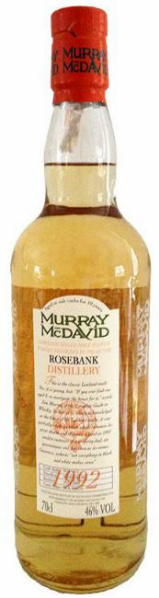
Rosebank 10yo 1992/2002 (46%, Murray McDavid, Bourbon Cask, MM1413)

Long time no Rosebank. It has been a long time since I reviewed a 1990 Rosebank, bottled by indie giants Gordon & MacPhail. That one was pretty good, it scored a healthy 88 points. Time for another go at Rosebank. This time a 1992 from Murray McDavid, remember them? By the way Murray McDavid bottled two different Rosebanks, both registered as MM1413. (The other one is a 1989, called Mission V). This 1992 is something of a farewell dram since Diageo decided, in it infinite wisdom, to mothball the distillery in 1993, never to work again…

Rosebank was founded in 1798, although some sources mention other years like 1840 and 1773. In the end, Rosebank was sadly mothballed in 1993 by Diageo which preferred Glenkinchie for its Classic Malts portfolio. And why not, nothing wrong with Glenkinchie I say. I’ve tried some very good Glenkinchies, and even reviewed a very good one, a 1987 bottled by Signatory. But why did Rosebank have to go? From an anoraks point of view, bad move since Rosebank distilled some pretty good spirit that turned into some pretty good Whisky if you ask me. Eternal shame.

Rosebank 10yo 1992/2002 (46%, Murray McDavid, Bourbon Cask, MM1413)Color: White wine.

Nose: Softly buttery and citrussy. Full aroma and nicely fresh. Nice acidity and sure some barley. Quite clean. If this isn’t your typical Lowland style, than nothing will be. Highly aromatic with soft wood and a nice grassy feel to it. Good spirit and even though the cask seems not that active (due to the lack of color), the spirit is decent and gentile, and the cask did enough to preserve that, and adding some vanilla and cold creamy butter to it. Lurking in the distance is actually some hints of new make spirit. Nice elegant (cedar) wood with milk chocolate and coffee with creamy notes (or coffee pudding).  Nice vegetal notes as well. Easily recognizable as a triple distilled lowlander. The big aroma is Rosebank from a good cask. Just compare this to the 1979 Rare Malts version (which I know is much higher in strength, but that would be missing the point).

Taste: Slightly toasted wood and creamy again. This starts with a bitterish and sappy oak attack (with some cardboard and malted barley), but that dissipates quite quickly to show it’s even more malty and grassy side. Also coffee and milk chocolate return here. A tad drier than expected and the body is more about new make spirit than the nose. Still not much though. And yes on the palate we can find the vegetal side. The bitterness of the wood stays on throughout. The whole is very nice, and don’t forget about the refreshing citrussy note!

Classic lowland and even though a fairly young Rosebank from a Bourbon Cask, this is clean and such a typical example of Lowland and Rosebank especially. Even this simple Rosebank shows what a mistake it must have been (looking at quality) to close this distillery down. Thank you very much. This particular expression reminds me of some Bladnochs, so I hope that distillery will be saved before it’s too late and someone turns it into their summer home of some sorts.

Points: 86

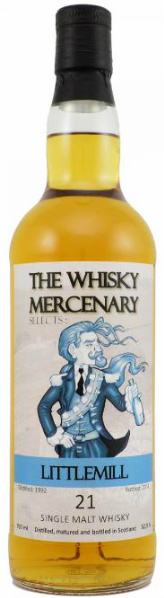
Littlemill 21yo 1992/2014 (52.9%, The Whisky Mercenary, Bourbon Cask)

Littlemill then. These days everybody seems to be raving about this sadly closed distillery. The official bottling seemed not to be very popular in its day and initially not a lot of tears were shed when this distillery closed in 1997 and subsequently was destroyed in a fire in 2004. Lots of Whiskies from the early nineties are bottled recently and surprise, surprise, a lot of them seem to be pretty good if not spectacular! Here we’ll have a look at a Littlemill that was aged in a Bourbon cask. This particular example was selected by Jürgen Vromans a.k.a. The Whisky Mercenary, who to this day has Always picked some great Whiskies. Just have a look at these reviews: Glenlossie, Tormore, Clynelish, Dailuaine and Cooley.

Littlemill 21yo 1992/2014 (52.9%, The Whisky Mercenary, Bourbon Cask)Color: Light gold

Nose: Fruity, waxy and spicy. Vanilla bean and vanilla Ice-cream. A breath of fresh air, but also some sea wind. Spicy oak with mocha. Extremely pleasant. Thin layer of honey and beeswax. Sugared yellow fruits, but also tiny, tiny hints of mustard. Hints of freshly cut oak but also an old cigar box. Cold tea (plain black tea, without milk or lemon). In the best sense of the word, a wood driven nose. Complex and very appetizing. Sometimes dry and dusty, the next very aromatic. Nice stuff!

Taste: Sweet and highly aromatic. A bit wet behind the ears, youthful oak. Yes this Whisky has been in an excellent cask. Lots of wax, beeswax, earwax, but also natural furniture polish, that doesn’t smell like an oil refinery. The wax and wood have an underlying sweetness and are aided by a nice hint of black fruits, and some oaky bitterness. Very well-balanced, and just right. It was bottled at the right moment. Maybe when it was younger it would have been more fruity, but would it have been such a distinguished gentledram?

Not every Bourbon cask is just a Bourbon cask, and not every freshly distilled Spirit that is meant to be a Single Malt Whisky is alike. Still when you take a (freshly used or refilled) Bourbon Barrel or remade Hogshead and put new-made Spirit in it, you more or less know what you’re going to get. Sometimes some especially great wood finds its way into the cask, or the barley was great, or fresh, or from a great variety. Sometimes something magical happens. Single cask Whiskies like these are all about the details so it takes an anorak like Jürgen to pick them out. Well done.

Points: 88

Inverleven (Dumbarton) 18yo 1987/2006 (57.9%, Cadenhead, Closed Distilleries, Bourbon Hogshead, 276 bottles)

And here is another Cadenhead’s, from the same kind of cask, from the same year 1987, with three years more ageing. Cadenheads call this Distilled at Dumbarton, made with Inverleven stills. Everybody else calls this whisky just Inverleven. To clear things up. The Single malt whisky that was made this way, was called Inverleven. Inverleven was made untill 1991. This was made with the ‘normal’ type stills. In the same building was also a Lomond type still that was installed in 1959 at the Dumbarton distillery and ran untill 1985 (With the malt being called “Lomond”, not Loch Lomond). Loch Lomond lies close by to the north. Only a few kilometres away, still Loch Lomond is a Highland Whisky, and Inverleven a Lowlander.  To wrap things up. The Dumbarton Distillery was the spiritual home of the Ballantine’s Blend.

Color: Light gold. (Darker than the 15yo Cadenhead).

Nose: Grassy and clean. Balanced, fresh and citrussy. Not sharp fresh lemons, but more deepness to the citrus. It not quite grapefruit. Old very ripe lemons maybe? Toffee and syrup. Candied old lemons, that’s it! In the back some nice elegant wood. This nose is definitely nicer than the 15yo, it’s more mature and balanced. Still the nose of the G&M was even more elegant, and woody. If you look for it carefully, in the depths of this Whisky you can smell a little bit of ether and acetone.

Taste: Sweet and spicy. Ok, the wood plays a role, but in no way like that of the G&M. The sweetness is also a bit more laid back compared to the 15yo Cadenhead. Great balance, fantastic balance actually. There is this perfect balance between the sweetness, the caramel, (more caramel than toffee) and the spiciness of the wood. Also some austere waxiness. Having said this, it still seems to lack a bit of complexity. The G&M seems to have more of that, yet every time I return to this Whisky is get better and better. Allow this to breathe and you’ll be rewarded. It could have remain a bit thicker in the finish, but still this is a stunner.

This version is definitely better than the 15yo, so maybe the extra ageing did some wonders, but you’ll have to allow for cask variation. It’s also better than the Gordon & MacPhail version. But both definitively have earned their place on anybody’s shelf. All of these Inverleven’s are Whiskies like no other. Quite a unique nice Lowlander. Highly recommended.

Points: 88