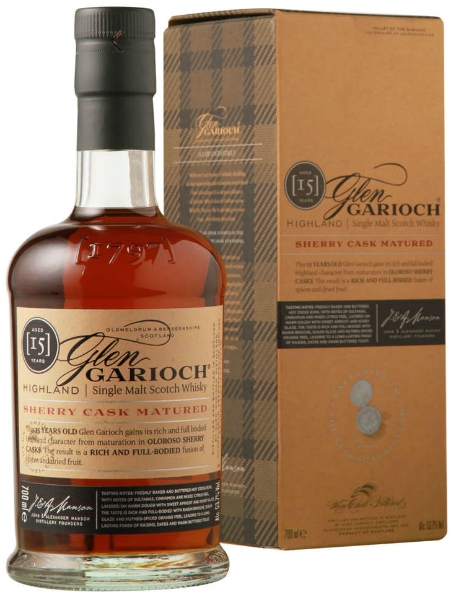
Glen Garioch 15yo (53.7%, OB, Oloroso Sherry Cask Matured, 2016)

Back in 2013 I reviewed Glen Garioch’s entry-level Founder’s Reserve bottling. Maybe a simple Whisky at first, but showing potential with its development in my glass. In the end it scored (maybe only) 83 points, and I concluded that my interest in Glen Garioch was rekindled. Fast Forward to 2019 and here finally is my rekindled interest with this Glen Garioch bottling. Took me long enough! I picked this one from my lectern because it goes fast, very fast, and the bottle is only 1/4 full, (or 3/4 empty if you are a pessimist). Considering I opened it not too long ago, you can already conclude I like it very much, although I could have had other uses for tasty Whisky as well.

This particular bottling saw the light of day in 2016 in travel retail outlets, like airports, on ferry’s and such. However by 2018, and maybe sooner, this bottling seems to be more widely available. Maybe Glen Garioch is our little secret and not widely known to the general public. Well if you ask me, this bottling should stay our little secret and I also feel this isn’t very suitable for the general public to boot, but more about that later. As far as I know, there are two batches made of this: L162341 and L162342. The bottle I have carries the lower of both numbers.
Color: Copper orange brown.

Nose: Creamy, spicy and fresh. Very exotic. Almost Indian, tasted blind I might have said Amrut. Lots of creamy woody notes quickly follow suit. Sawdust and pencil shavings, not old wood. Lots of backbone to this. Typical Oloroso notes we also know from Aberlour A’Bunadh, yet here it is somewhat less harsh, less alcohol as well, but also older and the spiciness is definitely more exotic. Which Oloroso Sherry was in these casks, I wonder? Hints of vanilla and some tar. Tiniest hint of sulphur adding to the backbone. Honey and overall quite dusty. Dark, deep and brooding Sherry notes, but not too much. It also has a lively vibrant side to it (as opposed to the Bunnahabhain I just reviewed). Lots of character to this. Appetizing. I need a Pizza after this review! (I did!).

Taste: Big and very creamy. Sweet as well. Toffee, caramel, the lot. The (fruity) sweetness is less pronounced in the evening. Starts with quite a big wonderful spicy woody note and some tree sap. Slightly dry and soapy, with tar and Sherry, but it’s a beautiful woody note. It fits the nose perfectly. Hints of black fruits start to emerge. Well balanced but not as much evolution as one might think after 15 years, not as complex as well. However, what you do get instantly is a very well composed, and utterly delicious Sherried Whisky. Sometimes I pick up some bitterness in the finish, but that is no problem whatsoever. Wonderful expression. Probably best after dinner and a cigar can’t hurt it either.

Trying this one right after the Bunnahabhain, I just reviewed, I have to wonder how stuff like this would be after 30 years of ageing. Nevermind this. Tasting this after the Bunnahabhain is bliss. They differ so much, but go together very well. The Bunnahabhain today is quite pricy at auctions, and If you’re quick, this Glen Garioch seems to be on sale quite a lot, but it will sell out eventually, and then its gone.

Finally, I often give the advice that you should give a Whisky some air and time to breathe. Just pick any Springbank review and it’s there. Surprisingly, that is not the case this time, This Glen Garioch is best right after pouring it, just sayin’.

Points: 88

Bunnahabhain 30yo 1979/2009 (45.5%, Ian MacLeod, Chieftain’s, European Oak Sherry Butt #9622, 612 bottles)

Back to some wonderfully Sherried Bunnahabhain. Most of the last few bottles of Bunnahabhain I reviewed were younger and much paler (and peatier) than the bottle I’m about to review. Here we have an independently bottled Bunnahabhain from a highly active European oak Sherry butt. Even though this has aged for a respectable 30yo, and was bottled 10 years ago, I still feel 1979 is not that long ago. If you try this particular expression, it seems to come from another century, or another dimension altogether. I’ll keep it short here, because I feel a lot of words will be needed th describe the complexity of this Malt.

Color: Dark Brown.

Nose: Fresh sea air. We didn’t see that one coming now didn’t we? Remarkably fresh, mint, yup mint. The mint you get from those hard mint sweets, not freshly cut mint, you make tea of. I did think it would be a cloying heavily Sherried Malt, but it’s not. Hints of toasted oak, charcoal and tar. Creamy vanilla powder, milk-chocolate, or better, plums in chocolate and a little bit of honey as well. Old distinguished wood. Wood polish without the petroleum smell, although very far back this does seem to have some petrol fumes going on. Caramel, tar, and some bits from an ashtray. Lots of Sherried notes obviously. Soft burnt sugar and a whiff of french cheese. Sherry and tobacco. It smells like it’s from another century altogether. Doesn’t really smell like a Whisky anymore. This must have been a very active cask. Still, nicely balanced and very chic. Fruity and coal, reminding me of early seventies Longmorn mixed with well aged calvados, since it has this apply feel to it as well. Just this bit though, not the whole experience, reminds me of Longmorn. Lots and lots of aroma’s and quite complex. Log fire and hints of fatty soft smoke. You can smell this one for hours before even thinking of taking a sip. You need to be alone for this one, and certainly not rushing it. If you smell it vigorously, it becomes meaty (gravy) for a brief moment, and some unexpected citrussy notes emerge as well. Beautiful wood notes re-emerge. Hints of old warehouse with old cardboard boxes in it. Dusty, quickly masked by the toffeed fruit. Although it doesn’t seem like it at first, this is a very high quality nose, which is immensely complex and has a lot to give. Wonderful.

Taste: Quite dry and woody, but also very tasty. Slightly soapy on entry. With lots of spices and borderline bitterness. Again you’re in for a treat. I have smelled this for quite a bit now, and doing so, I warmed the glass up in my hand. Fruity, but not much. I couldn’t even tell you what kind of fruit it would be. This has been a long time in cask. Tar and tobacco and maybe some leather. Not very heavy due to the relatively low ABV. Dusty and deep. So definitely a Malt that shows the Whisky can be about the wood it matured in. The creamy vanilla from the nose is lacking here, but definitely here, is the dry tannic wood and slight bitterness. Definitely not a chewy Whisky. Old and distinguished. Like an old mens club. Phileas Fogg style. The body falls back a bit. Finishes great, which makes up for the dry start, with a nice warming aftertaste. I like it. It’s a choice. Sure this could have been bottled (much) earlier. I don’t know if it was chance or choice, this has been allowed to age further, drying out considerably, yet picking up in “style”. It will be remembered for its great finish and the fabulous nose.

If you just pick this up and drink it, and don’t give it the attention it needs, you won’t pick up half of what its got to offer. If you do give it attention and time, wow! The more air it gets though, makes this Whisky less fruity and more about the wood, so know what you’re in for when allowing it to breathe for a while. Still, this is a wonderful malt either way, that develops enormously in the glass, so I can forgive its dryness with ease.

Points: 91

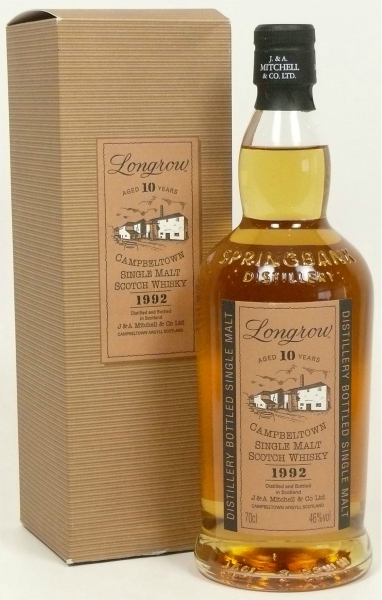
Longrow 10yo 1992 (46%, OB, 2002)

Back in the summer of 2016, I reviewed the 1993 10yo, the successor to the 1992 I’m about to review now. The 1993 stayed on the back of my mind, since I really liked that one, giving it 88 points. When, last year (2018), a local shop had a sale, this 1992 showed up for a very nice price, so at first I bought two, and a while later, at yet another sale at the same shop, I bought the two that remained on the shelves. That was 2018 and this was bottled in 2002, So not a very popular dram, it seems, in these neck of the woods.

Between 2001 and 2006, six similar looking annual release were bottled as a 10yo vintage, where the 1992 (from 2002) was the first one in the Springbank bottle we all know so well by now. (The 1991 was in the tall bottle).

Lets find out if this 1992 vintage is as good as the 1993 and lets find out if buying four bottles of this wasn’t a mistake. And yes, also with this one, the cork broke on me when first opened. Luckily I have my trusted brown bag with many corks in them, a life-saver in many occasions, especially when handling bottles with old corks.

Color: Light gold. Slightly more color to it compared to the 1993 vintage.
Nose: Fragrant meaty (light) peat, fatty and oily (olive), with a slight winey acidity. Freshening the whole up. In no way, this comes across as a heavily peated Whisky. Sugary barley and quite fruity. Buttery pop-corn and quite creamy. Well balanced, very appetizing and quite some depth to it. All works very well in this one. Soft and more meaty peat notes. Still light and soft. No smoke at all. Slightly fatty and it smells a bit sweet as well. Hey, apart from the nuttiness I almost missed, here also comes a burnt and smoky note, I always miss in the evening. Yes, I’m trying it now before breakfast. You should try it. Sugared and dried yellow fruits, but also a small hint of oranges. Yes, distant citrus fruits in the back. A very friendly and accessible Longrow. Longrow sees more peat than Springbank, but still Longrow can be very soft, and this one is no exception.

Taste: Starts with a short attack of smoke, quickly followed by the fruity bits and the soft peat. Butter. Toast with warm butter. Lots of fruity bits, some slightly acidic, and some sweet. Again light and soft and dangerously drinkable. Slightly salty as well when I lick my lips. Nice. Also a heavier note emerges. Fatty and caramel-like. Licorice. After a while more smoky, burnt and peaty notes emerge in the body of this Whisky. Time release? Fresh butter now. More creamy elements emerge from the Whisky. The lightness shows itself best towards the finish. Quite short and light, leaving only a warming note behind, without me being able to tell which of the notes mentioned above stays behind. One of the fruits probably, a nutty note, and some peat. If you wait a bit longer, it’s definitely the peat which has the staying power to make it well into the after taste. Nice stuff altogether, the only beef I have with it, this morning, is that it finishes a bit too sweet. It may be a daily drinker type of Whisky in the evening, but less so in the morning when I think of the sweetness. On another mornings the sweetness seemed less predominant and the buttery notes (with the toast as well), do make this a breakfast Whisky. Go figure, taste is a peculiar thing and we as humans are subjective as tasters beyond belief, so please take that into account.

Now lets see how the 1992 compares to the 1993 I reviewed earlier. Well just in case you thought all the vintages are alike. I can safely say that the noses of te 1992 and the 1993 are different. The 1993 is a tad more medicinal and lacks the creamy and buttery notes of the 1992. Somewhat more predominant in the wood department, but not by much. The fruit is similar, but toned down a lot of notches. The 1993 is smokier and reminds me of a sea breeze. It’s also cleaner and more oak is noticeable. Yes even some unlit cuban cigar tobacco. I guess that wasn’t in the original review of the 1993. I guess the relative sweetness of the 1992 hides the wood and all the other notes (if present). Where the 1993 is cleaner, the 1992 seems to be the bigger (sweeter and creamier) Malt. Taste wise, both are closer to each other with the same “lightness”. The 1993 is sweeter then I remembered, and also shows the fruit and the softness and even more of the nutty bits with milk chocolate. Variations on a theme I guess. Trying the 1992 directly after the 1993, shows some youth in the 1992. Both score the same and are definitely twins, but if I had to choose I’d pick the 1993. It is ever so slightly better. Does this mean I’m regretting getting four of the 1992? No, of course not. I love it!

Points: 88

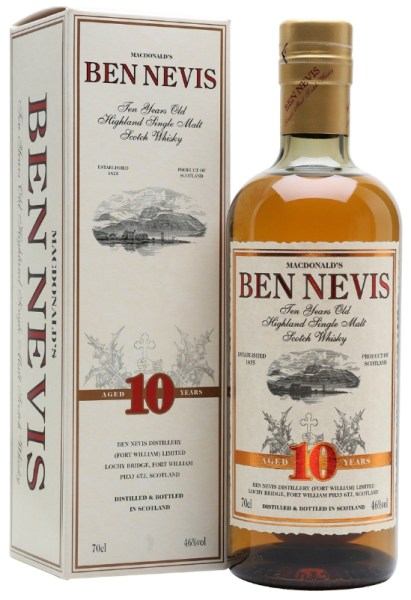
Ben Nevis 10yo (46%, OB, 2018, L18/8069)

I’m a big, big fan of Springbank and all of its output. I love the taste, the independence, the batch variation, the society. Buy a bottle and you never get the same Whisky twice. Above all however, I love the taste in combination with the sheer quality. Springbank 10yo was always the )only) Whisky I mention to people when they ask me for a bang-for-your-buck Whisky. Nevertheless, I’m always open to other Whiskies as well, I’m not bound to a few distilleries, or to one type of Whisky. I love a lot of different Whiskies with different styles. Dear readers, Springbank 10yo is about to be dethroned from that first place. I will still mention it, but with the same breath I will also mention this Ben Nevis 10yo. It’s fabulous. It’s complex, its unexpected, it’s simply wonderful. It has aromas I only encounter in Whiskies from yesteryear and not in modern stuff like this, distilled in the 21st century. I’m not sure if only this particular batch is so good, or that all Ben Nevis’ 10yo are this good, but we will find out someday, won’t we? Although I’m sure the latter is true!

Color: Light Gold.

Nose: Fresh, flowery, malty and fatty. Lightly sweet and very, very seducing. Smoky and fresh. Sweaty (Sauvignon Blanc), yet also lots of aroma’s from Alsatian White Wines and Rieslings from across the border (that would be Germany). Nice notes of subdued oak and even honey. Warming and big. Toffee, without the sugar. Creamy and nutty. Sweet yellow, tropical fruit yoghurt. Very special. Tiny, tiny, tiny hint of peat (and smoke) and also some Sherry. Tiny hint of pencil shavings and some sawdust as well. Extremely well-balanced.

Taste: Sweet, sweaty and big. Toasted oak. Benefits from air, so let it sit in your glass for a moment. The sweaty notes from the nose are here for you to taste as well. Tropical fruits, yes. Dried pineapple and papaya come to mind backed by a bitter oak note. This has definitely older Whisky in the mix. (18yo is rumoured). Where others probably sell a lot of Whisky and are aching for NAS-expressions. The owners of Ben Nevis (The Japanese) are taking it zen, and have older Whiskies to spare to make this special 10yo even more special. In fact the profile lies somewhere between Springbank 10yo (fatty, oily, warm motor oil, hints of peat and big) and Caperdonichs from 1972 (the fruit man, the fruit). Great body, medium finish (turning a wee bit sour for a moment), with a nice long warming aftertaste (not sour anymore). When its gone, its gone (and you need another sip). Complex, but not too much.

Ben Nevis 10yo looks like this, since 2016 and is released once a year, and it seems to me it sort of sells out before the next release has been bottled. For instance the 2019 versions hasn’t been released yet, but this 2018 I’m reviewing now, has all but vanished from many shops I know. It is the only standard bottling, with the rest of the output being specials and single cask bottlings. All sold at special prices indeed, making this the only standard bottling of Ben Nevis and also the only affordable one. I wish they would expand a bit with their standard range, like a 15yo for instance, and some others after that? Yes please!

Points: 88

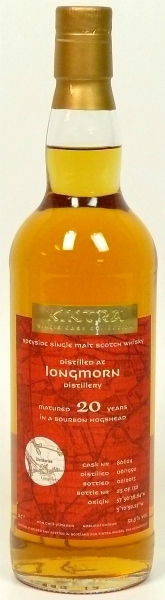
Longmorn 20yo 1992/2013 (52.3%, Kintra, Bourbon Hogshead #86624, 132 bottles)

Longmorn probably was one of the best Whiskies coming out of the sixties and seventies of the previous century. There are so many remarkable bottlings coming from that time, it’s nothing but amazing. Because of this, it also might be its curse. It is almost impossible to drink something like this (a Longmorn from the eighties and later), without having high expectations and looking back to the old stuff instead of comparing it to its contemporaries. Sure we all know stuff from “back then” is different from the stuff today, but still, Longmorn, has a special place with me…

Color: Gold.

Nose: Fruity, biscuity and malty. Fruity it is. Passion fruit and some pineapple, mixed with vanilla powder. Sugared and dried yellow fruits, but also a more waxy note. Meaty as well. Old warm dusty warehouse, more like a Kentucky warehouse than a cold and damp one in Scotland to be honest. So a lively, sunny, and dusty Whisky, from a dry warehouse with a summery feel to it. Nice fruity aromatics aided by a more creamy and vanilla note, backed by dust and oak. Character building. Nutty, with hot water. Overall laid back with a quiet disposition.

Taste: A sweet, nutty and spicy entry. Sometimes with a beer-like and hoppy note to it. The woody bit can taste this way when you try this early in the morning, when your palate is till fresh. In the evening its woody and spicy, nothing more. Typical Bourbon Hogshead Whisky. Funky green sweetness from the start, and even though not extremely high in alcohol, it does exert itself. Definitely fruity and nuttier than the nose. passion fruit again with old apricots next. Hints of toasted oak, this time more warming than sharp. Hints of clear glue and lots of fruits, apricot and to a lesser extent: peaches, even dried pineapple comes to mind. Nice touches of sweet vanilla and ice-cream, but never turning overly sweet and dessert-like by the backbone of spicy oak and toasted oak. Nice development though. It evolves over time.

Nice Longmorn, nice Whisky, but also almost anonymous. It could have been anything, apart from the amount of fruit in this one, which gives it away a bit. Keep in mind that this is from a Bourbon hogshead, so the distillate hasn’t been masked by Sherry or some kind of finish. This is pure Whisky. Its good, it does the job, however it’s almost not a ‘Longmorn” to me. Maybe I’m a bit harsh, maybe I’m a bit prejudiced and maybe I’m not truly objective as well. Am I capable to let the memories of old Longmorn go, for a review like this? I don’t know. This is a good one, but not a must buy for me, sorry. Come to think of it, this does have some similarities to the profile of the old Longmorn 15yo OB. That one is good as well, but also a bottling I don’t neccesseraly need to have. it doesn’t completely click with me. So If you really like the 15yo, by all means get this one as well when it pops up at an auction somewhere. For me, I’m glad I’m taking notes here, because after some time, I might forget how this tasted like, but thinking of the 15yo I’d probably remember.

Points: 85

Caol Ila 11yo 2004/2016 (46%, Gordon & MacPhail, Exclusive, for Milano Whisky Festival 2016 & Bar Metro, Refill American Hogshead #306662, 348 bottles)

Once nowhere to be found, now maybe one of the most bottled Islay Malts today. Caol Ila. For me at least, Caol Ila is always a nice Whisky which also ages well. This is a pretty young one, bottled less than four months shy of its 12th birthday. In fact, this Caol Ila has matured for precisely 4.275 days. It was bottled for the Milano Whisky Festival & Bar Metro in 2016, I picked this up at a well-known German auction and didn’t have to pay much, nor did I have a lot of competition for this bottle, so maybe there’s something I should have known? At the same auction I picked up its sister-bottling from Glen Elgin bottled for the same festival in 2016 and didn’t have to pay much for that one either. I bought these two, because I found out I had a lot of cask strength bottlings on my lectern, so I wanted to buy some bottles, to start an evening with. A bit reduced to work up an appetite. Gordon & MacPhail have (or had) lots of casks from the 3066XX-range, bottled in many different series; “Cask Strength”, “Reserve”, “Spirit of Scotland” and more “Exclusive’s” as well, so there is enough around for comparison. For instance, Refill American Hogshead #306664 was bottled for Maison du Whisky @ cask strength in the Exclusive range. By the way, some of the casks from this range are Sherry casks. Let’s find out now if this hoggie is any good.

Color: Straw.

Nose: Quite restrained. No big smoky peaty notes. Fresh, zesty but also a bit tame (at first), as in sweet barley with a wee bit of soft peat only. When the flow rate of air through the nose has been increased, lots more seems to be emerging. A prickly sensation awarded to a smoky note. Burning newspaper, and even more earthy peaty notes, still restrained though. Next more creamy notes of vanilla and pudding. Well balanced although I’m not sure yet about its complexity. Hints of sugared, or sweet, yellow fruits. Warming toffee and more soft barley, marzipan and almonds. Even a little bit of honey. All very restrained without it being closed. Dusty. All aroma’s work together nicely. Good balance. A cold and misty day with hardly any wind. As this Whisky picks up air, the good balance even gets better, definitely the forté of this Whisky, and it gets bigger, bolder and more aromatic as well. Quite a surprise. The longer it stays in my glass and I don’t hurry it, the better it gets. More of the fruity notes emerge and the marzipan, very nice. Some wood and ashes as well. So this needs a bit of air and patience. If you hurry this one, you’ll miss the reward of this Whisky.

Taste: Sweet, fruity and smoky, with a funky red fruit acidity on top (it may could do without). Yes, peat as well. Slightly too watery (at first), but as I wanted a “starting Whisky” this does the job quite well. Very nice fruity sweetness, the sweetness of ripe fruits rather than plain old sugar. Very balanced again. Milk chocolate, chocolate mousse, mocha and a tiny hint of coffee with lots of milk. Mint. Just like the nose, the sweetness moves into the territory of vanilla and pudding retaining the minty note. More toffee, caramel and mocha. Chocolate cake, custard, crème brûlée even, with the added bonus of peat, charcoal and ashes. Finally a green, leafy note. Earthy.

The finish is warming yet falls a bit short and I can’t say the wonderful balance reaches the aftertaste. A slightly acidic note peels of from the rest of the Whisky. Where the finish was somewhat short, the aftertaste recovers winning it a bit back for the team. Nevertheless a very nice Caol Ila again, and this probably its sisters as well, deserve your money. I for one, will try to find a G&M 2004 cask strength version from such a hogshead again.

Points: 86

The Benriach 18yo “Albariza” (46%, OB, Limited Production, Peated, Pedro Ximénez Finish. 3886 bottles, 2015)

2015 saw the release of the first of a trio of a brand new limited production series, “Albariza”, which was finished in Pedro Ximénez casks. I missed out on that one at first, so I started with the second one called “Dunder“, a Dark Rum Finish, which I got upon its release. After buying the final release of the trio, “Latada”, finished in Madeira casks, Master Quill got busy and bought himself Albariza at a well-known German Whisky-auction, to complete the trio. So after the second one, it is now time to get back to the beginning and try this Albariza before finishing off this series with the Latada in the near future. I still have the Dunder around for comparison, but sadly there is not much left. What to do when the time comes to review Latada?

Color: Dark copper brown.

Nose: Nice clean peat. Different from fatty Islay peated Whiskies, but very nice aromatics nevertheless. Breaths of fresh air and warm glue, with peat, peat and peat. Where is the PX? Just like Dunder this seems to be a bottling that has heaps of peat. It’s more about the peat than the particular finish. Maybe this has to breathe a bit more in my glass. Easy does it, be patient. After cleaning MQ’s lectern, and reorganizing the bottles a bit, I came back after some breathing. Well, it changed. Christmas spices, red fruits and black coal fire. More deep and brooding. Hints of sweetness and syrup have been added. So, fruit seems to wiggle its way in, how cute. Very strong aromatics, with sharp (peat) smoke right up my nose, opening it up for easier breathing. Nice fatty, big and dirty. Nice complexity, with a borderline classic peat-smell. Nice syrupy sweetness en fruitiness, but like Dunder this is primarily a Peated Whisky, yet, finished with taste. More than excellent nose if you ask me. Let it breathe.

Taste: I can feel the (sweet) PX when I sip this, the (thin) syrupy texture is there, but before you can taste it, the tarry peat slams it down with a vengeance. Well, almost. Maybe the words are a bit strong. This is definitely a Peated Whisky for sure! Second sip, again PX tries, but more like an engine that won’t start. For these three Whiskies I feel the focus of the naming and the labels, and the text written on it, is wrongly on the cask the Whisky was finished in, but should have been on the peat. Never mind that. Sure its peaty, but the finishes do add something to the whole, and good for us, they merely add, not overpower it. As I said before, finishing done with taste. If you let it breathe for a while, the Whisky gains more balance and the finish shows itself a bit more. Less peat, more smoke that way. More coal, licorice and a taste that brings images to my mind of crushed beetle. This is finishing done right. Excellent stuff and an example that it doesn’t have to be Oloroso alone, considering dark Sherries. PX has something to bring to the tabel as well. Just don’t over do it! Finish is great and of medium length. Aftertaste is short, and a bit too sweet, seems dissonant from the whole experience. If this sweetness would have been replaced by black fruits, this could have been one of the best bottlings from this decade.

Albariza is a very chalky soil, so how to taste this terroir, when the peat overpowers it all? Even in the taste it’s hard to find the PX directly. Again some more breathing is necessary. Dark chocolate and after a while a more sweeter note comes around, together with some ashes. Flint and a slightly burnt Sherry cask note with a hint of christmas again. liquorice in the finish and the sweetness manages to stay around for longer. Here the PX finally emerges.

When entering a shop, I never had a lot of interest in “newer” Benriachs. Some of the standard bottlings were ok, but not more than that and the rest were almost all finishes of some kind with labels in strange colours, looking like a bunch of skittles. However peated Benriach tastefully finished seemed something different, so this series sold very well, and sold out quickly as well. This year (2018) saw the release of the 22yo versions of “Albariza”, “Dunder” and “Latada” at what looks at first quite a hefty price, but then again, not a terrible lot more than these three 18yo’s fetch at auction today. I was already quite impressed with “Dunder” and this “Albariza” is in the same league as well, so I’m sure the 22yo’s will be pretty good as well. If only they would be higher in ABV and less expensive…

Points: 89

“Albariza” is darker and warmer and definitely different from “Dunder”, which is nutty, sweetish and funky. Where the peat subdued, making it more elegant, and the smoke is now more prevailing. I’m assuming since all three Benriachs matured in Bourbon casks first that they were pretty similar before entering the casks they were finished in. What’s similar as well is the peat part. The peat smells the same in both, so that corroborates my assumption. “Albariza” is bigger as well  “Dunder” is lighter and easily recognizable as a Rum cask finish. Rum casks gives off very specific aroma’s, both in the nose and on the palate. “Dunder” is now finished, so it tells you the bottle had plenty of time to breathe. Oxygen did bring out the aroma’s over time, so I’m guessing “Albariza” will change over time as well.

If you’re interested, here is some background on what Albariza actually is by Whisky’s (and Sherry’s) own, Ruben.

Linlithgow 18yo 1982/2001 (43%, Signatory Vintage, Vintage Collection, Cask #3002, 472 bottles)

Here we have a rather “young” Linlithgow, a.k.a. St. Magdalene. I really, really loved the extremely layered St. Magdalene 19yo, that was released three years prior to this one, so when this came out in 2001, I snapped up a few, expecting a similar experience to the one year older and cask strength expression mentioned above. Hey it was reduced a bit, and only one year older, so it could happen, and it was half the price of the 19yo! At the time, Whiskies from the Vintage Collection were never expensive, as was the case with this one. They sold this at the price of what a Springbank 10yo sells for today. Remember, even in 2001 this was already a closed distillery, so go figure. It was a different Whisky world back then. If I look around the net today retail price for this one is £699,-, and if you read this in 2025 it will probably be even higher, or have we all moved on to something else? If that is the case, why are you even reading about an old Whisky nobody cares for anymore?

Color: Pale gold, straw.

Nose: Extremely malty. hints of sugar-water and ear wax. Fruity and grassy. A Lowlander alright. A breath of fresh air. Toned down, almost shy, but don’t think this is light, because it’s not. It shows quite some aroma. The quiet (big) guy in your class, but you already know there is more to it than meets the nose. Yellow fruits and whiffs of American oak, It is definitely something from the past. Somehow Whiskies today aren’t like this anymore. Its like sitting alone in a field, middle of summer, nothing more than crickets and almost inaudible distant sounds of the rest of the world. Life is beautiful. Hints of cold butter and hay. Warm wood and a bit of old vanilla. Definitely not as multi-layered as the Rare Malts bottling mentioned above, and it hasn’t its evolution either. This is more straightforward and shy (again). Perfectly balanced nose. It got plenty of time to breathe and it can handle the air. No worries then of oxidation. By the nose alone another great example of the variety of St. Magdalene. Closing this distillery is a real loss, and this one is not coming back, so what you are holding in your glass is a piece of history, hence the hefty price-tag.

Taste: Sweet on entry. Malty, barley sugar. Slightly warming. Paper and cardboard. Creamy, with toffee on entry but it gets thinner towards the finish. Lots of fruits emerging at different moment when you keep it in your mouth, making for a sweetish, fruity, friendly Whisky. Only a slight bitterness reminiscent of toasted wood emerges. Less “big” than the nose suggested. In comparison to other Whiskies from this distillery, this might be a rather simple expression, (is it?), but still it oozes something special. Memories of black coal, and motor oil. If so, this can only have trace amounts noticeable, because in essence it is a sweet fruity Whisky. Simple, maybe, but it rewards you with aroma’s from the past, coming from a distillery like no other. Near the end of the body a somewhat burnt note emerges, burnt wood, hot machine (oil). Very nice industrial edge after the friendly fruitiness.

I spent a lot of time with this Whisky over the years, and I remember, when freshly opened, it showed a lot more of the waxy notes and even quite some bitterness. So don’t be afraid of oxidation, even when this is a reduced Whisky, because it will only get better. In the end it turns out much better than I have always thought it was…

Points: 86

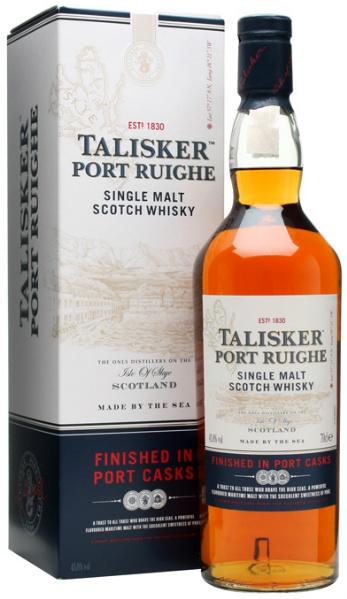
Talisker “Port Ruighe” (45.8%, OB, 2017)

This is another recent “NAS” Talisker, released in 2013, right after “Storm“. The bottle reviewed here is a newer batch from 2017 (L7317CM015). Back in 2013 when all these NAS Taliskers arrived on the market, a lot of people feared for the classic 10yo to be discontinued or moved to a market different from ours (This happened to the JW Green label), but it didn’t happen. In 2015 the same exercise happened again with the release of “Sky”. We’re in 2018 now and there is still no sign of the 10yo being discontinued or even an “update” of the price. The 10yo is still going strong and usually is still well priced below all these NAS bottlings. And I believe it is also still better than all these new NAS-sers.

Port Ruighe was matured in refill casks (of both American and European oak). It was then transferred to deeply charred casks and yet again transferred to receive a finish from Port Wine (infused) casks. That seems like a lot of ado, to give this, probably young Talisker, its own aroma. Is it an experiment of sorts? Let’s see…

Color: Copper gold, but not the pinkish hue you tend to see with Port finishes.
Nose: Starts with peat. Nice fatty peat. Toned down obviously, since this is not a heavily peated Malt. I mention peat a lot right now, because since this is a NAS bottling, this could also have smelled “young” and it doesn’t. “Storm” had that, but this doesn’t. Thus, nice peat, a little bit of smoke and butter, so a bit of youth is there nevertheless. Since it is a Port finish, it could have smelled winey and sweet, but it doesn’t at first. It starts simply with peat. No storm, just a calm sea. Easy and quiet. The protection of a harbour, or port maybe? Could it be thát designed? Next some soft notes, reminiscent of a claret matured Jenever I have, (the acidity). Nope, still bobbing in the harbour with our soft peat. No dark storm, no storm even, just me and this peaty breeze. Hints of vanilla and honey emerge and some sort of sweet cloaking perfume, yup, we have our Port here. Turns sharper and a bit more warming as well. Hints of Malt and vanilla powder. This is spicy as well. Nice soft wood and the slightly burned cask. It may be NAS, but it shows complexity and I feel everything works well in the nose-department of this Malt. Still no really true Port notes, and maybe that is a good thing, since Ruby Port casks can easily overpower a Whisky. Wonderful nose, I kid you not.

Taste: Already sweet, creamy and quite fruity when it touches my lips. Peated Whisky with some smoke and a big fruity follow-up. Sweet, buttery, yet also young, and strange enough, right beside the sweetness, also a brief watery edge. Where the youth was absent from the nose, it is definitely here, but to a lesser extent than in “Storm”. It is also less complex than the nose. Bolder and more simple with a slight burnt-spicy edge to it. Increasing with air are the winey notes, but still well in check, although there is an overall sweetness and waxiness to it, that gets in the way of drinking more than one dram of this at a time. At the same time the complexity, that already wasn’t great to begin with, decreases. This is a shame because the Whisky takes a turn where you don’t want this to go. The road of NAS, simplicity, lack of complexity and the mismatch with the promising nose. The finish is medium at best, and to be honest, falls flat on its face. It disintegrates when hitting the ground. Aiii. Some peat, but very sweet and winey. Too much. It has been overpowered by the Port, which probably says a little about the quality of the Port, or the wood used, but maybe more about the age of the Whisky itself, because one might expect Talisker to be able to handle a little bit of Port now, don’t we?

It is nice to have had the opportunity of yet another take on Talisker, but this is one I’m not keen on repeating (buying another bottle, that is). “Neist Point” although more expensive in many markets, and too expensive in some, it is definitely a better experiment than this one imho. Neist Points was released right on the heels of “Storm” it is nevertheless different from Storm. This is way more mature. Is it older Whisky (guess not) or did the Port finish hide the “young-Malt experience”? Although criticized by many, I have no real beef with this pair of 2013 NAS-releases from Talisker, but I do understand a lot of the comments made.

So this is young Whisky, in the end overpowered by the Port, however, based on the nose alone, there was a lot of potential, maybe if the Whisky was aged longer and the Port and/or the casks it aged in was slightly better, this might have been a great Whisky, and we may see one like this in the future.

Points: 83

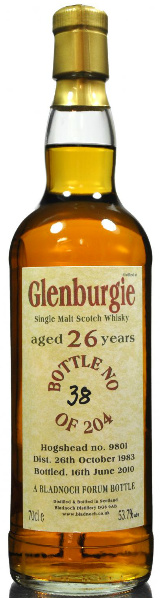
Glenburgie 26yo 1983/2010 (53.7%, Bladnoch Forum, Hogshead #9801, 204 bottles)

Kilnflat was founded, by William Paul in 1810. The distillery was closed between 1870 and 1878. When it was opened again, by Charles Hay, he also renamed the place to Glenburgie, a name are more familiar with. In 1884 Alexander Fraser & Co. takes over only to go bankrupt in 1925. Again the distillery changes hands, and this time to those of James & George Stodart Ltd. In 1927 the distillery was mothballed and stays that way untill 1936, when Hiram Walker buys the distillery. In the mean time in 1930, Hiram Walker also gained a majority of James & George Stodart Ltd.

In 1958 the distillery also gets Lomond Stills to produce another SIngle Malt you might have heard of: Glencraig. This will go on for several years but finally in 1981 the Lomond Stills are removed again and replaced by conventional stills, making Glencraig a “closed distillery” and somewhat of a collector’s item. In 1987 Hiram Walker is bought by Allied Lyons. In 2005 Chivas Brothers (Pernod Ricard) buys Allied Domecq becoming the current owner of Glenburgie.

In 2003 the distillery was demolished entirely and replaced (a bit further down the premises) by a new and highly modern distillery. Only the old customs house remains and the four stills, the boiler and the mill were brought in from the old distillery. By 2006 another pair of stills were added.

Unbelievable, this is only my first review of a Glenburgie. Amazing. That’s why I stared with this brief history “lesson”. Not so long ago I was asked about great, lesser known, Malts (from Scotland) a.k.a. personal favourites off the beaten track. Glenburgie managed to get into that top 10, that’s why I’m so amazed this is just the first review of Glenburgie, should have been much sooner. Glenburgie is a distillate that works extremely well in Sherry casks.

Glenburgie might be lesser known as a Single Malt, but that’s because a lot of it goes into the Ballantine’s Blend. In 2017, Chivas Brothers released three Single Malts under the Ballantine’s name. Huh? Yes Glenburgie 15yo (the heart), Miltonduff 15yo (the foundation) and Glentauchers 15yo (the finish), were released as such, to tell the story how they make up the Ballantine’s Blended Whisky.

Color: Almost copper gold.

Nose: Very big aroma, this leaps, or rather, attacks you, with a soothing friendly voice, from the glass. Nutty and fruity. Meaty and dusty. Some soft old oak right after that. Dusty old oak. Quite big and holding a promise of sweetness, sweet (and meaty) apples rather than the usual Sherry notes. The oak has an aroma reminiscent of tobacco and leather and hints of old Calvados. Very fragrant Glenburgie. Nice and spicy. In fact, this holds it all. Quite balanced, and very big, it’s so big it hides the complexity a bit. Try not to forget, this is a 26yo Malt. It doesn’t show a lot of evolution over time as well, it stays more or less the same when nosing it. But with a Malt so big and nice, who needs complexity and evolution?

Taste: Yes sweet on entry, but with a lot more. Cannabis and toffee. Crushed beetle again and lots of nuts. Yes, let’s throw in some caramel as well. The start is sweet and sticky. Quite hot and the 53.7% ABV printed on the label, seems a bit low. Very fruity but grassy as well, thick fat grass notes, different from fresh-cut grass or dry grass and hay, but as mentioned above, also the grass you smoke. It’s fatty grass and cannabis. Do I detect a nice tarry edge right behind the spicy oak? Hot black tea. Dries out towards the finish. What a wonderful complexity and blend of aroma’s. This bottle is now 1/3 down, and that’s a good thing, because right after opening, this was much tighter and closed. Amazing how the nose lacked complexity and evolution, and when tasting it now, it is all but complex and shows a lot of evolution as well. One has to stop oneself writing notes, since, this keeps emitting more aroma’s from my glass…

Wonderful Glenburgie, extremely drinkable, even at cask strength.

Points: 89