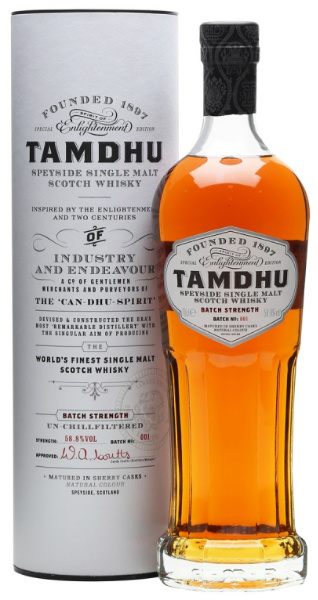
Tamdhu “Batch Strength” (58.8%, OB, Batch 001, Sherry Casks, 2015)

In our series of NAS Cask Strength Whiskies, here is number three. After the nice Glengoyne and the surprisingly good Tomatin, here is Tamdhu. Tamdhu is since 2011, the new jewel in the crown of Ian MacLeod, who have managed to save yet another distillery from the hands of the Edrington Group. The group chose to focus on the highly marketable Macallan and Highland Park brands, so no use for this low profile, but high quality distillery Tamdhu is. Over the years all previous owners haven’t done a lot with the Tamdhu brand, so there aren’t a lot of Tamdhu expressions around. Ian MacLeod, being the new owners, came up with a nice retro design and up ’till now have released four expressions. A 10yo that is widely available, blended from first and second fill Sherry casks. A limited edition 10yo, blended from first fill Sherry casks only, which has sold out rather quickly. And last but not least, two batches of the Batch Strength expression. Today we’ll have a look at the first batch, although last year the second batch saw the light of day.
Color: Orange gold.

Nose: Funky bread-like notes. Cereal and smelly, brooding Sherry. Quite spirity and paper-like at first. Cold dish-water. After a short while of breathing a more likeable fruity note emerges, but not much. Hints of gravy, Beer and menthol. Butterscotch and a rather strange burnt note, with an acidic top note (that’s why its strange). I’m not alarmed though, because the previous two NAS cask strength expressions started out funky as well, but turned out to be really tasty in the end. Next a more vegetable and woody note. Spicy but not in a big way. Still some paper, (slightly scented toilet paper comes to mind), as well as some jasmine tea. Pencil shavings start to emerge. Soft with a hint of sweetness. Creamy and nutty. The more it breathes the more toffee it shows. The strangeness mentioned above never really disappears.

Taste: Big on toffee and pencil shavings. Wow. Nice. Sweet. Hot. Big. Brash. I like it! Here too a funky note. Even some orange skin. Different from the other two, but one that screams yes! Its good. Where the nose had some off-putting aroma’s, the taste is very inviting. If you like cask strength, this is immediately likeable. Sure a bit raw and at times a wee bit under-matured, but not much. It won’t be twenty years old, but it won’t be three years either. Well made, you can taste a lot of care went into this. Lots of nutty Sherry notes, so I’m guessing some Sherries that matured under flor were used as well. Wonderful woody elements adding to the whole. Medium finish at best. The big aroma’s turn dry and then disappear altogether, which invites you to take another sip.

First of all, this is all Sherry casks, as the plan is for all Tamdhu releases, but way different from the all Sherry cask Aberlour A’Bunadh, blended solely from Oloroso Sherry casks. Compared to the other two I reviewed recently, or even to the A’Bunadh, this is maybe priced a tad to high, but I suspect this liquid was also quite pricy to produce.

However, if I had to choose on smell alone I would pick the Tomatin, which is also less expensive than this Tamdhu, but since Ian MacLeod made the bold move to buy this distillery, which isn’t known to the big public, I understand the pricing and the Whisky is definitely worth its price. In a direct comparison with the Tomatin Cask Strength, it is obvious both are equally good, and both show something about the distilleries they’re from. The difference in taste is a matter of opinion, as well as your mood. You can’t go wrong with either of them, including the Glengoyne which did score one point less.

Points: 85

Thanks Alan!

Mortlach 11yo 1992/2004 (46%, Douglas McGibbon, Provenance, Autumn/Summer, DMG 627)

Talisker Storm is essentially a young Whisky, one of today’s NAS-expressions. A decade ago, this 11yo Mortlach would be considered a young Whisky and back then we hardly ever heard of NAS-Whiskies to boot. Mortlach is known for its unique distilling regime where the Whisky in the bottle was distilled 2.6 times. Mortlach is also known for dark and dirty Sherry bottlings. Mostly first fill and Oloroso. Just have a look at this Wilson & Morgan Mortlach. So Mortlach fits in the group of Macallan (of old), Aberlour, Glendronach and Longmorn.

However, here we have a rather pale expression of Mortlach bottled by Douglas Laing, from the time Fred and Stewart were still running a business together. Douglas Laing had essentially three series of bottlings. Provenance, Old Malt Cask and Old & Rare (better known as the Platinum-bottlings). There were some more, but lets stick to these three better known ones, shall we? Provenance was mostly reduced to 43% and later 46%, Old Malt Cask to 50% (if possible) and generally older and more special. Finally Old & Rare-expressions were cask strength en even older still (and extra special). Maybe there are some exceptions but in my mind all were single cask bottlings. Here we’ll try a young and very pale Mortlach from the least expensive series of the three. Young-ish and reduced.

mortlach-provenance-11yo-1992-2004Color: White Wine.

Nose: Fresh, soft and fruity. Some barley and definitely some citrus notes. Very fresh and “summery”. Hints of bread, mocha and nuts, but also a chewy, green oaky note. Vegetal. Green leaves and perfumy. Hints of dishwater and latex paint as well, which really isn’t as bad as it sounds. Powdery and dusty, in part like the smell of old books, some leather and cold gravy. Warm butter and vanilla pudding. Quite a lot happening here, and a bit dirty alright. Although all of the aroma’s I’m picking up here, are pretty different, the whole is well-balanced. They mix together well. Mortlach is known for a meaty element (from Sherry casks), but that is lacking here.

Taste: Barley again and a lot of the vegetal, green and oak notes. Chewy again and it has a short sharp edge from the oak. It’s almost like virgin oak this, with a bite. A little bitter woody bite. Don’t think now this is a bitter Whisky, because it isn’t. The bite itself is extremely short, leaving room for a very soft and mellow Whisky. Cannabis and vanilla. Creamy, with cookie dough and chocolate-chip cookies as well. Sweet(ish) and fruity. The taste of this Mortlach is less complex than the nose. Judging by the color, the cask didn’t seem all that active, but it did impair a lot of the woody notes, so it probably was an easy pick when considering bottling a younger Whisky. Hey, but it’s not all (soft) wood notes, there is also some coconut, nutty and creamy aroma’s. (something you can also find in some Glen Keith‘s matured in ex-Bourbon casks). It’s fruity as well. Medium nutty and creamy finish, with hints of cannabis (the first time around). With a medium bitter aftertaste giving the whole experience some backbone.

Mortlach is known as a dirty, meaty Sherried Whisky. However, this probably came from an American oak cask that previously held Bourbon. So does the meaty part come from the Sherry then? Well not entirely. Especially on the nose, the distillate, without the influence of (Oloroso or PX) Sherry casks, still shows a meaty aroma. Cold gravy I called it, and dirty. It doesn’t taste as a dirty meaty Mortlach to me though. Remarkably soft, and pretty decent overall, yet nothing special as well.

Points: 81

The Balvenie 12yo “Doublewood” (40%, OB, Circa 2004)

It has been 15 months since I last reviewed a Balvenie on these pages, and how convenient now, that is was also a 12yo Doublewood. However, the previous review was about a Doublewood bottled in 2014 and here we have an example of the same Whisky, the only difference being, that was bottled a decade earlier, 2004. You never know, but I think I know which one will be better…

the-balvenie-12yo-doublewood-2004Color: Orange gold.

Nose: Spicy Sherry notes, bursting with aroma. Deep honeyed layers somewhat reminiscent of Bourbon. Nice oaky feel, combined with some hints of vanilla, warm butter, hot gravy, cardboard and paper. Vegetal and slightly dusty. Definitely some sweet barley notes underneath, accompanied by soe sweet/acid red fruit notes. Candied cherries, waxy red apple skins and meaty Sherry. Very much Sherry driven but the underlying Bourbon notes are a good match as well. Excellent big nose, with all aroma’s well integrated. wow. This brings back memories from when I first started to drink Single Malt Whisky. One thing is certain, the entry-level Whiskies form a decade ago were different from (the same) entry-level Whiskies of today.

Taste: The start is creamy and buttery. Pudding and custard. Next come the drier woody bits. Sawdust and oak. Slightly warming but also a bit too thin.The wood gives it a bitter edge. The Sherry aroma’s must be rather heavy since they come a bit late to the party. And here they are. Somewhat dark and brooding and slightly syrupy. But no doom and gloom, because on top there is a fresher and more acidic fruity note as well. Hints of warm apple sauce, which is very much different from the apple skins I got in the nose. Waxy with hints of Calvados. Towards the finish it starts to break down a bit. The waxy sweetness stays behind the longest, as, for a while, does the bitter edge (pencil shavings), but the distinct aroma’s merge first and then fade away…

Wonderful stuff brought down a bit by the 40% ABV. Should have been higher. Nevertheless, you don’t hear me complaining because it is big enough to overcome the 40% ABV. Very nice stuff especially the start. It tastes best right upon entry. It’s still going strong when it develops in your mouth, but loses grip a bit when finishing. At least a medium finish, but the overall aroma stays behind for quite a while with a nice and warming quality to it.

Points: 84

The Macallan 10yo (40%, OB, Circa 2003)

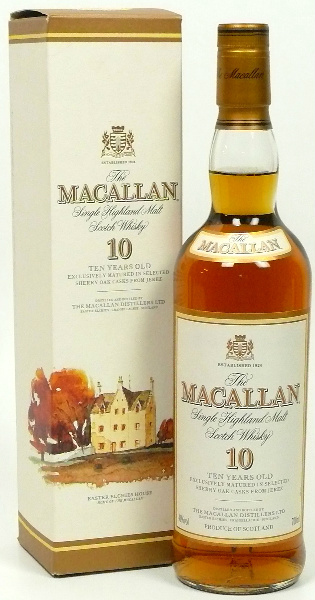
We move back a decade or so to visit one of our old friends. One of the most standard bottlings of that time, the original Macallan 10yo. It had an age statement back then and was diluted to 40% ABV. It was the time, no fan of Macallan or otherwise, was aware of the dark clouds that were forming up ahead. Finally the storm broke and we were given the Fine Oak series. So for me the downfall in quality started with bottlings issued in the newly designed bottlings like the “Fine Oak” series. However, if memory serves me well, in 2002 they started releasing some sort of NAS called the “Elegancia”, preparing us for a softer and smoother experience, moving away from the true Sherry experience of the true Macallan. Not truly a NAS by the way, since it did carry a vintage, like Elegancia 1991. Nevertheless, after the Fine Oaks I really didn’t look back. I was so disappointed. I turned my attention towards Longmorn instead. Back then a lot of it was around and at fair prices to boot. The standard 15yo was pretty good, although the introduction of the 16yo made me rise my eyebrows a bit. Better looking bottle, but the Whisky was less interesting. No, may independent released some pretty stellar Longmorns, so I needn’t look back at Macallan. Of course I did try some of the newer bottlings, but I was never convinced moving back towards the Macallan. Only the future can tell us.

Macallan 10yo (40%, OB, Circa 2003)Color: Dark orange gold.

Nose: Wow, very aromatic. Heaps of Sherry. Extremely fruity, Cherries, apples and banana. Simply wonderful. Already from the start a nice backbone of (new) Oak and a promise of toffee’d sweetness. Warm runny caramel. A lot is happening from the start and it only needs little time to reach a nice balance. This is how I remember drinking Whisky a decade ago, without even giving it much thought then. Stuff like this would be around forever, wouldn’t it? Damn, why is it so hard to make something like this today? Ice cream, vanilla, caramel, laced with apples. Sugared apples and a splash of plain and simple refined sugar-water. Fruity, but not only apples. Sugared cherries and hints of mango and passion fruit. A tropical mix that could have been an older Tomatin. Resembles Tomatin 25yo a bit. Thick and cloying at first, but give it some time to breathe and the whole gets thinner. I wouldn’t say it dies out on us, but it does get a bit more restrained. Balances out. Every time I smell this I get hints of well made Calvados. It becomes fresher. More waxy apple skin aroma’s emerge. When you look for it, there are hints of toasted cask. Hints that are more upfront in older good Ex-Sherry cask matured Whiskies.

Taste: Simpler. Starts out soft and sweet, but not as complex as the nose. Tropical fruits and runny caramel again. Is is youth? Probably not. Is it reduction? I guess so. Sweet and on entry, sometimes like someones bad breath mixed with cardboard, what? Relax, it’s not that bad actually. This time around definitely some toasted cask in the mix, which does wonders for the balance. It gives the fruity and fresh Whisky a nice backbone. Slightly bitter oak, slightly burned as well. New sappy wood aroma is also present, although it is highly unlikely new wood was used, but you never know don’t you. The wood is sappy and sometimes a bit harsh and upfront. It’s the “burned” sensation however, that stays well into the finish. Also a nice and rich nuttiness appears towards the finish, combined with the cardboard we found earlier. For a 40% ABV Whisky this has a pretty lengthy finish, but no, it’s not long.

Tasting it now, in 2016, this is high quality by todays standard. Remember this was the simplest of Macallans some ten years ago. Sure, Italy had their official 7yo, since they like young and fresh Whiskies. Hard to believe not so long ago this was entry-level stuff. Today this would have been packaged in a shiny box that costs more than the  Whisky itself did ten years ago. You don’t want to know even how much it would cost today. Looking at auction prices, I would say every time, you get a fair deal when you want to buy one like these. Go for it. They don’t make them like this anymore.

Points: 85

Glen Keith 21yo 1992/2014 (57.5%, Signatory Vintage, Cask Strength Collection, Bourbon Barrels #120566 & #120569, 271 bottles)

Whereas most of the reviews written come from samples accumulated over many years, it doesn’t mean I don’t open any bottles, because I do. Just click on “Whisky from Master Quills Lectern” down below, and in an instant you can see which reviews were written about bottles I have, or had, in my collection. Bottles I believed were worthy of buying, very often without even tasting them. Glen Keith is no stranger on these pages, which is no surprise actually. I rather like my Glen Keiths, and Strathisla, it’s sister distillery. Both reside on the same premises. Pernod Ricard, the owners, aren’t doing very much with Glen Keith (yet), so it is a bit of a hidden treasure, only known to aficionados and connoisseurs (I hate those words). Strathisla’s sister-distillery has been featured already three times before on these pages. One stellar one from the sixties, just as good as the legendary Strathisla’s from that era. Two more were reviewed, both from the nineties: 1990 and even one from 1992, just like this one.

Glen Keith 21yo 1992/2014 (57.5%, Signatory Vintage, Cask Strength Collection, Bourbon Barrels #120566 & #120569, 271 bottles)Color: Full gold.

Nose: Wonderfully creamy and appealing. Only one sniff suffices to let us know we’ll be enjoy this thoroughly. I can’t imagine anything smelling so nice being not enjoyable to taste. Bourbon barrels so yes, nice vanilla and creamy notes, as well as some tension from woody spices partly young wood. Milk chocolate. Next some nice florality emerges as opposed to fruity notes often found in ex-Bourbon barrels. Fresh, not roasted, nuts. Dusty and vibrant at the same time. Not only floral, but also some acidic fruitiness comes to the fore, just don’t smell it too vigorously, the cream overpowers it then and makes it smell sweet. Enough happening in this one, although it may not be the most complex stuff around.

Taste: Fruity and nutty. Almonds. Waxy and chewy. Delayed pepper. Again with nice chocolate sprinkled wood and just like the nose, it tastes sometimes sappy and young. As if new wood staves were added to a rebuilt barrel. This would be highly unlikely though. Sawdust as well. Plywood? People who read everything on Master Quill, know that I dislike not-so-well integrated acidity that lies on top. Abuelo 12yo comes to mind. This Whisky also has an acidic note that lies on top, only this time it works a bit. Amazing. Just like the nose, the Whisky doesn’t seem to be extremely complex. However, the body of the Whisky is so big, that it manages to deal with the acidic high note.

Sure, reduced Whisky is extremely drinkable, but Cask Strength delivers a punch, but also presents flavours to you on a silver platter. The finish has great length and lingers on, seemingly forever, in the aftertaste. Smells nice, tastes even better. Water enhances the nutty creaminess of the nose and at the same time downplaying the woody aromas, making it even bigger and creamier, but also less sophisticated. In the taste, the acidity is given a lager role to play, which in the end alters the balance of the Whisky, making it less balanced in fact. It also adds some complexity with chili pepper and some mint. The finish is more about milk chocolate than it was before adding water. So it might be fun to experiment a bit with water.

For me, something like this is a no brainer. Its more than 20 years old, came from nice active barrels, and gives you heaps of flavour, and a lot of alcohol to boot, so you can play around with it, adding some water with a pipette. If you can’t find this particular bottling, don’t hesitate buying one by another bottler, or one of it sister casks bottled by Signatory Vintage instead, I understand they are all good, and some even better! Some are still available, so what are you waiting for?

Points: 87

Glenfiddich 21yo “Havana Reserve” (40%, OB, Circa 2003)

And here we have an old, and somewhat controversial, Glenfiddich that was totally matured in boxes that once held cigars. Oops, I mean, casks that once held Cuban Rum. Cuban Rums is a light Spanish style Rum which doesn’t mean it doesn’t have a lot of aroma. Rum casks weren’t used much for finishing Whisky, and even today distillers and bottlers tend to prefer the obvious Bourbon and Sherry casks. Especially today, other casks are used as well, from fortified wines like Port and Madeira and red and white, sweet and dry Wines. So a Rum cask you say? Yes, we have had more of those on these pages. A fairly recent Benriach comes to mind, to name but one. Controversial? Yes. Problems arose when Whisky like this was sent to the US of A. They still had an Cuban Embargo, so more cigars for us, as can be read on these pages as well, oops I slipped up again. There still was an Cuban Embargo back then, so no Whisky with the word “Havana” on the label was allowed into the country.

Glenfiddich and The Balvenie have the same owners, William Grant & Sons. Yup, those from Hendrick’s Gin as well. Bad boys down there! Bad boys since they also decided to sue our beloved New Zealand Whisky Company for blatantly stealing the “Double Wood” words and misguiding the poor public, who now must believe that Balvenie Double Wood is the same as the NZWC’s Doublewood, and New Zealand is somewhere in the Speyside region…

William Grant was looking for the perfect Rum casks for their Glenfiddich and considered casks that once held Rums from Venezuela (Spanish style), Guyana (Demerara Rum a heavy English style Rum) and some others. Finally Rum from Sancti Spiritus was chosen to fill up the casks for two years, After two years the Rum was replaced with Whisky for a six month finish.

If I’m not mistaken, the first release was called Havana Reserve and the second was called Gran Reserva. Rumour has it, that for this second release the same casks were re-used, thus explaining reports of the Gran Reserva being lighter than the initial release. A third version was released. Just to be absolutely sure, this Whisky was not finished in Cuban Rum casks, but in casks that once held Dominican Rum. The label now mentions Carribean Rum finish in stead of Cuban Rum finish. Later, subsequent batches simply were called Rum cask finish, so absolutely nothing could be misunderstood and when changing Rums the label can stay the same.

Glenfiddich 21yo Havana ReserveColor: Full gold.

Nose: Very aromatic. Creamy, toffee, nutty, thick and chewy. Next a floral layer which at times is quite perfumy, with great earthy undertones (given by the Rum cask). Vanilla and restrained wood. Half dried grass is noticeable, but covered under a thick semi-sweet layer of aromatics. Fruity, baked banana and dried sweet apricot. In the distance there is even a hint of licorice. But the Rum, is the Rum noticeable? Yes If you know the style of Rum the Cubans make, and you know this Whisky is finished in Cuban Rum cask, than yes, its noticeable, otherwise you must have some experience in tasting to smell and taste it. The Rum upped the aromatics and the chewyness a bit, as well as the sweetness. Great nose.

Taste: Sweet with lots of toffee. Earthy and “green”. Broken off branch and fresh tree sap. The baked banana returns. It’s a big Malt. It is overwhelming in fruit and floral notes. Has some bitter wood and slightly burned edges to it. Wood obviously. Oak, fresh oak and even some pencil. The body of the Whisky already shows it will not be as complex as the nose. However the biggest problem, relatively speaking of course, is the partial disintegration towards the finish. It’s like a band just before breaking up. Some aroma’s don’t want to work with each other anymore, and get separated from each other. Still in the fold though, but more apart. Underneath the woody bitter note and on top some acidity. Short finish, which surprised me since it’s a bigger Glenfiddich than usual, and this has aged for a whopping 21 years, you know. Not a lot happening in the aftertaste. So on entry I was quite happy with the performance of the 40% ABV. but the finish needed some more.

This is a beauty. Excellent smelling Glenfiddich. Tastewise, well, not at the same level of greatness as the nose, then again, it was (since it was bottled some time ago, and since has been discontinued) a mass-produced Whisky aiming at the public already gained by the rest of the Glenfiddich bottlings, without scaring them away. With this in mind, they did what they could, to keep this public and at the same time be a bit more adventurous.

Points: 84

Glenrothes 1987/2002 (43%, OB)

Here is another vintage Glenrothes. After the 1992,  the 1989 and the 1979, this 1987 is the fourth of these vintage bottlings on Master Quill. All were nice, but never scoring very high. All were nice, with enough difference to warrant buying more than one, but also none of them blew me out of the water. Just look at both other Glenrothes I reviewed earlier. One bottled by Wilson & Morgan and one by Douglas Laing. Both managed to score higher than the official bottlings. By now I can say that I expect this one to be nice, but again I don’t think it will blow me out of the water.

Glenrothes 1987/2002 (43%, OB)Color: Gold.

Nose: Dusty, definitely Sherried. Spicy and tickles the nose. Also some burnt elements. Next some aroma’s you get from an old (dry) cellar or attic. Funky but not the funky damp notes you sometimes get from cellars. More like the odours of stored old stuff. Old paper, old cardboard and old wood. Old, worn out vanilla pods. Later a breath of rural fresh air, coming to you over water. Let it breathe some more, and it becomes more like a “normal” Whisky. Vanilla, wood, fruity Sherry notes and spicy oak and cask toast. Hints of butter and dry grass (not hay), and even some toffee.

Taste: Short attack of (fresh) oak and a more waxy note, quickly succeeded by cherries and sugared yellow fruits. Fruity sweet toffee, alas a bit diluted. Über-fruity sugar-water. Warming. Apart from the initial wood, this is quite a fruity expression of Glenrothes. Hints of soap and paper from the nose and a growing aroma of burnt wood. At best a medium finish with a note of Beer and burnt wood. Yes, a bit bitter, which adds to the character of the Whisky after the initial sweetness and fruitiness. The aftertaste matches the nose exactly.

Although the nose isn’t one of the most balanced expressions of Glenrothes, the taste is way better that way, helped along by the sweetness it has. It’s all right this one. It may be a bit simple, diluted and lacking complexity. It does some across as balanced and tastes nice. Maybe it’s time to up the strength a bit?

Points: 83

Benromach “Traditional” (40%, OB, 2004)

This is quite a unique bottling. In 1993, Gordon & MacPhail acquired the distillery, but it took them ’till 2004 to release this “Traditional”. The very first Benromach made by the new regime. Alas, today the traditional is no more, it has been replaced, last year, by the 5yo. For me this is a unique bottling, whereas everybody is coming up with, sometimes, silly names for their Whiskies, Gordon & MacPhail decided otherwise. They mothballed the “Traditional” name and replaced it with the 5yo, yes an age statement, so it’s not a NAS anymore. For some, “5” is a pretty low number, but at least you get a better sense of what to expect. Luckily this trend is gaining momentum as well, since there will be a Lagavulin 8yo shortly, and I expect quite a lot from that one. Back to the “Traditional”. It is said to be 20% first fill Sherry and the rest comes from first fill Bourbon. All first fill casks, so they must have impaired quite some aroma to this young Whisky.

Benromach TraditionalColor: Straw.

Nose: Barley, butter and lemon water. Very light and does not want to come out of the glass. Hints of Sherry and spicy oak. More barley and grassy notes come next. A bit dull, restrained, as in it doesn’t greet you, popping out of the glass with lots of fresh and citrussy notes. No, it’s restrained, like an English butler. By now, we have gotten used to the slightly peaty and waxy notes, but here it was something of a first. For those of you who know the new 10yo, both the reduced or the 100 proof version, this is definitely family. The peat is typical, and the waxyness of the spirit as well, so for me this is easily recognizable as a modern Benromach. The Cragganmore I reviewed last, had Fino Sherry written all over it, but I have to say, this one has some notes of that kind of Sherry as well. Hints of new make spirit, so a bit immature. There is also something missing here. This is said to be 80% first fill Bourbon, but where then is the vanilla? It’s there but the peaty notes overpower it. Nice.

Taste: Barley again and definitely sugar-water, with some hidden vanilla and paper underneath, did I mention that it is a bit restrained? At first that’s all there is. Soft. Pudding and paper again. Paper-like and peaty bitterness. Fatty. Diluted liquid honey. Hints, really only mere hints of red fruits (from the Sherry I guess). Slightly warming finish, with peat and again a lot of sweetness. Although it has a very light and uneventful (restrained) finish, it does have some staying power. Totally un-complex, which has a slightly different meaning than “simple”. A first offering but not quite there yet. The bitterness stays behind for the aftertaste.

This brings me to the subject of blind tasting, believed to be the most fair of all ways of tasting spirits. First of all, blind tasting is not entirely objective, since the taster is not objective, and not blind for that matter. You also have different moods and different expectations. Second, a blind tasting is usually done with several Whiskies, so you tend to compare the one to the other, both interact with each other, you like one over the other, but what if in a particular flight is this NAS Benromach as well as a Lagavulin 37yo, which would you prefer? I first tasted this in such a flight and my initial score was 65 Points. This time I’m tasting it by itself, and I know what it is. If I’m in the mood for a Whisky like this, I wouldn’t grab the Lagavulin 37yo now would I? Just like every other Whisky out there, every one has their time and place, but yes the Lagavulin is a way better Whisky, with a way better price-tag as well…

This Benromach is young and simple (un-complex). And not every aroma seems to fit, especially in the taste, but it is also light, grassy, citrussy and fresh, as well as peaty and bitter (and sweet). So it has its moment. Some would call it their summer Whisky. Its nice, simple and…restrained.

Points: 72

Cragganmore 14yo 1989/2003 (46%, Cadenhead, Original Collection, Sherrywood, 696 bottles)

Early on in my “Whisky career” I used to be a “regular” at one of the few Cadenhead Shops that were around. Amsterdam had one of the first shops outside of Scotland. I tried quite a few Cadenhead bottlings in those days and bought maybe even more, so I still have quite a few of those older bottlings. However, almost all the Cadenhead bottlings I brought home were cask strength versions, called Authentic Collection. At the same time Cadenhead bottled part of the same cask at 46% ABV, calling it the “Original Collection”, although I suspect, sometimes the whole cask was reduced and bottled at 46%. I’m not sure if there exists a cask strength version of this Cragganmore. I have to admit I hardly own an “Original Collection” bottling (if any). Cragganmore of course is one of the Diageo Distilleries, and is represented in the Classic Malts range. Since Diageo hugely promotes these Malts, it is always nice to compare that to one of the independent bottlings. I’ve already reviewed some of them on these pages. The 12yo, the 1988 Distillers Edition and the 29yo Special Edition. I also had a great 1993 Sherried Cragganmore, bottled by Duncan Taylor. Lets see how this 1989 Cadenheads offering will do.

Cragganmore Cadenhead 1989/2003Color: Copper gold.

Nose: Rich and sweet. Fruity. Waxy apple skin. Funky raisins, honey and cherry water. The initial fruity acidity is quite thin so after a while you don’t smell it anymore. If you use a lid for a while, the acidity gets concentrated and is noticeable again. Without this acidity, this is a dark and brooding offering. A bit goth I would say. Damp earth and slightly rotting leaves on forest floor. Still smells quite toffee-sweet and underneath there is some vanilla as well. Dusty with notes of dull wet wood mixed in with more toffee and caramel. Quite aromatic but at the same time sweet and syrupy. A two-faced puppy this is. Put a lid on it, and its more fruity and acidic, let it breathe and it becomes more brooding. Very interesting malt though. Smells nice and appetizing.

Taste: Almond and toffee sweetness (which dissipates quickly). Lots of toffee. Short licorice attack. Apple skins and apple aroma’s more akin to Calvados. Very nutty (Sherry) this is. Probably a Sherry that aged under flor, so not from our usual Oloroso and PX casks. No, this is more Fino or Amontillado. Wine people believe this is Sherry royalty, much better than Oloroso and PX, which are the most popular casks for ageing Whisky these days. Just check out the bottlings of Glendronach. Having said that it, obviously doesn’t automatically mean the Whisky is better off as well. This has some wood, with a slight bitter edge, but also vegetal bitterness, like you get from biting fresh leaves. Strange? Get out of your chair then and spend some more time in nature! The body starts big, but gets light quickly and the finish isn’t as long as expected, and the aftertaste, with a strange chemical fruitiness to it, is otherwise, with, paper, sweet toffee and caramel, quite anonymous too. One to take in in big gulps, to maximize the flavour. Seems likeable, but also a bit unbalanced and short. Many flaws, but still likeable.

Personally, I find Fino Sherry casks can produce very nice, but different Whiskies. For me it was something I had to grow into, and I guess I’m not finished growing just yet. I really do recognize the quality of the result, but it somehow is not something that like right off the bat. It needs some work. On the other side, I believe, this profile suits a nice Cuban cigar, if you are able to pick the right one for it.

Points: 82

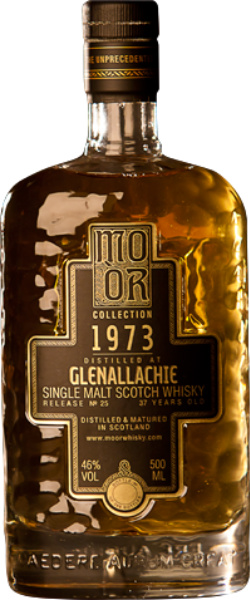
Glenallachie 37yo 1973/2010 (46%, Mo Òr, Bourbon Hogshead #6746, 266 bottles, 500 ml)

After all those fairly recent distillates, I guess its time to look at something older. This time we’ll have a look at a 37 year old expression of Glenallachie bottled by the Dutch Whisky Investors: The Whisky Talker. The Mo Òr line of Single Malt Whiskies was thought of as an investment, or as a luxury gift for business people. Sometimes you can even encounter a bottle like this in a super-duper hotel bar. Yes, Whisky is the new Swiss Watch or a premium golf-set. Glenallachie though, is one of the workhorses of Pernod Ricard, a laborer, meant for the Clan Campbell blend, not really a luxury brand isn’t it? But if you are worrying about the size of your next yacht, who cares? Ignorance is bliss. Let’s see if this old Glenallachie is any good.

Glenallachie 37yo 1973/2010 (46%, Mo Òr, Bourbon Hogshead #6746, 266 bottles, 500 ml)Color: Almost gold.

Nose: Soft and fruity. Next, some old bottle effect and great Speyside seventies fruity wax. Anoraks know this from Caperdonichs from 1972 and Tomatin’s from 1976, to name but a few. Vanilla plays a nice part in keeping the whole together. Definitely a (second) refill Hogshead. The cask wasn’t very active, but over almost 40 years, the wood did play it’s part in ageing this Whisky. Just let this breathe and it gets even better and better. Hints of old soft (sugared) mint in the background. Almond cookies with a bit of dust on them. Old wooden floor and a very distant smoky touch. The mint holds its ground and keeps accompanying the rest of the aroma’s from the nose. Great old malt, but it has its limitations. Lacks a bit of development compared to some of the (non-Sherried) greats from that era, but the whole is still fantastic and a treat to nose. Don’t get me wrong. Maybe this one shouldn’t have been reduced, although at 46% it’s still no dud.

Taste: Quite light and fruity. Sure, Speyside peach from old American wood. Hints of paper. Slightly sweet black tea with raspberry flavour. Especially here tasting it, the reduction shows itself. Making the whole a bit thin and shortening the finish. Also the cask seems to have been a bit tired. Hints of wood and sawdust and a hint of white wine. Sweaty high quality Sauvignon Blanc from the Loire. The wood shows a more soft mocha note now. Sawdust and pencil shavings. The mint from the nose stays behind in the back of my throat.

Whisky from a great time, but not the best expression from that time though. Probably a bit too tired a cask, and certainly should have not been reduced. It may have been already a bit frail and reducing it may have dulled it down. However, it still is an example of aged Speyside Whisky from the era, with this wonderful fruitiness and lighter style. I don’t know why, but this screams for some Roxy music from 1973. “The Bogus Man” sounds just right.

Points: 87

Followed this up with the 1976 Benromach. Both are 46% ABV, and both score 87 points, but the The Glenallachie is lighter, and smells more like a Whisky from another time. I would prefer the Glenallachie, especially for its nose.