 Punch is next. Punch is Cuban Cigar brand, but as with many Cuban brands, also exists outside of Cuba. You know all about families fleeing the country and selling the rights abroad, and the Cuban government seizing the Fabricas and continuing production. The “other” Punch is made in Honduras.
Punch was founded by German born Mr. Stockmann and named it after a character from a puppet show. Don’t you just love the names for Cuban Cigars? The third owner of the brand was Manuel López Fernández, and it is his name that still is mentioned on the boxes. The Cigar I’m about to review is from before 2005, a time this Cigar was released without a band. Since 2005 is does have a band, like in the picture below. In 2010 the Cigar was discontinued. There is a finite amount of excellent tobacco, and other sizes, with larger ring gauges, are more popular these days, so they use the tobacco for that. Today it has to be at least ø50, so no use making and (not) selling something that is a mere ø42…

Punch Royal Selection No.12 (42 x 129mm, Marevas, Petit Corona, Box code unknown)
Color & Looks: Colorado with small veins. It has some small black spots and some green discoloration. Nothing major. Straight build and feels somewhat flexible. Cuts nicely.
A cru: Nice leather and wood. A deep smell with all kinds of dry leaves. After the cut, quite fresh and mild smelling.
Taste: Starts good, good draw and smoke. Unique spiciness combined with wonderful woody aroma’s with some distinct woody bitterness. Works well with mild coffee. Although overall very mild and soothing, there is a slight chemical edge to it, that stays behind in the back of my throat. After just a few cm’s it seems to be a bit stronger than the mild start. It’s still not a Bolívar, so no worries. The wrapper produces light gray ashes, the filler turns into a darker shade of gray, but also some white and pitch-black ash can be found deep in the heart of the Cigar. A bit of a mess actually. The ash is not firm since it falls off quite easily.
A big part of the taste does remind me of dry Dutch Cigars’ Sumatra tobacco. This definitely is a cigar that has been lying around for a long time. As I said above, this one works well with coffee, but it doesn’t like water as an accompaniment, turning it acidic. Going along, the creamy bit increases. This one doesn’t seem to be tightly rolled, but nevertheless stays firm all the way, even when warming up. Incredible amount of smoke. It may not be a very strong smoke, but the taste is a bit harsh and not completely inviting. I’m doing my best to smoke this slowly, not to let it get too hot. Not a lot of development and most definitely not my favorite Cigar. For me not something I would smoke by itself, it needs some kind of accompaniment. The was quite a bit left when the Cigar turned, so not something you smoke untill you burn your fingers or your lips. Dry and woody throughout and definitely after dinner.
Marevas is a great size, maybe a bit thin for todays taste, but it still is a Cigar, you still are holding something in your hand, without it being tiny like a cigarette. It is most definitely thinner than a Robusto. This would seem a good one when you don’t have a lot of time on your hand. Not so. An older Royal Selection No.12 tends to be woody and harsh. It has to be smoked slowly, because when this gets hot, it is overly woody and even gets bitter. More recent examples, lets say from 2008 and later, are more creamy and definitely milder.
Points: 76
 Color: Orange brown.
 Color: Straw, light gold.
 This Rum is from 1992, the same year the column still was supposedly exchanged for a pot still. As far as I know, Gardel never bottled Rums themselves, but Gardel was bottled by numerous independent bottlers, although I don’t think a lot of Gardel is still around, so If you like Rhum Agricole and if you like Gardel, be quick. This particular Gardel was bottled by Swiss distiller and spirit importer
  Color: Copper brown.
 The old Rum community is enriched with Whisky people fishing in the pond of Rum and getting to know the product and a different kind of romanticism. Where Scotland is beautiful, but also cold and wet, Rum predominantly comes for the Caribbean and especially the image of paradise islands comes to mind. Older Rums are becoming scarce very quickly and just like Whisky, will become almost extinct, Prices are on the rise as well. Where have we seen this before?
 Thomas bottled a Rum from Guadeloupe from a distillery nobody has heard of, South Pacific (as stated on the label), not to be confused with the South Pacific distillery of Fiji, which is entirely different place altogether. Thomas explained to me he was offered a cask of South Pacific, which turned out to be Bellevue instead, so in this case the label is wrong. Casks like this are sold to bottlers through brokers, so it’s not a surprise there are a lot more Bellevue casks from 1998 bottled by different parties. And with brokers there lies a problem. Brokers only want to sell on casks, not really caring informing the buying party what really is in the cask if they have the information at all.
 Color: Orange brown.
 Color: White wine.
 Color: White Wine.
 Ahhh, finally a Bolívar. This is a first one on these pages. Bolívar isn’t a big global brand for Habanos, but it is available in a lot of markets nevertheless. Not a big brand, but it has a specific and fanatical following under seasoned Cigar smokers. Bolívar is known for heavy and strong Cigars.
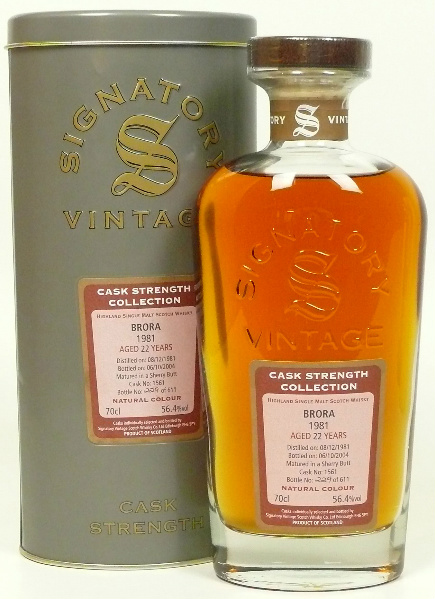
 Post number 600, so lets break out something special. Special for me is Brora. Sure Port Ellen, Ardbeg, Lagavulin, they all are Cohiba’s, but Brora is Trinidad. Brora is extra special (to me). 600 is a round number but it’s not 1.000, 10.000 or even a million. It’s 600, so I won’t be reviewing a 1972 Brora, which for me is the pinnacle of them all. The
  Color: Copper gold.
 Color: Copper gold.
 Master Quill