Last time we tried a Chardonnay from Languedoc, made by a Burgundian winemaker. All French thus. This time let’s fly halfway across the world and have a taste of Chilean Chardonnay. This Chardonnay comes from Maipo Valley that has a cool climate, granite soil and is located near the pacific. Like I said before, Chardonnay is an easy grape variety and can be found all over the world.
Viña Tarapacá, as it is called today, was founded in 1874 by Francisco de Rojas y Salamanca. It was then named Viña de Rojas. In 1892 the winery got a new owner, Manuel Zavala-Meléndez and gave it its current name. Today the winery is owned by Chili’s largest matchstick producer!
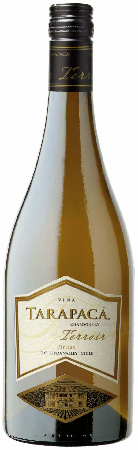 Color: White wine
Nose: Sweet and fresh, typical Chardonnay. Promises a nice balance between the acidity and the sweetness. Estery, meaty and flinty with a slight floral perfume. Dried apricots and maybe some pear, nectarine and banana. The fruity sweetness is quite thick. Licorice.
Taste: A dirty kind of sweetness. Its acidity is quite raw and different from what I expected, but then again, this is no Chablis. Quite good when it get in the mouth, but the middle and especially the finish are not very strong. The acidity is matched with a slight hint of bitterness which takes away the elegance. It’s a bit like a Roter Vitamin C tablet. This still needs some work.
At first this appears to be a pretty decent Chardonnay, but for me it has more than one rough edge. The sweetness is a little bit strange, and the acids are not refined. Sometimes it can attack you, hidden away behind the initial fruity sweetness. Add to that the hint of bitterness in the finish. Still, it’s pretty good, but not excellent. There ís a lot going on, but to me it almost tastes like a work in progress. We’re on our way, but not quite there yet. Especially the second part could have been better. The wine has an ABV of 14%.
Points: 77
And yes, this wine was also provided by Richard, muchas gracias!
 While we’re at it, why not try another gem (hopefully) by Michel Dupont-Fahn. This time his Chardonnay from…Languedoc! For those of you who are alarmed, don’t worry, this Chardonnay is well made into the Burgundy style (whatever that is).
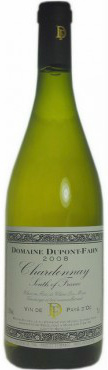 Color: White wine
 Michel Dupont-Fahn is a wine producer from Burgundy. He makes modern wines like Meursault, Puligny-Montrachet and some other wines. Michel makes modern wines that are meant to drink young.
 Color: Pink salmon, grapefruit.
 Color: Full gold
 At this point I must give off a little warning. I was in a beer shop recently and overheard some clients talking about pouring the big bottle of Rodenbach Vintage down the toilet. The big bottle should even be better than this Grand Cru, but this is a Flemish Red Brown beer, it’s acidic, so probably not for everyone…
 This is the first Tobermory on these pages and the Whisky itself comes from the Island of Mull. This distillery was founded already in 1798 and was originally called Tobermory. Tobermory closed in 1930 and was turned into a power station. It stayed closed as a distillery, untill it reopened in 1972, but this time as Ledaig. Ledaig’s history, from its reopening was a rocky one, with a lot of buying and selling of the distillery with production stops to match. The current owner is Burn Stewart (which itself is/was owned by an insurance company (since 2002), that again was rescued by the government of Trinidad & Tobago in 2010. You don’t want to know…)
 Back to Tobermory (or Ledaig). Ledaig was sold to Burn Stewart in 1993, and they decided to give back its original name: Tobermory. In 2005 Tobermory issued three 32yo from 1972. These were Oloroso Sherry finished Whiskies. One with a black label, one with a red label and this green label reviewed here. Purists mention an additional brown labeled version for sale at the distillery. Also 32yo and 1972, but “put on bottle” in 2010, so it must have been kept in stainless steel tanks of on glass from 2005 to 2010 to stop further ageing. Not a lot is known about this bottle…
 Color: Brown
 sometimes seems thinner than the other two.
 Here are a few firsts, and on paper a quite interesting one to boot. This is the first Ben Nevis on these pages. It’s also the first time I’m reviewing a Whisky that was bottled by
  Color: Pinkish gold
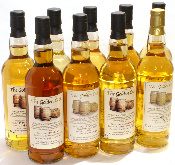 goes a bit wrong in the finish. Slightly acidic and the vegetal part (fern) starts to play a larger role. Also, but very late, comes in some bitterness from the wood. Fern with the sweetness, and the slight bitterness, is maybe a strange combination, but hey it’s only part of the finish, so don’t worry.
 Readers that like my occasional reviews of cigars will know by now that I don’t smoke inside the house. The sparsity of these cigar reviews are only caused by long stints of bad weather. It almost seems to me that the last five years, we didn’t even had one decent summer! It’s june, and here we had only a few whole days of Sunshine! You do not have to be a rocket-scientist to figure out when that happens, a cigar will be freed from its humidor. This time I chose a Partagás. Partagás usually are on the heavier side and I thought let’s start the season with a nice nicotine rush!
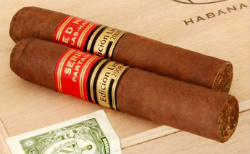 A cru: Chocolate, dusty old books with a nice creamy touch and with a slight hint of toffee.
 Spicy and full of character, woody and dry. I’m having a mild arabica coffee with this, but the cigar doesn’t overpower it. So it is full of Partagás character, but it doesn’t pack that Mr. T. punch Partagás so often have. Excellent. With water on the side the cigar tastes more sour, so I wouldn’t recommend drinking water with this cigar because it changes the fine constructed character of the cigar.
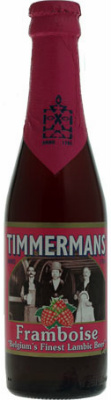 Timmermans is part of
 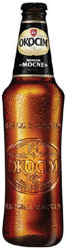 Here we have a beer from Poland. I visit the country on a regular basis, so it’s not that hard for me to come in contact with some of the Beers they’re making over there. Poland, of course, is better known for its Vodka, than for its Beers, but during the last few decades has seen a big shift away from the consumption of Vodka (even the tax on Vodka was lowered at some point) to Beer. A few moments later, brewers from the west saw this opportunity and quickly bought up all the large brands. Especially Heineken (f.i. Zywiec & Warka) and Carlsberg (f.i. Okocim & Harnas) were quick to snap up the Polish brewers. Lets have a look at this Okocim Premium Mocne then. I aged the Beer for an extra year (I love to do that), and this Beer can take some ageing.
  For me always a good sign.
 Master Quill