Here we have an Aultmore from 1974. The one official bottling in the Rare Malts range was also from 1974. Three years ago Douglas Laing bottled a 1974, and even more recently, two bottlings from The Whisky Agency saw the light of day. There is one more by Adelphi, but more about that one later.
Aultmore was founded in 1896 by Alexander Edward who also founded the Craigellachie distillery with Peter Machie in 1891. In 1896, Mr. Edward also owned the Benrinnes distillery. Mr. Edward sold Aultmore to John Dewar’s and Sons in 1923. John Dewar’s and Sons naturally became part of what is today Diageo, but Diageo sold the whole of John Dewar’s and Sons to Bacardi in 1998. Aultmore was built with two stills and two more stills were added in 1971, so this 1974 Aultmore was already made with four stills.
 Color: Full gold
Nose: Estery and full. Seems sweet and has a perfect woody touch. Powdery with vanilla, but also some vegetal sourness creeps in, but only in whiffs, it’s not always there. Malty freshness, and the slightest hint of cow-dung, great! This kind of organics in Whisky is the best, look at all those fantastic Brora’s. I really like the complete profile this nose shows me. A great, but toned down or laid back Whisky. It doesn’t shout from rooftops it’s great, but whispers. People who know, will hear it’s call.
Taste: Woody cannabis, and in this case that’s very nice. Sugary sweet, but the “wood” is the taste giver of this malt. Mind you this is not a woody malt. It’s like somehow there is some fruit in here but it isn’t allowed to get out. Medium, slightly disappointing finish, and probably the reduction could have been skipped, since the Whisky shows some laziness. Could have been fuller, if so I’m shure it would have scored in the 90’s. Nevertheless a great Whisky!
One of my favorite Aultmore’s is also from 1974, a bottling by Adelphi, Cask #3739, yes a sister cask! That one yielded only 101 bottles @ 49.6% ABV. Cask #3740 yielded 264 bottles reduced to 46%, so I’m guessing this was a lot higher in ABV (I can’t imagine Adelphi doing a cask share, but you never know). If memory serves me well, this sister cask also has a lot of yellow fruits, cask #3740 lacks. I have a bottle of Adelphi’s 1974 Aultmore, so in the future, that one will be reviewed on these pages too…
Points: 88
Thanks go out to Dirk for handing me this sample some time ago…
 At this point I must give off a little warning. I was in a beer shop recently and overheard some clients talking about pouring the big bottle of Rodenbach Vintage down the toilet. The big bottle should even be better than this Grand Cru, but this is a Flemish Red Brown beer, it’s acidic, so probably not for everyone…
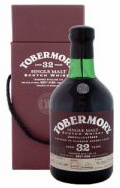
 This is the first Tobermory on these pages and the Whisky itself comes from the Island of Mull. This distillery was founded already in 1798 and was originally called Tobermory. Tobermory closed in 1930 and was turned into a power station. It stayed closed as a distillery, untill it reopened in 1972, but this time as Ledaig. Ledaig’s history, from its reopening was a rocky one, with a lot of buying and selling of the distillery with production stops to match. The current owner is Burn Stewart (which itself is/was owned by an insurance company (since 2002), that again was rescued by the government of Trinidad & Tobago in 2010. You don’t want to know…)
 Back to Tobermory (or Ledaig). Ledaig was sold to Burn Stewart in 1993, and they decided to give back its original name: Tobermory. In 2005 Tobermory issued three 32yo from 1972. These were Oloroso Sherry finished Whiskies. One with a black label, one with a red label and this green label reviewed here. Purists mention an additional brown labeled version for sale at the distillery. Also 32yo and 1972, but “put on bottle” in 2010, so it must have been kept in stainless steel tanks of on glass from 2005 to 2010 to stop further ageing. Not a lot is known about this bottle…
 Color: Brown
 sometimes seems thinner than the other two.
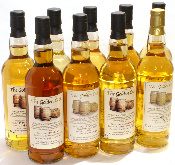
 Here are a few firsts, and on paper a quite interesting one to boot. This is the first Ben Nevis on these pages. It’s also the first time I’m reviewing a Whisky that was bottled by
  Color: Pinkish gold
 goes a bit wrong in the finish. Slightly acidic and the vegetal part (fern) starts to play a larger role. Also, but very late, comes in some bitterness from the wood. Fern with the sweetness, and the slight bitterness, is maybe a strange combination, but hey it’s only part of the finish, so don’t worry.
 Readers that like my occasional reviews of cigars will know by now that I don’t smoke inside the house. The sparsity of these cigar reviews are only caused by long stints of bad weather. It almost seems to me that the last five years, we didn’t even had one decent summer! It’s june, and here we had only a few whole days of Sunshine! You do not have to be a rocket-scientist to figure out when that happens, a cigar will be freed from its humidor. This time I chose a Partagás. Partagás usually are on the heavier side and I thought let’s start the season with a nice nicotine rush!
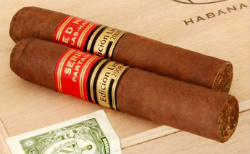 A cru: Chocolate, dusty old books with a nice creamy touch and with a slight hint of toffee.
 Spicy and full of character, woody and dry. I’m having a mild arabica coffee with this, but the cigar doesn’t overpower it. So it is full of Partagás character, but it doesn’t pack that Mr. T. punch Partagás so often have. Excellent. With water on the side the cigar tastes more sour, so I wouldn’t recommend drinking water with this cigar because it changes the fine constructed character of the cigar.
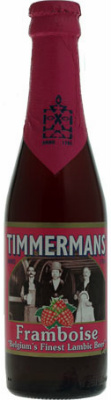 Timmermans is part of
 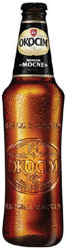 Here we have a beer from Poland. I visit the country on a regular basis, so it’s not that hard for me to come in contact with some of the Beers they’re making over there. Poland, of course, is better known for its Vodka, than for its Beers, but during the last few decades has seen a big shift away from the consumption of Vodka (even the tax on Vodka was lowered at some point) to Beer. A few moments later, brewers from the west saw this opportunity and quickly bought up all the large brands. Especially Heineken (f.i. Zywiec & Warka) and Carlsberg (f.i. Okocim & Harnas) were quick to snap up the Polish brewers. Lets have a look at this Okocim Premium Mocne then. I aged the Beer for an extra year (I love to do that), and this Beer can take some ageing.
  For me always a good sign.
 Color: Gold
 Second thing i noticed is that it’s 43% ABV, making the 12yo the only one in the standard range this is 40% ABV. The rest is higher with 43% and 46%. Having said that, Tomatin placed this Legacy before the 12yo, simply by making it cheaper. Pretty neat.
 Color: Light gold.
 Moving on to a beer this time, and not just any beer, but a Guinness, you know the dry stout that is good for you! (especially for the heart, because the antioxidants found in the beer, battle cholesterol depositing in your body). Today it’s almost everywhere illegal to make such a medical claim.
 If you want to know more about the beer, I have found the
