Recently I reviewed a Glen Keith by Malts of Scotland (a german bottler) that one was also 19yo (1990) and was quite the surprise. This time another Glen Keith that is 19yo old (1992) and this time by the Dutch bottler Kintra. Glen Keith itself was mothballed for more than a decade (1999-2013), but has restarted recently, Probably the last one of the mothballed distilleries that could have been revived. The rest of the closed distilleries are demolished or used for warehousing or have been turned into apartments or warehouses. It is very unlikely that any other of the closed distilleries will reopen. As of now probably only new distilleries will see the light of day.
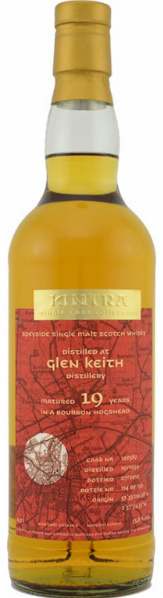 Color: Gold
Nose: The nose starts out rather sweetish and slightly soapy. Next up some fresh air and latex paint. This changes seamlessly into a perfect woody touch, that gets spicier with time. Vanilla and ice-cream with cherry bon-bon liquor (without the chocolate). Sometimes it even smells a bit as new wood. Those of you that think that something’s wrong because of the hints of soap and latex paint are mistaken. Pretty neat nose, one to be taken in vigorously, Smelled like this I also get a hint of sweetened yoghurt and some toffee. Later on some hints of dark chocolate and red fruit gello. In no way does is smell like a cask strength Whisky. No, this is a very laid back Glen Keith.
Taste: A perfect balance between the wood and the sweetness. There is a nice caramel like sweetness that underlies the whole experience. Nice and warming, and never bitter. Luckily it is not quite clean. Again some ice-cream, but after the sweet and the vanilla, the wood returns, which makes for nice balance. They play together well. Small hints of lemongrass and some lemon skins, but don’t get the wrong picture, these are only in here in hints, and make the whole even more interesting. It does develop a bit in the glass, more to the woody side and late in the taste a little bitterness does emerge, like walnut skin. That’s no problem.
Compared to the Glen Keith by Malts of Scotland, this is even a better example of a Bourbon matured Glen Keith. Again a bottle that will be finished rather quickly. Nice Pick by Erik Molenaar.
Points: 86
Thanks to Andre and Erik for providing the sample.
 Second thing i noticed is that it’s 43% ABV, making the 12yo the only one in the standard range this is 40% ABV. The rest is higher with 43% and 46%. Having said that, Tomatin placed this Legacy before the 12yo, simply by making it cheaper. Pretty neat.
 Color: Light gold.
 Moving on to a beer this time, and not just any beer, but a Guinness, you know the dry stout that is good for you! (especially for the heart, because the antioxidants found in the beer, battle cholesterol depositing in your body). Today it’s almost everywhere illegal to make such a medical claim.
 If you want to know more about the beer, I have found the
  Grüner Veltliner is a white wine grape variety that stems from Savagnin and further down the line, Rotgopfler and Pinot Noir. Despite of the name Veltliner, the grape isn’t related to Roter Veltliner and Frühroter Veltliner. Most Grüner Veltliners are planted in Austria and to a lesser extent, Slovakia and the Czech republic, but more recently also in the United States and Australia. One-third of all the grapes planted in Austria is Grüner Veltliner. In Slovakia one-fifth and in the Czech republic “only” one-ninth of the planted grape varieties is Grüner Veltliner. Most Grüner Veltliners age well and accompany food excellently.
 Especially in the Wachau wine region on of the following terms can be found:
 Color: Straw
 Returning from my vacation, a blank white box was waiting for me. Inside this rather large sample (70cl !), wrapped in a black velvety cloth, of the new Glenlivet Alpha or α (being the first letter of the greek alphabet). Alpha is also used as a synonym for first (of a series) or simply meaning “the beginning”. If this Glenlivet is the first of a series, then there are 23 more letters in the greek alphabet. Bring on The Glenlivet Iota and Omega! (The 9th and the 24th letter of the greek alphabet).
 It therefore has become more common practice to bottle Whisky without an age statement (or NAS), and give it a name. Just have a look at a lot of recent Ardbeg’s or some of the newest Macallan’s, but also Tomatin Legacy and Talisker Storm to name but a few, almost all with extensive add-campaigns to explain what kind of Whisky it is and what’s inside the bottle.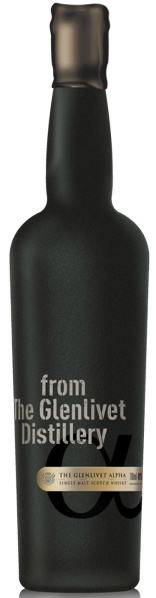
 Looking back, I see that two of the last four posts are old Clynelishes. One from
 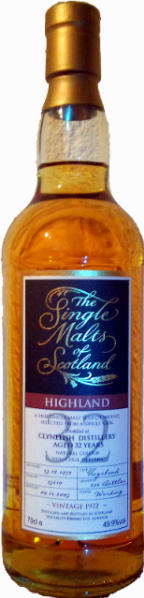 But that’s Brora, here we have a 1972 Clynelish, so it’s distillate from the then newly built distillery next to Brora…
 Here in Holland the Asparagus season has started and nothing goes better with that, than a nice fresh white wine. This Berger Riesling was ogling at me for quite some time, since all Austrian wines have the Austrian flag on top, it is easily recognizable.
 This Riesling (12.5% ABV), is wine from
  They are on a stony soil dating from prehistoric times. From these parts you can have a dry, minerally Riesling or Grüner Veltliner. Second on the south of the Krems Valley on the south bank of the Danube, small vintners in ancient villages make local wines in their own old-fashioned way. Third, to the east of Krems, towards Rohrendorf and Gedersdorf, there is löss in the vineyards which is noticeable in the wine, its softer and more lavish in style. The best wines from this region are called reserves.
 Color: White wine.
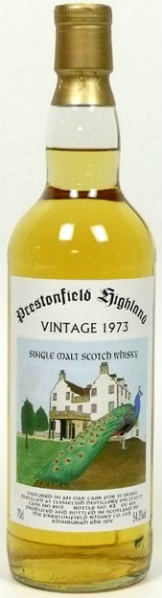 This Clynelish was distilled July 23rd 1973, a year Brora was still open but not very active, if active at all. As we all know, 1972 was Brora’s finest year, or so it seems. Time to find out what they did one year later at Clynelish…
 Color: Copper Gold
 After the
  Color: Gold
 Master Quill