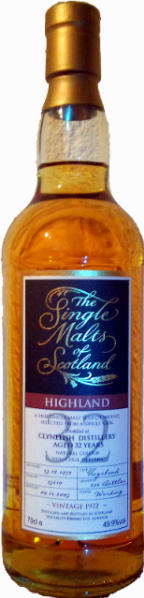
Clynelish 32yo 1972/2005 (49.9%, The Single Malts of Scotland, Hogshead #15619, 226 bottles)

Looking back, I see that two of the last four posts are old Clynelishes. One from 1974 and one from 1973. What could beat that? Well maybe another old Clynelish? Why? Because we can! And this time we’ll do a 1972! Exactly 1972, the year in which the adjacent (old) Clynelish distillery (a.k.a. Brora) reached the stellar quality we all (should) know by now. If you don’t know Brora 1972 by now, prepare to dish out some serious cash to do so, but then again, you might be a Sheik? Clynelish 32yo 1972/2005 (49.9%, The Single Malts of Scotland, Hogshead #15619, 226 bottles)But that’s Brora, here we have a 1972 Clynelish, so it’s distillate from the then newly built distillery next to Brora…
Color: Light Gold

Nose: Old once (painted) wood. The whole nose has a nice oldness to it. A smell you don’t encounter in more modern malts. Lots of woody caramels. The whole nose has some similarities to the 1973 I reviewed some days ago. This one is more leafy though, and less waxy. It’s not only sweets and woods. Pencil shavings and fresh air. Quite clean. Apple skins, nuts and some flowers. Freesia maybe?

Taste: Wood and a thin kind of waxiness. half sweet and a spicy bite of wood (do I detect a hint of smoke?). The wood doesn’t dominate. Also some hints from the animal kingdom. Something along the lines of a sweating horse. Again the added leafiness. Dry leaves and cold and wet black tea leaves. The body is medium to full, but with a lot of character. Orange skins. The finish is longer than I thought, but also thinner due to the lack of the big sweetness and waxiness a lot of Clynelishes have. Having said that I do like this one. It oozes Whisky from times long gone…

Brora’s from 1972 are special amongst others by the use of peat. This Clynelish lacks that peat. The cask itself didn’t do a lot for the whisky, apart from giving some woody traits to the Whisky. Wood, vanillin, that sort of things. This does allow us to have a glimpse at the distillate of Clynelish.

Points: 90

Berger Kremstal DAC Riesling Spiegel 2008

Here in Holland the Asparagus season has started and nothing goes better with that, than a nice fresh white wine. This Berger Riesling was ogling at me for quite some time, since all Austrian wines have the Austrian flag on top, it is easily recognizable.

This Riesling (12.5% ABV), is wine from Weingut (Erich) Berger, Gedersdorf Austria. Gedersdorf is in the North-East part of the Kremstal (2200 – 2300 Ha.), next to the Danube River. Weingut Berger is one of 150 Winegut’s in Kremstal (and in fact Kremstal itself is not one, but three valleys). The region also has Three different terroirs. First, the vineyards west of the city of Krems are similar to those in the adjacent Wachau wine district. They are on a stony soil dating from prehistoric times. From these parts you can have a dry, minerally Riesling or Grüner Veltliner. Second on the south of the Krems Valley on the south bank of the Danube, small vintners in ancient villages make local wines in their own old-fashioned way. Third, to the east of Krems, towards Rohrendorf and Gedersdorf, there is löss in the vineyards which is noticeable in the wine, its softer and more lavish in style. The best wines from this region are called reserves.

Color: White wine.

Nose: perfect Riesling nose. Crisp and fresh. Lot’s of yellow fruits. Some grapefruit, banana, apple, apple skins. Definitely stoney and mineral. I really like these kinds of white wines from Alsace, Germany and Austria, and again a nose like this is perfect.

Taste: Quite simple, but great balance in the acidity and sweetness. Again apple come to the fore. Light body and medium finish. Especially the finish is quite mono-dimensional, showing almost nothing else than (sugared) lemon. This is a wine for big gulps, drinks great that way and it concentrates the flavours a bit. Easy going and very accessible. What’s not to like here. Quite good with asparagus, but I can imagine this is a great wine for easy drinking in the summer. Simple, but I like it.

This wine was especially good the second day around. It was quite closed when freshly opened and the taste wasn’t rounded out and actually quite dull. The second day around it got smoother and sweeter, and the fruits al be it very light come through some more. Not a complex wine, but very likeable and stunningly fresh, and it won’t break the bank!

Points: 83

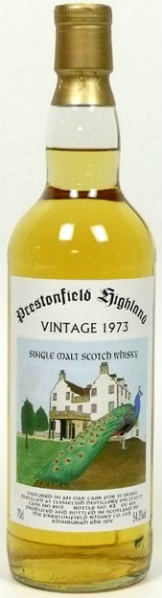
Clynelish 33yo 1973/2006 (54.3%, Signatory Vintage, The Prestonfield, Cask #8912, 405 bottles)

At last a new review at Master Quill! Some kind of throat infection and a Polish vacation stood in the way of writing some new reviews. But now all’s well and time to do some tasting again! I’m also happy to inform you that at last today was a day that made me forget about the half-year winter we had. First time it was really nice to sit outside in the sun, with even a nice cup of coffee and a little cigar, a Vegueros Seoane I reviewed more than a year ago.

Let’s get out some Clynelish. This Clynelish was officially bottled by The Prestonfield Whisky Company Ltd. which is just another moniker for the Signatory Vintage Company. There is also a second bottling of a 1973 Clynelish, of sister cask #8913. Under the Signatory label, Casks #8914 and #8915 were bottled in 2006 and 2007. These last two bottlings mention a Refill Butt, so this one here is probably from a Refill Butt as well. All four Butts were bottled as 33 year olds.

Clynelish 33yo 1973/2006 (54.3%, Signatory, Prestonfield, Cask #8912, 405 bottles)This Clynelish was distilled July 23rd 1973, a year Brora was still open but not very active, if active at all. As we all know, 1972 was Brora’s finest year, or so it seems. Time to find out what they did one year later at Clynelish…

Color: White wine

Nose: Farmy, with butter and old wood spice. Sweet and sweaty. Dusty and above all lots of beeswax. Typical Clynelish and a typical old Whisky. Also a fresh sea-air note. It has some hints that make me think this was a Fino Butt, but it could have been a Bourbon cask as well. Nothing is particularly Sherry in this one. It’s mainly oak (which here is a very lovely smell), and wax. It does tend to smell sweet, but not very fruity. Not fruity at all.

Taste: Sweet and again the spicy waxy wood. Great and elegant! Who said old whiskies are overly woody, and who said wood is a bad thing. Not in this one! This taste is a great example of how wood can taste when it’s carried by some sweetness and waxiness. It’s fat! Mocha, milk chocolate, toffee and again very Fino-ish. Later on a toasted not emerges accompanied by some sea weed and wait for it…It’s medicinal! The elegant wood lingers on and stays in the finish for quite some time.

A whisky of great balance, what you smell is what you taste (WYSIWYT). When I think of it, no, it’s still not very complex (but it is pretty sweet). Just like a Prestonfield Ben Nevis 1975. Also fabulous tasting whisky. That one is almost a Scottish Bourbon, yet also not very complex.

Points: 91

Bowmore “Dusk” (50%, OB, Bordeaux Wine Casked, Circa 2002)

Here we have a Bowmore oldie. This is the Bowmore Dusk, that was finished for two years in a Bordeaux Wine Cask (sometimes called a Claret finish). In 1999 Bowmore Claret was released, also a Bordeaux Wine Casked Whisky (12.000 bottles, 56% ABV), and was at the time a lot more expensive. Bowmore Dusk was introduced in 2000 whilst Bowmore Dawn, that had a second maturation in (Ruby) Port pipes, was introduced one year later. Both got the same look as Bowmore darkest, that had a second maturation in Oloroso Sherry Casks. Darkest wasn’t considered a speciality as Dawn and Dusk were, so Darkest was more accepted as part of the “standard” range and still exists today. Dusk and Dawn are no longer made, and hardly available anymore. The three were also sold together as a three-piece set (3 x 200 ml). Back to Dusk. There is some batch variation over the years, so there are versions available that are much lighter in color than the one I’ll be reviewing here…

Bowmore Dusk (50%, OB, Bordeaux Wine Casked, Circa 2002)Color: Copper Gold

Nose: Smoke pops out first. Very nice organic and peated smoke. Peat smoke, bonfire at the beach, at night. That sort of thing. Next some coastal freshness, with butter and something smelly from the animal world. Animal sweat? Clean oak, without any toast. A little bit powdery. Most definitely a wine finish. Caramel and vanilla, but the wine doesn’t allow them to be full, or round. They are around as an aroma, but more spiky in nature. Still this is all about smoke and luckily the wine doesn’t take over or ruin the bonfire at the beach party.

Taste: Sweet, caramel, toffee, fatty peat and lots of licorice. Medicinal. Great body, full and balanced. Long finish. After a long time, the finish that started out creamy, shows some woody sourness and the wine part shifts the whole into a slight unbalanced state, that is less sweet and creamy. But as I said that is way in the back of the finish. Not overly complex, but the wine finish is done with taste. Very drinkable. The ABV seems just right, and I can’t imagine this needing any water.

When I had this a long time ago, the taste is what I always remembered, the nose, well I completely forgot how nice this actually smells… I have to admit this is a tastefully crafted Whisky and I appreciate it better now, than I did back then (old score was 84). Here everything fits together nicely. Well done.

Is it just me, or do these older bottles look way better than the new ones? (Also true for Old Malt Cask bottles imho).

Points: 86

Clynelish 32yo 1974/2006 (58.6%, The Whisky Fair, Bourbon Hogshead, 266 bottles)

After the 1994 Clynelish I reviewed last summer, it took me a lot of months to return to Clynelish. As we all know, Brora 1972 (from the old Clynelish distillery) might be the closest thing to whisky heaven, I know there are more, but bear with me. The distillery built next to the old Clynelish distillery is the current (new) Clynelish distillery, so in fact what we heave here is a whisky made very close to heaven, close in space and close in time. Luckily to keep the legend sort of burning, Clynelish managed to keep up the quality and still makes a pretty decent Whisky. The 1994 reviewed earlier, was above average, now let’s have a look at this 1974 Clynelish.

Clynelish 32yo 1974/2006 (58.6%, The Whisky Fair, Bourbon Hogshead, 266 bottles)Color: Gold

Nose: Slightly farmy, leafy, clean and fruity. Old wax, but more wax off, than wax on. Rather fresh and lively. Dried apricots. Dusty paper, and  powdery. Vanilla. Bold (sour) wood, which is not up front. Naked oak, hence the sourness that sticks to it. It’s not particularly woody, but it ís the wood that keeps it together. Some grounded coffee. Cold cigar tobacco (Havana naturally). Musty clay and late vanilla. It’s not a Banff but I do ‘get’ some mustard here…

Taste: Wow! A nice attack of smoke, cannabis and hops. Creamy sweetness. Like true vanilla ice-cream with an apricot/mango syrup on top. Definitely a nice bite from the wood to accompany it all. The longer I keep it in my mouth the woodier it gets. It’s never too woody though. Quite strong, but it is almost 60% ABV. The finish lacks a bit of sweetness to round it all out. The wood makes it ‘pointier’ and dries out the lips. It does remind me a bit of the 1974 Rare Malts version, which was (also) no punishment to drink, but I liked that one a bit better.

This is one of many bottlings that are dedicated to one of earths finest Whisky festivals, or fairs, of all times. The Whisky Fair in Limburg Am Lahn in Germany that will be held at the end of this month. Of course this is long sold out, but new festival bottlings keep emerging as mushrooms on a wet forest floor, most of them pretty good, to say the least. It’s a very good Clynelish but the last part of the experience keeps it out of the 90 points range.

Points: 89

Lochside 18yo 1991/2009 (56.7%, Gordon & MacPhail, Reserve, Refill Bourbon Barrel #15220, 106 bottles)

Yet again we have one of the many 1991 Lochsides, and one of the many that were issued as a Gordon & MacPhail Reserve. This one was picked by Dutch retailer Van Wees. Gordon & MacPhail code for this one is JI/ACAC. The spirit was distilled on September 18th, 1991 and eventually bottled on October 15th, 2009. Picked by Van Wees in July 2009. Those of you that meticulously read this blog probably had a Deja Vu experience. We know this bottle, we know this lay-out. Well yes and no. February 4th 2013, I published a review of quite a similar Lochside, opened by Master Quill’s Apprentice (like this one). That was Cask #15217, here we have sister cask #15220, distilled and filled on the same day. This one was bottled some five months earlier, so here we have a chance to compare the two, to see what the effects are of another, but similar cask, and almost half a year of maturation…

Color: Gold (ever so slightly fuller in color)

Nose: Clean and fruity. Distant wood. Clay and organic. Dusty with smoked ham. All in good balance, but nothing pops out. A very quiet Lochside. The esters I remember from the “other” Barrel, are here too. Vanilla from the wood. The yeast is way down in this one, and there is no peat, rubber or petrol. It’s easier on the nose (more balanced), more rounded out, but also less complex. When nosing this a long time, slightly more (sour) oak comes along, but still not a lot, and it gets fresher, but in a mint and menthol kind of way. Also cherry liquor bonbons. The chocolate from them are in this Whisky too.

Taste: Sweet and farmy, with a great sweetish attack. Definitely less woody, at first, than the other Barrel. A nice peppery bite, next to the sweetness and the fruity, farmy notes. Again a nice big body, aided by the ABV. Honey and a great balance. Here too a chocolate liqueur bon-bon. Big body with a matching long and balanced finish. The wood is a lot more contained within this Lochside. Less vanilla though, so the wood reacted differently, it gave slightly more color, but less wood and vanilla. If you let it breathe for some time, the wood does play a larger role, and overall this is less “deep”.

You can’t go wrong with these kinds of Lochsides. There are a lot of 1991 bottles around, but they all are slightly different. sure the family resemblance is there, but I’ve tasted more of the 1991 G&M Reserve, and they all are variations of a theme. I feel it’s safe to say that some four or five months of extra maturation has a smaller effect on the maturation of a whisky, than te particular staves that were used making the barrel. Maybe I’m wrong. I just can’t imagine that the differences between cask #15217 and #15220, come from the small difference in maturation time. Here the “younger” one is more balanced but also less complex. For me I prefer the nose of barrel #15220 over #15217. Considering the taste, this one is easier, and less complex, but it has a better balance. All in all it’s definitely the same family, but the easiness, better balance and containment of the wood, the added farmyness and the difference in fruityness, makes me score this even two points higher. I just like this one better!

Points: 88

Thanks go out to Erik for providing yet another Lochside sample.

Glen Keith 19yo 1990/2010 (52.1%, Malts of Scotland, Bourbon Barrel #13678, 232 bottles)

Last time around we had a stellar but also antique 1967 Glen Keith bottled by Gordon & MacPhail. This time around we have a more modern expression distilled in 1990 bottled in 2010 by german outfit Malts of Scotland, in a more modern type bottle. Let’s see if a more modern Glen Keith is up to par. We’re now in April 2013 and this should be the month the distillery would be reopened. I have looked around in the media but haven’t found a word about it, so I guess the distillery hasn’t opened yet. I hope I can inform you on the reopening in the next Glen Keith review.

Color: Straw

Nose: Clean wood, overall clean, spicy naked wood or virgin oak as they like to call it. Not a lot of character for something that was 19 years in a barrel. Definitely a refill. a slight hint of vanilla, which can’t be a surprise. Cloves, not very ripe pears and a little bit creamy. Well considering all, clean is the word here, you could almost call this sterile, but I won’t because it isn’t. No faults too. I guess the spirit’s great, but the barrel didn’t do a lot for this Whisky. When warmed up a little, some grassy or hay-like notes appear and it gets slightly perfumy (like soap), mind you it’s not soapy! Maybe we should call this profile ‘honest’.

Taste: Sweet and creamy and actually very drinkable, Small hints of wood which gives the whole some character. Overall creamy, with vanilla and mocha and some ice-cream and clotted cream as well. It has a very confectionery feel to it. The sweetness is sugary, but again there is absolutely nothing wrong with it. It’s quite nice, it’s very simple because there isn’t much to it, but easy drinkable likeable. An easy sipper, and I can imagine people having a lot of fun with this.

Let it breathe to open up. Well its incomparable to the oldies from the sixties and seventies. Those were mostly sherry bottlings to boot. Still this is from a cheap Bourbon Barrel, but it shows us that the spirit is rather good. For a simple refill cask. still it did nothing wrong and makes this a nice sippin’ Whisky. Nice.

Points: 84

Bruichladdich 14yo 1991/2005 “Yellow Submarine” (46%, OB, WMD II)

WMD stands for Whisky of Mass Distinction. A name one would find on a Frankie Goes To Hollywood 12″ in the eighties. Two years earlier the first WMD was released (a 19yo from 1984) and had a rocket on the label. This second “weapon” is a Yellow Submarine. Most of us would have thought of the Beatles, but this time it about another submarine. One owned by the Royal Navy of Great Britain.

Islay Fisherman Baker was at sea to check his lobster baskets, when he saw a yellow object floating just under the surface of the water. Which first seemed a buoy seemed to be a 2 metres long radio-controlled mine detector from the Royal Navy. When Fisherman Baker called the coastguard informing them that he spotted a submarine with markings from the Royal Navy, they told him to he was drunk, not very uncommon on such an Island. Still fisherman Baker wouldn’t budge and the coast guard called the Royal Navy, but they denied it’s existence!

Just days later the Royal Navy admitted they had lost HMS Penzance (The Yellow Submarine) in a drill. But just after 6 months they decided to pick the thing up> They sailed out at night, to arrive very early in the morning, not to draw a lot of attention to the operation. But the people of Islay are no fools, so half the Island was present at the beach. 12.000 bottles of Yellow Submarine were made and the Royal Navy got six to commemorate the incident. Later the French manufacturer of the Sub ordered another 1000 bottles of this edition for marketing purposes…

Color: Light Gold.

Nose: Woody and smoky. Quite estery and fruity as well. Clay and wet earth. Chewy (in the nose?). In a way candied and wine-treated (it is ACE’d in Rioja Casks, well that’s very Obvious in the nose). The wine finish takes the nose hostage, never to let go, whatever ransom you’re prepared to pay. Is that a bad thing, no not really it is likeable in the nose. I just hope is does the palate some justice. Creamy milk pudding. Powdery perfumed wood. Fresh.

Taste: a bit harsh and winey from the start, but it seems balanced. Wood and milk chocolate pudding. Creamy. Also a little bit from the wood and a wave of sugary sweetness. The palate is very nice, but also very simple. Probably a good idea to reduce this to 46% ABV, because now we have a very drinkable whisky. Nothing overly special though, with also an unspectacular finish, but it definitely is all right!

Well this most definitely is a Rioja finish. The Rioja is all over the place. It draws all attention to itself. Although wine finishes almost every time ring my alarm bells, this is not bad. Alas the maker doesn’t state what kind of Rioja it was red, white or rosé, although rosé would be pretty uncommon, most probable would be red. Most used grape variety in Rioja is the Temperanillo grape, remember the Temperanillo casks used by Tomatin?

Points: 85

Caol Ila 26yo 1974/2001 (50%, Douglas Laing, Old Malt Cask, 294 bottles)

Next up is this Douglas Laing bottling of a 1974 Caol Ila and most probably from a Hogshead, but you never know. 1974 is a pretty special year for Caol Ila because from 1972 through 1974 the whole of the distillery was rebuilt, completely! Everything, apart from the warehouses, was demolished and completely rebuilt. In 1974 six new stills were installed, so here we can have a taste of the first whisky that ran off the stills in 1974. This is the first of the “modern” Caol Ila as we know it today. Is it new and improved?

Color: Gold

Nose: A very refined yet fatty peat, quite sweet and floral. Fantastic organics! Grassy, lemongrass actually, in perfect harmony with excellent (fishy) peat. Do I detect some tarred rope? Pretty light for a Caol Ila, but so elegant and fresh, it does have some sea breeze to it. Oil spill on water. Beautiful bonfire smoke and leafy. Nice elegant wood. Bushes in summer in the rain. Nothing oomph or in your face, this a very refined Islay Whisky. I already like this very much, but the nose just keeps developing…

Taste: Again quite sweet, light peat and clay. A little bite from the smoke, than the wood and the smoke again (in that order), after that slightly sweet and a thin palate of yellow fruits. Very balanced. Lemonade fruitiness combined with fatty elegant peat (again) and nice smoke. The saltiness these old Caol Ila’s often have is absent from this 1974. medium finish that gets thinner, which underlines the brittleness of this malt. Old age. Still it is so good, the initial taste and the body are that nice, that I don’t care about the weaker, but not short finish. This is a lovely dram.

What a fantastic Caol Ila this is. Sure Ardbeg, Port Ellen, Laphroaig and Lagavulin all have fantastic old drams, and are big names, but those seventies and early eighties Caol Ila’s are right up there with them. How nice Douglas Laing had a 1974 Caol Ila, a shame only that it was only one cask… I would have wanted more.

Points: 91

Thanks Andries for the sample!

Santa Cristina Toscana IGT 2009

This is a widely available inexpensive blended wine from Cortona (an Etruscan settlement) in Tuscany, Italy. The first bottle of Santa Cristina saw the light of day in 1946 right after the second world war. The wine then was made by Marquis Niccolò Antinori. In 2006 a new winery was opened.

The wine is made of 60% Sangiovese, 40% Cabernet Sauvignon, Merlot and Syrah. 13% ABV. The various grape varieties of the blend are fermented separately and aged partly in oak and partly in stainless steel. Harvesting of the grapes takes place in September and October, Merlot being harvested first. Ageing takes place from the end of winter through spring and by the end of spring the wine was bottled.

Color: Dark ruby-red.

Nose: Creamy, with notes of hot dry earth. Soft notes of raspberries and other ripe red fruits. Ripe because it comes across as soft, and doesn’t have a lot of sourness to it. Lots of strawberry jam.

Taste: Again the strawberry jam and it does have some acidity. Nicely blended to a balance. It’s quite light and lively, but on the other hand nothing really pops out, and it does have a short finish. As I said, easily drinkable, but also easily forgotten. Still I like this, just don’t expect too much. Nicely priced also.

It’s blended to a soft wine, that is very easy drinkable, and will go with anything. Just stay off game. The nose is light and balanced, but very nice, you can imagine the surroundings in summer, where the grapes are grown. It certainly shows where it comes from. The taste however is a bit more anonymous. It’s well made, and it will not repel anyone, as there are no obvious faults. The only thing that disappointed me a little was the finish, it breaks down a little, and is quite short and again anonymous. One to have a lot of fun though and it isn’t going to break the bank. good with food and for carelessly sipping away on the couch.

Points: 80