Mortlach 10yo 2011/2021 (57.3%, Signatory Vintage, Finished in 2nd fill Sherry Butt #3, A Farewell Dram bottled for Walter Schoberts Final Tastings, 527 bottles)

What can I say, Mortlach is a special distillate with a special profile. First of all, Mortlach is known for its unique distilling regime where the spirit has been distilled 2.6 times. Mortlach is also known for its big and meaty Sherry profile, like the 16yo Flora & Fauna bottling or this 10yo Wilson & Morgan bottling. But even the lighter (ex-Bourbon) versions of Mortlach always bring something special to the table, like this 11yo Provenance bottling, not a high scorer, yet very interesting indeed, or this small batch 12yo Signatory bottling from 3 Bourbon Barrels. This time around however, we’ll have a look at a Mortlach that has its initial maturation in, most likely, American oak Bourbon casks and a finish in a second fill Sherry butt. As usual, no info about the type of Sherry, and we all know there are a lot of different types of Sherry around. Oloroso is no Palo Cortado, ain’t it! Nevertheless, this Whisky seems to be more on the light side, so at this point I don’t expect a meaty Sherry expression.

Color: Light gold.

Nose: Nice entry. This immediately reminds me of good Whiskies I tried in the early noughties (if you let it breathe for a minute or so), definitely brings back memories. A slightly mineral and somewhat Sherried barley note. Wow, really old-skool nose. Quite organic at first with hints of sugary sweetness, cardboard and white bread. Slightly biscuity. Fresh and vibrant nevertheless, since bread is not a vibrant aroma. Very classy and well balanced for a 10 year old dram. Some fruity notes emerge next. Initially some unripe cherries. More fruits in general, more syrupy yellow fruits actually. Peach syrup and candied pineapple. Sweet peachy yoghurt. Together with this a fresh and warm barley wind bringing a Gin-like freshness. Warm old wood in the sun. Slightly dusty and powdery. Not floral at all although it is slightly perfumy. It has quite a lot of different aroma’s going for it. For me personally Mortlach often has this meaty quality to it (especially when aged in a Sherry cask), but I’m struggling to find that here. It is definitely more fruity than meaty. Don’t think the fruit is masking it, I feel the meatiness just isn’t here. The longer this breathes, the fruitier and sweeter it becomes. Very appetizing fruity fresh and vibrant Mortlach this time. After some time a more soapy note emerges as well as some more freshness. Not in a bad way though. Definitely a quality nose. Maybe a little bit light, and this might have been ruined (a bit) if it would have been reduced. All in all definitely a quality and classy nose.

Taste: Nutty first, almonds, hazelnuts and fruity second yet not far behind. Big, sweetish and balanced. Did I mention that its nutty? Notes of burnt or toasted oak, and some cold dishwater to be honest. Big aroma initially which quickly becomes somewhat thinner. Definitely a fruity Whisky with lots of ripe yellow fruits and some red berry acidity. After the layered and complex nose, the taste is simpler and more straightforward. Notes of a yellow fruity beer and ever so slightly soapy. Even though the nose is way more complex, the nose and the taste of this Whisky are well balanced and suit each other well. Since this was finished in a Sherry butt, I guess this initially aged in probably two or three ex-Bourbon casks (barrels and/or hogsheads), and where I struggled to pick up on the Mortlach meatiness, I also struggle to pick up on vanillin from the American oak, so, probably not first fill. A vanilla note or ice-cream note, yeah, maybe, gets lost a bit in the slight thin-ness of the body. And maybe somewhat overpowered by the fruity acidity. Let’s say this is a summer expression of Mortlach. The aroma’s are transported well, so 57.3% ABV, yes indeed, but it doesn’t really show this much alcohol. More woody towards the finish, warming, with a bonfire like toastiness, as well as some paper and cardboard notes. Dirty and fruity, yet not meaty.

A Good summery Mortlach. The nose is really good. Sometimes the taste seems thin, but that also depends a bit on you yourself. For this review I tasted it twice on different days, and the second time around it wasn’t as thin as the first time. Very good Mortlach again, and this particular expression has some similarities to Bimber that has matured in Bourbon casks, Like this cask #194.

Points: 87

P.S:(I). This one is very nice after a cup of coffee…

P.S:(II). In case you are not German and you want to know who Walter Schobert is:

Walter Schobert (* 1943 in Erlangen) is a German museum director and author. Schobert studied Protestant theology and theatre studies. He then worked as a priest and as a film speaker for three years each. From 1974 to 1985 he was chairman of the working group for community film work. From 1979 to 2003 he was the founding director of the German Film Museum in Frankfurt am Main. He is the author and editor of numerous writings on film and film history and has taught film history at various universities. Since 1994 he has been an honorary professor at the Institute for European Art History at the University of Heidelberg. In 1995 he was awarded an honorary doctorate from the University of Edinburgh. In addition to his work on film history, he has published numerous publications on the subject of Scottish whiskey and regularly conducts tastings. He is a member of the “Keepers of the Quaich”, an association that looks after the whisky culture in Scotland [Source: Wikipedia].

Ledaig 9yo 2005/2015 (56.8%, Signatory Vintage, Cask Strength Collection, 1st Fill Sherry Butt #900146, 664 bottles)

After Caol Ila and two cask strength Laphroaig’s, lets stay with peat for a while (winter is coming) and check out this peated offering from Ledaig. Yes I know, Ledaig isn’t from Islay. Why should it? You can distil with peat anywhere on the planet, or in this case, Scotland. There is already a lot happening on Islay, lots of distilleries, and isn’t Mull more unique? Not a lot of distilleries on Mull. Ledaig as we all know by now, is the peated Whisky made at Tobermory Distillery. You did read all my previous reviews on Ledaig, in preparation to this one, now did you? So you should know by now, yes? Tobermory distillery also releases unpeated Whisky, calling it…well…Tobermory, how did they come up with that! You could fool me sometimes with this statement though. Seems to me some Tobermory’s are peated as well, maybe less so than Ledaig, yet peated. Maybe they’re just not as good at line clearance as they are in making Whisky? Who knows, and who cares if the output can be this good. By the way, not even that long ago Tobermory did have some sort of a wonky reputation concerning the quality of their Whisky.

Earlier I reviewed a fantastic 11yo Cadenheads offering distilled in 2005 which has matured in a Sherry Butt. This time around I went for this 9yo 2005 Signatory Vintage offering, that also matured in a Sherry Butt, expecting and hoping for more of the same and wanting that all 2005’s are somewhat created equal. I just wonder why Cadenheads only managed to draw 450 bottles at cask strength from a Butt and Signatory 664 bottles. That’s quite a considerable difference. By the way, Cadenheads bottled two other casks from 2005, yielding 510 and 516 bottles. Still no 664 bottles though. Different oak with more evaporation or different warehousing conditions? Who knows.

Color: Orange gold.

Nose: Fatty, fragrant and delicious peat. Slightly Sherry sweetness. Full on sweet smoke with some toffee. A little dirty yet sexy. Licorice smoke. Salty and smoked licorice candy. Prickly smoke, with a minty side to it. Smoked menthos. Nom, nom, nom. I have to say, a peated spirit like this, aged in a Sherry butt, what a combination. The start was peat which morphs slowly into smoke. Hints of anise seeds and cumin. In the background dried beef, gravy and salty smoked fish. This has also an underlying fruity side to it, but again, just as in the Caol Ila I just reviewed, this is masked by the usual suspects of peat and smoke. What a wonderful smelling Ledaig again. Utterly amazing smelling Malt and it’s only 9 years old. Glowing embers, warm glowing charred wood. Hot barbecue before anything is put on it, burning off the last spots of fat left behind from the previous session, right before putting something on it again. Or imagine sipping this near the fireplace high up in the mountains. This nose never stops giving. Warm oil emanating from a steam locomotive (a fresh experience from two months ago in Quedlinburg, Germany).

Taste: Starts sweet and peaty, yet also somewhat unbalanced. The peat and the smoke have a bitter edge here right from the start, but also something fresh like a cola has. Nutty and some burnt fat from the barbecue. This note smells better than it tastes, by the way. Very warming and hot going down. Now I do notice quite some dry wood underneath, tucked away neatly between the peat and the smoke. So it might be a bit hidden, but the cask is quite active as well. More towards burning plastic now and again the minty note. The peat note is more bitter and together with the smoke, also less dominant. The Sherry comes trough some more. Dried salty fish. This one needs some time to breathe, but not too much. When standing around in my glass for a long time, the taste deteriorates a bit (the bottle is also nearly empty by the way, so I notice the air did play its part). This will be of no concern with a freshly opened bottle, because then, this Malt still does need a lot of air. Crushed beetle in the finish, and overall still warming. Also some caramel comes forth.

Are all Sherry Butt matured Ledaig’s from 2005 created equal? Nope they aren’t. The Cadenheads rose to the occasion much more than this Signatory initially, but, oh boy, when this got enough time to breathe in an open bottle, yeah man! The nose is up to par with the Cadenheads, alas on the palate, the Signatory falls apart a bit and the Cadenhead is the clear winner. Sure it’s different from the Cadenheads offering as well. That one was tasty from the first poured dram until the last, and this Signatory one did need some time to find its place, which luckily it did, although it never reached those highs of the Cadenheads, and deteriorated a bit when nearly empty. Nevertheless two big peated hits in a row from Tobermory. I’m suspecting an album of greatest hits now, so for the time being, I will be replacing every emptied Ledaig with another one. Can’t wait to open up the next one now. I have to look in my stash for one matured in a Bourbon cask after these two Sherried ones.

Points: 86

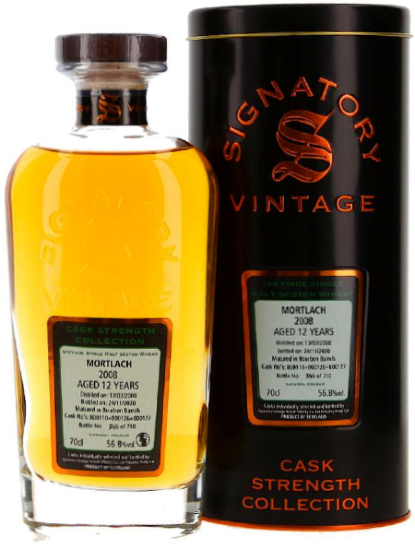
Mortlach 12yo 2008/2020 (56.8%, Signatory Vintage, Cask Strength Collection, Bourbon Barrels #800110, #800126 & #800127, 710 bottles)

After the wonderful and very interesting Loch Lomond, let’s try another Whisky fully matured in ex-Bourbon casks. This time one that was distilled at Mortlach. Mortlach has quite the reputation with Whisky Aficionado’s and rightly so. For instance, Mortlach 16yo was arguably the best offering in Diageo’s once extensive Flora and Fauna Range. Having this niche popularity, Diageo decided to do something more with the brand that is Mortlach and discontinued the 16yo around 2012 in favour of a Rare Old (NAS, not rare nor old, 80 points), an 18yo and a 25yo (84 points). All in 500 ml bottles! These three were released in 2014 and replaced in 2018 by more common age statement versions: 12yo, 16yo (a magic age statement for Mortlach) and 20yo. All three now in 700 ml/750 ml bottles. Mortlach is known for its Whiskies matured in Sherry casks. The 16yo Flora and Fauna is an example of this, and I thought an offering by Wilson & Morgan was even better than that. No surprise then, this has matured in a Sherry cask as well. I also reviewed a Provenance Mortlach earlier, I suppose was matured in Ex-Bourbon wood, which was not so interesting, so let’s see if this Signatory Mortlach is any good, or we should stick to Sherried versions of Mortlach altogether.

Color: Light gold.

Nose: Winey, clear glue, creamy and slightly acidic. Not your usual creamy vanillin kind of smell though. A moment later some more fruits emerge, as well as the creamy vanilla powder notes. Dusty and slightly smoky (probably from toasted oak, not peat). Hints of gravy and cold dishwater, and some soft sugared fruit notes. This is a big Malt, which already shows amazing complexity. Not a cloying smell, since a nice fruity acidity keeps playing its part. This is a Mortlach and Mortlach is a special distillate, and boy, does this smell special. For some this may be a simple kind of Whisky, just pour new make into Bourbon Barrels, mind you, they didn’t even turn those into hogsheads, lazy buggers, and job done, easy, simple, no hassle. Yet Mortlach in a Bourbon Barrel, comes out slightly different from Whiskies from other distilleries matured like this, there is always something different about Mortlach, richer, beefier, meatier, just bigger, special. It’s almost like the fatty acid chains are just longer with Mortlach (without becoming soapy). Hints of raspberry hard candy, next to the half-ripe yellow fruits. Just not as exotic as it can be in well matured Tomatin’s. However, keep in mind that this is only 12yo, and not 30yo like the Tomatin’s I just mentioned. I don’t even know why I brought that up, since Mortlach and Tomatin are very different from each other. So fruity it is, just not all that tropical.

Taste: Sweet and very, very nutty and fruity at the same time, much more fruity than expected actually. Some wood, more akin to pencil shavings than oak, to be honest. Including a slight harmless bitter note. Again, not cloying since the big body also has enough fruity acidity to help it along. Nice. What a wonderful start. Signatory have recently issued some Mortlach Sherry Monsters from the 2010 vintage, which are more or less the same age, but I can’t imagine those ones beating something like this. Licorice powder, some paper and some spices as well as a peppery backbone. Sometimes a sweet minty note pops up. Mocha, milk chocolate. Tastes like a dessert Malt now. Hints of hay, more paper and overall still quite complex. Nice finish and a long warm aftertaste, including the glue again, which you pick up on initially when smelling a freshly poured dram of this.

This is an excellent Mortlach that was not matured in a Sherry cask. Very big and tasty, with complexity and length. The quality is unmistakeable and this will please a lot of Whisky aficionado’s. Its a good example of the spirit of Mortlach and a good example of what “simple” American oak can do. The quality is right upfront, and easy to see for everyone. I scored the Loch Lomond from the previous review slightly higher than this Mortlach, but I also believe, that one might not be for everyone, and you can only find the true beauty of the Loch Lomond when you work it a bit. The Mortlach is more suitable for casual drinking, its always good. the Loch Lomond needs your full attention, otherwise it can be a grumpy old git and will Will-slap you across the face.

Points: 88

Linlithgow 18yo 1982/2001 (43%, Signatory Vintage, Vintage Collection, Cask #3002, 472 bottles)

Here we have a rather “young” Linlithgow, a.k.a. St. Magdalene. I really, really loved the extremely layered St. Magdalene 19yo, that was released three years prior to this one, so when this came out in 2001, I snapped up a few, expecting a similar experience to the one year older and cask strength expression mentioned above. Hey it was reduced a bit, and only one year older, so it could happen, and it was half the price of the 19yo! At the time, Whiskies from the Vintage Collection were never expensive, as was the case with this one. They sold this at the price of what a Springbank 10yo sells for today. Remember, even in 2001 this was already a closed distillery, so go figure. It was a different Whisky world back then. If I look around the net today retail price for this one is £699,-, and if you read this in 2025 it will probably be even higher, or have we all moved on to something else? If that is the case, why are you even reading about an old Whisky nobody cares for anymore?

Color: Pale gold, straw.

Nose: Extremely malty. hints of sugar-water and ear wax. Fruity and grassy. A Lowlander alright. A breath of fresh air. Toned down, almost shy, but don’t think this is light, because it’s not. It shows quite some aroma. The quiet (big) guy in your class, but you already know there is more to it than meets the nose. Yellow fruits and whiffs of American oak, It is definitely something from the past. Somehow Whiskies today aren’t like this anymore. Its like sitting alone in a field, middle of summer, nothing more than crickets and almost inaudible distant sounds of the rest of the world. Life is beautiful. Hints of cold butter and hay. Warm wood and a bit of old vanilla. Definitely not as multi-layered as the Rare Malts bottling mentioned above, and it hasn’t its evolution either. This is more straightforward and shy (again). Perfectly balanced nose. It got plenty of time to breathe and it can handle the air. No worries then of oxidation. By the nose alone another great example of the variety of St. Magdalene. Closing this distillery is a real loss, and this one is not coming back, so what you are holding in your glass is a piece of history, hence the hefty price-tag.

Taste: Sweet on entry. Malty, barley sugar. Slightly warming. Paper and cardboard. Creamy, with toffee on entry but it gets thinner towards the finish. Lots of fruits emerging at different moment when you keep it in your mouth, making for a sweetish, fruity, friendly Whisky. Only a slight bitterness reminiscent of toasted wood emerges. Less “big” than the nose suggested. In comparison to other Whiskies from this distillery, this might be a rather simple expression, (is it?), but still it oozes something special. Memories of black coal, and motor oil. If so, this can only have trace amounts noticeable, because in essence it is a sweet fruity Whisky. Simple, maybe, but it rewards you with aroma’s from the past, coming from a distillery like no other. Near the end of the body a somewhat burnt note emerges, burnt wood, hot machine (oil). Very nice industrial edge after the friendly fruitiness.

I spent a lot of time with this Whisky over the years, and I remember, when freshly opened, it showed a lot more of the waxy notes and even quite some bitterness. So don’t be afraid of oxidation, even when this is a reduced Whisky, because it will only get better. In the end it turns out much better than I have always thought it was…

Points: 86

Glen Elgin 19yo 1991/2010 (53.9%, Signatory Vintage, Cask Strength Collection, Refill Sherry Butt #2324, 412 bottles)

After the amazement of the Glendronach I recently reviewed, here is another shock (at least for me it is). I’m actually baffled I didn’t throw in Glen Elgin earlier on these pages, since it is one of my secret loves. Every Single Malt aficionado knows which Malts are just the best, but one always has a secondary, more personal, list of Single Malts. Everybody just loves Brora, or at least knows its one of the best around. However, not a lot of people would pick f.i. Teaninch as such, which is one of my other favorites. Usually it is a Malt with a less “easy” profile that somehow manages to tickle one’s fancy. It’s personal.

Glen Elgin. I love it. Many times it just floats my boat, and this one is no different. I brought it with me as a favorite to my Whiskyclubs gathering in Hamburg, where it failed to get the applause, I thought, it deserves. Yes, again, my opinion. The same club presented me a while back with a sister cask of this one, bottled something around the 61% ABV mark, and since then, I was looking out for a bottle of my own. This cask #2324, in Hamburg, was deemed too extreme and hot by many, but after a 1990 Family Cask of Glenfarclas, the Elgin was retried and deemed more accessible and creamy. So, remember, when tasting a lot of Malts in short succession, it is important where it is placed in the line-up, what you had to eat, how tired you are, and understand how your palate works. It all depends…

Color: Copper orange.

Nose: Sherry, nutty, creamy with lots of soft vanilla notes. Soft wood fiber, but right from the start, not the usual oak aromas. I get hints of Rhum Agricole. Storm by the waterfront. Waterfront organics. Reed. Old air-dried oak (the outside of the cask). Vanilla, cream and wood, but not very fruity yet. Spicy and slightly grassy (wet). Sometimes hints of licorice (wood). Otherwise thick and syrupy with the sugar smell you get from a freshly opened sugar packet. The Rhum Agricole notes stay around, rendering the smell more dry. Add to this another layer of an acidic red berry smell (and some gravy) for complexity. Greek yoghurt? Only hints of sugared and dried yellow fruits now, but I couldn’t tell you which ones (dried papaya and pineapple come to mind).

Taste: Short attack. Big. Starts with some vanilla sweetness mixed with paper or cardboard. Wood, nuts and fruit. Fresh almonds (chewed). Creamy and dusty. Nutty and a medium wax aroma. Altogether a medium and very pleasurable body. The big start soon gets smaller. Fruity acidity on top, from red fruits. Berries. The acidity is quite unexpected and doesn’t fit the nose all that well, or the Whisky as a whole for that matter. Hints of Beer. Finishes (long) on the fruity acidity adding some light bitterness for the first time. The bitterness makes up the aftertaste as well.

I have to be honest. I don’t like it as much now as I did in the beginning. It is definitely one you have to work with, but you also need to forgive some minor flaws (like the acidic top note). I also fear this suffers a bit from oxidation. This is a bottle I often grab when I want a few cask strength Sherry expressions, so it is already 2/3 down, lots of air to play with.

Points: 85

Highland Park Week – Day 5: Highland Park 9yo 1988/1997 (59.6%, Signatory Vintage, Sherry Butt #10700, 630 bottles)

Lets backup in time even some more. We stay in the land of the independent bottler, this time Signatory Vintage. We are going to take a look at another Highland Park matured in a Sherry cask, a butt even. This one is an even younger example at 9 years of age. The G&M/Whisky Mercenary bottling was 20yo, The Wilson & Morgan was around 14yo, and this Signatory Vintage bottling is a mere 9yo. Highly unusual back then, not so unusual today, since demand has risen dramatically. There is no time anymore to age the bulk of Whisky when there are so much of you around, dear readers. We’ll also go back in time bit since this was distilled in 1988. That is almost 30 years ago!

Color: Copper gold.

Nose: Funky Sherry, but this time with some quality behind it. Meaty and buttery as well, with some nice distant fruit going on. Dusty mocha and milk-chocolate. Dark chocolate as well. Steam, sowing-machine oil. Clean toilet notes, not to be mistaken by a freshly cleaned toilet odour. I know this sounds pretty peculiar, but I get it in this, so I couldn’t help myself and had to write it down. Deeper and more brooding. Probably Oloroso. Cedar wood with an oriental spice-mix and pencil shavings. Even though it is a young Whisky, it already smells like something from another era. Christmas spices. Christmas cake. Dusty and very thick. luxury and velvety, just like the box. The more it breathes the better is gets, give it lots of room for development. A much better Sherry cask than the one, the 1992 Wilson & Morgan expression matured in. After this, forget about that one.

Taste: Well this is almost 60% ABV and that shows. Its big, thick and a bit hot, but also very fruity (meaty blueberries), and amazingly pretty woody as well, but not too much. Luckily it also has some toffee sweetness to it, to balance it all out. Steam and coal. You are conned, by the initial sip, this is going to be sweet, but the sweetness is shoved aside by bullying tannins and Italian laurel licorice. I’m guessing this came from a first fill Oloroso butt, which impaired enough onto this Whisky, so it could be used as a very nice refill cask the second time around. Long oaky finish, with an even longer aftertaste full of black fruits and (cedar) wood. It isn’t all that complex, but when a Whisky is as tasty as this, it doesn’t need to be. It’s only 9yo, but it is bottled at the right time, believe me. Probably Oloroso, but Cream Sherry or PX might be possible as well.

Ohhh, I want one of these. 1988, wow, 9yo, wow-wow. This in my glass and some 80’s music, and I’d have a great day.

Points: 90

Glen Keith 21yo 1992/2014 (57.5%, Signatory Vintage, Cask Strength Collection, Bourbon Barrels #120566 & #120569, 271 bottles)

Whereas most of the reviews written come from samples accumulated over many years, it doesn’t mean I don’t open any bottles, because I do. Just click on “Whisky from Master Quills Lectern” down below, and in an instant you can see which reviews were written about bottles I have, or had, in my collection. Bottles I believed were worthy of buying, very often without even tasting them. Glen Keith is no stranger on these pages, which is no surprise actually. I rather like my Glen Keiths, and Strathisla, it’s sister distillery. Both reside on the same premises. Pernod Ricard, the owners, aren’t doing very much with Glen Keith (yet), so it is a bit of a hidden treasure, only known to aficionados and connoisseurs (I hate those words). Strathisla’s sister-distillery has been featured already three times before on these pages. One stellar one from the sixties, just as good as the legendary Strathisla’s from that era. Two more were reviewed, both from the nineties: 1990 and even one from 1992, just like this one.

Glen Keith 21yo 1992/2014 (57.5%, Signatory Vintage, Cask Strength Collection, Bourbon Barrels #120566 & #120569, 271 bottles)Color: Full gold.

Nose: Wonderfully creamy and appealing. Only one sniff suffices to let us know we’ll be enjoy this thoroughly. I can’t imagine anything smelling so nice being not enjoyable to taste. Bourbon barrels so yes, nice vanilla and creamy notes, as well as some tension from woody spices partly young wood. Milk chocolate. Next some nice florality emerges as opposed to fruity notes often found in ex-Bourbon barrels. Fresh, not roasted, nuts. Dusty and vibrant at the same time. Not only floral, but also some acidic fruitiness comes to the fore, just don’t smell it too vigorously, the cream overpowers it then and makes it smell sweet. Enough happening in this one, although it may not be the most complex stuff around.

Taste: Fruity and nutty. Almonds. Waxy and chewy. Delayed pepper. Again with nice chocolate sprinkled wood and just like the nose, it tastes sometimes sappy and young. As if new wood staves were added to a rebuilt barrel. This would be highly unlikely though. Sawdust as well. Plywood? People who read everything on Master Quill, know that I dislike not-so-well integrated acidity that lies on top. Abuelo 12yo comes to mind. This Whisky also has an acidic note that lies on top, only this time it works a bit. Amazing. Just like the nose, the Whisky doesn’t seem to be extremely complex. However, the body of the Whisky is so big, that it manages to deal with the acidic high note.

Sure, reduced Whisky is extremely drinkable, but Cask Strength delivers a punch, but also presents flavours to you on a silver platter. The finish has great length and lingers on, seemingly forever, in the aftertaste. Smells nice, tastes even better. Water enhances the nutty creaminess of the nose and at the same time downplaying the woody aromas, making it even bigger and creamier, but also less sophisticated. In the taste, the acidity is given a lager role to play, which in the end alters the balance of the Whisky, making it less balanced in fact. It also adds some complexity with chili pepper and some mint. The finish is more about milk chocolate than it was before adding water. So it might be fun to experiment a bit with water.

For me, something like this is a no brainer. Its more than 20 years old, came from nice active barrels, and gives you heaps of flavour, and a lot of alcohol to boot, so you can play around with it, adding some water with a pipette. If you can’t find this particular bottling, don’t hesitate buying one by another bottler, or one of it sister casks bottled by Signatory Vintage instead, I understand they are all good, and some even better! Some are still available, so what are you waiting for?

Points: 87

Glencadam 15yo 1989/2005 (58%, Signatory Vintage, Cask Strength Collection, Sherry Butt #6014, 578 bottles)

Another one I found in the attic. Although this hasn’t been bottled ages ago, this time around I have a Signatory Glencadam bottled back in 2005. That’s already 11 years ago. Time flies. This is just the second Glencadam on these pages and it seems not to be a Malt with a big reputation. Having said that, the “new” 10yo I reviewed last time around, was something of a nice surprise for me. Quite impressive for an officially bottled 10yo. However, I have seen it before that the first release of something is better than most subsequent releases. Just sayin’…

Glencadam 15yo SigVColor: Copper gold.

Nose: Creamy and strictly Sherry. Smells like a Red Wine cask actually. Whiffs of stale Beer. Wow, where is this going? Hints of caramel and licorice. Creamy and perfumy. Definitely more floral than most Whiskies I recently tried. Floral pudding. Sure some dried apricots underneath, but not enough to call this fruity as well, although the fruit aroma becomes stronger with prolonged breathing, so it may be more fruity then I initially thought. Hardly any wood. Fruity and floral it is and dry warm wind blowing over the top. After even some more time the floral part seems to have disappeared. Interesting effect. It’s all about what evaporates the first. It becomes nicer over time, and better balanced as well.

Taste: On entry again the feeling this comes from a Wine cask. Apart from the slightly harsh winey note, a lot of paper and cardboard notes. A Beer-like carbonation taste (not saying there are bubbles in this one, an effect I know from a certain Teaninich, also bottled by Signatory (not reviewed yet, but I do have a bottle of that somewhere). Lots of pronounced Italian laurel licorice. Cumin and slightly minty. Hidden sweetness and a nice bitter (hoppy?), and slightly soapy, edge well into the finish. Well this one seems to have it all doesn’t it?

If you work on this a bit it is quite nice and wonderfully complex. For some it may be an acquired taste. You need to let this breathe for quite some time though, although seeing it change with time is quite nice as well. Interesting Malt. Recommended for aficionado’s. I liked the feel of the 10yo I reviewed earlier, and this one doesn’t disappoint as well. However, I’m not that positive about some of the other regular releases by the owners themselves, so be careful with buying those without trying.

Points: 85


Brora 22yo 1981/2004 (56.4%, Signatory Vintage, Cask Strength Collection, Sherry Butt #1561, 611 bottles)

600Post number 600, so lets break out something special. Special for me is Brora. Sure Port Ellen, Ardbeg, Lagavulin, they all are Cohiba’s, but Brora is Trinidad. Brora is extra special (to me). 600 is a round number but it’s not 1.000, 10.000 or even a million. It’s 600, so I won’t be reviewing a 1972 Brora, which for me is the pinnacle of them all. The 30yo OB from 2004 contains lots of 1972 Brora, so look at that review how great 1972 Brora can be. Back to this Signatory bottling from 1981. In 1981 Brora was in production, obviously, but were all over the place. Some expressions are full of peat and some are not. I wonder if this one has some peat to it…
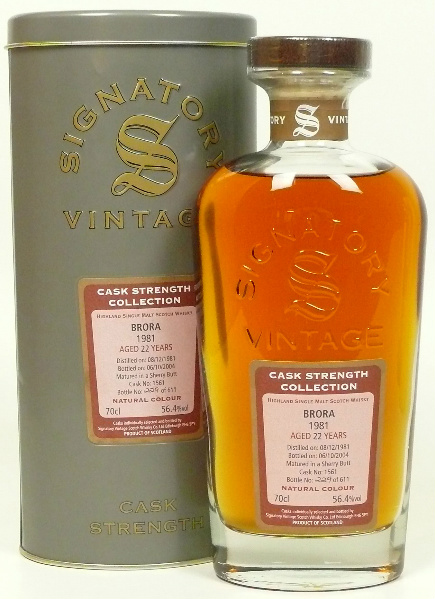
Brora 22yo 1981/2004 (56.4%, Signatory Vintage, Cask Strength Collection, Sherry Butt #1561, 611 bottles)Color: Copper gold.

Nose: Fresh and vivid. Definitely Sherry, but in no way funky. Quickly a fresh creamy and toffee note develops and only a mere hint of peat, just inhale vigorously. Needs to breathe a bit. Nice soft woody note, which sometimes take a turn towards old paper turned yellow. A bit dusty as well, (with whiffs of white peach). In no way dry. Quite spicy. I tickles the nose, and again toffee mixed with wax. Chewy would be the word. Mild yellow fruit notes appear, adding some acidity and yet more freshness to the nose. It’s not typically peach, white or other, but some whiffs come across as peach in semi-sweet yoghurt. The wood stays soft and is part of the fruity and creamy mix, instead of giving it a spine. Its nice overall, and does develop al lot, where initially it didn’t seem very complex. Hardly any peat at all and just a splash of smoke.

Taste: Thick, waxy and fruity. Definitely a profile we get from fruity Speysiders from the seventies. Nice soft wood. Toffee, without being very sweet. It has some fruity sweetness, but just the right amount. It has more than 56% ABV, but it’s still friendly. Not hot, nor burning my throat. Very drinkable. To my amazement, a lot disappears towards the finish and the finish itself is medium at best. Only in the aftertaste it starts to come apart a bit, fading out. Just the right moment to take another sip.

This one isn’t about the peat and the smoke, and the ruggedness of highlands, and sea storms after which you need warming. This one is for those moment you need an old Speysider, Bourbon matured, with lots of fruit and wax. Remember this isn’t from a Bourbon cask, but is from a Sherry butt. It has hints of peat and smoke. It’s a bit like the profile Benromach is going for today with the new 10yo and 15yo.

Points: 89

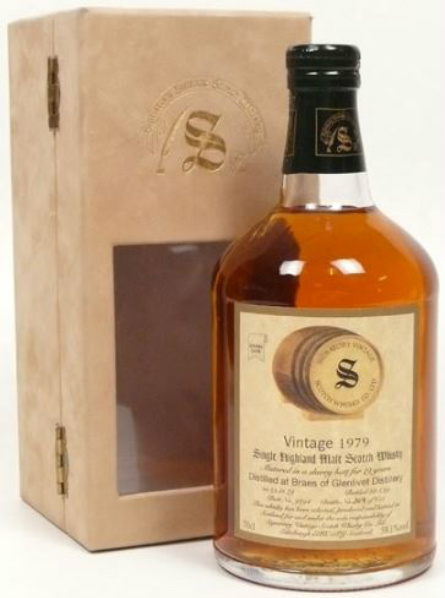
Braes of Glenlivet 19yo 1979/1999 (58.1%, Signatory Vintage, Sherry Butt #9294, 658 bottles)

The day before yesterday I reviewed the first Braeval on Masterquill.com, the domain I was finally able to acquire. Today we’ll have another first, this time the first Braes of Glenlivet. Well not really since both are one and the same distillery.

Braes of Glenlivet was founded just in 1973, so it’s not thát old. At that time Seagram’s was a company with only two distilleries: Strathisla (I love Sherried Strathisla’s from the 60’s and 70’s) and Glen Keith (equally so). Both distilleries are next to one another by the way. Chivas needed more capacity, due to huge demand of the Chivas Regal 12yo blend in the States and was looking for a distillery to take over. When that didn’t work, plans were made to “build” five distilleries in the same amount of time. Braes of Glenlivet was the first in 1973 and Allt-a-Bhainne the second a year later. The next three distilleries were brought into the portfolio by acquisition in 1978: Glenlivet, Longmorn and Glen Grant (now owned by Campari since 2006). Other noteworthy facts are that the name of Braes of Glenlivet changed to Braeval in 1994 (to allow Glenlivet to be The Glenlivet, as in “there can be only one”). Breaval was mothballed between 2002 and 2008 and is the highest situated distillery in Scotland. 1665 feet.

Braes of Glenlivet 19yo 1979/1999 (58.1%, Signatory Vintage, Sherry Butt #9294, 658 bottles)Color: Copper Gold.

Nose: Musty and a high quality Sherry note. Not a big heavily Sherried nose (hence the color). But dry and meaty. Slightly smoky (char) and vegetal (fern). Nicely oaky but also pencil shavings, which usually isn’t oak but cedar. Perfumy. This needs some air to balance itself out. Again the wood is playing a big role in this Braes/Braeval, just like the one I reviewed before. The vegetal part is developing into what I can only guess is a Japanese tea kind of note. Not floral, so it’s not the perfumy part of the nose, but very deep, profound, but also elegant and light. Having said that, next up is a hint of Velpon or Uhu (clear glue). Great herbal and earthy complexity (surely not only from the wood?), with a tiny hint of new make spirit. This is a very nice one to take deep breaths of. Stuff for connoisseurs I guess, so maybe not everybody’s cup of tea.

Taste: Strong, sweet and dry at the same time. Very nice. Lot’s of Beer and Hops, and not really Sherried for me. The hops doesn’t make this all that bitter. Quite some masked sweetness and again quite woody too. The bitterness is really a hoppy one. Interesting. Just like it’s younger brother, it’s coming undone a bit in the finish. The alcohol is really prominent, so most definitely a force to deal with. Finish with tea and wood, a hint of soap and rather drying. Beer and soap who would have guessed? The complexity of the nose isn’t really here in the taste. And I really miss the high quality Sherry I smelled initially. Beer and Sherry who would have guessed?

What really caught me by surprise were the similarities between the 1991 Braeval bottled by The Whisky Mercenary and this particular expression from 1979. Especially on the nose. One was distilled in 1991 and this one in 1979. Both have a similar full on smell and a woody part that plays a big role in the bigger picture. This Signatory has a more pronounced Sherry derived full and sweetish body, whereas the 1991 was more fruity.

Points: 85