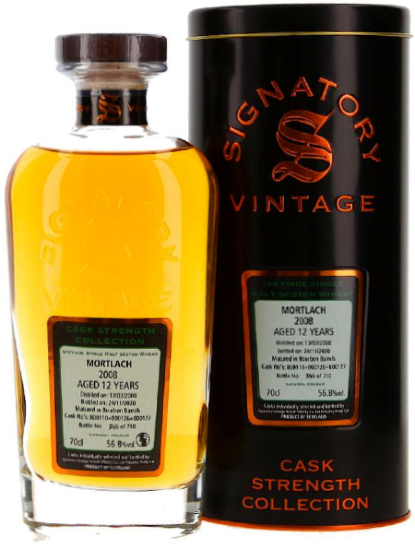
Mortlach 12yo 2008/2020 (56.8%, Signatory Vintage, Cask Strength Collection, Bourbon Barrels #800110, #800126 & #800127, 710 bottles)

After the wonderful and very interesting Loch Lomond, let’s try another Whisky fully matured in ex-Bourbon casks. This time one that was distilled at Mortlach. Mortlach has quite the reputation with Whisky Aficionado’s and rightly so. For instance, Mortlach 16yo was arguably the best offering in Diageo’s once extensive Flora and Fauna Range. Having this niche popularity, Diageo decided to do something more with the brand that is Mortlach and discontinued the 16yo around 2012 in favour of a Rare Old (NAS, not rare nor old, 80 points), an 18yo and a 25yo (84 points). All in 500 ml bottles! These three were released in 2014 and replaced in 2018 by more common age statement versions: 12yo, 16yo (a magic age statement for Mortlach) and 20yo. All three now in 700 ml/750 ml bottles. Mortlach is known for its Whiskies matured in Sherry casks. The 16yo Flora and Fauna is an example of this, and I thought an offering by Wilson & Morgan was even better than that. No surprise then, this has matured in a Sherry cask as well. I also reviewed a Provenance Mortlach earlier, I suppose was matured in Ex-Bourbon wood, which was not so interesting, so let’s see if this Signatory Mortlach is any good, or we should stick to Sherried versions of Mortlach altogether.

Color: Light gold.

Nose: Winey, clear glue, creamy and slightly acidic. Not your usual creamy vanillin kind of smell though. A moment later some more fruits emerge, as well as the creamy vanilla powder notes. Dusty and slightly smoky (probably from toasted oak, not peat). Hints of gravy and cold dishwater, and some soft sugared fruit notes. This is a big Malt, which already shows amazing complexity. Not a cloying smell, since a nice fruity acidity keeps playing its part. This is a Mortlach and Mortlach is a special distillate, and boy, does this smell special. For some this may be a simple kind of Whisky, just pour new make into Bourbon Barrels, mind you, they didn’t even turn those into hogsheads, lazy buggers, and job done, easy, simple, no hassle. Yet Mortlach in a Bourbon Barrel, comes out slightly different from Whiskies from other distilleries matured like this, there is always something different about Mortlach, richer, beefier, meatier, just bigger, special. It’s almost like the fatty acid chains are just longer with Mortlach (without becoming soapy). Hints of raspberry hard candy, next to the half-ripe yellow fruits. Just not as exotic as it can be in well matured Tomatin’s. However, keep in mind that this is only 12yo, and not 30yo like the Tomatin’s I just mentioned. I don’t even know why I brought that up, since Mortlach and Tomatin are very different from each other. So fruity it is, just not all that tropical.

Taste: Sweet and very, very nutty and fruity at the same time, much more fruity than expected actually. Some wood, more akin to pencil shavings than oak, to be honest. Including a slight harmless bitter note. Again, not cloying since the big body also has enough fruity acidity to help it along. Nice. What a wonderful start. Signatory have recently issued some Mortlach Sherry Monsters from the 2010 vintage, which are more or less the same age, but I can’t imagine those ones beating something like this. Licorice powder, some paper and some spices as well as a peppery backbone. Sometimes a sweet minty note pops up. Mocha, milk chocolate. Tastes like a dessert Malt now. Hints of hay, more paper and overall still quite complex. Nice finish and a long warm aftertaste, including the glue again, which you pick up on initially when smelling a freshly poured dram of this.

This is an excellent Mortlach that was not matured in a Sherry cask. Very big and tasty, with complexity and length. The quality is unmistakeable and this will please a lot of Whisky aficionado’s. Its a good example of the spirit of Mortlach and a good example of what “simple” American oak can do. The quality is right upfront, and easy to see for everyone. I scored the Loch Lomond from the previous review slightly higher than this Mortlach, but I also believe, that one might not be for everyone, and you can only find the true beauty of the Loch Lomond when you work it a bit. The Mortlach is more suitable for casual drinking, its always good. the Loch Lomond needs your full attention, otherwise it can be a grumpy old git and will Will-slap you across the face.

Points: 88

Loch Lomond 17yo Organic (54.9%, OB, First Fill Bourbon Casks, L2 120 18, 30.04.2018)

After all those unhealthy and environmentally unfriendly products we have been putting into our bodies, finally some Organic Single Malt Whiskies start to emerge onto the market sporadically. The first Organic Malt I reviewed on these pages was an Organic Bruichladdich, This Loch Lomond is just the second. I have checked my stash, but I could only find a 12yo Organic Loch Lomond and a 14yo and a 15yo Organic Deanston, and that’s about it, no more. I should investigate if there are some more to get. I know there were a few Springbanks and some (young) Benromachs, but beyond that, who knows? Apart from the Deanston’s, this is the only well aged one out there. I did some quick and dirty research, so don’t expect something very deep now, but Nc’Nean also has Organic Whisky in its portfolio, but after that, its mostly American made Whisk(e)y that is also organic. Quite surprising from the land of fast food and a huge overweight problem. Wall-e was no joke. And before you start sending me hate-mail, or even worse, Will Smith, I’m quick to add that I am overweight as well. The Organic Bruichladdich was young and simple, easy, yet tasty. Scored rather high, since it was a high quality Malt, but could have done with some more ageing. Well, if you are after a better aged Organic Malt, than a 17yo Loch Lomond is quite a step up! Yes Loch Lomond, ahhh no, please no, you’re not going to talk about a certain Captain now, don’t you? Well, OK, let’s not. I’ll finish off this introduction with the fun fact that this was distilled in a combination of a swan neck and a straight neck pot stills.

Color: Light gold.

Nose: Barley, dusty and woody. Classic Bourbon casked Single Malt Whisky nose. Sure, we’ll throw in Organic as well, although I have no clue whatsoever how “Organic” is supposed to taste. Smells very clean and honest. Artisanal. A bit sweetish as well, resembling, bot only in a small part, a Grain Whisky. A nice combination of dust, wax and light citrus skin notes. Fruity and lively. In a way delicate and also a bit old skool. Soft wood, mocha and slightly spicy. Light smell of an old aired out, weathered, stock cube. All nice and well integrated. Better now than when freshly opened. Sometimes a short soapy whiff passes by. After a while in my glass even more balance is reached between a waxy note that got company from some peanuts and more fruits. By far, the best smelling Loch Lomond I ever had. You probably think it’s the only Loch Lomond I ever had, but this is not the case. Not at all. Especially nice when you are of an older generation, like me, and remember the old stuff filled from an Ex-Bourbon cask. A classic. The spicy notes in this nose are just excellent, especially when this is sniffed outside. Fresh air helps this one along quite a bit. Great stuff for sure.

Taste: Sweet on entry, The spicy notes from the nose are right up front here as well. Grassy and wonderful. Here it is a bit accompanied by some licorice. Creamy yet also a bit hot. A slight metallic note, reminding me of Tormore. In fact, if I would have tasted this one blind, I would have probably thought this was a Tormore. Tormore distillates in casks like these perform rather well IMHO. Similar spices too. Both this and such Tormore’s bring a smile to my face. These suit me very well, but that is a personal thing, and might not be true for you. Again, what an amazing balance this Whisky has. Nothing short of a must-have for me. Perfect for some quiet me time (and a book). After the first sip, the nose develops even more in the cavity of your mouth. Good quality stuff this one. Amazing, remember the times when Loch Lomond had this awful reputation, well they certainly managed to turn that around with this one. Well done! Medium body with all these wonderful woody, spicy and woody aroma’s. The ABV of almost 55% carries this Whisky beautifully. Really good stuff. Must find me another one.

This Whisky is very good. When consumed carelessly, often within a flight of other Whiskies, I didn’t pick up on the all the wonderful bits this Whisky has on offer. When reviewing it, it is usually reviewed on its own (on occasion H2H with another somewhat similar example for comparison). For obvious reasons, one tends to give the subject a lot of attention when reviewing. So, when this is given your full attention, this Whisky reveals a lot more than meets the eye at first. It deserves to have your full attention and you might also give it some time to breathe and you’ll be able to pick up on some delicate and wonderful old skool classy aroma’s. Recommended.

Points: 89

Lagavulin 11yo “Offerman Edition” (46%, OB, 750 ml, 2019)

If I would have written this review a bit earlier, than this particular review would have concluded the Lagavulin-prequel-quartet of the 8yo, 9yo, 10yo and this 11yo. However, just recently, yet another Offerman Edition has been released, this one finished in Guinness casks. Damn, now I have to find me that one as well, and just like the original Offerman Edition, this one isn’t destined for our European market. This Offerman is mostly US-only. They kept the new one at 11yo as well, because I suspect they wouldn’t dare on touching on (another) 12yo, as to not confuse the public too much with the annual cask strength version. This Offerman Edition is made with hand-picked Bourbon and rejuvenated Bourbon casks, in part by Offerman himself. Especially when you’re in Europe, you might wonder who this (Nick) Offerman is? Nick Offerman is an American Actor playing the role of Ron Swanson in the TV-series called “Parks & Recreation”, and Ron just loved Lagavulin (because Nick loves Lagavulin).

Color: Gold, lighter than the 9yo GoT version.
Nose: Wow, this has a mild, farmy, clay like start. Hay from healthy, fatty, full grown grass, making it somewhat different from the 8yo, 9yo and 10yo. Loving this. Otherwise, it does resemble the 9yo a bit. Just like I expected before reviewing the GoT Edition, this time again, I expected something more along the lines of the 8yo and 10yo, but with the 9yo already being quite the surprise, this one does even smell better. It smells a little bit like a…Brora! Man, if this tastes like it smells, please take my money now Diageo and thanks to you, Nick Offerman, for picking these casks! But wait a minute, let’s not get ahead of ourselves now. Iodine (and a tiny hint of chlorine as well) comes knocking on the door, especially when this gets some time to breathe in your glass. I suspect Nick especially sought out this Iodine. Old, wet wood spice. Slightly perfumy even. Tiny bonfire and a wee bit of prickly peat. This Malt has it all, including the underlying (candied) fruit. Wet iodine laden peat with salty seaside notes. The Broraness wears off and Lagavulin emerges some more, Lagavulin we know from the 16yo (which has Sherry) and especially the GoT edition. But the farmy bit that remains is still very nice, turning a bit meaty even. Not a lot of smoke any more. Dull vanilla powder, with still this zesty citrus note as well. Is there something like dry almond powder? Overall quite a soft edition, but one that works quite well. The GoT has slightly more of the creamy and buttery vanilla notes than the Offerman, but the bonfire notes are the same.

Taste: Starts as thin like the GoT, but this time with some crushed beetle and some fresh, slightly crushed almonds, and a very nice sweetish fruity bit. This one has even more of a licorice-peat note than the GoT. Fruity and appetizing, like cola on a hot day. It does have cola notes, hence the association. Almonds again and a wee bit of hot plastic. Warming and soft, so not this burning sensation when going down. This one has some sweetness as well, but definitely less so than the GoT. Slightly less complex than the nose, with seemingly less development. I like the lingering bonfire notes. It gives me a happy association, because who doesn’t like sipping a good Whisky when sitting and staring at a bonfire in the woods, or some pieces of wood in the fireplace.

This one turned out to be like a better variant of the GoT, but a variant of it nevertheless. Offerman offers us more than the GoT did, especially on the nose. Nice profile. Dear Nick, since you are a Lagavulin aficionado, why not pick some more casks like this, and bottle them at cask strength? Since this is Bourbon casks only, a fitting choice by an American if I may say so, it is more of a prequel to the 12yo, yet it is different in its profile. The empty glass (after a while), is iodine laden, where the empty glass of the GoT (the next morning) smells of peat and warm plastic. Looks like this (Iodine) is what Lagavulin and Nick went for.

Points: 87 (so the odd’s clearly beat the evens)

After the Offerman, I tried the GoT again, I find that there are a lot of similarities, but it is also lacking an entire (farmy) level. The Offerman is just a better and expanded version of the GoT. Tried it again and yes, the GoT is just simpler, still good, yet simpler. I haven’t seen Parks & Recreation yet, but I wonder if it’s also a better TV-series than GoT. Apart from some states in the US, this edition seems to be hardly available any more, thus prices are rising at auctions and the secondary market. Prices as I see today are such that even though this is a good Lagavulin, I can’t recommend it to you, because when taking the price into account, I believe you are better off with the 16yo and the Distillers Edition as well as the Game of Thrones version which turns out to be a very nice Lagavulin as well, is less expensive and more readily available. If you can spare the cash, please do buy it, because it’s another good Lagavulin differing from the others.

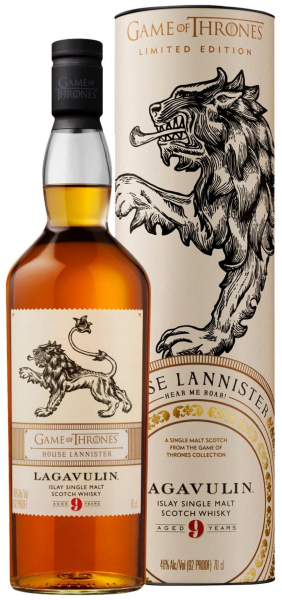
Lagavulin 9yo “Game of Thrones” (46%, OB, “House Lannister” L9016CM008, 2019)

For a Long time, Lagavulin was the unknown jewel in the crown of what is now Diageo, known to only a few. Lagavulin saw more recognition when it became part of the Classic Malts. Before that, Lagavulin was more or less only an utterly wonderful 12yo. Later came the also stellar 16yo and a nicely done Distillers Edition, again a very, very good version of this great distillery. Last of the newer regular releases the return of a 12yo, this time from Bourbon casks only and since 2002 bottled annually as a special release at cask strength. Some batches of these Whiskies have been reviewed on this site earlier.

Personally Diageo was taking a wrong turn starting with Talisker for me, with the release of a lot of mediocre (NAS) “versions”. I might have mentioned this already in several previous reviews, (Talisker is Diageo’s best selling Malt). The 10yo is still by far the best affordable Talisker, although it suffers sometimes of batch variation, just have a look at the following two more recent releases from 2015, and 2019. Incomparable to an earlier bottling from 2002. When NAS wasn’t all that accepted at first, Talisker tested out a rather young Malt, but gave it an age statement. The 8yo from 2018, is a very good Whisky, but the follow-ups from 2020 and 2021 are less so. Alas. I have tried them all, but have yet to review them here.

Back to Lagavulin. When Talisker was being taken advantage of (to up the sales), by all those aforementioned releases, Diageo left Lagavulin alone, at least for a while. Then all of a sudden in 2016 the 8yo and in 2019 the 10yo surfaced. In hindsight, both editions are gnawing away at the perfect reputation Lagavulin had (for me). Sure, both releases are not bad, especially the 8yo was acceptable (for a Lagavulin), but the downward spiral is easily noticeable. A disappointing and depressing feeling for me. Well, the time has come to look at the next one. Between the 8yo and the 10yo came a 9yo, bottled in 2018 in the Game of Thrones range, yeah because coupling up this Classic Malt with a TV-show makes sense now does it. And sure it does, from a business standpoint. I’m sure it’s making Diageo a lot of money and even selling more of the less popular Whiskies from the Diageo portfolio in the Game of Thrones series. Amazing how many people I know, have the whole range at home, some even got the GoT Johnny Walker editions. I respect the fact Diageo is in the business of making money and are not only aficionado’s. I’ve met several Diageo employees who have no clue what it is what they’re selling (but look the part and talk the talk) and only care about their monthly sales and what car they will be allowed to drive next. On the other hand I’ve also met several Diageo employees that are true aficionado’s and big ones as well! (This second group is usually a bit older than the first group).

Having said all that and with the experience I had with the 8yo and the 10yo, I’m not having high hopes for this 9yo, especially with the caramel colouring remark on the back label, but nevertheless here we go!

Color: Gold, slightly brownish.

Nose: Slightly sweet, with nice bonfire smoke and peat notes. Even some (dried) meaty notes crop up. Underneath, a little bit of fresh lemon skin acidity, as well as some menthos you are already chewing on. As always, the E150a cloaks the smell a bit, but also adds some artificial balance, as per design, although I also feel not a lot of colouring was needed for this one. Whiskies with lots of colouring tend to be dull and cloaked. But credit where credit’s due, this is a pretty good smelling Lagavulin. Nice and fresh. Since this is supposed to be first fill Bourbon casks only, is it really? Since it has this added caramel, it still has a decent spicy, ashy, waxy and fruity feel to it. On occasion, I even encounter some floral dishwater-detergent kind-of-job aroma. Spicy with some hot tar and smoking embers. Some molten plastic, clay, wood, some (burning) paper (and ashes), but some red fruit notes seem to point at Sherry, but no Sherry casks were used for this one. Yup, this is a very nice smelling Lagavulin. If the taste is on par with the nose, which has some classic Lagavulin traits to it, I’m in for a nice surprise.

Taste: Here it is a bit thinner than the nose promised. Sweet with obvious licorice and black and white powder right from the start, as well as the sweet lemon skin note from the nose. Smoky toffee. Here the caramel colouring seems to have a greater effect than it had on the nose. Nice chewy peat, nicely framed by some smoke. Waxy. Some cloaking caramel, and creamy, fatty hand ointment, but it’s also letting though some nice red fruity notes. Appetizing. Towards the finish the woody bits show some slight bitterness, fitting the rather large licorice profile quite well. However, for the profile it has it is actually a little bit too sweet. One glass of this on an evening is enough.

Well, this one is a bit of a surprise, I didn’t expect much of it to be honest, considering I’m not really a fan of the 8yo and especially the 10yo, as well as coupling it to a TV-show was a bit suspicious. The Talisker GoT was pretty decent as well. Nothing of the milky, new make-ish, youthful notes I got from both other mentioned Lagavulins. Maybe the E150a did some good here (yeah right, hahaha), or maybe the casks were just better (more likely). This would be a really really good Whisky if it was somewhat less sweet and bottled at a higher strength. Still, this was bottled at 46% ABV instead of the 43% ABV of some other Lagavulin releases. This is a review from a particular batch (L9016CM008) from 2019. I haven’t tried any others, so I can’t comment on batch variation, but there is always a chance that different batches have (slightly) different outcomes.

Points: 86

Talisker 8yo (57.9%, OB, Special Release, Carribean Rum Cask Finish, 2020)

Talisker is no stranger on these pages, and this 8yo is already the fifteenth Talisker reviewed, and why not, I ask you. Talisker has a lot going for it. It is an excellent distillate, has some peat, although not as much as some others on the market, and has a distinct and maybe unique feature, it is often considered to be peppery. A lot of wonderful aroma’s can converge in a Talisker. Works well in both Bourbon and Sherry, and the core range 10yo is already a very good Whisky. One other distillery manages to tick all these boxes save one. The distillery’s name is Springbank and the box not ticked is the box for pepper, I did say it was an unique feature, didn’t I?

In 2018 the first 8yo was released in Diageo’s annual special releases series. That “first” 8yo, was a very good one, and I remember back then, (and this is not that long ago), the talk of the town were the plethora of NAS releases (in general). At the time, there were many Talisker NAS bottles released as well. This 8yo was so good, a lower number like 8 suddenly became acceptable again, and the public always seem to prefer an age statement, so better a low number than none at all. I guess this took Diageo a bit by surprise, who knows, because there wasn’t an 8yo released in 2019. In 2020 this Caribbean Rum version saw the light of day (rushed maybe?) and earlier this year, another 8yo was released, from the smokiest stock they could find. Looks like the 8yo is here to stay. We’ll see what next year brings.

Color: White Wine.

Nose: Initially milky and young. Tasted blind, I would have guessed this was a Lagavulin, since it has some similarities with the 8yo and the 10yo, similarities, which, I didn’t like by the way. I really, really like Lagavulin, never came ‘cross one that was sub par. So when coming across the 8yo and the 10yo, it felt a bit like a sell-out by Diageo, and I was overly disappointed, damn, I didn’t think they would stoop so low as to mess with the ‘vulin. But I digress, back to the Talisker at hand. Sweet tea leaves (wet), rain water and dead dry leaves on the street in autumn. It shows more (quite nice) wood spices when the initial milky component wears off a bit. Spicy, with mild sulfury organics, sweet mint and orange powder. Smells of a distant wood fire whilst walking on a snowy street at night (by yourself). This bit is great. When drinking this Whisky casually, I have a hard time to find any notes of Rum, both in the nose and in the taste. I do now, but for me they are more similar to a Rhum Agricole than the Caribbean Rum that is stated on the label, and by the way, Caribbean Rum, that isn’t really narrowing it down now doesn’t it? So Rum yes, but there isn’t a lot of it though. I feel all the alien notes this Talisker shows us, maybe aren’t even coming from the Rum casks at all, but they probably are. Diluted smoky toffee notes and hints of Brazilian Rum (Epris 15yo). At times sharp. The wood turns towards, toffee, coffee, mocha and pencil shavings. This will improve a lot with air, so give it time, but if you pour yourself another dram, the whole experience starts anew, including the wait for the nose to improve. Recognizable as a Talisker though. Apart from the wonky start the nose is all-right.

Taste: Starts with coarse alcohol, like Wodka, right from the start, not balanced. Paper and cardboard and some residual (barley) sweetness. Not much later the wood and all the lovely aroma’s from American oak kick in, as well as a peppery attack, yes, there it is. The aroma’s are there but the balance still struggles, like its missing a component. The wood also impaired a healthy amount of bitterness onto this Whisky, but since this Whisky also has a bit of sweetness, the bitterness is kept in check. The bitter notes take residence right on the very back of your tongue. Smoky and thus a peppery attack as well, so it’s still a Talisker after all. Fresh almonds, wood and latex paint. Come to think of it, this one isn’t really all that complex. The body of the work is good, the ending a bit less, so the finish shows the unbalance again, and the aftertaste does so as well, and shows us again the bitter notes this has.

First piece of advice. Pour this dram and put it away, let the air do its job first, because the first aroma’s that escape from your glass are too close to new make spirit. And after a long wait the whole experience is much better. The nose improves a lot and therefore the taste is helped along. In the end it is an interesting Talisker, no regrets opening it and it wasn’t a nasty chore to finish it as well (not empty just yet, but it will be soon). I won’t be opening a second bottle anytime soon though. Buy the 2018 version in stead, and well see about the 2021 edition in the (near) future.

Points: 85

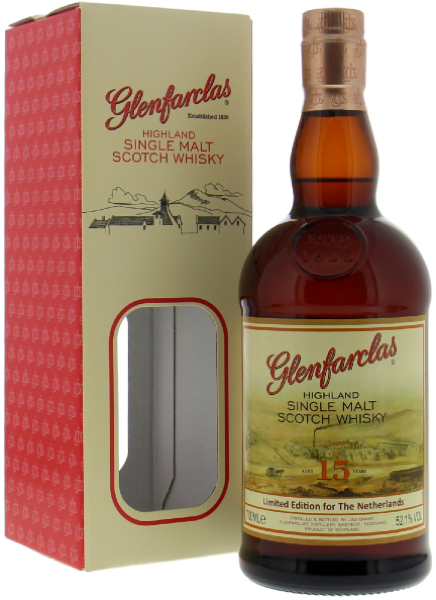
Glenfarclas 15yo (52.1%, OB, Limited Edition for The Netherlands, 50% Refill & 50% First Fill Oloroso Casks, 1.800 bottles, 2020)

In 2015, I wrote a review about the core range 15yo (from 2006), and even with 83 points being a half-decent score, it also means it didn’t really blew me away back then. But, as is often the case with core range bottlings, there is a possibility of batch variation. Most distilleries try to replicate a certain profile and they usually succeed. Understandable because the bulk of those bottles are sold to people who like consistency, because they buy the same expression over and over again because that’s the one they like. Lets mention Talisker 10yo as an example of this consistency, although this 10yo exists for quite a while now and a shift in profile as times passes is inevitable, however, the quality seems consistent. Some distilleries are less proficient. Highland Park 18yo comes to mind showing a lot of variation in batches close to one another, just punch the reviews for these 18yo’s up from this site, like these 2012 and 2014 bottlings. Some distilleries embrace the possibility that batch variation gives them, Springbank is a master at this. With Glenfarclas I’m not sure, but I do know that this Dutch 15yo differs quite a bit from the 2006 15yo mentioned earlier.

Color: Copper gold.

Nose: Fresh, tight and fruity, maybe a little bit sweaty even, as well as some deep and brooding dusty notes, dust and chocolate powder. Sometimes farty organics. Beautiful fresh wood and wax. Fruit cake. Mushy red fruits, mushy after speedy or forced defrosting in a microwave. Wet or soaked oak, slightly sour, yet also some sharp fresh air. Very lively, with red fruit acidity combined with American oak vanillins, milk chocolate and the tiniest hint of toasted cask and cigarette smoke from a sixties living room. Fresh mushrooms. An autumn Whisky for sure. Rainwater flowing down the road. Dusty and quiet with a full on aroma. The woody bits transform into more paper like and old cardboard aroma’s, which sounds horrible, but isn’t. Red fruit still present throughout. Perfumy, leafy and all sorts of kitchen spice notes (a note of some dull, weathered, cinnamon comes to mind, mixed with the toasted oak and the chocolate powder), give this one some time to release all the aroma’s. It’s almost like it is in part steeped in the past and in part modern. Very well balanced. Very nice.

Taste: Starts sweet and fruity, like diluted jam, forest strawberry jam, raspberry jam, red fruit jam altogether. Warming going down, well balanced and tasty. Nice wood aroma’s, just the right amount. Fresh oak and toasted oak are all here. Nutty. Tiny hint of tar and toast mixed in the distance with some menthos (I don’t get that all the time though), which is a nice addition to the fruity and syrupy notes. After swallowing, a slightly more dry and spicier wood note comes forth, as well as more tar. Again warming and drying my lips. So definitely some astringent wood with actually not a lot of bitterness. At times slightly soapy, but not every time I taste this. The woody bit of the body, let’s say the middle bit, seems to have some definite tarry notes to it. Tasty stuff, really good, especially after not expecting this one to be this good.

When analysing this one in my controlled environment, it is a very good expression, when tasting this one randomly, let’s say within a flight of some other Whiskies, this one performs differently, so beware. It doesn’t overpower others so it depends a bit, what came before. It can be easily overpowered by other Whiskies, and I don’t even mean your heavy hitting Islay Whisky or a bona-fide confirmed Sherry monster, no, even a normal refill bourbon casked single cask Whisky like the Tamnavulin 8yo I just reviewed can overwhelm this Glenfarclas. Something one wouldn’t say from tasting this Glenfarclas alone.

Top tip, give this one the attention it deserves, take your time with it and you’ll be rewarded. Still, this is very tasty stuff and it is better than I initially expected. As said above, it is well balanced. This is a bottle that will be gone soon, since when I see this standing on my lectern, the only words that come to mind are “yes, please” and off comes the cork. A fun and foremost a very good Whisky. An instant gratification Malt. Maybe not all that complex, but what you get is very balanced and tasty. As I said, this will be finished soon. Is this really merely the undiluted version of the core range 15yo? If so, it is a worthy special release by any means and decently priced to boot for those el cheapo Dutch. Lucky bastards!

Points: 89

Tamnavulin 8yo 2009/2017 (59%, A.D. Rattray, Cask Collection, Bourbon Barrel #700628, Finished in a First Fill Bourbon Barrel for 16 months, 229 bottles)

This will be an interesting bottle. After the Dalmore I reviewed last, here is another example from a distillery from the portfolio of Whyte and Mackay, and yet another independent bottling. This is the first review of a Tamnavulin on these pages and to be honest, I never ran out of the house to fetch me a Tamnavulin. Tamnavulin just doesn’t have such a reputation. I did buy a nice, and very old, example from Duncan Taylor once, in the USA many years ago, but that’s about it. A few years back I visited the stand of A.D. Rattray at the Whisky Show in London, and tasted this Tamnavulin, I though it was rather nice and being a Tamnavulin, I bought it at the show shop. I couldn’t have been very expensive then.

Apart from the taste, I really liked the idea of maturing a Whisky in a Bourbon Barrel and then finishing it in another first fill Bourbon Barrel. This may imply the first cask it matured in wasn’t a first fill, but I might be wrong. The other thing that grabbed me was the mention of the number of the first cask it matured in (#700628), yet not the number of the cask it was finished in. But wait, there is even more. The label claims this was first matured for “over” 7 years and then received a finish of 16 months, so 100 months or more. Distilled on 10.05.2009 and bottled on 31.08.2017 equals less than 100 months. Being a Tamnavulin and all this wonky information on the label, and having tasted it, I just needed to have it, especially since Tamnavulin is rather a scarcity on my lectern.

Color: Medium gold (and seemingly not filtered to death).

Nose: Vanilla and soft oak. Malty and biscuity. Pleasant and fruity. Quite floral and perfumy. Classy. Underneath a more sweetish and fruity bit. Big and bold, with lots of aroma’s and an open character. Even though it is quite a young Whisky, there are no traces of new make and it smells quite mature. The oak gives off some spicy notes, but not much. Seems to me the initial cask wasn’t all that active and the second maturation wasn’t long enough for that cask to dominate the strong oaky notes. Interesting finish this is. Notes of yellow fruits are a bit overshadowed by this perfumy and soap-like aroma. The more I nose this, the more spices are noticeable, but all under this floral cloak. Smelling harder pulls out the yellow fruity bits, as well as some mint and a wee hint of horseradish and rainwater. The fruit turns slightly acidic. Maybe this makes the balance department suffer a bit, but it’s not a big problem though. After a while it turns a bit dusty and the mint vapor has some staying power in my nose. The sweetness picks up some licorice as well. This is an autumn Whisky (based on the nose alone at his point). Given more time, notes of cold dish water, bad breath and honey, these are adding to the complexity, but again making the balance suffer some more. Still this is still not a big issue though. I know “interesting” often has a negative ring to it, but without implying any negativity, this one just is interesting, due to the complexity and the oddness of the aroma’s this Whisky gives off.

Taste: Ahhh, nice. Spicy, slightly bitter and sweetish. Vanilla, nutty and some nice wood, that seemed not to be there in the nose. Warming and highly drinkable. Meaty as well. The vanilla bit grows slightly stronger when you hold this in your mouth. The first sip sort of repairs the nose, focusing it on the more lovely floral bit. Very appetizing and much better balanced than the nose was. Sweet and nutty, honeyed nuts. However the wood gave off plenty of spiciness to counterbalance the sweetness, which is definitely here, yet masked by the wood. Tasty example this is, and seems definitely more mature than the 8 years it (only) has. Apart from the sweetish yellow fruits on the palate, this Tamnavulin also has some zesty citrussy notes. Here it works well, in the nose the acidity isn’t helping the balance of it, however, on the palate this Tamnavulin is well balanced and the slightly bitter notes, this shows towards the finish, can put off some tasters, who don’t like bitterness altogether, but it does add to the balance. The dishwater and soapy bit in the nose, does play an unexpected role here in the aftertaste as well. Unexpected because it arrives late and I didn’t expect it at all to be honest. Along with this bitter note the nose shows us some licorice to go with it, changing the Whisky a bit. Nice complexity thus. Still an autumn Whisky I would say.

I like this Tamnavulin. The two casks worked quite well together. It’s mature and tastes great. The first cask must have been a refill cask, not giving off too much woody and bitter notes from the cask for the stated 7 years. The second cask, a more active one, did have enough time to impair its creamy and vanilla notes, but after 16 months, it didn’t have enough time to give off a lot of woody aroma’s, making for a reasonable well balanced young Whisky without the wood dominating the palate, nope the wood is just about right.

Points: 85

Kingsbarns “Balcomie” (46%, OB, 100% ex-Oloroso American Oak Sherry Butts, 2020)

Since this isn’t the first Kingsbarns on these pages, the distillery doesn’t need any further introduction. If you want to know more about Kingsbarns, please have a look at my earlier review about the Kingsbarns “Dream to Dram”. “Dream to Dram” was a very young expression that showed some potential. “Dream to Dram” was also the first bottling of Kingsbarns meant for the general public (released in 2018). It’s reduced to 46% ABV and it’s a bigger batch. The rest being mostly Single Cask offerings. The second general release is this “Balcomie” from 2020 and this year (2021), the third one just saw the light of day called “Bell Rock” which is made with ex-Oloroso Sherry Butts & ex-Bourbon Barrels. Let’s focus on the Balcomie now shall we?

Color: Medium gold.

Nose: Extremely malty and biscuity. Initially this Whisky is about the hints of milky new make, which come to think of it, is a very similar experience to that of Tomatin. Grassy and floral. Cereals, oatmeal and biscuits. Hints of smoke, like standing on a field in summer, where someone in the distance is burning off garden waste. After this green and young start, some of the Sherry provenance of this Whisky kicks in (somewhat), giving the nose something more body to it. Diluted red fruit lemonade and dish water. Light notes of citrus and toffee, without bringing the toffee sweetness actually. Quite some fresh air and some crushed wet mint leaves that already were used one time before for infusion. Citrus fruit with paper and cardboard. Spicy wood sometimes whiffs by. After a while the nose turns more towards the direction of sweet fruit. If you let this sit in your glass for a while, and it doesn’t need a lot of time, the Whisky reaches a more balanced state, without really losing these young components mentioned earlier. I still get this distant smoky note and now it has a more flinty edge to it as well. Not bad, the potential I saw in the previous offer of Kingsbarns is here as well, even though it most definitely smells like a work in progress. Some sort of soapiness comes to the front after you sip it, as well as some honey.

Taste: Thin. Paper-like maltiness, with late sweetness and some smoke (toasted oak probably). Rain water, slightly bitter wood and cardboard. The wood made the Whisky, or so it seems. Tastes like it’s not ready yet, but closer to a Whisky than it is to new make, although notes of new make are here. Some wood, some spicy wood, some paper and some indistinct sweetness. Bees wax and ear wax. Something just had to be bottled I guess. Very young with some oaky notes. Almost like it is almost a different distillate than Whisky. To be Frank, I expected more after the “Dream to Dram” expression. It’s all very young but also a bit boring and predictable, like nobody dared to be more bold, for instance by giving it a more meaningful finish. Maybe there is some conservative thinking behind the Malt? The Oloroso casks themselves hardly impaired a lot of Sherriedness. Tired casks maybe, or not enough time? Maybe some fear creapt in all this could have overpowered the light Lowland style of the distillate. This taste bit of the review might seem a bit short, but there isn’t a lot happening actually, so there isn’t much more to pick up on. Even the American oak impaired some of its bitterness, but non of the vanillin I expected.

To be honest, after the other Kingsbarns, I saw some potential, but this one isn’t better at all, alas. The nose seems to show the potential, but taste-wise this is lacking a fair bit after the other release. You might think, give it some slack, they are new, just started up and so forth. However, I’m writing this review having just been at the London Whisky Show, and actually this year (2021), a lot of new distilleries were present, and I can report to you that I tasted a lot of fairly new distilleries that have come a long way further with their young Whiskies than Kingsbarns have at this moment. So it can be done. Ardnamurchan and Copenhagen Distillery to name but a few, both from a colder climate, but also Milk and Honey (M&H) from Israel, but they have the advantage of climate which ages the Whisky faster. Still, these are all young distilleries making great Whisky. A lot of work to do for Kingsbarns, just keep at it!

Points: 74

Thanks go out to Nico again, for this second Kingsbarns sample.

Dalmore 2001/2015 (46%, Gordon & MacPhail, Connoisseurs Choice, Refill American Hogsheads, AE/JBAC, 05/03/2015)

So here’s Dalmore. Dalmore isn’t a Whisky I have many bottles of, if any. It was also a long time ago Dalmore’s were featured on these pages. This is now the third review, after the two reviews I did back in 2014. Obviously one from the distillery itself, the 12yo from around 2004 (so also a while back) and one 11yo independent offering from Kintra Whisky from The Netherlands. Both a bit under my radar to be honest, not spurring a lot of interest in buying more Dalmore’s, (which I didn’t). Dalmore also seems known for some affordable middle-of-the-road bottles, as well as quite some super rare, super premium, super old bottlings, giving Macallan a run for its money. How odd. After all those years, yet another Dalmore managed to emerged on top of the heap of samples. After many of my own bottles, here is sample for a change. As often happens with distilleries and their owners, they tend to change hands more often than they used to back in the day. In the year of both other Dalmore reviews, namely 2014, the company that holds Dalmore, Whyte and Mackay, was bought by Philippines’ largest liquor company called Emperador. Just to refresh your memory, Whyte and Mackay doesn’t only operate Dalmore distillery, but also in their portfolio are: Fettercairn, Tamnavulin, Jura and Invergordon (grain).

Color: White Wine.

Nose: Fruity and Malty, with a tiny hint of smoke in the back. When freshly poured this is big on fruit, candied fruit, but a lot of this is just blown away rather quickly. Smells of toffee, caramel and apple, caramelized apple to be precise, but also fresh apple flesh and hints of apple skin. Warm cookie dough. Apple pie, but most definitely without the cinnamon, no cinnamon in this apple pie whatsoever. Fresh air and an even sharper breath of air, probably because of the smoky note this Whisky has. Maybe this comes from the toasted oak. Not sure right now. The Malty notes are getting more of a say and seem to introduce some more waxy notes, like the wax from the skin a red apple. With this waxy note comes the promise of some bitterness in the taste, we’ll see if that is the case here. By now, more wood as well. Sawdust from plywood. Dusty altogether. Hints of lemon peel and some remarkable horseradish notes, I didn’t expect here. Smells like a modern Whisky, although tasted blind, I wouldn’t have been surprised if this was coming from some sort of refill Sherry cask (as well). For me this doesn’t have (only) the classic refill Bourbon notes we all know so well by now. No, this one has something else as well, something I also picked up on in the Dalmore 12yo, being different from others.

Taste: Soft, spicy, slightly woody and creamy. Sugar water. Wood, paper and a nice sweet chewiness. Waxy and indeed slightly bitter. Having this in your mouth makes the nose expand a bit. Not really fruity though, but it is vegetal. Highly drinkable, but not easily drinkable, it seems to have a taste profile more cut out for aficionado’s or connoisseurs. It has too much fresh oak notes and it might be a bit too bitter for the general public I guess. It’s also rather simple and thin, although it does have good balance. However, after tasting this, the nose expands, more and more is showed there. I’m wondering if this effect of the nose evolving and the taste being rather simple, comes from too much reduction of this particular example. Medium finish at best, disintegrating a bit, but the aftertaste is nice and warming, shows some of the sweetness and paper-like bitterness this Whisky possesses.

Definitely different from both other reviewed Dalmore’s, and it is not as bad as it seems. It has to be worked a bit and personally, I wouldn’t like to try this as a novice. I like the vegetal notes it shows, but it needed a very long time in my glass to show this. More than 30 minutes for sure…

Points: 85

Kilchoman 5yo 2012/2018 (50%, OB, Sauternes Cask Finish, 10.000 bottles)

In the previous review, I wrote that the way to go with Kilchoman, (for me at least), are the red labelled ones. Nice single cask bottlings, with quite some ooomph, like this Belgian and German one. Often still young, but already finished. Not a sign of extreme youth or new make spirit in sight. Bourbon casks work well with the Kilchoman spirit and all the other varieties, are definitely not too bad either. Time maybe for a green labelled one. I just can’t claim the red ones are the best, without even considering Kilchoman’s other colours now can I? A while back Nico and I did a bottle share of this Sauternes cask finish. This, in itself is odd, since both Nico and I do have a fondness for bottlings that came in contact with Sauternes. I guess Nico wasn’t too sure about Kilchoman back then, and I’ll have to ask him how he feels about Kilchoman right now. Sauternes, by the way, is a sweet White Wine from Bordeaux (France). You may have heard of Château d’Yquem?

Color: Light gold.

Nose: Soft, creamy and dusty. Cookie dough. Sweet smelling, perfumy and fruity (white peach in sweet yoghurt comes to mind). Fruity acidity, yet not only citrus. Apples with a hint of exhaust gasses from a small, yet efficient, petrol car. Dusty with cold motor oil. Spicy as well, dry kitchen herbs, cinnamon and some white pepper. Old cardboard box, bad breath and cold dishwater. Nice soft wood and some mint. The typical Kilchoman bonfire smoke note is here again, but toned down a little. Overall quite elegant, although some of the off-putting notes, I just wrote down, seem to indicate differently. Nevertheless, elegant it is. Let’s say Islay style elegant, with Kilts and muddy wellies. The whole Whisky seems slightly toned down, compared to the Bourbon single cask bottlings (the red ones, remember) I reviewed earlier. Slightly less sparkly. Light vanilla notes combined with mocha flavoured whipped cream, mixed in with pencil shavings and a wee bit of menthol. Dry garden waste lying in the sun in autumn. This nose keeps giving and giving and evolves, it’s just not as powerful as the German Single Cask. This is again a quality Malt from Kilchoman, more complex than a Bourbon cask alone, and this one is also softer. Hint of sweet mint now. It shows a different side of Kilchoman. Very appetizing and very good again. It seems a bit more harmonious than a single cask Bourbon expression, and as said, it gained some complexity with the Sauternes finish. However, in all the aromas presented, it is impossible to find any true Sauternes notes. I no way I can smell a sweet White Wine in this Whisky. All the elements that went into making this Whisky do work perfectly, so it seems. Very good Kilchoman again.

Taste: Paper and ashes. Wax and sugar syrup. Dry tall grass and hay foremost. Borderline Grappa. Creamy and sweet candied yellow fruits. Less strong than the single cask expressions. Clearly reduced. A very appealing sweetness, aromatically close to a sweet apple. Fresh air after some rain. Ashes, black and white powder (licorice), hints of spicy wood and some (sweet) bitterness. Warming going down. Little bit of molten plastic in the finish. I know, this sounds terrible, but rest assured, it isn’t. This is a very drinkable expression, due to the balance and probably the reduction to 50% ABV. The aftertaste does pick up some more on the medium bitterness. The nose was definitely more complex than the taste. This, in all fairness, tastes simpler than expected. All is good and tasty, yet not as complex as the nose promised, (and the buzz in the anorak-y part of the Whisky world). I believe the recently tasted German Single Cask expression may have even tasted more complex. This is more of an instant gratification Malt (and the reduced ABV helps with this).

This offers a (slightly) different take on Kilchoman. It’s good and definitely softer than the Single Cask expressions I reviewed earlier. Sauternes, well, if I tried this blind I might not have picked up upon the White Wine finish, although there are some hints in the depth of the taste, some sort of brooding sweetness, if that makes any sense to you. For some, this offers a more likeable Kilchoman, personally I still like both earlier reviewed red labelled ones better. Can’t wait to open another Kilchoman though, to have some more Kilchoman’s under my belt for comparison and a better view of the Whisky that is Kilchoman. Impressive Whisky, especially considering the age of the reviewed stuff.

Points: 86