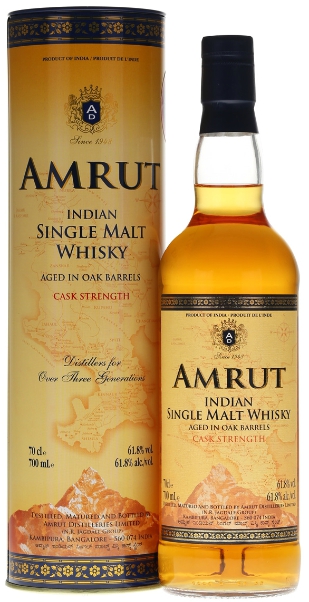
Amrut Cask Strength (61.8%, OB, Batch 87, 2017)

Well, it almost seems a bit unfair reviewing a Paul John Whisky and not look at Amrut too, so here it goes… ehhh, ok, ok, ok, it has nothing to do with being fair. I seem to like Indian Whiskies, so I will come up with almost any excuse to review another one. I had to hurry writing this review, (spoiler alert), because this one is going fast! At Amrut they also make entry-level cask strength versions of their Whiskies. We already know NAS is not a terrible problem with Indian Whisky, since maturation in India moves at a pace like trains move in Japan. Apart from this Amrut Cask Strength Single Malt Whisky there is also a Amrut Peated Cask Strength Single Malt Whisky, which will find a place on my lectern right before I finish this unpeated one, and I’m guessing that won’t take long…

Color: Vibrant orange gold.

Nose: Creamy, vanilla and oak, with a hint of orange (the fruit, this time). Vanilla powder and fairly simple initially. Hints of oak, exotic spices on oak and sometimes pencil shavings, fresh air or ozone. Sweetish and full on aroma. Warm, warming and fuzzy, sunny. This has a very positive vibe. Milk chocolate, maybe even some mocha. Creamy with a slightly acidic top note, yet not fruity, so no unripe berries here, although I do get some candied yellow fruits. Dried apricots but well in the back although on some occasions it is more upfront. That’s it really. That’s all there is. Now for something funny, in a Whisky like this, it is also all you might need. It is well-balanced and very tasty, so I have no beef with the relative simplicity here. It’s instantly rewarding, not far behind the single cask reviewed earlier.

Taste: Creamy pencil shavings on steroids. Lots of exotic spices with soft oaky bitterness. Very nice wood notes, and again fruity. A bit hot, like the climate in Bangalore, but definitely all about Indian 6-row barley malt, and American oak. Candied yellow fruits again. Apricots in sweet yoghurt. Very high quality and very, very balanced. No off notes and everything is in the right place. Spicy, with very good wood notes. Tasty stuff. Amazing value! Not for nothing, this is already batch 87, and this was back in 2017! Wonderful aftertaste, maybe even better than the body itself since it seems to reach an even higher level of balance. Good, slightly short, aftertaste with hints of lightly roasted coffee, arriving late.

First of all, this looks the part, simple bar style bottle with a nice label, and packaged in a proper shiny heavy-duty tin.

If Master Quill would be an institute of some sorts, issuing awards, this Malt would most definitely win a category, something like best (Indian, or World, or any) cask strength bang-for-your-buck Whisky. Excellent quality for an excellent price. I’m baffled you’re still reading this. Stop it now, go out and buy one. Wonderful stuff, a definite must-have.

Last but not least, I have to make the same remarks as I did the previous review (Paul John). For me, this might be a no brainer, but I have been informed, and I occasionally witness, that Indian Whisky may not be for everyone. personally, I love this style and I can’t believe someone wouldn’t like it, but the same goes for every style of Whisky. Some don’t like peat, some don’t like heavy sherry, some don’t like grassy Lowlanders and some like Loch Dhu… So be warned. Keep an open mind though, you don’t know what you’re missing otherwise…

Points: 87

Longrow 14yo 2003/2018 (57.8%, OB, Limited Edition, Refill Oloroso Sherry, 9.000 bottles)

At the moment I have two Longrows open on my lectern. One is the 1992 Vintage, which, I have to admit, is damn fine, really very good, so it is a favourite and I don’t think it’ll be around for long. The second one is this, limited to 9.000 bottles only, edition of Longrow. This particular Longrow was fully matured in refill Oloroso Sherry casks. I really like the output of the Springbank Distillery, so I expect a lot for each and every Whisky of theirs I can afford to buy and review. This time a bottling that has fully matured in Oloroso cask, so not a finish and not a blend with Bourbon casks, like many standard expressions are. The 12yo cask strength version for instance is usually blended from 70% Sherry casks and 30% Bourbon casks. The link, by the way, will lead you to my review of batch 8 from 2014. Now let’s have a look at this 14yo Longrow. Yes please!

Color: Copper gold.

Nose: Spicy, with slightly rotting banana’s, some muddy sulphur and fruity Sherry. Fatty peat (not a lot) and some soft wood. Freshly ground coffee and lots of fresh coastal air. Some licorice and somewhat more sulphur. Toasted wood. Big bonfire and more aroma’s from being in the woods at night (with a bonfire burning close by). Night air, with a smelly pond (yes, sulphur again) and a sweeter bit close to creamy raisins. As I’m smelling this a lot, this raisiny bit has the staying power and not the sulphury bits mentioned earlier, but since its part of the DNA of this Whisky, I wouldn’t be surprised if it returns. More creamy bits emerge. Vanilla, Sherry casks made of American oak? Probably. Sweetness from the Sherry and the oak as well, so yes, American oak, if you ask me. Raspberry hard candy adds a tad of more fruit to it. Dries out a bit over time with more burnt notes coming forward. By now I’m again struggling to find peat on the nose of an aged Longrow. Did I already mention raisins? I did? Alright then!

Taste: Wood first, then sweet fruits, sulphur, ashes, and even some more wood. they present themselves in this order. Ashtray, and candied red fruits come next. After this first sip the nose gets bigger instantaneously. Still, not a lot of peat, but more on the smoky (sharper than peat) and ashtray side, and don’t forget about the slightly bitter wood. Maybe it’s not the wood that’s bitter, but the sulphur. Hint of burn plastic. Warming honey. Second sip reveals more of good old Oloroso, we know from the past. Red fruits and coal. Burnt rubber, and aroma’s, I tasted last in Rhum Agricole. The aromas of cold ashtray never leaves the palate. It is an integral part of this Whisky and pretty dominant. Sure, some sulphur is here as well, but it seems to be mixed in with the ashtray notes. Cigarette ashes in the aftertaste accompanied by some woody bitterness, which is not a problem in a profile like this.

Definitely not an easy Whisky, and probably not for everyone. I can imagine a lot of drinkers of Whisky and even fans of Springbank and Longrow, consider this to be somewhat flawed. Sulphur (the devil) has been detected. Sure it is here, and maybe even plenty of it. But for me it’s not the harsh and sharp kind you sometimes get, I can forgive its flaws to a degree, but one has to decide for oneself if one can. As I said, maybe not for everyone, although I believe most Longrow’s do end up on connoisseurs shelves anyway. It’s probably a wee bit to expensive as well for a casual pick at your dealer of choice. Nope, most of the people of this particular Longrow are already members of the Springbank Society. A show of hands please?

I mentioned the Vintage 1992? Well, in that one, one could easily taste what a Longrow is. It shines with distillery character. This Oloroso expression is as opposite to the 1992 Vintage, as the flat earth society is to the dead poets society. Oh, my, I hope I haven’t offended anyone. A show of hands please? Here the Sherry overpowered the Longrow, and pushed it out of sight altogether. Considering this and the overall profile of this Whisky I can’t score it as high as I did the ‘1992″. Still good though, but definitely not as good as the “1992” or the Springbank 17yo Sherry Wood, which also matured fully on Sherry casks, for even longer than this Longrow has.

Points: 86

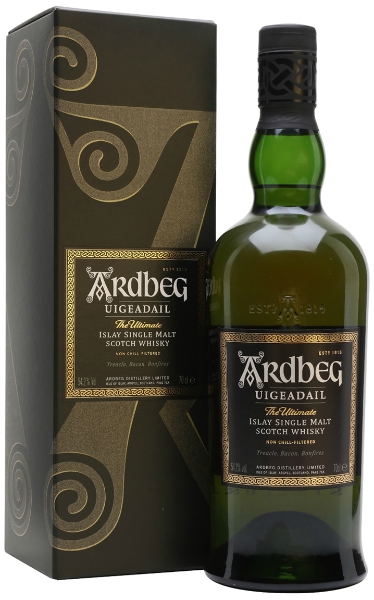
Ardbeg “Uigeadail” (54.2%, OB, 2018, L70174)

My Ardbeg Corryvreckan from 2014 is almost empty, and it will be replaced by this Uigeadail from 2018. However, even before the Corryvreckan is finished, I already opened the Uigeadail, so I can taste them both Head-to-head. Well just for fun, because the Corryvreckan is almost empty, so it had time to breathe, and the Uigeadail is freshly opened and full. Not a truly fair comparison. I’ll compensate by taking my time. If you surf the interweb, and read about the standard Ardbegs, the Corryvreckan gets less love than Uigeadail. Uigeadail is some sort of favourite for fans of Ardbeg. Nevertheless, when I reviewed the Corryvreckan I scored it a hefty 89 points, and never regretted that score over time, when emptying the bottle. I love this (batch of) Corryvreckan. Where Corryvreckan is about ex-Bourbon casks and new French oak. Uigeadail is about ex-Bourbon casks and Sherry casks containing older Whisky than the aforementioned ex-Bourbon casks. Or so they say…

Color: Light gold.

Nose: Nice soft and sweet peat and definitely some smoke rising from the bonfire (I found out later, bonfire is mentioned on the label). Bits of coal for good measure. Big aroma, perfectly balanced. In no way does this smell young or immature, remember this is a NAS bottling, right! Citrus and floral notes. Very fresh and working well with the peat ‘n smoke. The peat is fatty and brooding, but especially this peat reaches greater depths by the Sherry influence. I struggled a bit, at first, to “find” the Sherry, as I expected it to be far more upfront, maybe fruity and obvious, but in fact, it hid in plain sight, it hid in the shadows of peat, just shy of the gates of hell… uhmmmm… I got carried away a bit, sorry Auke. Nevermind, lets continue the review, shall we? Hints of forest floor late in autumn. Spicy, decaying wood, soft wood, but add to that a more meaty feel. Bacon is suggested by the label. I hate that. It indoctrinates the consumer, did I get bacon by myself or am I pushed that way? I can’t unsmell the bacon now, can’t I? Get it off the label, please Mickey, pretty please.

Next something that reminds me of crushed beetle (a ladybug actually, and yes, it was an accident). Yet also some licorice, and earwax on a breath of fresh air. Dry cocoa powder and salty, smoked bacon and more bonfire again. By the way, the label mentions treacle, something I don’t get on the nose. This just keeps evolving. Probably the influence of Sherry again. Hey, quite late to the mix some fresh oak, probably not virgin, but very upfront nevertheless. Even later in the mix some minute amounts of sweet ripe red fruit, of which raspberry is the most obvious to me. I say, excellent stuff again, just like the Corryvreckan. I hope all batches are this good, or did I get lucky again?

Taste: Ahhh, here is the treacle, and the peat and the smoke. Luckily the treacle is thin, making the entry not too sweet, although memories of old Demerara Rum, fly in and out of my head now, more than Sherry notes, although I do pick up some sultana’s, raisins. More liquorice and milk chocolate (liqueur). Burnt plastics and liquid bonfire. Luckily the label only uses three words “describing” this Whisky, which I can report are correct. Treacle wouldn’t have been one of my top three words, yet I understand why. Personally I might have gone for “Chocolate”, but it may be another word tomorrow, only human, y’know.

After tasting the Whisky, the smell gets more of those spices you smell around Christmas, as well as some kippers and creamy latex paint. Tastewise the odd plastic note remains, and in come some more youthful aroma’s hinting at young Whisky. Vanilla and salty butter. More smoke, but like an ashtray this time, mixed with liquorice notes. Sometimes some bitter woody notes, but not every time. Less balanced than the nose though. Fatty, but also with some acidity, splitting the Whisky a bit. The finish has medium length, with the return of the ashtray in the aftertaste. Nice long and warming aftertaste, better than the finish itself. Good stuff.

What an odd standard range. A TEN and two NAS bottlings. Beforehand, the difference seems to be the difference between Sherry casks and new French oak casks. Where one might say that one prefers the former, I have to say that in Corryvreckan the latter works very well. I really can’t say if that is true for all the batches that have been released, through the years, but my 2014 batch was very good indeed. If I was less adventurous, or have a shelf somewhere for bottles that I should have around all the time, both these NAS Ardbegs would be on there. Both wonderful Whiskies, well made, tasty and quite affordable as well.

Points: 87

H2H: Which of the two do you think is darker in color? Corryvreckan! Virgin oak is quite different from Sherry oak, and both nose differ as such. Uigeadail is dirtier and smokier, and saltier, and plastic-ier. Corryvreckan is more about American oak. More vanilla, creamier, very appetizing. Nose and taste alike. Both noses are great, but for me Corryvreckan has a very special side to it. I’m finishing the bottle right now (I saved the last bit for this review), but I’m really, really sad to see it go. Great one, and it certainly deserves my high mark, I mentioned above, both of these would get a place on my “always open shelf”, if I had one that is. I would recommend to have them both open at the same time. Both make the other one better, very different and that’s exactly why. One the main course and the other the perfect desert. I really have to look into a shelf like that!

Bunnahabhain 30yo 1979/2009 (45.5%, Ian MacLeod, Chieftain’s, European Oak Sherry Butt #9622, 612 bottles)

Back to some wonderfully Sherried Bunnahabhain. Most of the last few bottles of Bunnahabhain I reviewed were younger and much paler (and peatier) than the bottle I’m about to review. Here we have an independently bottled Bunnahabhain from a highly active European oak Sherry butt. Even though this has aged for a respectable 30yo, and was bottled 10 years ago, I still feel 1979 is not that long ago. If you try this particular expression, it seems to come from another century, or another dimension altogether. I’ll keep it short here, because I feel a lot of words will be needed th describe the complexity of this Malt.

Color: Dark Brown.

Nose: Fresh sea air. We didn’t see that one coming now didn’t we? Remarkably fresh, mint, yup mint. The mint you get from those hard mint sweets, not freshly cut mint, you make tea of. I did think it would be a cloying heavily Sherried Malt, but it’s not. Hints of toasted oak, charcoal and tar. Creamy vanilla powder, milk-chocolate, or better, plums in chocolate and a little bit of honey as well. Old distinguished wood. Wood polish without the petroleum smell, although very far back this does seem to have some petrol fumes going on. Caramel, tar, and some bits from an ashtray. Lots of Sherried notes obviously. Soft burnt sugar and a whiff of french cheese. Sherry and tobacco. It smells like it’s from another century altogether. Doesn’t really smell like a Whisky anymore. This must have been a very active cask. Still, nicely balanced and very chic. Fruity and coal, reminding me of early seventies Longmorn mixed with well aged calvados, since it has this apply feel to it as well. Just this bit though, not the whole experience, reminds me of Longmorn. Lots and lots of aroma’s and quite complex. Log fire and hints of fatty soft smoke. You can smell this one for hours before even thinking of taking a sip. You need to be alone for this one, and certainly not rushing it. If you smell it vigorously, it becomes meaty (gravy) for a brief moment, and some unexpected citrussy notes emerge as well. Beautiful wood notes re-emerge. Hints of old warehouse with old cardboard boxes in it. Dusty, quickly masked by the toffeed fruit. Although it doesn’t seem like it at first, this is a very high quality nose, which is immensely complex and has a lot to give. Wonderful.

Taste: Quite dry and woody, but also very tasty. Slightly soapy on entry. With lots of spices and borderline bitterness. Again you’re in for a treat. I have smelled this for quite a bit now, and doing so, I warmed the glass up in my hand. Fruity, but not much. I couldn’t even tell you what kind of fruit it would be. This has been a long time in cask. Tar and tobacco and maybe some leather. Not very heavy due to the relatively low ABV. Dusty and deep. So definitely a Malt that shows the Whisky can be about the wood it matured in. The creamy vanilla from the nose is lacking here, but definitely here, is the dry tannic wood and slight bitterness. Definitely not a chewy Whisky. Old and distinguished. Like an old mens club. Phileas Fogg style. The body falls back a bit. Finishes great, which makes up for the dry start, with a nice warming aftertaste. I like it. It’s a choice. Sure this could have been bottled (much) earlier. I don’t know if it was chance or choice, this has been allowed to age further, drying out considerably, yet picking up in “style”. It will be remembered for its great finish and the fabulous nose.

If you just pick this up and drink it, and don’t give it the attention it needs, you won’t pick up half of what its got to offer. If you do give it attention and time, wow! The more air it gets though, makes this Whisky less fruity and more about the wood, so know what you’re in for when allowing it to breathe for a while. Still, this is a wonderful malt either way, that develops enormously in the glass, so I can forgive its dryness with ease.

Points: 91

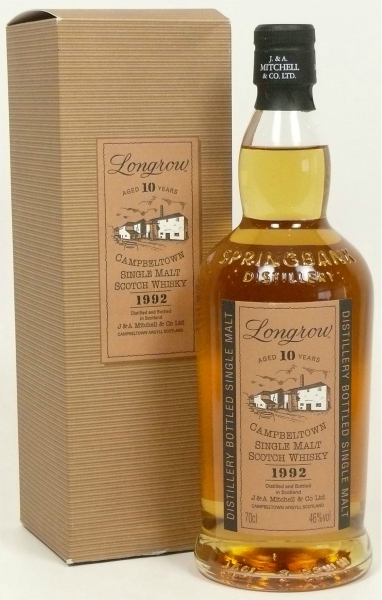
Longrow 10yo 1992 (46%, OB, 2002)

Back in the summer of 2016, I reviewed the 1993 10yo, the successor to the 1992 I’m about to review now. The 1993 stayed on the back of my mind, since I really liked that one, giving it 88 points. When, last year (2018), a local shop had a sale, this 1992 showed up for a very nice price, so at first I bought two, and a while later, at yet another sale at the same shop, I bought the two that remained on the shelves. That was 2018 and this was bottled in 2002, So not a very popular dram, it seems, in these neck of the woods.

Between 2001 and 2006, six similar looking annual release were bottled as a 10yo vintage, where the 1992 (from 2002) was the first one in the Springbank bottle we all know so well by now. (The 1991 was in the tall bottle).

Lets find out if this 1992 vintage is as good as the 1993 and lets find out if buying four bottles of this wasn’t a mistake. And yes, also with this one, the cork broke on me when first opened. Luckily I have my trusted brown bag with many corks in them, a life-saver in many occasions, especially when handling bottles with old corks.

Color: Light gold. Slightly more color to it compared to the 1993 vintage.
Nose: Fragrant meaty (light) peat, fatty and oily (olive), with a slight winey acidity. Freshening the whole up. In no way, this comes across as a heavily peated Whisky. Sugary barley and quite fruity. Buttery pop-corn and quite creamy. Well balanced, very appetizing and quite some depth to it. All works very well in this one. Soft and more meaty peat notes. Still light and soft. No smoke at all. Slightly fatty and it smells a bit sweet as well. Hey, apart from the nuttiness I almost missed, here also comes a burnt and smoky note, I always miss in the evening. Yes, I’m trying it now before breakfast. You should try it. Sugared and dried yellow fruits, but also a small hint of oranges. Yes, distant citrus fruits in the back. A very friendly and accessible Longrow. Longrow sees more peat than Springbank, but still Longrow can be very soft, and this one is no exception.

Taste: Starts with a short attack of smoke, quickly followed by the fruity bits and the soft peat. Butter. Toast with warm butter. Lots of fruity bits, some slightly acidic, and some sweet. Again light and soft and dangerously drinkable. Slightly salty as well when I lick my lips. Nice. Also a heavier note emerges. Fatty and caramel-like. Licorice. After a while more smoky, burnt and peaty notes emerge in the body of this Whisky. Time release? Fresh butter now. More creamy elements emerge from the Whisky. The lightness shows itself best towards the finish. Quite short and light, leaving only a warming note behind, without me being able to tell which of the notes mentioned above stays behind. One of the fruits probably, a nutty note, and some peat. If you wait a bit longer, it’s definitely the peat which has the staying power to make it well into the after taste. Nice stuff altogether, the only beef I have with it, this morning, is that it finishes a bit too sweet. It may be a daily drinker type of Whisky in the evening, but less so in the morning when I think of the sweetness. On another mornings the sweetness seemed less predominant and the buttery notes (with the toast as well), do make this a breakfast Whisky. Go figure, taste is a peculiar thing and we as humans are subjective as tasters beyond belief, so please take that into account.

Now lets see how the 1992 compares to the 1993 I reviewed earlier. Well just in case you thought all the vintages are alike. I can safely say that the noses of te 1992 and the 1993 are different. The 1993 is a tad more medicinal and lacks the creamy and buttery notes of the 1992. Somewhat more predominant in the wood department, but not by much. The fruit is similar, but toned down a lot of notches. The 1993 is smokier and reminds me of a sea breeze. It’s also cleaner and more oak is noticeable. Yes even some unlit cuban cigar tobacco. I guess that wasn’t in the original review of the 1993. I guess the relative sweetness of the 1992 hides the wood and all the other notes (if present). Where the 1993 is cleaner, the 1992 seems to be the bigger (sweeter and creamier) Malt. Taste wise, both are closer to each other with the same “lightness”. The 1993 is sweeter then I remembered, and also shows the fruit and the softness and even more of the nutty bits with milk chocolate. Variations on a theme I guess. Trying the 1992 directly after the 1993, shows some youth in the 1992. Both score the same and are definitely twins, but if I had to choose I’d pick the 1993. It is ever so slightly better. Does this mean I’m regretting getting four of the 1992? No, of course not. I love it!

Points: 88

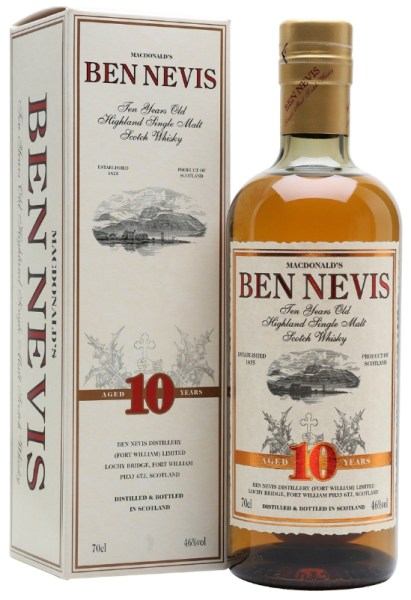
Ben Nevis 10yo (46%, OB, 2018, L18/8069)

I’m a big, big fan of Springbank and all of its output. I love the taste, the independence, the batch variation, the society. Buy a bottle and you never get the same Whisky twice. Above all however, I love the taste in combination with the sheer quality. Springbank 10yo was always the )only) Whisky I mention to people when they ask me for a bang-for-your-buck Whisky. Nevertheless, I’m always open to other Whiskies as well, I’m not bound to a few distilleries, or to one type of Whisky. I love a lot of different Whiskies with different styles. Dear readers, Springbank 10yo is about to be dethroned from that first place. I will still mention it, but with the same breath I will also mention this Ben Nevis 10yo. It’s fabulous. It’s complex, its unexpected, it’s simply wonderful. It has aromas I only encounter in Whiskies from yesteryear and not in modern stuff like this, distilled in the 21st century. I’m not sure if only this particular batch is so good, or that all Ben Nevis’ 10yo are this good, but we will find out someday, won’t we? Although I’m sure the latter is true!

Color: Light Gold.

Nose: Fresh, flowery, malty and fatty. Lightly sweet and very, very seducing. Smoky and fresh. Sweaty (Sauvignon Blanc), yet also lots of aroma’s from Alsatian White Wines and Rieslings from across the border (that would be Germany). Nice notes of subdued oak and even honey. Warming and big. Toffee, without the sugar. Creamy and nutty. Sweet yellow, tropical fruit yoghurt. Very special. Tiny, tiny, tiny hint of peat (and smoke) and also some Sherry. Tiny hint of pencil shavings and some sawdust as well. Extremely well-balanced.

Taste: Sweet, sweaty and big. Toasted oak. Benefits from air, so let it sit in your glass for a moment. The sweaty notes from the nose are here for you to taste as well. Tropical fruits, yes. Dried pineapple and papaya come to mind backed by a bitter oak note. This has definitely older Whisky in the mix. (18yo is rumoured). Where others probably sell a lot of Whisky and are aching for NAS-expressions. The owners of Ben Nevis (The Japanese) are taking it zen, and have older Whiskies to spare to make this special 10yo even more special. In fact the profile lies somewhere between Springbank 10yo (fatty, oily, warm motor oil, hints of peat and big) and Caperdonichs from 1972 (the fruit man, the fruit). Great body, medium finish (turning a wee bit sour for a moment), with a nice long warming aftertaste (not sour anymore). When its gone, its gone (and you need another sip). Complex, but not too much.

Ben Nevis 10yo looks like this, since 2016 and is released once a year, and it seems to me it sort of sells out before the next release has been bottled. For instance the 2019 versions hasn’t been released yet, but this 2018 I’m reviewing now, has all but vanished from many shops I know. It is the only standard bottling, with the rest of the output being specials and single cask bottlings. All sold at special prices indeed, making this the only standard bottling of Ben Nevis and also the only affordable one. I wish they would expand a bit with their standard range, like a 15yo for instance, and some others after that? Yes please!

Points: 88

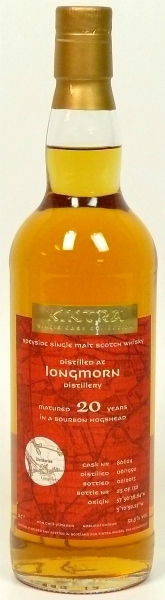
Longmorn 20yo 1992/2013 (52.3%, Kintra, Bourbon Hogshead #86624, 132 bottles)

Longmorn probably was one of the best Whiskies coming out of the sixties and seventies of the previous century. There are so many remarkable bottlings coming from that time, it’s nothing but amazing. Because of this, it also might be its curse. It is almost impossible to drink something like this (a Longmorn from the eighties and later), without having high expectations and looking back to the old stuff instead of comparing it to its contemporaries. Sure we all know stuff from “back then” is different from the stuff today, but still, Longmorn, has a special place with me…

Color: Gold.

Nose: Fruity, biscuity and malty. Fruity it is. Passion fruit and some pineapple, mixed with vanilla powder. Sugared and dried yellow fruits, but also a more waxy note. Meaty as well. Old warm dusty warehouse, more like a Kentucky warehouse than a cold and damp one in Scotland to be honest. So a lively, sunny, and dusty Whisky, from a dry warehouse with a summery feel to it. Nice fruity aromatics aided by a more creamy and vanilla note, backed by dust and oak. Character building. Nutty, with hot water. Overall laid back with a quiet disposition.

Taste: A sweet, nutty and spicy entry. Sometimes with a beer-like and hoppy note to it. The woody bit can taste this way when you try this early in the morning, when your palate is till fresh. In the evening its woody and spicy, nothing more. Typical Bourbon Hogshead Whisky. Funky green sweetness from the start, and even though not extremely high in alcohol, it does exert itself. Definitely fruity and nuttier than the nose. passion fruit again with old apricots next. Hints of toasted oak, this time more warming than sharp. Hints of clear glue and lots of fruits, apricot and to a lesser extent: peaches, even dried pineapple comes to mind. Nice touches of sweet vanilla and ice-cream, but never turning overly sweet and dessert-like by the backbone of spicy oak and toasted oak. Nice development though. It evolves over time.

Nice Longmorn, nice Whisky, but also almost anonymous. It could have been anything, apart from the amount of fruit in this one, which gives it away a bit. Keep in mind that this is from a Bourbon hogshead, so the distillate hasn’t been masked by Sherry or some kind of finish. This is pure Whisky. Its good, it does the job, however it’s almost not a ‘Longmorn” to me. Maybe I’m a bit harsh, maybe I’m a bit prejudiced and maybe I’m not truly objective as well. Am I capable to let the memories of old Longmorn go, for a review like this? I don’t know. This is a good one, but not a must buy for me, sorry. Come to think of it, this does have some similarities to the profile of the old Longmorn 15yo OB. That one is good as well, but also a bottling I don’t neccesseraly need to have. it doesn’t completely click with me. So If you really like the 15yo, by all means get this one as well when it pops up at an auction somewhere. For me, I’m glad I’m taking notes here, because after some time, I might forget how this tasted like, but thinking of the 15yo I’d probably remember.

Points: 85

Caol Ila 11yo 2004/2016 (46%, Gordon & MacPhail, Exclusive, for Milano Whisky Festival 2016 & Bar Metro, Refill American Hogshead #306662, 348 bottles)

Once nowhere to be found, now maybe one of the most bottled Islay Malts today. Caol Ila. For me at least, Caol Ila is always a nice Whisky which also ages well. This is a pretty young one, bottled less than four months shy of its 12th birthday. In fact, this Caol Ila has matured for precisely 4.275 days. It was bottled for the Milano Whisky Festival & Bar Metro in 2016, I picked this up at a well-known German auction and didn’t have to pay much, nor did I have a lot of competition for this bottle, so maybe there’s something I should have known? At the same auction I picked up its sister-bottling from Glen Elgin bottled for the same festival in 2016 and didn’t have to pay much for that one either. I bought these two, because I found out I had a lot of cask strength bottlings on my lectern, so I wanted to buy some bottles, to start an evening with. A bit reduced to work up an appetite. Gordon & MacPhail have (or had) lots of casks from the 3066XX-range, bottled in many different series; “Cask Strength”, “Reserve”, “Spirit of Scotland” and more “Exclusive’s” as well, so there is enough around for comparison. For instance, Refill American Hogshead #306664 was bottled for Maison du Whisky @ cask strength in the Exclusive range. By the way, some of the casks from this range are Sherry casks. Let’s find out now if this hoggie is any good.

Color: Straw.

Nose: Quite restrained. No big smoky peaty notes. Fresh, zesty but also a bit tame (at first), as in sweet barley with a wee bit of soft peat only. When the flow rate of air through the nose has been increased, lots more seems to be emerging. A prickly sensation awarded to a smoky note. Burning newspaper, and even more earthy peaty notes, still restrained though. Next more creamy notes of vanilla and pudding. Well balanced although I’m not sure yet about its complexity. Hints of sugared, or sweet, yellow fruits. Warming toffee and more soft barley, marzipan and almonds. Even a little bit of honey. All very restrained without it being closed. Dusty. All aroma’s work together nicely. Good balance. A cold and misty day with hardly any wind. As this Whisky picks up air, the good balance even gets better, definitely the forté of this Whisky, and it gets bigger, bolder and more aromatic as well. Quite a surprise. The longer it stays in my glass and I don’t hurry it, the better it gets. More of the fruity notes emerge and the marzipan, very nice. Some wood and ashes as well. So this needs a bit of air and patience. If you hurry this one, you’ll miss the reward of this Whisky.

Taste: Sweet, fruity and smoky, with a funky red fruit acidity on top (it may could do without). Yes, peat as well. Slightly too watery (at first), but as I wanted a “starting Whisky” this does the job quite well. Very nice fruity sweetness, the sweetness of ripe fruits rather than plain old sugar. Very balanced again. Milk chocolate, chocolate mousse, mocha and a tiny hint of coffee with lots of milk. Mint. Just like the nose, the sweetness moves into the territory of vanilla and pudding retaining the minty note. More toffee, caramel and mocha. Chocolate cake, custard, crème brûlée even, with the added bonus of peat, charcoal and ashes. Finally a green, leafy note. Earthy.

The finish is warming yet falls a bit short and I can’t say the wonderful balance reaches the aftertaste. A slightly acidic note peels of from the rest of the Whisky. Where the finish was somewhat short, the aftertaste recovers winning it a bit back for the team. Nevertheless a very nice Caol Ila again, and this probably its sisters as well, deserve your money. I for one, will try to find a G&M 2004 cask strength version from such a hogshead again.

Points: 86

Booker’s 6yo (62.45%, OB, Batch C01-A-18, 750 ml)

In 1987, Booker Noe, grandson of James “Jim” Beauregard Beam (you might have heard of Jim Beam), introduced Booker’s. Booker’s is uncut (so no added water) and thus bottled straight from the barrel. Booker’s friends and to no lesser extent, Booker himself, really liked the cask strength Whiskey, so Booker introduced it to the grand public in 1992, making it the first of Jim Beam’s “small batch series”. Already in 1984 Elmer T. Lee (you might have heard of him as well), from the Buffalo Trace distillery, introduced the first widely available cask strength Bourbon by releasing Blanton’s, so the people at Jim Beam already knew there was a market for these high strength Bourbons.

Other additions to the original Jim Beam small batch collection were: Baker’s, which is 7yo and bottled at 53.5% ABV and Knob Creek, 9yo and reduced to 50% ABV. Essentially all Bourbons made by Jim Beam come from the same recipe, and variations are only made by different ages, different ageing (hotter or cooler parts of the warehouse) and dilution with water. There is one exception though. Basil Hayden’s is a Bourbon made with the original recipe used for Old Grand-Dad which is the final addition to the original small batch series.

Color: Copper orange.

Nose: A short whiff of acetone. Very fragrant and spicy wood. Sawdust and altogether quite floral. Honey, paper and cardboard. Smells of an old barber shop (shaving cream, perfume, old furniture). Fresh almonds and more dusty wood. Cigar box and a minute amount of pencil shavings. Tiny, tiny hint of lavas. Cookie dough and leather. Not very creamy nor sweet, but there is some vanilla to it, however less than expected. Sometimes hot, lots of alcohol and it has a lot of aroma, but still you can’t call this really “big”. Sometimes its even soapy and highly drinkable. A sort of feminine counterpart to Old Grand-Dad. Definitely Jim Beam (Jug) yeast this time, with a minor role for rye. Wood driven, but all kept well in check, very balanced wood. More dust later on, and meaty notes after that. This keeps on giving. Excellent.

Taste: Starts hot, with lots of wood and woody bitterness. Next some wonderful tobacco and even more wood. Waxy, soapy and woody. More honey as well. I gather this came from the hot part of the warehouse. Nutty, fresh almonds and cotton. Slightly perfumy in the taste as well. Funky sensation. Grassy, and sometimes a bit green. Spicy old wood, like in an old attic of a wooden house, thus more perfumy notes. Indistinct hard fruit candy. Yellow fruits, not the reds. Big entry and a big body. Warming, not hot. Remarkably short finish with matching aftertaste (short), nothing mentioned above really stays behind apart from the soapy elements, which takes away a bit from this Bourbon. I can imagine other batches of this bottling have the potential to perform better than this particular expression. This is in a way a bit simple, although the nose showed a lot of complexity. At times it’s a bit to floral, so pick your moment wisely with this batch. Still, this is a very good Bourbon which I can easily recommend.

If I had to pick only a few bottles made by Jim Beam it would be this one and Old Grand Dad 114, these two sum it up for me. This the best they can do, and these two, if you can handle the high ABV. makes all the others a tiny bit obsolete. With these two yeast strains you get all Jim Beam has to offer.

Points: 83

Potter Distilling Company 15yo 1985/2000 (54.9%, Cadenhead, Indian Corn, Bourbon Barrel, 360 bottles)

For the first time on these pages we’ll have a look at a Canadian Whisky, sorry Davin, I hope you can forgive me. This is some sort of oddity considering the place this was distilled as well as the grain used. Let’s start with the latter. It’s easier. For this Whisky, Indian Corn was used. Indian Corn is better known as flint corn, with a hard (as flint) outer layer, making it also suitable for use as popcorn. It has a very low water content, so it is more resistant to freezing than other vegetables and thus pretty resilient under harsh conditions. This is actually one of the three types of corn cultivated by Native Americans hence the name Indian Corn. Most Indian Corn is multi-colored.

Information about The Potter Distilling Company was a bit harder to find. Potter’s Distillers was founded in 1958 by Ernie Potter in Langley B.C. The company first operated as a bottler of Liqueurs but after a few years expanded into spirits. Sometimes the distillery is also known as the Cascadia distillery. In 1962 Captain Harold John Cameron Terry (Born in Australia) bought Potter’s Distillers and headed the business for more than two decades. According to the website of the current owners Highwood Distillers, production was moved in 1990 from Langley B.C. to Kelowna B.C. where it remained until 2006, after which it moved to its roomier current location at High River, Alberta. Does this mean the label of all those Cadenhead’s bottlings are wrong? The Whisky in those bottles was distilled in 1985 (a 14yo, 15yo, 31yo and a 32yo) and 1989 (a 10yo, 11yo, 24yo and a 26yo), but state Kelowna B.C. and not Langley B.C. Oops!

The picture below is from the 11yo, 1989 bottle, but the 15yo I’m about to review, looks exactly the same. Both Whiskies were bottled in 2000. I tried both before buying and I ended up with the 15yo…

Color: Pale gold.

Nose: Sweet and fatty, yet very fresh with a nice touch of wood and Bourbon Whiskey. Very big nose. It has two sides to it. One big on creamy notes with vanilla, fudge, caramel, toffee, butter and pudding, you know where this goes. The other side is sharper, like a breath of fresh, very cold air. Nice defined wood, sharp and spicy. Toasted oak and licorice. The alcohol is quite pronounced as well. Notes of mocha. This is a big strong Whisky, which has been open for a long time and these are literally the last few drops from the bottle. Time and air can’t hurt it. Well balanced and slightly dusty now. A wonderful nose, that you need to add to your library of Whisky smells.

Taste: Sweet and tasted blind I might have said Demerara Rum, or Rhum Agricole even. Somewhere in between both. Definitely closer to a Rum, than a Single Malt Whisky. Just like the nose the alcohol is pronounced in the taste as well. Yup, sweet vanilla, warm butter and notes of a liqueur. Hints of toasted oak, tar and caramel and some slightly burnt sugar. Beyond the sweetness, there is more. It does have a certain depth to it. In a way it has something of a Rum, a Bourbon Whisky and the added freshness of a Gin. This is a Chameleon of a drink. The finish is not as long as expected, and a nice warming creamy, buttery and toffee note stays behind for the aftertaste, which is of medium length.

Another bottle finished as I’m writing a review. I’ve had this a for long time (I opened it in 2006). You can’t drink this sweet stuff very quickly. This needs its moments, and if you pick them wisely, you’ll have this around for a while, but every time you’ll get it, it’s great. I’m actually sad its empty, and for old times sake I’ll try to get another one of those Potters by Cadenhead’s. I can be a very sentimental guy sometimes.

Points: 84