Lagavulin 2002/2018 “Distillers Edition” (43%, OB, lgv.4/507)

Lagavulin is a great distillery with great people and has a great output of very high quality, although, my firm Lagavulin-faith was rocked a bit with the more recent releases of the 8yo (@ 48% ABV) and the 10yo (@ 43% ABV). I still have to review the 9yo Game of Thrones Edition (@ 46% ABV) and the 11yo Offerman Edition (@ 46 % ABV). Before we get to those, I have this modern classic on my lectern, yes @ 43% ABV, this is a bit of yesteryear’s ABV, but The Distillers Edition has always been good and and already tried by many. I would be surprised if you were reading this and never had tried a Lagavulin Distillers Edition before.

In 2016, I already had an earlier edition of a Lagavulin Distillers Edition on these pages. The 1996/2002 lgv. 4/490. That is most certainly an oldie compared to the one I’m about to review. In fact, this one was distilled when the earlier one was bottled. Just like all the other Lagavulin Distillers Editions, this was finished in Pedro Ximénez (PX) casks. PX is a sweet fortified Wine, so expect some sweetness, although in general, this isn’t necessarily always the case. Also, this Whisky has been coloured with Caramel, why? The 1996 edition was bottled in clear glass, but this 2002 was bottled in smoke coloured glass, so why still alter the Whisky with E150? This is something that was on my mind reviewing the Lagavulin 12yo for the friends of the Classic Malts as well.

Color: Copper gold.

Nose: Nice warming peat, with quite a lot of iodine. Bonfire in winter. Fire place at Christmas. Smoked vanilla and toffee. Cold outside, quite hot inside the log cabin. PX is recognizable, giving off a sweet raisiny, meaty and fruity aroma. Wood, burnt wood, scorched wood. Tarry. Licorice. More smoky than peaty, but warm peat is certainly here as well. Wonderful balanced nose. After a while breathing in my glass, the rougher notes of smoke and, to a lesser extent, peat, dissipate a bit, leaving more room for a sweeter more syrupy note. Syrupy is not always a good note, mind you, and here it offers a cloak of sweetness masking some of the wonderful notes from the beginning. Apart from the iodine laden smoke a more perfumy note emerges as well. Big and smoky not light and fruity. This is essentially what one might call a winter dram. Wonderful nose. Amazing at this price point.

Taste: Initially lighter and thinner than the nose promised. Lacking a bit in the oomph department and with it killing a bit of the depth this probably had. Here bitter smoke and quite a lot licorice seems to be upfront, something, if present, that seemed masked in the nose. Sweet sugar-coated anise-like licorice. The sweetness kicks in now. It works wonders with the bitter notes of smoke (fire place!) and peat. Crushed beetle and vanilla. Still a very tasty Islay dram different from the rest, a potential masterpiece. Again more smoky than peaty. By now I really wish I could have had the chance to try this before it gets diluted, that version must be surely stellar. Salty lips, very dark chocolate bitterness. Is it me or does this really have notes of red fruit syrup, not much, but detectable. Way to easily drinkable @ this ABV. I’m actually amazed this bottle is already so far gone, when did that happen? Every time I want to take another sip to expand on these notes, the glass is also empty. This is also a Malt the works better with bigger sips. A Malt to be drunk. The sweetness even makes it into the finish, with chocolaty bitterness in the aftertaste. Again, like the nose, well balanced. Good stuff, more please. I have to refill my glass. Nom, nom, nom.

Really dear readers, If you can get a 16yo, which is utterly wonderful, and/or this Distillers Edition, of which I almost forgot how good it really is, there is absolutely no need to buy the 8yo and/or the 10yo, both are so much less of a Whisky than these two and offer nothing more or new, they seem unfinished and come across as an afterthought. It absolutely pains me to say this about these two offerings from one of my most beloved distilleries, but please do yourself a favour and avoid both the 8yo and the 10yo, and if you know them and feel one of both are very good, are you sure you have tried the 12yo Cask Strength, the 16yo or one of these Distillers Editions? Are you sure? Because for me the difference is amazing. Just like Ardbeg with their Uigeadail and Corryvreckan, Lagavulin also has truly great Whiskies in their core line-up with the 16yo and the Distiller Editions. So really good Islay Whiskies can still be had at a very reasonable price point. All four belong on a bang-for-your-buck list.

Points: 88

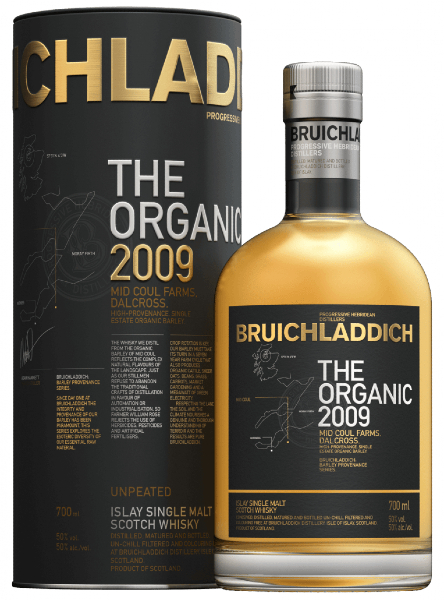
Bruichladdich 8yo The Organic 2009 (50%, OB, Bourbon and Tennessee Whisky casks, Mid Coul Farms, Dalcross, 18.000 bottles, 17/333, 2017)

The last Bruichladdich on these pages was the 2007 Islay Barley, and I suspect this Organic 2009 should be somewhat comparable to it. These two (Islay Barley and Organic), together with the Bere Barley expressions, seem to be Bruichladdich’s answer to Springbank’s Local Barley series. Both distilleries are sure that terroir matters, and you lovers of good food already know to use local, seasonal and fresh products. Where on every Local Barley bottle there is a statement of the Barley variety used, in this case Bruichladdich only mentions the use of 100% organically grown Scottish Barley. The Barley was sourced from Mid Coul Farms, Dalcross which is just to the north of Inverness and has Inverness airport as its closest neighbour, quite an odd place to grow organically. So no pesticides, but jet exhaust instead? Odd. As we already know, distillation took place in 2009 and the Barley used was from the 2008 Harvest.

Lets make it ourselves easy this time and finish off this introduction with the official introduction to the organic 2009 by Bruichladdich themselves: “The whisky we distil from the organic barley of Mid Coul reflects the complex natural flavours of the landscape. Just as our stillmen refuse to abandon the traditional crafts of distillation in favour of automation or industrialisation, so farmer William Rose rejects the use of herbicides, pesticides and artificial fertilisers. Crop rotation is key. Our barley must take its turn in a seven year farm cycle that also produces organic cattle, sheep, oats, beans, grass, carrots, market gardening and a megawatt of green electricity. Respecting the land, the soil and the climate nourishes a genuine and thorough understanding of terroir and the results are pure Bruichladdich”.

Color: White Wine

Nose: Initially cereal and biscuits, very clean. Briefly the aroma of cherries on syrup and almonds, but when air hits this Malt, this is soon gone, never to return again. Powdery and some vanilla, yet still fresh and clean. Warming mocha, creamy latex paint and a hint of light chocolate powder. No sign of new make spirit though, even though this is a pretty young Malt. Sure, I’m probably somewhat biassed by the organic name, but this smells like a honest Malt an “integrity” Malt and I’m happy to report no jet-exhaust at all! Next, some development letting a citrussy and more fruity bit through. Sweeter and slightly more floral now, whiffs of perfume whizz by. Soft wood, very soft wood. A breath of fresh air and this brings me back to the days in the noughties of many Cadenhead hogsheads, bottled in their Authentic Collection. Ahhh, memories… More milk chocolate, wood, also some fresh mud now. Instant coffee powder and also these half-sweet yellow fruits. After a long while the woody bit gets some more room and smells a bit like pencil shavings (and a wee bit of ear-wax) and a wee-er bit of Spanish cedar as well. Sometimes I even get the original Nivea cream. It may be young, but it smells impressively balanced already, sure it lacks the depth of a well aged Malt, but you already knew what to expect, when buying this didn’t you? (I did).

Taste: Sweet, just the right amount, and not really the oomph of 50% ABV. I did let it sit in a glass for a while, maybe the oomph evaporated? Just kidding, or aren’t I? It’s most definitely not harsh now and actually quite soft. Sweet barley and more wood than initially showed up in the nose, and after a while, some bitterness emerges. Vanilla and the wee bit of ear-wax from the nose is present on the palate as well. Quite nutty. Sweet floral lemon balm on my lips. Runny caramel which fits perfectly with the fruity acidic notes. This may not be a very complex Malt, but I wouldn’t make the mistake of calling this simple. This is a well made Whisky, with a lot on offer.

I’m writing this review from a bottle that has about one third left, and the Whisky is more mellow now and better balanced than it was when freshly opened. It might have even been a bit harsh on opening. Many of you know the difference between tasting a malt in an controlled environment, (no I don’t mean a laboratory), like your living room or man cave for instance, a place you know well. Tasting a Malt outside, with it’s constant flow of fresh air, I often don’t pick up on certain markers from a Malt, I most definitely do pick up on inside. The tasting experience outside, therefore differs for me, from inside. Having said all that, this Organic 2009 actually works wonderfully well outside. This malt just needs some more fresh air, and with this, it shows you more, as if amplified. At least today it does, and it is quite a grey and windy day. Not a dull day, mind you, hard wind and rolling clouds are fun to watch, as well as the stuff blowing by my window. Circumstances not unknown to Bruichladdich. Just pour it and leave it there for a while, again a Malt that needs your attention (like the Ben Nevis I just reviewed). This may very well be an anoraky Whisky. Personally I like it a lot and have a lot of fun with. Somewhat of a hidden gem if you let it. Good stuff, just like Islay Barley 2007, scoring the same.

Points: 86

P.S. I found this Whisky works best in a larger Whisky glass, my favourite glass for this Whisky was the Holmegaard Perfection Spirit Glass.

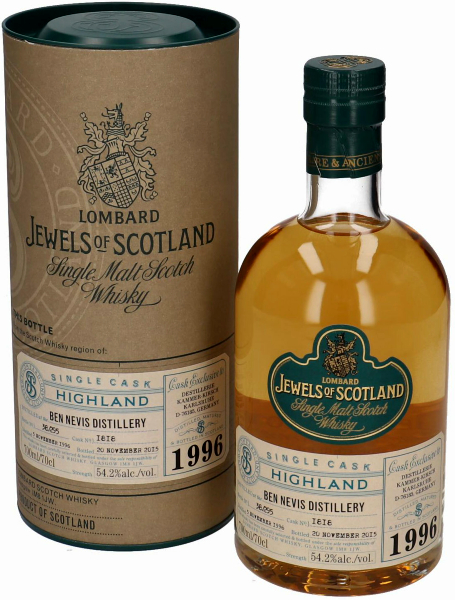
Ben Nevis 19yo 1996/2015 (54.2%, Lombard, Jewels of Scotland, for Distillerie Kammer-Kirsch, Cask #1818, 295 bottles)

Ben Nevis is an interesting distillery. It once had a sort of wonky reputation. In the past, I was warned on several occasions, to try before you buy. However, today it seems like a pretty popular distillery, with official bottlings fetching some very high prices, and definitely better quality. The distillery itself, is still a bit struggling today, so they do deserve to get enough recognition and money to keep on going. I’ve tried some very good expressions along the way. This is the fourth Ben Nevis on these pages and two of those reviews ended with 88 points. I’m happy to report that the official 10yo was one of them. This Lombard expression, I’m about to review, was “won” at an auction. Didn’t “win” it, because still had to offer more for it than the rest of the interested parties, well you now how an auction works. Let’s see if this is worth your, and in this case, my hard-earned cash.

Color: White Wine

Nose: Barley, bread and cookies, Bread dough, cookie dough and sweet bread. Hints of ginger. Quiet yet powerful and very nice smelling, especially when the more fruity note kicks in. Less funky than I’ve come to expect from Ben Nevis, yet also a bit more flinty. Reminds me of several old Cadenhead bottles. Sweet and fruity. Candied yellow and even some candied red fruits. Hints of dust, cardboard, dishwater and bad breath, bordering on soft wood. Reminds me of a grey day after heavy rain, Blade Runner style, with the sun finally getting some room to come out again. Even though the colour is quite light, this doesn’t mean the cask was inactive, because there is a lot here. Even an ever so slight sulphury note, emerging quite late. A very welcoming Malt after stints of dark coloured Whisky from Sherry casks or Wine finished Whiskies. So, back to basics, (refill hogshead), and let the details in the Malt do the talking. More dough and cookies with a slight burnt quality to it. Hints of black pepper and nice interaction with the oaky elements. Nothing is overpowering, so I’m happy to report this Ben Nevis has great balance. Love it. It is slow to evolve, but if you are willing to keep it in your glass for a while, more and more will emanate from your glass.

Taste: Malty and biscuity and quite sweet, but in a very good way. Lots of candied yellow fruit sweetness with white pepper and some hints of cannabis. Based on this and if tasted blind, I would have guessed this was a Bunnahabhain (Signatory). Creamy as well. Nice development in the mouth, especially the fruit gets enough room to shine, even though there are quite a few, woody, peppery and spicy notes present. Some dough and some more candied fruits. Wonderful organics somewhere in between licorice, milk chocolate, mocha and coffee, all somewhat dry, but now try to imagine these notes with this wonderful creamy sweetness added. Spicy and nice soft wood-spice as well. I’m actually amazed how much the sweetness does for this Malt, and don’t get me wrong, this is not a very sweet or overly sweet Whisky to boot, no, this just has the right amount to it. With Whiskies like this, you need to have some experience. It is most definitely not an instant gratification Malt, and you have to work it a bit. Only with experience comes the knowledge to look into the details of the Malt some more, because, obviously, if you don’t, you might miss these details that, for me, define this Malt.

As often this turned out to be a Malt that needed a lot of air to open up. Freshly opened, this is a bit closed and holding back on almost all aroma’s present. I mentioned details in the notes above, and do pay attention to them, this is a Malt that because of these details, does need your full attention, because when sipped carelessly, you might miss out on those wonderful details. Definitely recommended for experienced Malt-heads, and after the bottle is finished, I wouldn’t mind tasting this again somewhere in the future. Don’t think that Sherried Ben Nevis is the only way to go with this distillery…

Points: 89

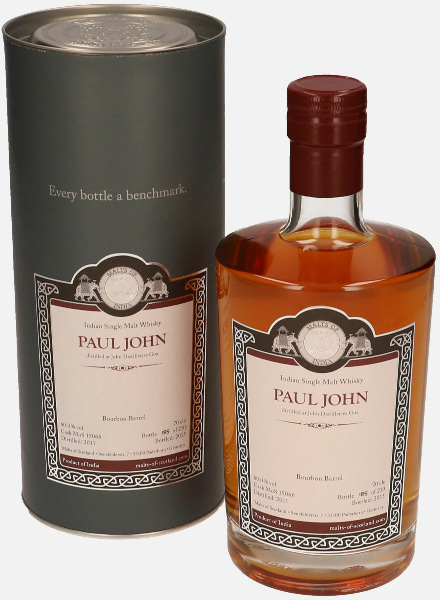
Paul John 2011/2015 (60%, Malts of Scotland, Bourbon Barrel MoS 15066, 210 bottles)

In the previous post I mentioned that I always have two Paul John Malts open, as well as two offerings from Amrut. I’ve grown quite a fondness for Single Malt Whiskies from India. I’m sure that when more room comes available for open bottles, India will be the first to get more room on my lectern. The previous post was about the peated official Paul John single cask #745 I currently have open, and it’s a stunner again, after #777, and now we’ll have a go at another unpeated one. This time I chose one, bottled by German independent outfit Malts of Scotland (and in this case: Malts of India, really, it says so on the label). This is not the first Malts of Scotland’s Paul John on these pages though, in 2018, I reviewed a different cask, MoS 15068, that matured longer and contained peated Whisky, and again yet another stunner. Both Malts of Scotland and Paul John need no further introduction, so lets move on to the tasting.

Color: Full gold.

Nose: Malty and biscuity. Cookie dough with fresh citrus notes, occasionally sweet mint, and quickly taken over by more woody and dusty notes. This one smells a bit younger and simpler than #745 and #777, lacking some age maybe and the added bonus of peat. This is a back to basics kind of a smell. Since the peat is not here, there is more room for this Malt, or the Paul John distillate in particular, to show its more floral side (borderline men’s cologne). The wood is, well woody and waxy, and somewhat spicy, but not your typical Indian or exotic spiciness though, but a kind of spiciness that can be had in a Scottish Malt as well. Let’s say spices coming from the wood. So, kind of heavy, but the rest is fresh, floral and friendly. The sun is shining in this one even though the “heavy” bit can dominate at times. This is definitely a less complex Paul John, but a Paul John nevertheless, very recognizable. At first I thought this was maybe a closed Malt and given time it would develop some more, but no this is more or less it. Not bad, but simpler.

Taste: Initially sweet and fruity. Wax and ear wax. The sweetness is quite quickly pushed aside. A little sting from wood, some woody acidity as well. This must have been quite an active cask and maybe it aged right under the roof in hot surroundings. Quite some woody bitterness now. Big and hidden sweetness now, with a lot of wood spices. Barley (sugar) and biscuity. Soapy feel on my tongue. But even for this quite young Paul John, this is still remarkably balanced and very tasty. Again dangerously easy to drink, even though it is wood driven and bottled at 60% ABV. Quite hot going down, this sure is a 60% Malt. The finish is more of the same, wood, wax and to a lesser extent, some fruit in the aftertaste. Quite some bitterness stays behind in the middle of my tongue. I’ve spent some time with this Malt, again thinking it might be somewhat closed, but no, again it is what it is and for me it is quite a simple expression dominated by a few big aroma’s mentioned above.

So there you have it, all in all a simpler take on a Paul John single cask, quite young and dominated by wood. The wood gave off quite some bitterness, that I believe they couldn’t even leave it ageing for longer even if they wanted to, before the bitterness would be taking over, and dominating this Malt. As it is now, the bitterness is still acceptable, but definitely present. Luckily there are some other dominating factors in the Malt as well, not to let the bitterness rule. So still, a good, rather young and simple Malt. I say young, but coming from India this has nothing to do with the aroma’s of new make spirit, so don’t you worry ’bout a thing! This is still a good Malt and I’ve spent many happy moments with it, especially when it’s sunny.

Points: 86

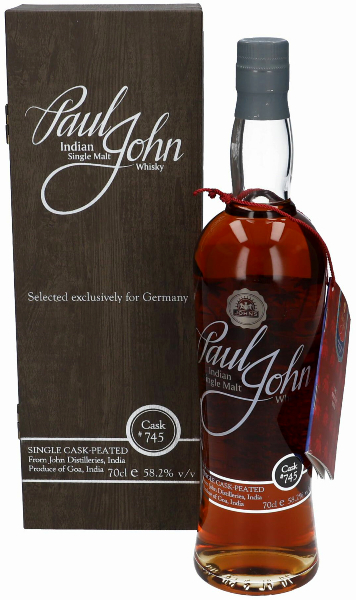
Paul John (58.2%, Single Cask #745, for Germany, Peated, 2016)

On an average day, I have two open Paul John bottlings on my lectern, if possible one peated and one not peated. Recently I reviewed the two bottles I had open at that time. The official peated cask #777 and an unpeated 6yo Cadenhead’s bottling. Both are gone now, and have since been replaced. Today we are going to have a look at the peated replacement bottle. This one is another official single cask release and even better, it looks like a sister cask of #777. Why would you do that? I hear you ask. Isn’t there a risk that it’s more of the same? A similar cask, with the same distillate in it? Well first things first. #777 was so good (it scored 90 Points), that there is definitely no risk in opening another one of those beauties, even if it is exactly the same (which I doubt). Second, as many Whisky producers and bottlers already tried to show for a few times now, (remember Gordon & MacPhail’s “Wood makes the Whisky” campaign?). Wood makes the Whisky, and no two casks are alike, just have a look at my reviews of Gordon & MacPhail’s Ledaig cask #464 and cask #465. Both the same distillate, the only difference being the cask itself (and what it previously held). So I’m confident the differences between #745 and #777 will be easy to spot and maybe even greater that one would expect.

Color: Orange golden brown.

Nose: Initially fresh and friendly. Lots of honey, oranges and a lot of prepared horseradish (Chrzan). May seem strange, but I get this every time and its here right from the start. Nice clean wood and sometimes fresh sawdust, which changes into more wet wood pulled from a prolonged stay in a pond. More prepared horseradish and ear wax. Fresh, fruity and also some candied fruits. More honey, wax and wood. Licorice. Fatty, organic and perfumy. J.M Rhum from Martinique. Extremely aromatic, complex and right from the start balanced and big. There is so much happening, that the wood has been pushed back quite a bit, I can’t image the wood is that soft, hidden under all these aroma’s. More floral than peaty, with some smoke. Fireplace on a cold winter’s evening, Christmas, but also the smell of horseradish incense sticks, as if they would exist), but not much. Deep smell of waxy almonds, toffee and clay. Smells like a rural house this, a house thoroughly in use, with wave after wave of smells passing by. Furniture smells, smells of preparing food, smells from the fields outside (including the clay), whiffs of a perfumed woman passing by, whiffs of cold dish water, whiffs of funky organic bad breath and warm, almost melting plastic (polyester!) and the smell of the dusty insides of a warm old TV. The plastic/polyester, once smelled, will be around and can’t be un-smelled. What an amazing smell this Malt has. Smells released in many layers, amazing complexity. Tiny hint of smoke trickles in from outside, but the even sharper element in this nose is still the prepared horseradish. You know salted caramel? Well, this one is more horseradished caramel. I like that, since I don’t encounter horseradish a lot in Whisky. More honey, toffee and vanilla powder. It certainly has excellent balance, and layer upon layer of complexity. Very good expression again, I like it very much. It is a wonderful Malt to smell, but beware, it can anaesthetize your nose for some time, since the smell is so wonderful and complex you’ll be smelling this for a long time before tasting. After numbing down your nose, further smelling is futile, after which it is better to have a taste…

Taste: Well, more wood here, and most definitely waxy, nutty and sweet. More of the Rhum Agricole notes as well. Sometimes, yet not always, a hint of cola early in the taste. There is this certain (slightly unbalanced) acidity to it. Smoked toffee and caramel are here, spread thinly, but where is the honey? Well? Undistinguishable sugared ripe fruits. Faint orange skin oil, grapefruit meat. Toffee, corn flakes and quite some licorice, and lots and lots of ashes (cigarettes in an ashtray, the day after). Syrupy sweet, runny caramel. Waxy and fruity. Waxy fruit and ear-wax. This is a bit of a strange puppy, because this has plenty of tastes originating from fire, but they really aren’t from peat and smoke this time. Dry, cured, salty and smoky meat. Cigar smoke and smells I have only encountered in a Sauna. This one is quite ashy. Is there something like waxy cigarette ashes? A quite nice sweetness makes the Malt bigger. Is it fruity underneath? Thus, again a big Malt. Now, more smoke than peat in the nose. No horseradish (well, maybe…). Must have some hidden wood now, because it carries some bitterness. There is so much happening, that even this medium size bitterness isn’t half bad. After extensive sipping, the Horseradish is even more obvious on the nose. I encourage the people of Poland to try this Malt with their excellent szynka, and let me know if the chrzan notes match up. Ashes here too, dominating the aftertaste. Liquid smoke, still not peaty though. The finish is waxy and woody. The aftertaste is warming and somewhat stinging. Smoke and wood spices, somewhat less friendly, but bolder, towards the end. Polyester returns in the aftertaste. Very interesting Malt with a finish of medium length.

This is definitely the most complex Malt I have smelled in a long, long time. This has many layers and many different and unique smells. The empty glass smells of Honey and wait for it, an electrical fire and iodine, something I didn’t pick up on, when smelling the Whisky whilst reviewing.

In comparison, the recently reviewed cask #777 is way more friendly. It’s a dessert in itself. If you compare this to the Swayze brothers, #777 is Patrick and #745 is Don. They both share a lot of genes and it is easy to see that both are brothers. Just #777 is more “beautiful” and #745 is more “rough”, less polished. Maybe it’s even deeper. Even though both Whiskies share a lot of the same markers, #777 just outshines #745, although for some #745 has many amazing bits as well. #777 seems better balanced and more “perfect”. Softer and friendlier. #745 has more power, and a lot more complexity and an amazing layering of smells. The peat comes through better in #777 and it’s heavenly, especially in combination with the Malt’s sweetness. #745 has more honey, wood and waxiness coming through, but it also has a lot of unique aroma’s. Some elements are just bigger and more exaggerated in comparison to #777. I can imagine that over half of the time one would prefer #777 over #745, but definitely not every time, sometimes bigger is just better. Yes, with #745 we have another belter, I repeat, another belter from India on our hands. Life is good.

Points: 89

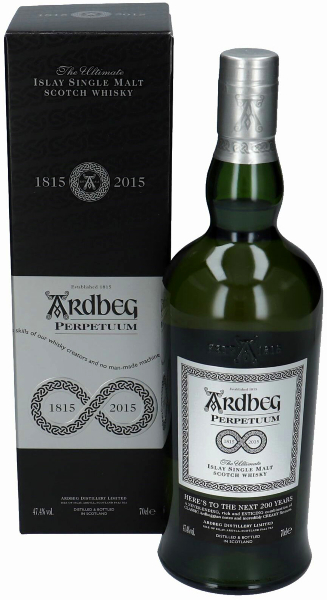
Ardbeg NAS “Perpetuum” (47.4%, OB, Bourbon & Sherry casks, 72.000 bottles, 30/03/2015)

Most of today’s Ardbeg core range has been featured on these pages now. I already liked Ardbeg in the past, but all modern Ardbeg’s seem to be to my liking as well, but they are quite different from the old ones obviously. I have to say that the core range of Ardbeg might be quite unusual to some; a 5yo (Wee Beastie), a 10 yo (Ten), and three NAS bottlings of which one has a lower strength (An Oa) and two are at a rather high ABV (Uigeadail and Corryvreckan). These bottlings show that Ardbeg is still a wonderful Whisky today. This prompted me to look beyond the core range and buy (at auction), some of the special releases Ardbeg has been doing for a while. First one up, is one that has been released for the 200th anniversary of the distillery, and honouring this fact, this must be a stellar release. Looking at auction, this might not be the case, since prices are still reasonable today, even at the time of writing. Sure 72.000 bottles is not really a limited release, but even with the popularity of Ardbeg, these are still widely available (at auction) and affordable, although at least twice the price of any of the core range bottlings.

Color: Light pale gold.

Nose: Right upfront soft peat and warm smoke from the fire place, soft wood and tar. Sea spray, barley sugar (quality Rum sweetness) with a hint of cardboard. Tarry rope. Salty, aromatic and balanced. After a while, more iodine is noticeable as well as some lemon notes. Grandma’s old bar of perfumed soap, found after many years in the back of a closet (behind her rather large knickers). Nice subdued yellow fruit. Green garden plants (not flowers, nothing blooming), just the leafy stuff. Black tea (the dry leaves) and do I detect some chlorine (mixed in with the lemon)? The “hefty” peat notes that jumped out of my glass before, dissipates rather quickly, making the nose rather soft. I’m guessing this is quite a young Malt or has at least quite some young stuff in the blend, without it being anyway near new make. Nothing wrong in that sense, because young Ardbeg can be damn good. When the peat takes a back seat, the iodine I already mentioned, is accompanied by some plastic and pencil shavings and some deeper older peat, so probably some older casks were used as well. Since this is another modern sea faring Malt, lets call it tarry nylon rope, shall we? The warm smoke I mentioned before, has some more staying power. More of the faint citrussy note, as well as some cold butter and maybe even some unripe yellow fruits, but as I said, it’s faint. Late in the mix another faint note of spices emerges. This is again a very nice smelling Ardbeg, still a force from Islay to reckon with. This promises a lot for what is to come next…

Taste: Sweet, soft and friendly. Somewhat fruity already with molten vanilla ice cream and toasted wood. Lots of licorice, black and white powder and chlorine on the palate as well. Salty. Fruit and fruity acidity. Initially lacking a bit of balance, and it seems overall simpler as well. It tastes a bit like a dram to which I’ve added a little bit too much water. (I haven’t added any water at this point). Wee hint of a bitter note in the back and traces of coffee. Quite tasty, but not truly powerful. A fruity Ardbeg. Crushed beetle, prickly smoke and not so soft peat. More fire and fireplace. Sometimes it seems like the fruit and the peat aren’t very happy with each others presence. For instance, the fruit and the peat did like each other much more in the Benriach Latada I reviewed recently. Also, the promise made by the nose, isn’t kept by the taste. A shame really, because the nose is really good. So what went wrong here? Has this suffered from too much reduction? I do think that might be one of it’s problems, as well as the youthy bit and therefore lacking some depth of the whole. Seems to me they tried to get too many bottles out of this batch. Maybe this should have had a higher ABV and maybe some more older casks blended in. I don’t know, I’m not a blender. However, having said that, I do like this expression quite a bit, there is a lot good stuff here, and it sure has some weak points, in the end it has more strong points. I had a lot of fun with this one. The Ardbeg quality is certainly there.

In the big world, this is quite an unloved Ardbeg, This is the quintessential Ardbeg, that in the beginning of gym class never gets picked for the side, even when it’s liked by everyone. It just doesn’t seem to perform or isn’t considered a winner, and we play to win now, aren’t we? There is most definitely nothing wrong with the nose, because this is a very nice nose with lots of nice things to smell. Taste wise, yes, sure, it is a bit weaker, reduced, but given some time to breath this Ardbeg do catches its breath and reaches a higher level. This would make for a nice addition to Ardbeg’s core range as a third high ABV, NAS bottling. But as is, this might be something of an underdog. Lets be clear, the nose is nothing short of wonderful and the taste, although lacking some oomph, is likeable and easily drinkable. An easy Malt to be around with. Soft and friendly, with a good character and tasty as well. If you feel, taking part is more important than winning, than this is still a good Ardbeg if you allow it to be. If you are critical and expect every Ardbeg has to be an absolute winner or stunner, than no, this is not for you. Get a Twenty Something instead, which is relatively recent and easily a 90+ points Whisky to boot.

Points: 86

Because its different from my two favourites out of the core range: Uigeadail and Corryvreckan, then sure, you can get this and it won’t fail you. It didn’t fail me. But in the end, both NAS bottlings are slightly better and both together cost more or less the same as this one Perpetuum by itself, definitely something to consider.

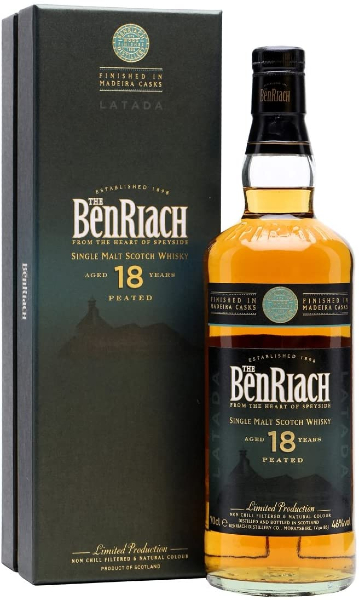
The Benriach 18yo “Latada” (46%, OB, Limited Production, Peated, Madeira Finish. 4001 bottles, 2015)

The Benriach Limited Production 18yo’s. It took me a few years but now we can finally put this trio to rest. In the year 2015 three 18yo’s were released, but not on the same moment. Albariza (PX finish) was the first one, reviewed in 2018, Dunder (Rum finish) the second, reviewed in 2015 and finally this review of Latada (Madeira finish) in 2021. Quite a lot has happened in the world in this space of time. In 2017 also two second edition’s were released, both 22yo, so the original casks for these two, were filled earlier than those for the 18 yo’s. However, this tells us nothing about length of the finish. Albariza and Dunder were thus repeated, but there is no 22yo Latada. Were the Madeira casks used for finishing unavailable or did they forget to produce it? Were the results unsatisfactory and the decision was made to hold it back, or maybe the original 18yo Latada didn’t sell all that well or was somehow unpopular and they just didn’t bother to repeat it. Who knows? So, let’s find out for ourselves, shall we?

Color: Full gold.

Nose: Fruity and very pleasant light peat. Latex paint, vanilla powder and warm apple sauce. Very pleasant nose. I’ll let you in on a little secret with this Malt. You can force this Malt to smell like a 1976 Benriach or Tomatin. Fruit, fruit, fruit, tropical fruit, well you catch my fruity drift now, yes? Excellent old-skool Benriach fatty, sweet and succulent yellow fruit. If you pour this Malt in your favourite glass and cover it up right away, allowing for the aroma’s to concentrate under the lid. Leave it there for a few minutes (or even better, hold it in your hands to speed up the process). When you feel confident, take the lid off and smell it… Remember, you heard about this here first! This Benriach has this amazing trick upon its sleeve. Thick sunny fruit with a nice black peaty edge. Good balance. Warm smoked apple sauce and moisturising hand cream (Nivea). Crushed beetle and smouldering leaves. Fresh oak with nice medium wood spices and some bonfire notes. Amongst all these Benriach’s that were released under Billy Walkers reign, with labels in colours you didn’t even know existed, these three finishes (Albariza, Dunder and Latada) really stand out for me, as if these received some kind of extra care. Benriach is already a great distillate and Malt, and these three are certainly no slouches. Otherwise this Latada seems to be somewhat simpler and less peaty than both Albariza or Dunder.

Taste: Sweet and sour fruity acidity. Apple sauce, sugared yellow fruits, slightly nutty (like a mix of freshly burnt and unsalted nuts you buy at the market on Saturday) and cigarette ashes. Thick (sweetness + peat) and thin (acidity) at the same time. Some nice wood, more than the nose had, but not very much, not a lot of bitterness as well, which is great. This leaves more room for the fruit and the peat. I expected even some more peat here though, and maybe even some prickly smoke, but foremost this Malt shows me ashes first, apart from the fruit that is. Soft and (light) peat do come next. Only next, comes some sweet licorice and again some wood. All in all a very tasty Whisky (hints of diluted Fanta), but less complex than expected. Excellent finish though. Nice warming and peaty aftertaste. Sure, of the three, Latada makes you work the hardest to show you what it’s got, but it is still a very nice one. The body of this Malt is narrower than both the Albariza and Dunder and as said also somewhat less complex.

Keep a lid on this one! Focus them aroma’s!

Points: 87

I understand that the scoring of Albariza (89 Points), Dunder (88 Points) and Latada (87 Points) seem a bit “coincidental”, but for me these scores reflect perfectly the quality of all three Malts and the differences between them. All three are very good, and some finishes just work a little bit better than the next. Keep in mind that this is my personal opinion, and it is highly likely, your preferences will differ. The perception one has, concerning the PX, Rum and Madeira finishes is also a matter of taste and can differ from one person tot the next. So for me the PX finish works best, but the other two are very nice as well. All three finishes work very well with the peat, and I can recommend all three. Considering these 18yo’s, I could be tempted to buy the Albariza and the Dunder back, but luckily these two have 22yo’s versions, so I’m getting those in stead. If a 22yo Latada would have existed I would have bought that one as well, because the 18yo version is still a good Whisky, receiving a well deserved 87 points. It would be interesting though to see how the 22yo would have been. However, I’m not sure if I would be getting the 18yo Latada again. For me it is still the least one of the three if you compare them to each other, and it is also the one that needed the most work to get everything out of it. Albariza and Dunder are easier in that respect. Get them all, they are good and differ quite a lot from each other. I would only recommend opening them in reverse order, so Latada first, than Dunder and finally Albariza. That will work best.

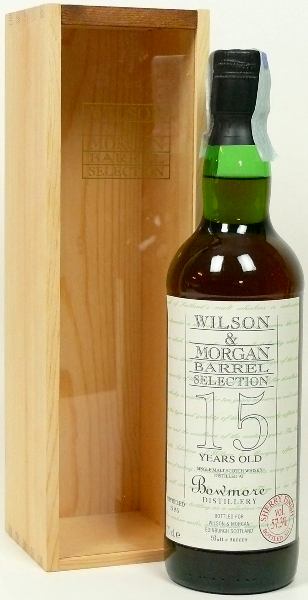
Bowmore 15yo 1996/2011 (57.3%, Wilson & Morgan, Barrel Selection, Sherry Finish, Butt # 960005)

I don’t know why, but every time I saw this bottle on a shelf, (when it was still readily available), I just wanted it. Which is quite strange. I’m not the world’s biggest Bowmore’s fan. Bowmores from yesteryear surely yes, but more modern Bowmore’s somewhat less so than other Islay distillates. Maybe this has something to do with Bowmore’s FWP*-problem from the eighties? Who knows. But why did I want this one? 15yo sounds nice, Bowmore, definitely not so bad, Sherry, yes, finished, what?… but why not? Wilson & Morgan and Sherried bottlings (Macallan, Mortlach, yes pretty damn good!) And last but for me certainly not least, I have always been a sucker for green glass bottles. Dark Whisky just looks fantastic to me through green glass. I even hosted a large Whisky tasting once, you guessed it, only with Whiskies bottled in green glass.

So, I always felt, more likely assumed, (the mother of all fuckups), but there is some educated guessing involved here, this would be a good one. Excuse me for this unnecessary complex sentence. Right after getting one of these Bowmores, I found another discounted one, so I snapped that one up as well, just in case. Better safe than sorry ‘eh? As most anoraks/aficionados/connoisseurs already know, Wilson & Morgan is an Italian private bottler, led by the über-Italian Fabio Rossi, who seems to prefer to focus more on bottling Rums lately, and doing a great job there as well. I already reviewed some Rums bottled by Fabio’s Rum brand; Rum Nation, as well as Whiskies from his Wilson & Morgan range. Ohhhh that Mortlach, nom, nom…

Color: Dark orange brown.

Nose: Perfect peat and smoke. Syrupy Sherry. Spicy chilli pepper powder. Vanilla and boiling vegetable water. Hot motor oil, licorice, tar and a faint whiff of plastic and latex paint, all adding to the complexity. Raspberry jam. What an amazing smelling Malt. The label states this as a Sherry Finish. Often Oloroso comes to mind, but in this case it reminds me more of PX, not claiming this really came from a PX cask though. Leafy, vegetal. Fresh air in between the peat and the smoke with some hidden vanilla underneath. Excellent wood spice, and fresh oak vanilla. Soft, creamy and lovely. Cigarette ashes from an ashtray. Licorice and some minty black and white powder. The Sherry finish brought a lot to this Malt without overpowering it. It is still an Islay Malt, with this added bonus to it. Wonderful work Fabio. I wonder how the original Malt was before it was finished to see what this finish exactly did. I guess we will never know. The smoky and ashy industrial feel wears off a bit over time, exposing some burnt newspaper, sinaspril and chlorine as well as the vanillin of American oak. Excellent balance throughout the nose. Dark cherries on syrup and a tiny whiff of the oil from orange skins and warm mineral oil as well. It’s just the orange skin oil, but it isn’t very orange-y. Some cigarette smoke as well as some more tar at this point. Black tea and leafy with hints of smoked kippers and some clay. Quite a complex Malt, changing directions several times, yet always well balanced. When Bowmore gets is right it can really hit it out of the ballpark.

Taste: Ahhh, wonderful, strong and prickly peated plastic and smoked rubber on entry. Gravy and lots of (tarry) red fruits. Black fruits and ripe strawberry. Sweetish at first, turning dry. Black coal, steam and tarry with rubbery cherry syrup. Bitter licorice. Laurel licorice. Unlit cigarette. It really does taste thick. Quite some wood but never really bitter, the wee bitter note here comes from the smoke. It’s dry and smoky throughout and quite fruity as well. Ashy. If this wasn’t peaty and smoky and spicy, it would have been a lemonade. I’m sure, part of the smoky notes come from the Sherry cask and not the Whisky alone. On the palate it may not be as wonderfully complex as the nose, but at this point, who cares, this is such an outstanding Malt. Wonderful. Quite a dry aftertaste, waxy and woody with the plastics and the peat, the medium waxy bitterness has the longest breath.

This one right after Tamdhu Dalbeally No. 3 is simply stunning, Dalbeally brings out the best out of this one, coal, machines etc. Man, when Bowmore is great it is truly stunning. Never thought a Bowmore from the nineties could be so great. If I had tasted this blind, I would have guessed this was an older Bowmore, probably from the seventies costing a lot more than this one did me.

Points: 92

*French Whore Perfume

Springbank 18yo (46%, OB, 11/14)

Whenever one walks in, there are always several Springbank’s on my lectern. I always have to be careful not to empty the bottle before the review has been written. Amazingly the last Springbank featured here is the 15yo bottled in 2018. The review was written in 2019, so no Springbank was reviewed in the whole shitty year that was 2020, how is that even possible? Never mind, here is the review of the Springbank 18yo bottled in 2011. One with the nice old black label that has already been replaced with the blingy and shiny purple label we still have at the time of writing. As said many times before, one of Springbank’s strong points is batch variation. No release of the 18yo is similar to any of the other releases, and this one is no exception. The 2011 never was considered to be one of the best, so let’s see why this one gets less love than other editions of this Malt.

Color: Light gold.

Nose: Fatty, yet fresh. Citrussy and fruity, but also waxy and some (wet) hay and dry coconut. Sometimes a bit farmy. Smoked sweet toffee, latex paint and soft wet wood. Wood that has been under water for quite some time. Burnt wet paper. Old matches (lit a long time ago). Very aromatic as a whole. In part a men’s perfume and otherwise quite fruity. Warm motor oil. Fatty. Easily recognizable as a Springbank. Smells balanced and really appetizing. This has a very good nose. Yellow fruits like white peach and tropical fruits like passion fruit and maracuja with a wee edge of smoke. Sweet and ripe smelling. Lime, candied pineapple and some almonds. Hints of sweat combined with the men’s perfume. The whole Whisky smells like a Whisky from yesteryear, you know, one of those Malts, people say, “they don’t make them like that any more”. Smells extremely well made and thus a wee bit old fashioned maybe, but then again, Springbank never smelled anything like anything else out there. Some more caramel and toffee, and some alcohol as well. Alcohol like you get from a cherry liqueur with a wee snuff of old white pepper, so not fully aromatic white pepper. Faded white pepper and add to that some warm anise (milk). Maybe this is a bed-time dram? Not woody at all, but there is this sense of toasted wood, although not much.

Taste: The taste is less big than the nose is. Well, initially it is, but the big fatty, nutty and fruity start dissipates rather quickly (making room for some wood and its bitterness). Still fruity, but also a bit thinner, maybe a tad more watery. Still quite warming going down. Here the age exerts itself through more wood and loads of almonds. With the second sip, the more waxy and nutty notes come to the front. Toffee and paper. Wax with citrus aroma’s blended in. Lemon and lime notes, not your orange or tangerine aroma’s. Although the woody bitterness does resemble the oils from orange peel a bit. Nice soft wood with (just) enough bitterness to let you know this is a well aged Whisky, and yes it aged in a wooden cask alright. Upfront are the waxy and toffee bits with the citrus and tropical fruits, the start of the body is the best. The more time you spend with this sip, brings out the more astringent woody bits and especially the bitterness of which there were no early warning signs of its arrival. The nose seemed so sunny and friendly and now this somewhat gloomy bitterness shows itself. It’s not bad, but it does come a little bit unexpected considering the nose. The finish is of medium length at best, and the aftertaste is somewhat dominated by the wood and its bitter friend. However, when this bottle was freshly opened, I don’t remember this bitterness at all. I guess this is what the breathing accomplishes. I have to admit, not every day is the same and personally it depends on the day how I get on with bitterness. Springbank almost always needs a lot of breathing, here with this one that is not the case. Strange, and again unexpected.

Yes, this is still a classic Springbank offering, yet not a big and bold one. As happens with a lot of offerings from this distillery, it only gets better over time. These Whiskies need to breathe to develop even beyond a point you couldn’t imagine when freshly opened, and this one was a good one right from the start, and as said above, quite different from Springbank 18yo bottlings form other years. We just love batch variation here! This one did develop to a high quite soon, but also managed to get past its top, and found its way down again. I don’t get that a lot with Springbank. As said earlier, this is not a Big Springbank, hence its reputation, so in this particular case the Whisky probably would have been even better at a slightly higher ABV. Around 50% I would say. This one is still a good one, hence the score.

Points: 87

Glenallachie 26yo 1992/2019 (54.8%, Cadenhead, Bourbon Hogshead, 240 bottles)

Here is another example of a soft spot Whisky that has been aged for a good while in a (refill) Bourbon Hogshead, like the Glentauchers I just reviewed, although this Glenallachie is twice the age of the Glentauchers. In my recent reviews of Inchgower and Tormore, I mentioned Whiskies although they may be lesser known to the public, I particularly like. This may very well be, and most definitely is, a personal thing. I believe one of the interesting aspects of one’s Whisky adventure is finding a Whisky that suits you personally. One that clicks. Often these lesser known Whiskies come from work-horse distilleries built for the sole purpose of making whisky for some big volume blend. In the case of Glenallachie that was the Clan Campbell blend. Well, Glenallachie might just be another one of those work-horse distilleries that could suit my palate just right. Up ’till just recently, only bearded extremist, poncho wearing, aficionado’s had ever heard of Glenallachie and knew what the distillery was capable of, and sure enough, even Master Quill did only write about independent bottlings of Glenallachie until the recent review of the official 15yo. So the tradition has already been broken, but here is yet another independent bottling of Glenallachie, this time one bottled by Cadenhead.

Fairly recently things have changed considerably at Glenallachie. Billy Walker cashed in big-time by selling Benriach and Glendronach, and turned his eye upon Glenallachie for his next project. Similar to what has happened with Benriach and Glendronach, a lot of Single Cask bottlings and a new and extensive standard range, with lots of variants, is hitting the markets as we speak. Hot stuff! At the Whisky Show in London, I had the opportunity to try a lot of these newly released Glenallachie OB’s for the first time, and, I have to say, I was quite impressed and especially pleasantly surprised by the “younger” expressions. The 12yo OB as well as the first few batches of the cask strength versions of the 10yo were very good. I am liking the potential here and will keep an eye out for this distillery and its offerings.

Color: White Wine.

Nose: Spicy, fruity and appetizing. Smells a bit like (any) classic Cadenhead refill hogshead bottling I know from 20 years ago. Citrussy, almost the clean and cold citrussy (lemon) smell of a freshly cleaned toilet. Wonderful soft wood. Even the toilet paper seems to be here. It is definitely not as bad as it sounds, it is actually quite appealing, but I find a freshly cleaned toilet also appealing (and inviting). So fresh and clean it is (The Whisky). Next, a more warming and medium spicy wood smell next to the citrus. Pencil shavings. Nice development as well. It’s aromatic, but it is not big. Next, more sweeter (diluted honey). The fruit is never far away just like this impression of sweetness. Some seriously fine fruity aroma’s emerge. For instance, green apple emerges quite late. Damp forest floor as well as some plants in the summer. Slightly minty and hints of Calvados. Dry lavender pouch from grannies drawers and lots of fresh air too. The citrus I already mentioned, but also some ripe sweeter kinds of yellow fruits. This needs some time to open up. Excellent balance between the wood and the fruit. Probably from a (second, or more) refill Bourbon Hogshead. This one is just about the cask and the distillate, giving us some nice results. The recently reviewed Cragganmore 12yo Special Release, is also a Whisky built around this theme (as well as some unexpected smoke, in that particular case). A perfect example of a Whisky where the beauty lies in the details, which works excellently in a flight of Whiskies like these. Top Tip!

Taste: Hot entry, where the wood has a louder voice than it had on the nose. Alcohol first. Caramel, toffee, cold chocolate milk and a candied apple on a stick. Sweetness second. Starts with only a clear hint of wood. Sharpish (painted) wood (old paint), yet not a lot of it. Wood third. Quite pleasant. Sweet and lots of sugary sweet yellow fruits, very, very appetizing. The start of this Malt is really wonderful and well balanced. Very tasty. Towards the body of the Malt and especially in the finish, there is also quite some, lets say, some less hidden wood, which is no surprise after 26 years. The wood becomes quite pronounced towards the end of the body and especially in the finish. The wood shows quite some bitterness as well, which takes away a bit from this Dram. Plant sap and oak. A bit hot going down. Drying on my tongue, making the malt more astringent. The sweet start is entirely pushed away. The fruit is still there but the wood replaces the sweetness, making it less lively and less “tropical”. The bitterness has some staying power but not much. Actually, nothing has a lot of staying power, so this definitely is of medium length at best. A light bitter woodiness makes up the aftertaste.

Yes this is a good Malt and I understand the people who say they really like it. It has some really good traits. For me personally though, losing the sweetness along the way and the wood, and its bitterness, taking over like this, takes away a from this Malt. But hey, this is a 26yo Malt, so there is bound to be some wood in here, don’t you think? I wonder how this was when it was younger. Would the wood have less to say, less drying and less bitter? Would the fruit be still as developed as it is now or would it be more youthful and vibrant? Maybe we’ll find out some day from a sister cask that was bottled several years earlier. In the intro I was wondering if Glenallachie might be another work-horse distillery which would suit my palate? Well after the Glenallachies I tasted up ’till this point, I wouldn’t place it in that category with Tormore and Teaninich just yet…

Points: 86