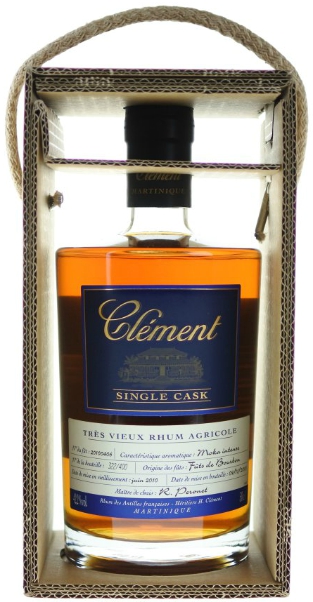
Clément 5yo 2010/2015 Très Vieux Rhum Agricole (42.2%, Bourbon Cask #20100409, Moka Intense, 412 bottles, 50 cl, Martinique)

Earlier, I reviewed both the 100% Canne Bleue (the original single cask bottling) and the first variation upon the single cask theme, called Vanille Intense. Where the first version was marketed with the emphasis on the sugar cane variety (Canne Bleue), the second, or so it seemed to me, more marketed towards the wood, since vanilla is an obvious marker of American oak, but sure, it can emerge from the Rhum as well. Here we have the next variant called Moka Intense, boasting mocha and coffee notes. I’m a big fan of coffee, so this variety is most welcome. However in the back of my mind the Vanilla Intense variety wasn’t quite as good as the original 100% Canne Bleue was, so I’m really expecting something along the lines of Vanilla Intense. Still these are single cask bottlings so it isn’t said that all 100% Canne Bleue are better than every Vanille Intense bottling. This Moka Intense is half the age of the other two. Maybe the coffee notes are more obvious in younger Rhum?

Color: Copper orange gold.

Nose: Soft, vanilla, slightly nutty. Lozenges and soft wood. Nice Agricole notes. Sometimes it’s too soft really. Hint of sugared orange skins and cherry liqueur with some dark chocolate. Black tea, infused for a short while, with lots of sugar in it. Mocha? maybe, not now at least. Coffee, nope, sorry. Very soft and un-complex. Its really simple really. Sugared. Wait a minute, I do get a sweet coffee note somewhere in the back, but actually it is a note that can be found in many other R(h)ums. So not a coffee that stands out. Mocha is softer and definitely present. I have to admit this Rhum does need some breathing. It opens up nicely and starts to show more of the above but now with better balance. Nose-wise this is now better than the Vanille Intense was. It has a very appealing quality to it, but it does need a lot of time to get there. Nice stuff nevertheless.

Taste: Not cloying, but definitely sweet. Warm going down, with bitter notes from the wood, maybe that’s why it was bottled earlier than the other two examples. Canne Bleue underneath but cloaked. Some notes of diluted sugar in warm water, without the taste being overly sweet. Just like some Whiskies go soft and smooth by caramel colouring. Personally I steer clear from distillates that are called soft and smooth. Never a good thing. On the palate this is definitely a wood driven Rhum. Even after extensive breathing that helped the nose forward, it doesn’t bring complexity to the palate. Alas. The body of the Rhum is black tea, typical Agricole notes, somewhat nutty, with a slight acidic edge. Lacking a bit in balance to be honest. Finish is not very long, and even less balanced. Is this the age? Sure it is. Aftertaste, some more typical Agricole notes and some sugar, that’s more or less it.

Since this is younger than the other two expressions I expected something more raw and bold, but au contraire, it turns out to be quite austere. I was afraid this next variant would be somehow less good than the original and it is. Although this still is not a bad Rhum, not at all, but both the Vanilla and especially this Moka Intense, seem to be out of their depths compared to the original single cask 100% Canne Bleue. This is a softer version, but with that, also more boring than the 100% Canne Bleue and even less interesting than the Vanille Intense. Now that I have reviewed all three, I’m now very interested how another batch of 100% Canne Bleue would perform. Anyone? For now, I would recommend you get the 100% Canne Bleue and forget both variants which add nothing more to the world of Clément single casks to warrant you, buying all three.

Points: 83

This one is for Lance who had to wait a long time for me to review a R(h)um again!

Talisker 57º North (57%, OB, L5054CM000, 2015)

I opened Talisker 57º North, not as a direct replacement of Amrut Cask Strength, because that was already done by Amrut Peated Cask Strength, but it does have the same “function”, in my collection of open bottles, similar to Amrut Cask Strength. All three fit the bill of NAS and high ABV Whiskies. All three are sold at a decent price point, and all three offer pretty high quality as well. Talisker, in general, is a wonderful Whisky, there are many wonderful bottlings to be had, and I’m sure that in my stock, Talisker might just be the distillery most represented. Official bottlings and independent bottlings. Old stuff and new stuff. However, the sign of the times is that many brands are hastily pushed forward by their owners, suddenly offer you many NAS bottlings, counting on you to want them all, or tailored for different markets, but there are many reasons.

Talisker may very well be Diageo’s most popular distillery, so with Talisker, we have “Skye”, “Storm”, “Dark Storm”, “Port Ruighe”, “Neist Point” and now even a “Game of Thrones” edition and today’s victim: “57º North”. This one is already around for quite a while, longer than the others I mentioned. This is the only one of those, sold at higher ABV. 57º North was first released in 2008, and the version I’m about to review was bottled in 2015. Like many offerings that are made regularly, there is some batch variation, and the sentiment you get with that is people believe the first, or earlier bottlings to be better than later or more recent bottlings. I’m not saying these people are wrong, because I know many first versions that are most definitely better than recent bottlings. Ardbeg Uigeadail and Hazelburn 12yo come to mind. However even recent bottlings of Uigeadial are very good, but different. I tried one of those earlier bottlings of “57º North” and it was stellar. Older readers can tell you how extremely good the Talisker 10yo was when it was released before it became part of the classic malts. So lets have a go with this litre bottle of 2015 “57º North”…

Color: Light orange gold

Nose: Dusty, soft oak, a little vanilla and unexpectedly quite vegetal as well. Initially sharp fresh air, but turning soft and staying soft, quite quickly. As a bonus some whiffs of milky new make. I don’t care for that. Hints of clay and at times, slightly meaty. Wood and some hidden sweetness. Fresh vanilla ice cream and coffee (with milk and a wee bit of smoke and caraway). Amazing how soft this is. At this ABV, I expected something closer to Thor’s hammer, but it’s more like Mario’s wrench. Next some white chocolate with enough wood influence to counter it. Warm vegetable oil. Sweet oil. Appetizing. Distant hint of peat and sometimes whiffs of cardboard and an old bar of soap. Musky, perfumy, more coffee and soft oak. More floral than spicy. Sometimes a breath of fresh air. No sign of this being 57% ABV though, so soft. When freshly opened, this was quite closed, but by now, with 80% of the bottle gone, it opened up nicely.

Taste: Powerful, sweet right from the start and slightly acidic. Immediate pepper attack. Well, lets call it a moderate attack. Next, definitely some oak influence. Sometimes fresh oak, and sometimes sweetish oak. When this starts to wash down, space opens up for a much more sweeter and definitely a nuttier note and quite some candied and dried yellow fruits as well. Toffee with a nice acidic note (again) and lots of nuttiness (again) in this one. Creamy and soft. Towards the end of the body a more bitter attack, toasted oak. Fruity and fresh. Next sip, mouth seems more coated. After the astringent bits, sweeter and more toffee and vanilla notes (re)appear. Luckily no sign of the new make the nose had. Both the nose and the taste show a lot of balance. Not a very long finish though, and I’m not sure about the balance as well at this point. I guess this is where it may show its youth. Vegetal aftertaste with hints of cardboard. Essentially turning “green”.

This definitely came around with lots of air. Word is, this might be axed, but word was also the 10yo was going to be axed after the emergence of all those NAS-bottlings like “Sky” and “Storm”, but the 10yo still around. I enjoyed this 57º North. No problem this being a litre bottle. Personally, I would have liked the youngest part of this blend to be matured a bit longer, and pay more for it. When this loses it’s new make whiff it sometimes has, it could be much better. Just sayin’.

Points: 85

Talisker Select Reserve – Game of Thrones – House Greyjoy (45.8%, OB, 2019)

Sooner or later, one of these Game of Thrones bottlings was bound to show up on theses pages now, wouldn’t it? Hard to miss them, especially since Diageo is throwing some serious money towards marketing them. But don’t you feel they missed the boat, since the series already came to a close some time ago? The question remained, which one of those bottlings would make it first. For a long time it looked like Lagavulin would be the first, but before I could open that one, I got my hands on the 10yo Lagavulin for travel retail and opened that in stead. Since the 8yo and in hindsight this 10yo weren’t very impressive, I really wasn’t in a hurry to open the 9yo Game of Thrones bottling fearing more of the same, so this is how Talisker beat Lagavulin to pole position.

Color: Orange gold, so pretty sure this was caramel colored.

Nose: Dry, dusty and malty but with a very nice funky note to it. Dirty toffee, in part, reminiscent of the smell of caramel colouring, cloying, fatty and creamy. Yes caramel colouring does have a smell, and it does have an effect on Whisky. Don’t let them tell you otherwise. Nevertheless, this Whisky is still very likeable. You have to work at it a bit to focus on the aroma’s underneath. Nutty with hints of second hand cigarette smoke and hints of toasted cask and virgin oak. Old cabinet and very aromatic. It has an “older” smell to it, as well as a heavily engineered and doctored feel to it. Spicy, almost Indian Whisky spicy. Lots of cinnamon and cookie dough. Some smoke and some fresh oak. Also it seems some virgin oak found its way into this. On top of that, a lemony fresh acidity which really helps the whole forward. Yet also this feel of uncomplexity, helped along by this cloak of added caramel. An instant gratification Malt. Toffee notes, but in this somewhat suspicious way. However, I really like the Indian spices and lemon combination. Much friendlier than the milky unfinished notes of those new Lagavulins I mentioned above. I really like this nose (to a degree). If you are into Amrut and Paul John, you may like the smell of this (or not).

Taste: Nice entry. Somewhat sweet. Big, sweet, spicy and nutty attack, but also in a way thin. The fatty and creamy start is washed away by the alcohol, leaving room for more peaty and slightly smoky notes, but also some spicy wood and yes, a tiny pepper attack. Hints of ripe red fruits on top of the toffee and cinnamon. Sometimes it is almost like a Christmas pudding. Next, some virgin American oak. A vanilla note intertwined with cinnamon. A little bit of “older” wood as well as a slightly burnt note, maybe some smoke even. Cookie dough, even more than the nose had. Don’t we all like cookie dough? Sure, this has plenty of added caramel roundness to it, which kills some bits of it. It’s beating down the complexity this must have had. Slightly hot going down, with pepper in the finish and especially in the aftertaste. Highly drinkable though. A bottle of this won’t last you long. Easy and without any off-notes. Easy and even more drinkable than “Neist Point”, and that already was a highly drinkable Malt that didn’t last me long.

Wait a minute. Greyjoy? Wasn’t that from the Iron Isles. Sure, Talisker is also known as the Lava of the Cuillins, but this expression of Talisker has nothing to do with lava, and it tastes more like it was made on the shores of Goa. So hardly rugged Cuillins. Do you remember the weather and atmosphere on the Iron Isles? Boy, this house really doesn’t match the Whisky. Maybe Diageo should have paired this with 50 Shades of Grey in stead of Game of Thrones, or maybe House Tyrell, the house of sweet Margaery Tyrell (Natalie Dormer). That would have been a far more convincing match imho.

I sure can understand when people don’t like this. Because it may lack a bit in the complexity department, and has definitely been tampered with added caramel big time. Still, I had plenty of fun with this one. Sure, no high flying Malt, but since this is often sold for “not a lot”, it sure surpasses many other entry-level Malts. A bit of a guilty pleasure maybe?

Points: 84

Thanks to Auke for the sample!

Cardhu Special Cask Reserve (40%, OB, Batch Cs/cR.10.09, 2010)

Wow, here we have a Diageo NAS bottling “selected from very old casks”. Really? So instead of just putting the number up, lets say 30yo or maybe 40yo, and ask a hefty sum, they let you have this for a song, just by replacing the very old age statement by “Special Cask Reserve”. Lets not tell anybody, and let this be our little secret! Sush. What a wonderful idea! Who said Diageo isn’t thinking of their consumers! Well if this is a very old Cardhu. I’m expecting quite a lot now! A few years back I reviewed a Diageo Cardhu 22yo, that did have an age statement, and at only 22yo, this was truly very, very good! And as this must be older… But hey, wait a minute, reading that post I mention that I didn’t like the Special Cask Reserve. Did I already try this particular Cs/cR.10.09 earlier (which was already out at the time) or was it from another batch? Thud! That was the sound made by my expectations lowering…

Color: Light gold, with a slight pink hue

Nose: Fresh and fruity. Lively. Malty with hints of toffee. Summery with an unexpected meaty note, maybe even some sushi. Some funky notes, I have a hard time putting a finger on. It is a meaty, slightly salty smell, somewhere in between bacon and cold gravy, combined with lavas maybe? lavas I’m getting for sure. On top a slightly fruity note and on top of that a slightly meatier floral note. (This bit I like). I have to breathe as if my life depends on it, because the whole is pretty weak. It already smells pretty reduced. I’m guessing I know, by experience, what was there, but somehow got washed away by reduction. Still, no off notes, so nothing obtrusive to report here. I really feel I have to hurry smelling this before all the smell is gone, and I have to poor it again, to smell something. This really suffered a lot from reduction, because the nose, when you work on it hard, does show some interesting sides of itself. I wonder how this would be at cask strength.

Taste: Some sweetness, like a very weak Rhum Agricole, with quite some added sugar, paper and cardboard. Hints of cigarette, and some toasted wood notes, with added bitter notes shortly thereafter. Sweaty notes next, like the isolated sweaty notes of Sauvignon Blanc with added sweetness to the sweat. It’s not me, I have just showered. Hints of sweet fruits, but so diluted, that I can’t even tell witch fruit that can be, apart from the color, yellow. Papaya and peach, some banana in sweet yoghurt? Definitely some fresh butter in here as well. Super-short finish and a non existent aftertaste. Still slightly warming going down and even when this has no aftertaste, the meaty lavas bit of the smell (rancio?) does have some staying power.

Well…well, what can I say about this? I have to admit, it has been a long time I have tasted something as weak as this. It is so weak I would have difficulty, when tasted blind, telling if this is a Whisky to boot. I have never had a Whisky before which after you swallow it is immediately gone. Amazing, this isn’t worth your money, nor is it worth your time. Since this was brought to you by Diageo, and they do things on purpose, they must have an market in mind. I’m so curious how they would describe the consumer wanting stuff like this. Maybe its meant for mixing? having said all that, and I am rightfully so, pretty negative about this malt, I have to say the nose does bring a smile on my face. From an anoraks point of view, this is even an interesting Malt. Who would have thought…

Points: 76

Tormore 12yo 2004/2017 (59.6%, Gordon & MacPhail, Cask Strength, First Fill Bourbon Barrels #901 & 902)

Sometimes less obvious Whiskies just hit the right spot with the drinker. No big names, no big marketing ploy. Usually these are workhorse Whiskies originally meant for blends. Just like Inchgower (I just reviewed this 1998 bottled by Gordon & MacPhail as well) is mainly used in three well known blends. White Horse, Bell’s and Johnny Walker. Teaninich is another right-spot Whisky for me, but there are more. Tormore is one of those right-spot Whiskies as well (and used in several blends too). Tormore has a profile I rarely encounter elsewhere. Sometimes funky or even sulphury, sometimes industrial and frequently metallic. It doesn’t seem right, but it is most definitely not wrong either.

So what is it about Tormore? Maybe it is safest just to call it an acquired taste? Sure, I’m the first to admit that the markers I mentioned above don’t sound all that appetizing, but for me the strange profile works wonders. It broadens the horizon a bit, if you will. Entertaining and interesting. Unique and a bit strange. I first had this click with an metallic and industrial Tormore from the hot 13yo Cadenhead’s bottling I reviewed quite a while back. Tormore may not be entirely for novices, I’m sure it isn’t, but I found that people who are “doing” Whisky for a longer time, secretly have a soft spot for this Malt! I’m so curious now, I can hardly wait to take a sip…

Color: Very light gold, White Wine.

Nose: Cereal, barley, wood and strange enough, since this is coming from Bourbon barrels, some sulphur, but a nice light sulphur it is. Warming, funky, almost like a nice smelling fart. Don’t be offended, you’ve been there, admit it. There is another association I have with this smell. When growing up near a rural area I used to poke a stick into the bottom of a pond or stream, and the sulphury bits of this Tormore remind me of the bubbles coming up. Just like previous Tormore’s, it’s also metallic and nicely spicy. Funny when Tormore just seems dead wrong, it still is right (for me). It’s a bit off (or is it just different), but I just like it. Old dusty vanilla and fresh citrus notes. Ginger. Dry vanilla powder. One moment perfumy and chic. Fireworks and striking matches the next. (including the gas-passing, mentioned above). So, when did you have that last in a Whisky? The “off” notes, wear off a bit, showing more of the fruits and ginger underneath. Zesty, fresh and citrussy and still this huge breath of fresh air. When smelled vigorously, a meaty note comes to the fore. After a longer while, old furniture pops up. Dusty old furniture. My minds eye sees this old furniture, lit by a ray of sunlight falling into the attic through a small round window. My god what a nice farty, complex and interesting philosophical Whisky this is!

Taste: Quite sweet on entry. Fatty and creamy. Toffee and vanilla ice cream. All these creamy notes are masking the high ABV, because in no way does this taste like a near 60% ABV Whisky to me. Big and bold. Spicy, stingy, but then this soft, cloaking, toffee layer takes away the pain. Milk chocolate, mocha flavoured cream. You can sense that there is wood and there is most definitely quite some bitterness present, but the big, bold and creamy aroma’s just don’t let it all through, well sometimes it does. Alas, not as complex as the nose, but tasty nevertheless. Sugared mint towards the finish. I’ll even throw in the chocolate again, to make it an after eight type of experience. Hints of ashes, mere hints only. Cow manure (this is the sulphur talking again, showing one of its guises), mint, toffee and caramel, without being overly sweet. What a nice Whisky. The longer you keep this in your glass the more the mint excels. The bitterness turns out to have some longevity to it though. Luckily it is not too much.

In ways even science can’t wholly explain, I manage to have a soft spot for Tormore, and this example is no exception. But buyer beware, this is me and you are you, you might dislike it as much as I like it. Don’t say I didn’t warn you. I think it is wonderful in its uniqueness and for me, one to relax, recline a bit and watch a good looking and good sounding version of the Matrix. This Tormore somehow has the same feel as this movie…

Points: 87

Tomatin “Fire” (46%, OB, Five Virtues #2, Heavily Charred Oak, 6.000 bottles, 2017)

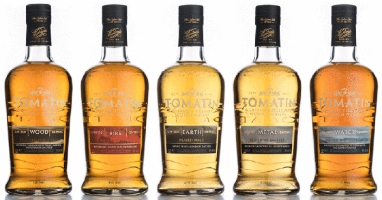
Where “Wood” is #1 in the Five Virtues series, here is #2, which is called “Fire”. It is called “Fire” because of the char and toast of the wood, and char and toast come about through the ways of fire. Tomatin “Fire” comes solely from a batch of stripped and (heavily) recharred oak casks. It is said that the distillate is from 2005, one year only this time, making this a Single Malt which is 11yo or 12yo, which these days is quite old for a NAS. “Wood” was blended from distillates between 1999 and 2006, and since 2006 is more recent than 2005, “Fire” is officially an older Malt than “Wood”  even though much older Malts were used for it.

What this bottling also might want to prove is: should you buy a new (or used) American oak cask, when you can also scrape out the insides, hopefully without losing the soul, of your old, dead tired and worn out cask and set it on fire to rejuvenate it? Boys do like to set things on fire don’t they? After this, one might have a reusable cask again. Recycled and good for the environment, maybe apart from the burning that is. Maybe very responsible and certainly sustainable. One less tree to cut down. This should be certified green!

Color: Light gold.

Nose: Again, a woody Whisky, but this time a more vanilla driven Malt. American oak alright. Sweet, fragrant, slightly floral and right from the start this slightly acidic and creamy strawberry aroma. Sometimes a bit dusty even. Not as much char as I expected from something called “Fire” or “heavily charred”. Hardly any char really. Quite fresh, fruity and milky. The milky notes scared me for a while, but dissipate after a while in my glass and these milky notes disappear completely when the bottle cbecomes emptier. Paper and woody notes and initially not all that different from “Wood”, but after enough time to breathe the difference is bigger than I imagined possible. The “Fire” I do get from this Malt is the aroma of a burning wood fire in winter, minus the sharp smoke. Just like “Wood” this essentially is again about (recharred) Wood, and the woods in “Wood” are charred as well. To me it is more like a sequel to “Wood” so they might have called it “Wood II” just the same, but this probably would not have worked inside the Five Virtues framework.

Where “Wood” was about the blend of different kinds of wood, this is a little bit closer to a virgin oak type of bottling, just a bit more refined, especially after some breathing. This really needs to open up, because it really was disappointing when freshly opened. Where “Wood” was creamy, this is even more creamy. Again no new make aromas, but it is slightly closer to new make than “Wood”. Lots of fresh oak notes, creamy and yes, lets call it green. Fresh plants and garden notes. Breaths of fresh air and some burned toast notes, but not a lot. Initially quite simple, it seems much simpler than the “Wood”. Reminds me sometimes of Bruichladdich Islay Barley. That sort of simple, yet lovely, stuff. Only, Bruichladdich reaches that already after 5 to 6 years, Tomatin takes twice the time. Maybe simple, but especially after a while in the glass, it becomes quite nice. In the end a nice example of an honest Malt matured in American oak. Good smelling stuff, just not right from the very start, be warned.

Taste: Again, it starts fairly simple. Tea with a dash of sugar. Latex wall paint, sweet custard and definitely sweet malt. Mid-palate a cloying burnt note. Sometimes a slight hint of cigarettes being smoked in the distance, an aroma blown over by cold wind. I also pick up on some minty notes and some tasty ripe red fruits. Quite a short finish at first and a fairly non-existent and unexciting aftertaste. But buyer beware, don’t get fooled, this Malt also has a trick upon it sleeve. Yes it is more than a bit unbalanced when poured from a freshly opened bottle, but responds extremely well to some air, gaining lots of depth and some very nice black fruits suddenly emerge from nowhere. Wow, first we had the ripe red fruits and now these black ones. The return of fruity Tomatin, something absent from “Wood”. See how some Malts need to breathe? Quite some evolution. However, even after some breathing, the finish is still quite short and malty again and dare I say it, it remains a bit unbalanced.

It started out a bit really disappointing (not more than 82 points), but by now it is definitely on par with “Wood”, but I have to admit, you have to work at it a bit, and maybe have some experience (and patience) as a Whisky drinker, to see the beauty in this one. So “Fire”, in the end, turns out to have a nice, fragrant start and beautiful body, better than “Wood”, but it keeps struggling towards the end, the finish stays short, with hints of Beer, strange enough, and a thin, slightly woody and bitter aftertaste, and some creamy notes as well, which by now aren’t creamy. fatty or big enough to make the finish better. The second half of the experience therefore is definitely won by “Wood”. This is surely a flawed Malt on the outside, but with hidden beauty inside. Personally I find it very tasty right from the start with an additional fruity and appetizing body, just be very careful with it when freshly opened. I kept the cork off for at least a day after the initial disappointment. Did it lots of good. Interesting stuff and certainly an education.

Points: 85

Tomatin “Wood” (46%, OB, Five Virtues #1, French, American & Hungarian Oak Casks, 6.000 bottles, 2017)

I like my Tomatin’s. Good Whisky. Good people work there and represent it, with wit, honesty, intelligence and humor, no funny business. Lots of releases too. From 2017 onwards, they started with this five part series, showing what the five virtues of Whisky are. Wood (2017), Fire (2017), Earth (2017), Metal (2017) and last but not least, Water (2018). Although all five are NAS Whiskies, I was told, that no young Whiskies were used throughout the range, and all would have some proper numbers comprising of two digits if they would have been bottled with age statements. Thank God, because I feel Tomatin spirit really does need it’s time in oak. Young Tomatin’s can be milky, somewhat sour and heavy on new make characteristics.

When I visited the Tomatin stand at a show in 2018, I tried the “Metal” and “Water” expressions, which I liked very much. I bought both of them, and looking at the two bottles, yes, I’m human too, I just couldn’t resist to find the previous three releases of this series. I have this series complete, and will open them one after the other, in stead of opening them all at once, due to a lack of room for too many open bottles. Well, actually there is never really a lack of room, but I do have to restrict myself a bit, Whisky madness and all. “Wood” here, is the first of the Five Virtues, and this one was matured in a combination of different oak casks, French oak (70%) and American oak (20%) we know, but this time also some Hungarian oak (10%) found its way into the mix. Am I already expecting Tokay now? The spirit used for “Wood” was distilled between 1999 and 2006.

Color: Light Orange Gold

Nose: Barley sugar and lots of cereal notes with late woody notes. Sweet, soft and fresh. Deep and accessible. Appealing. there is a lot happening in a furthermore very balanced nose. Quiet and distinguished. A sort of Steely Dan Whisky. American oak vanilla. Creamy, with vanilla pudding, custard, that kind of thing. Sweet fruity (peach) yoghurt. Some nice slightly acidic White Wine notes, again well balanced. It all works well on the nose. I don’t care for young Tomatin’s and luckily there is non of that here, so even when this is a NAS, it also tastes like there is quite some age to this. Quiet creamy and slightly funky. Nutty as well. In the distance a nice edge of toasted, and again, creamy and sweetish oak. The toasted oak also brings a slightly smoky note, which works very well for this fragrant expression.

Taste: Less creamy, (but still enough), than the nose promised and definitely some more of the acidic White Wine notes mentioned above. Fresher and lighter. Still not overly woody, but enough wood notes to warrant the name and thank god, not young tasting as well. Warming. A little bit of creamy wood and quite unexpectedly, some cocktail cherries. Sweetened fruit yoghurt. Sweet and acidic at the same time. After a while the more sweet notes from the nose come to the front. The body of this Malt is not as big and thick as one might think by now. It has more toasted oak (and wee licorice) than the nose had. Overall somewhat simpler than the nose was and even that wasn’t nuclear science to be honest. Still a very nice, somewhat sweet easy drinker. Both the nose and the taste show a lot of balance, yet the balance suffers a bit towards the finish. The fruity acidity seems to unhinge from the main, creamy, body, to hover above it and some woody bitterness emerges (finally). Still, in this case, the fruity acidity still has a positive effect on the whole. For an expression which was called “Wood”, it may have been blended from the various mentioned woods. French, American and Hungarian Oak that is, but it is not really a wood driven Malt. Although on some occasions, when trying this, I do pick up on some woody bitterness. Today a lot of over-oaked, new or virgin oak, bottlings emerge, but this isn’t one of them, even when carrying the “Wood” name. This has a nice nutty and warming aftertaste. Tasty too, but not as big as the nose promised. Final thought: this maybe more of a wood-Malt than I initially thought, because, this Tomatin lacks the typical tropical Tomatin fruitiness, so maybe this really is a wood-expression after all…

For a lot of people Tomatin is not the most well known Malt, which is a shame really, because over time, I’ve come across many well made and well blended Tomatin Single Malts. When I tried “Wood” for the first time, I was more than pleasantly surprised by this expression. I’m a bit afraid I may have not given this malt the attention it deserves. This is an easy drinking Malt and I carelessly reached for it many times. Now when it’s almost gone, and I’m analysing it more carefully when writing this review, before its all gone, I do come across very nice balance and some nice aroma’s. Yes I do regret not giving this Malt enough attention, since, this really is one that deserves it. Its a great example of a malt that is nice to analyse and contemplate a bit about the woods used for this Malt. Very nice indeed.

Points: 85

Thank you Alistair, Stan, Krish and Scott. This one’s for you!

Ardbeg “An Oa” (46.6%, OB, L69049, 2017)

I bought, reviewed and finished Corryvreckan and Uigeadail quite recently and was amazed by the quality you get for the price. Especially since these two are very, very good yet aren’t overpriced special releases. Ardbeg caters to that as well, but that’s another story entirely. No, these two are readily available core range bottlings. When An Oa came on offer, it was a no-brainer to get that one as well, it’s an Ardbeg after all! When freshly opened, whilst I was killing off both aforementioned Ardbeg’s, I wasn’t all that impressed. It’s hard to come out of the shadows of both stronger ABV, NAS Whiskies. This doesn’t say much about An Oa though, but more about how good Corryvreckan and Uigeadail actually are.

An Oa is the latest, widely available, addition to the core range, together with the 10yo and the two I already mentioned several times already. So how did they blend An Oa together, what is its unique selling point, what makes it stand out? For An Oa, Pedro-Ximénez casks, heavily charred virgin oak casks and first-fill Bourbon barrels were used, married, and here comes the unique selling point, wait for it, married in a French oak vat in The gathering room at the distillery. Yes the gathering room. I’ll run that by you again, The gathering room. By the way, some suggest, other casks might have been used as well, maybe there even will be some batch variation over the years because of using different types of casks in the marrying process?

Color: Light sparkly gold.

Nose: Softly peaty and softly smoky. All very restrained and held back. Green. Hints of dried fish, ground coffee and tar, but also a fresher and fruitier note, almost citrussy. Dusty and soft. Good job again. Salty, cigarette smoke, powdered vanilla. Hmmm some chlorine even after it had some time to breathe. Spicy and cold, sweet vanilla pudding. Lots of typical Islay markers. Virgin oak yes, Vanilla notes from American oak yes, PX, on the nose, barely, not right now, the virgin oak is much stronger. PX? not so much when looking at the color of this Whisky. I really wonder about the PX though. What did or should it do for this Whisky? An Oa, again like the other NAS Ardbegs, doesn’t smell young or unfinished. It’s not very complex though. Nevertheless it does smell good.

Taste: Wood, paper and cardboard, mixed in with sweet licorice, tar and some ashes. Ashy toffee and almonds, does that make any sense? That right there is what this Whisky is all about. (Slightly bitter) wood, (sweet) licorice and (burnt toast) ashes. These three are omnipresent in this Whisky at any time. Again, very accessible, due to its sweeter side. More licorice even, oily, and a nice warm feeling going down. It tastes familiar. Even when this is a new expression is feels a bit like coming home. Warm and cozy. 46.6% ABV is nothing to worry about. It is enough, and works well for this expression. More wood notes emerge. Sappy fresh oak, not old dry planks. Does carry some woody bitterness towards the finish. Quite green and lively. Some raspberry and citrus notes. Some sort of brooding hidden fruitiness on the back of my tongue. This is from the PX. The finish is of medium length and there isn’t all that much happening in the aftertaste apart from some woody bitterness reminding me of…earwax. Here it shows its apparent youth. Its all in your face right from the start but it lacks in depth and experience older guys, I mean, Whiskies have. Very drinkable. I fear, this won’t last long on my ledger too. I sticked it in the back for a while, but that hardly helped…

What can I say, I’m a sucker for green glass bottles and I like the look as if it was made in the thirties. I love Ardbeg, even these modern ones. They are of high quality and very accessible. Just read back and see how good the Uigeadial and the Corryvreckan are. Laphroaig makes one expression especially for Whisky ‘fans’, the 10yo Cask Strength, made in annual batches. Ardbeg even makes two! Both are way less expensive and even more readily available than the Laphroaig is. Yes they don’t carry and age statement.

Alas, both have been finished already, but boy, do I miss them. When I’m on Islay time, I start out with Lagavulin 10yo which, compared to all the Ardbegs mentioned in this review, seems milky, and unfinished, young, new make-y. They must have used some pretty tired casks for that one I guess. The unusually low ABV of 43% (these days) doesn’t help either. Where the Ardbegs are accessible and just ‘right’, crash tested and approved, the newest young Lagavulins just are not. I’m definitely not a fan of the 10yo nor the 8yo, (but I am of the 12yo and the 16yo core range offerings). Oops, the 12yo is a special annual release. I do welcome the age statements on the 8yo and the 10yo (as well as on the Game of Thrones 9yo, and the Nick Offerman 11yo), but in this case I prefer the NAS Ardbegs and the trusty old Lagavulin 16yo and the 12yo Cask Strength over the 8yo and the 10yo. I have yet to try the 9yo and the 11yo.

Word always was that it’s hard to meet up with the demand for the 16yo, so are all these new and younger editions ways to lure some of us away from the 16yo, to keep it more visible? Wait a minute, is there really some sort of shortage of the 16yo? I see it everywhere, it’s never sold out, and I see them often on offer somewhere. Maybe another ploy to scare the consumer. Making him or she believe, it may sell out and not come back? A rumour always surrounding Talisker 10yo because of al the NAS offerings from Talisker released in the past few years.

This An Oa, because that is where this review is actually about, is a nice one. Its fun stuff. As said above, for me both the Uigeadial and Corryvreckan are just better and very hard to top. I just like higher ABV’s, but I also understand many of you don’t. Should it stand aside them? Nope, it shouldn’t. An Oa is made for different people than Uigeadail and Corryvreckan are, but I do feel it does have a place right by the side of the 10yo, to offer another take, with a different composition and being a NAS.

Points: 84

Inchgower 1998/2013 (46%, Gordon & MacPhail, Connoisseurs Choice, Refill Sherry Butt, AC/JIID)

Inchgower is not often encountered and therefore this whisky is often one of the great unknowns. Very understandable, when you consider the fact, this Malt is made for three well known blends: White Horse, Bell’s, and last but not least, Johnny Walker. Considering the cases sold of these, it’s almost a miracle they bottle Inchgower officially or even sell casks to independent bottlers.

Up ’till now, only two Inchgowers have graced these pages before, a Bladnoch Forum bottling and a Dewar Rattray bottling. Luckily for us, both have scored well above average. When reviewing the bottling at hand, there is only something like 30% left in the bottle, so it had some air to work with. At 46% ABV this is usually one of the first Whiskies I grab when taking a dram, and it is quickly surpassed by almost all of the follow-up drams. After all these drams from this Inchgower, I still don’t have a mental picture in my head how this particular Malt actually is, almost as if it just doesn’t leave an impression, unremarkable, forgettable. No, I don’t have a drinking problem, because I can fondly remember many, many different drams I had over the past 20 years or so. But let’s get back to this Malt we’re reviewing here, whatever it is…

Feeling an independent bottler as big as G&M probably don’t have just the one cask, I went out surfing to find another G&M Inchgower from 1998, and yes, there is. G&M have bottled another Single Cask, #11275 to be precise. It was distilled on 15.12.1998 and bottled in October 2011. That was a refill Sherry Hogshead @50% ABV. If our Connoisseurs Choice bottling is from the same distillate, our Malt is a 14yo.

Color: Dark Gold, hint of copper

Nose: Light, Sherried, very fruity and also a bit musty. Musty yes, farmy even. Still, there is this breath of fresh air to it as well. Fanta Orange and sinaspril, bordering on sulphur. Fresh and bubbly, appealing and likeable. Toasted almonds, but foremost, lots of citrus fruits. Zesty, apples. Warm apple compote. Very friendly and appetizing. Well balanced. Maybe slightly meaty, although it does retain its fruity freshness. Slight hint of oak and paper, but not a lot. Slightly smoky, whiff of cigarette? Licorice, and toasted oak. Also some black coal, mixed in with ahorn syrup on a bit of cardboard. Warm cooked vegetables. The breath of fresh air from the start returns a bit like menthol. Although there seems to be enough happening here, because it is an impressive list of smells, the whole does seem a bit simple, and light, too light. Strange, because it is really a wonderful nose, thin, simple and sharp. Lacks a bit of sweetness, roundness. Could have been more supple. All three words hated by connoisseurs, because, what do they mean? Still, a good nose though.

Taste: Half sweet tea, but not enough sweetness for this Sherried, fruity profile. Fruity acidity. Unripe pineapple. Caramel, toffee and toasted oak, yet not big nor sweet. Lacking depth. lacking development. Thin. It just shows you right from the start what it is, goes down well, and just waits, sits there like a puppy, waiting for you to take another sip (throw the bone). Its nice, but too narrow and too simple and it really, really lacks development. Very drinkable yet also quite simple and thin. It is a narrow path ahead, not a wide motorway of aroma’s. Pancakes with ahorn syrup. After tasting, the nose opens up a bit more, and there is nothing wrong really. Lets say this has a short finish, it isn’t even a medium fish. Slightly hot, but it might be me, this evening. Forget about the aftertaste, it was all washed down, nothing left for the aftertaste. This is why it is, and stays, anonymous and this is why next week, I will have forgotten, yet again, how this tastes. Nothing wrong, no off notes, no too young Whisky, just narrow, short and simple. Forgettable. Some moments later, this review still open on my laptop… dare I say that after all that, when casually sipping on, watching a re-run of Frasier, some sweetness does finally emerge and the finish becomes a wee bit longer? A tiiiiiny bit of oaken bitterness moves into the…..aftertaste? yes, an aftertaste, finally! So, maybe all is not lost after all.

Maybe the anonymity of this bottle was also brought upon by the Crabbie I reviewed earlier. I always started with that one, and since that one was essentially not OK, it may have ruined this one in the process, since I always grabbed this Inchgower next. The Crabbie is gone now, so maybe the bit that is left in this bottle gets the respect it deserves. Even though the nose it quite rich, it also predicts some sort of narrow Malt. Tasting it proves it. It is a narrow malt. It has the sharper notes, from toasted oak to Sherry oak and acidity, but it really lacks something bigger, no sweets no vanilla notes we know from American oak. Essentially, this Whisky lacks some more wood influence, so despite the color, the cask didn’t bring what it was supposed to. Not bad, but nothing you really need in your life as well. This one let me down a bit, but didn’t damage my faith in Inchgower. Bring on the next one please!

Points: 82

Wild Turkey “Rare Breed – Barrel Proof” (56.4%, OB, 2016, 112816A12029M)

I came across this no-batch Rare Breed in a hypermarket whilst on holiday in Poland. It sat there (two of them to be precise) on a sad little shelf made of metal wire, between some marked down totally anonymous cheap wines lit by cold light. So I just had to take these two golden orphans with me. These were also marked down considerably, so essentially a no brainer. I reviewed a Rare Breed before, one with batch number WT-03RB, and that was certainly not bad, since it scored 82 points, and I may have been a bit on the conservative side. I ended that review with the remark that Wild Turkey is axing the batch numbering and making it younger an lighter in the process. I read somewhere that Rare Breed was a blend of 12yo, 10yo and 8yo Whiskies, but more recent batches are said to be 12yo, 8yo and 6yo Whiskies, by word of WT themselves. Well, and finally here it is, one of those no-batch younger and lighter Rare Breeds.

WT-03RB was pretty good, and was almost there, (but not quite), so I’m hoping the next step will be forward in stead of backward. I might be getting ahead of myself assuming it probably got worse is also not very professional, now isn’t it? So I opened this bottle a while back, in a time when I actually was very much busy with Whisky from Scotland, so Bourbons were shifted towards the back burner, big time. After finishing a recent review, I parked myself on the couch, opened the doors of my stash, and my eye fell towards the bottom shelf, bar one, where the Bourbons are. Its just one of the bottom shelves, not “the bottom shelf” quality wise. I started with Evan Williams, decent, easy and reduced too much, so the next step was obviously to go ahead and move up with this no-batch, younger and lighter Rare Breed. Well this certainly hits the spot. I pressed repeat two times more before finishing off with Booker’s. And guess what, sometimes I like this Rare Breed better than Booker’s and almost all of the time I prefer it to the Evan Williams, which is most definitely not a dud in it’s own right. Where the previous Rare Breed had some soap, this one has none. This batch of Booker’s also has this very floral, soapy, floral perfume notes to it. It seems to me this “batchless” might be better than the WT-03RB. Lets find out for sure if its lighter and d-lighter or not.

Color: Light orange gold. (Much lighter than the WT-03RB batch)

Nose: Big on aroma, creamy and chewy. Cookie dough. Fresh spicy wood and gravy. Yes, this has a meaty note. Vanilla and sappy oak. It’s like you can discern several different ingredients in this. Toasted oak, grains and cereals and even the yeast. Next comes a more fruity note. Little forest strawberries and hints of red lemonade. This passes quickly and moves towards a more drying note. Warm desert wind, with lots of wood and showing the youngest Whiskey blended in. The more you smell it, the sharper and drier the wood note gets. Finally it smells like a wood shop altogether. Sawdust and all, turning into paper and cardboard over time. Also the yeasty bit stays around as well. The big creamy aroma, from the start, subsides quite a bit. Give it even more time, and after some sips, (the aroma I smell is also released from my mouth), the wood note itself starts to evolve into a more fragrant, perfumy note. A hint of honey even. Nice.

Taste: Hot, quite dry and woody. Not so creamy as expected, but the odd toffee and liquid caramel notes are there. Yes some vanilla and sweet corn notes as well. (Wild Turkey use 75% Corn in their mashbill, the rest is 13% rye and 12% malted barley). Sometimes a bit thin and definitely wood driven, sometimes I even pick up a licorice note in the woody bit. Still a good dose of corn and a little bit of rye. Only slightly bitter. Dry leaves. Wood seasoned by high temperatures. Nice thin layer of sweetness laughed away by the wood, but extra points to the sweetness for trying. If I remember correctly, somewhat simpler than the WT-03RB batch I tried earlier, much earlier. Hey almost 4 years ago, so give me a break! The sweetness keeps battling with the wood, and this makes it fun to drink. It just doesn’t know how to give up. Nope, even with 12yo Whiskey blended in, this still lacks a bit of complexity it should have had, but still, this is much better than many other Bourbon’s around. This is why this bottle is almost empty already. The finish is medium at best, hot and fun, but the aroma’s don’t have a lot of staying power.

This is a whisky made with a high corn mashbill, however it is also a wood driven Whiskey. It has quite a stiff backbone and enough alcohol to carry it well. Sometimes a bit simple, but nevertheless quite enjoyable.

Points: 84

P.S. rummaging around my stash I found a sample of the WT-03RB batch I reviewed 4 years ago! This older batch is definitely much darker in color, much softer in taste, but quite similar in complexity. The 2016 no-batch, easily overpowers it. Sharper and bolder, much more fresh sappy oak and more of the yeast notes as well. Seems much higher in alcohol too. WT-03RB even seems a bit less balanced with quite a lot of toasted and burned notes to it. Even though WT-03RB is older and darker, it isn’t better. I really thought I might be upping the original score of 82, but alas, after careful tasting, H2H, 82 is still the right score for that batch. Go figure.