Dutch Courage Aged Gin 88 (44%, Zuidam, Batch 001, 2013, The Netherlands)

Over here, summer has now seriously started. For the time being anyway, so it would be no use, and somewhat odd to try to review a nice heavy hitting, iodine clad, peated Whisky, now would it. Sure, I could go for a nice Rum, since that is a distillate that loves these kinds of temperatures. However, yesterday, after spending most of the day outside, I suddenly had a craving for a nice Gin & Tonic. Looking back I only reviewed only one Gin on these pages, since I guess, Gin more or less belongs in a good Tonic, and not a lot of people drink Gin neat. By the way, I can’t stress that enough: Tonic must be good if you want a nice experience, without downplaying the role of Gin of course. That would be almost blasphemous now wouldn’t it. The first Gin I reviewed here was the organic Gin of Hven, which is excellent, and worthy of my reviewing method of tasting it neat. If it’s good neat, it must be good with Tonic right? Not the case, but a good start. It all depends how the combination will work. Today we’ll have a look at a Dutch Gin, made by mad professor Patrick van Zuidam. No ordinary Gin, but an aged one. This one has aged in new American oak barrels. Let’s try this one neat as well, so I can familiarize myself with it, and work out which Tonic to pair it up with.
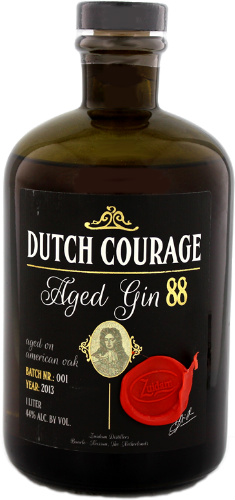
Dutch Courage Aged Gin 88Color: Citrus gold.

Nose: A very appetizing smell. Lot’s of citrus. Sweet orange skins and other citrus fruit skins, with hints of fresh (not sweet) orange juice. Nice soft Juniper comes next. Not overpowering at all, it is used with taste. Spicy, sweet cinnamon and (toasted) oak. It actually smells like spices used for baking cookies. The slightly sweet profile (It’s not an old Tom, mind you), is enhanced by the vanilla-like notes coming from the American oak. Although it is aged, it hasn’t been ageing for a long time I guess, it doesn’t smell like a very old distillate to me. It has kept it youthfulness, but the ageing did give it an extra layer, making it softer and “rounder”.

Taste: Slightly bitter and definitively sweeter than I expected. Still not an Old Tom though. Heaps of nice (sweetish) citrussy notes. Nice Orange notes, but also some more fresher citrus components. As with the nose, the juniper is present, without overpowering, allowing for great balance. Spicy, the cookie spices are here too, but this time with a shift towards licorice. In the background a vanilla pudding note, which adds to the perception of sweetness (or “roundness”). All that is present in the finish which seems to be built around sugared anise seeds. Nice. Again, Gin, for me, is often not meant for sipping, but just like Hven, it is unbelievably drinkable. Maybe it is a sort of hybrid between Gin and Genever (the granddaddy of Gin, which most of the time is consumed neat).

One day I made two G&T’s, for me and my wife to try. I paired up this Dutch Courage 88 with Indi Tonic and for comparison the well-known Hendrick’s with the also well-known Fever Tree. Although the latter makes for a very good G&T, one easy to enjoy, however, the combination of Indi with Dutch Courage was something else. Softer, excellent bitters, with a lot of aroma’s presented in excellent balance. Definitely a must-have Gin. I’ll have a go at this Gin soon, paired up with some more Tonic’s. Recommended!

For the completists, I also did a head to head with Hven Gin. The Zuidam is more accessible, sweeter and benefitted of oak ageing. The Hven is obviously unaged, but also even softer on the nose, more restrained. The taste initially also shows some sweetness, and for a moment nothing happens, but it doesn’t take long for taste-evolution to take place. These two are actually very nice to try one after the other, like they were meant to be together. Both are excellent sippers. Luckily I don’t have to choose between them, because both are worthy in any liquor cabinet. My advise, buy the biggest bottle available, both of them.

Points: 81 (and believe me, that is quite a lot of points for a Gin by itself).

UPDATE (29-6-2016): I did a H2H2H with Hven, Hendrick’s and this Zuidam. First of all the Hendrick’s is the one best behaved. It’s nice and friendly and definitely the subtlest. You can’t go wrong with it and it a worthy sipper. The Hven is sweeter and a bit bolder. Bigger if you want, but also somewhat simpler. Another good sipper. This Zuidam however is something exceptional. It is big and dirty. Tasting the three side-by-side, this one seems to have some goût de pétrole you get in good Rieslings. Less typical Gin I guess, but very special nevertheless. For me a must-have.
Angels Envy “Port Cask Finished” (43.3%, Batch #113)

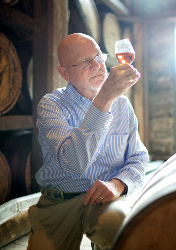
The Story of Angel’s Envy is, in part, also the story of Lincoln Henderson, whose signature is conveniently placed upon the bottle. Mr. Henderson used to be Master Distiller at Brown-Forman and was in part responsible for creating Woodford Reserve (personally not one of my favorites), and Gentleman Jack, as well as Jack Daniel’s Single Barrel. Since I don’t really like Jack Daniel’s Old No. 7, I never was in a hurry to try the rest. I hope this Angel’s Envy will be more to my liking.

Lincoln HendersonIn 2004 Mr. Henderson retired from Brown-Forman and in 2006, joined his son Wes(ley) and grandson Kyle in their Louisville Distilling Corporation, experimenting with finishing Bourbons in casks that previously held other distillates. The Bourbon itself is said to be made by MPG in Indiana, which is very odd for a Kentucky Bourbon, as stated on the label. The Bourbon is around 4 to 6 years old, obviously first aged in American oak, as all Bourbons are, and finally finished for 3 to 6 months in 225 litre Ruby Port barrels made from french oak. It’s a small batch Whiskey each time made from 8 to 10 barrels only.
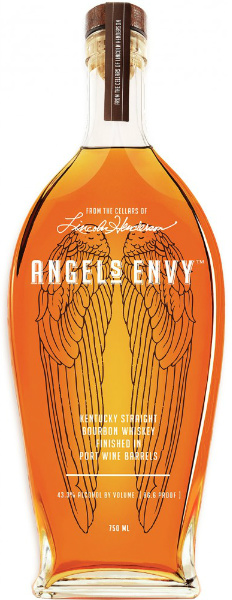
The first Angel’s Envy saw the light of day in 2012. Sadly, Mr. Henderson’s lights went out in September 2013, aged 75, becoming a spirit himself. Angel’s Envy itself, the legacy of Mr. Henderson,  was finally sold off to Bacardi in 2015.  It is said that Mr. Henderson, throughout his career, tasted some 430.000 barrels of Bourbon. Who said Bourbon is bad for you?

Angels Envy PortColor: Light copper gold.

Nose: Chewy sweet Bourbon smell with indeed an added winey note. The finish seems to be done with taste, since in no way does it dominate the profile. If tasted blind you’d still call this a “normal” Bourbon. The Bourbon part reminds me a bit of Four Roses actually, (the low rye mashbill). Nice, soft and creamy. Some worn saddle leather combined with the smell of a cold cob of corn, Give it some more time to breathe and the finish becomes more apparent as well as a different kind of oak. Honey and an appetizing fresh leafy note. I’m amazed at the wonderful balance achieved. Lovely stuff to nose.

Taste: Aiii, a bit to sweet and thin on entry. A short flash of fresh oak, with milk chocolate and honey, quickly followed by red fruit aroma. The oak returns for a moment delivering a nice balancing bitterness, Nice jammy note as well. Creamy vanilla. Again the Port finish has been done with taste and works extremely well. It is a Bourbon, but in part it has a “new” edge to it. The Finish is of medium length at best, but if you have a moment to spare you can wait for the aftertaste which leaves a nice creamy mixture of honey, and vanilla with again some hidden elements of the Port. As was the entry, the finish is a bit too sweet as well. Nevertheless, a job well done, even when reduced too much.

Probably made for a hip market, and not to scare to many people off, it has been reduced to 43.3% ABV, At this strength the Bourbon is also dangerously drinkable, which in my case would mean the bottle would be finished sooner than later. As I am based in Europe, prices here are much steeper than across the big pond. I understand the US pricing of this, but over here for such a drinkable Bourbon I find it too expensive. Pricing aside, this may look as a designer Bourbon, and it probably is, but it still carries a lot of quality and good taste from the makers. There is also a (Plantation) Rum finish, Rye with a Rum finish, as well as a cask strength edition, also finished in Port barrels. Depending on availability, these seem to be extremely expensive.

Points: 83

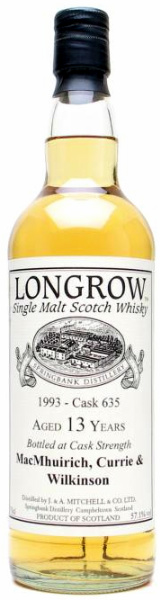
Longrow 13yo 1993/2006 (57.1%, OB, Private Bottling, for MacMhuirich, Currie & Wilkinson, Cask #635)

This is a sample I have lying around for a very long time. I last tasted it last some ten years ago, and there was definitely something wrong with this. Just have a look at the review posted by Serge. yes, he’s a big fan of this one! Ten years ago I found it pretty odd as well, but come to think of it, Springbank make such good Whisky, what must have happened for it to be so “strange”, and for it to be bottled? Today I’m becoming more and more a fan of Springbank, feeling they can’t do anything wrong. In these days of NAS (some bad, some good), Springbank are able to churn out one good bottling after another. NAS or no NAS. So this less than half full sample got plenty of time to balance itself out with some air, so let’s see how this private cask of MacMhuirich, Currie & Wilkinson will do in 2016. Sounds like a law firm, doesn’t it?

Longrow 1993 Private Bottling Cask #635Color: Light gold.

Nose: Light peat, but not much and some burning plastic. Herbal lemon. Deeper down a more buttery note. Fatty with hidden sweetness. Slightly burnt wood (toasted cask), fresh dried oak and an acidic off-note. Bread, butter, paper, cardboard (they all go together) and caramel. Toffee even. Next some crushed beetle. In my case an accident, because I’m not cruel to animals, but once I’ve gained the experience, I’ll never forget the smell. Well, it’s in this Whisky. (Tobacco) smoke and cold charcoal. Hints of menthol. It is a nose that wants to be dry and spicy, not fruity. It’s not floral, but may very well have been. Add to that a creamy, butter and toffee and you have this in a nutshell. Very well hidden is the aroma of new make spirit, a sweetish Vodka aroma. Sure, this is (still) lacking in balance a bit, but it’s not as bad as it was ten years ago. It did get better with “some” air. I actually like how it smells now.

Taste: Sweet, but with a lot of bread and paper notes. Floral plastics and vegetal. The initial sweetness works well with the relatively high ABV. Sweet sugared yellow fruits. Sugared apricots. the body itself is not so sweet. Interesting. Damn, this is really about vegetal paper. Paper, cardboard, wet paper, pulp. It’s hard to impossible to get past this. The paper notes overwhelm the entry and the better part of the body. When this dissipates, an acidic note shows itself which just is wrong. Towards the end of the body, the Whisky also becomes slightly soapy. Yeah, lets add to the plastic pleasure. Hey, now I get some smoked eel skin as well as the aroma of an ash-tray and sweet jasmine powder. What a Whisky. This has quite a few flaws, so maybe it’s good the finish is not very long (and hardly an aftertaste).

If after Serge’s review (and mine) you still want to buy it, be advised that you should let this breathe extensively. And I do mean extensively this time. It will help the nose along, the taste however is beyond repair. I wonder what went wrong here. It probably wasn’t the spirit going into the cask, but was the cask somehow contaminated? Rotting bung cloth? A fungus maybe? In the end not a complete dud, so I won’t be scoring this 55 Points like Serge, but for a Longrow this is not a good score either…

Points: 80

Punch Royal Selection No.12

Punch LogoPunch is next. Punch is Cuban Cigar brand, but as with many Cuban brands, also exists outside of Cuba. You know all about families fleeing the country and selling the rights abroad, and the Cuban government seizing the Fabricas and continuing production. The “other” Punch is made in Honduras.

Punch was founded by German born Mr. Stockmann and named it after a character from a puppet show. Don’t you just love the names for Cuban Cigars? The third owner of the brand was Manuel López Fernández, and it is his name that still is mentioned on the boxes. The Cigar I’m about to review is from before 2005, a time this Cigar was released without a band. Since 2005 is does have a band, like in the picture below. In 2010 the Cigar was discontinued. There is a finite amount of excellent tobacco, and other sizes, with larger ring gauges, are more popular these days, so they use the tobacco for that. Today it has to be at least ø50, so no use making and (not) selling something that is a mere ø42…

Punch Royal Selection No.12

Punch Royal Selection No.12 (42 x 129mm, Marevas, Petit Corona, Box code unknown)

Color & Looks: Colorado with small veins. It has some small black spots and some green discoloration. Nothing major. Straight build and feels somewhat flexible. Cuts nicely.

A cru: Nice leather and wood. A deep smell with all kinds of dry leaves. After the cut, quite fresh and mild smelling.

Taste: Starts good, good draw and smoke. Unique spiciness combined with wonderful woody aroma’s with some distinct woody bitterness. Works well with mild coffee. Although overall very mild and soothing, there is a slight chemical edge to it, that stays behind in the back of my throat. After just a few cm’s it seems to be a bit stronger than the mild start. It’s still not a Bolívar, so no worries. The wrapper produces light gray ashes, the filler turns into a darker shade of gray, but also some white and pitch-black ash can be found deep in the heart of the Cigar. A bit of a mess actually. The ash is not firm since it falls off quite easily.

A big part of the taste does remind me of dry Dutch Cigars’ Sumatra tobacco. This definitely is a cigar that has been lying around for a long time. As I said above, this one works well with coffee, but it doesn’t like water as an accompaniment, turning it acidic. Going along, the creamy bit increases. This one doesn’t seem to be tightly rolled, but nevertheless stays firm all the way, even when warming up. Incredible amount of smoke. It may not be a very strong smoke, but the taste is a bit harsh and not completely inviting. I’m doing my best to smoke this slowly, not to let it get too hot. Not a lot of development and most definitely not my favorite Cigar. For me not something I would smoke by itself, it needs some kind of accompaniment. The was quite a bit left when the Cigar turned, so not something you smoke untill you burn your fingers or your lips. Dry and woody throughout and definitely after dinner.

Marevas is a great size, maybe a bit thin for todays taste, but it still is a Cigar, you still are holding something in your hand, without it being tiny like a cigarette. It is most definitely thinner than a Robusto. This would seem a good one when you don’t have a lot of time on your hand. Not so. An older Royal Selection No.12 tends to be woody and harsh. It has to be smoked slowly, because when this gets hot, it is overly woody and even gets bitter. More recent examples, lets say from 2008 and later, are more creamy and definitely milder.

Points: 76

Millstone 12yo “Sherry Cask” (46%, OB)

Non Scottish Single Malts a.k.a. world Whiskies are taking over the…uhhh…world. Sure, Scottish Single Malts are still in high demand, especially in countries that are fairly new to them. They are embracing them with much love, as long as the local government permits them to. However, there isn’t enough well aged Whisky to go around the world. Thus, opportunity knocks for the rest of the world to step up their game. Add to that the growing interest of local products and you know where this is heading. Some countries already had a prosperous Single Malt culture, but were ahead of their time, and almost didn’t manage to stay afloat for the current boom. Just look at the history of Irish and New Zealand Whisky to name but a few.Luckily most of them have survived and see a bright future ahead. Then there is a second group. Whisky from countries that didn’t have a blooming local Whisky culture, like Sweden and The Netherlands, again to name but a few, because there are many, many others. I already reviewed a Rye Whiskey from Millstone (Zuidam) from the Netherlands and this time we’ll have a look at a proper Single Malt Whisky. I still have an old expression with the cream label. As far as I know there were two small batches of this, one made up from only two casks, and one made up with three. I only don’t know which of the two I have here…

Millstone Sherry Cask 12yoColor: Orange brown.

Nose: Sherried, definitely Oloroso, but quite dry and elegant as well. Spicy with nice wood, but also some honey sweetness. Wonderful fresh (and slightly soapy) fruity acidity. Good spirit in good casks. I also get some licorice, quite surprising for a Dutch malt. Creamy vanilla, maybe from American oak. Towards the end some nice red fruit notes appear as well as some lavas. Nice development.

Taste: Very creamy but less integrated than the nose suggested. Some light raisins and warming. Almonds and a bigger nutty aroma altogether. The Sherry cask bestows even a winey note to the Whisky. On entry, the cream has a sweet edge to it, although the wood and the Sherry quickly overpower it with a nice and spicy dryness, never to let the sweetness take over again. I’m guessing Oloroso again, but probably a high quality one. A two-faced Malt. Towards the finish a medium kind of bitterness emerges, but in a soft way. It like chewing on a pencil. The finish itself is of medium length. In the aftertaste a slight burnt note, with even a hint of tar.

A Whisky which is great already and still shows lots of potential and is definitely something The Netherlands should be proud of. Kudo’s for Patrick and the Van Zuidam family.

Points: 84

Bunnahabhain 8yo (43%, Gordon & MacPhail, The MacPhail’s Collection, Refill Sherry Butts, Heavily Peated)

Let’s continue with a Margadale. You might have never heard of Margadale, but that is how the heavily peated Bunnahabhain spirit is actually called. Margadale has a peating level between 35 and 40 ppm. Bunnahabhain means “mouth of the river”, now guess the name of the river itself… I would have liked it if they really would have called it Margadale, just like Tobermory and Ledaig. Now, the peated spirit Bunnahabhain produces is called Margadale, but when the spirit becomes Whisky, the bottled peated Bunnahabhain is called Moine. That’s probably a name you have encountered before. Only Berry Brothers & Rudd have once bottled a peated Bunnahabhain with a mention of Margadale. Bunnahabhain used to be an (almost) unpeated Islay Whisky, even the water used didn’t ever flow over peated land, but when the going got tough, aided by some changes in ownership, they started to make peated Whisky as well…

Bunnahabhain 8yo The MacPhails CollectionColor: Straw, light gold.

Nose: Fatty and buttery. Nice Islay peat. Sea breeze, salty and warming, but also with a soft quality to it. Peat, smoke, crushed beetle and tar. Burning newspaper. Hidden sweetness and florality. Effective and typical. Everything is there, but nothing is overpowering the rest. I would say elegant, as far as heavily peated Whiskies can be called elegant. Nice citrussy note, giving some freshness on top of the peat, smoke, tar and saltness. The floral and fruity notes are deeper and heavier and lie more on the bottom, or in the depth of the nose. Balanced and fine. With some more air it dumbs down a bit. Hints of (burning) paper (again), and the fruits come more to the fore. Dried apricots and white grape. Here you can see how the Sherry casks worked. It adds fruit and a nice woody spiciness. It somehow lacks the obvious vanilla you get from American oak Bourbon casks, although most Sherry casks these days are made with American oak as well. Sometimes you could guess its relative youth, but on the other hand, this shows enough complexity to be considered and older Whisky. Good ‘un. Nice distillate.

Taste: Right from the start we get some separation. The aroma’s aren’t very well-integrated. Interesting. Starts off with smoked salt and creamy butter and a nice White Wine acidity. Fatty peat, very fatty and buttery indeed. Licorice, sweet wood and honey sweetness. Sweetness there is, but not your regular white sugar sweetness. Yes runny thin honey it is. All the way through it keeps not integrating well. The acidity is displaced and hangs around too long in the back of my mouth, and the sweetness is trying to get too much to say underneath. Not sure this Sherry is a perfect match for the peated spirit. The more it breathes, the more it actually develops in the wrong way.

Nice stuff at 43% ABV. Sure, in times it is a bit thin, but I have no problem with the reduction. It makes this Islay Whisky very accessible. Don’t let it breathe though. It allows the acidity to develop and hold it hostage. The wood makes the Whisky, but in this case the wood broke the Whisky. It’s not terrible, but especially in the details this Whisky fails a bit.

Points: 80

Gardel 1992/2003 (42%, Fassbind, The Secret Treasures, Barrels #4, #8 & #121, 1401 bottles, Guadeloupe)

We are going to visit Guadeloupe again! This time I have more room for some geography, since the previous review was already a bit long as it is. Guadeloupe lies in the Lesser Antilles in the Caribbean. Guadeloupe is not one island. What usually is considered to be the main island is in fact two islands with a narrow strait in between. Grande-Terre in the east and Basse-Terre in the west. To the south lies Marie Galante. There are more islands to Guadeloupe, but those don’t have Rum distilleries on them. From Guadeloupe comes this Rum I’m about to review. What else could it be? The Rum was made by Gardel, which was founded in 1870 by “General Sucriere”. After working for almost 130 years the distillery is now closed, but the Gardel sugar company still exists. The sugar factory is the sole remaining sugar factory on Grande-Terre, and still one of the largest in the world. Depending on the harvest, it crushes around 500.000 tonnes of sugar cane, produces 50.000 tonnes of sugar and 25.000 tonnes of molasses per annum.

GuadeloupeThis Rum is from 1992, the same year the column still was supposedly exchanged for a pot still. As far as I know, Gardel never bottled Rums themselves, but Gardel was bottled by numerous independent bottlers, although I don’t think a lot of Gardel is still around, so If you like Rhum Agricole and if you like Gardel, be quick. This particular Gardel was bottled by Swiss distiller and spirit importer Fassbind. We already know them from the Linkwood I reviewed earlier. I have seen quite some Rums from them, but most of them have been bottled in 2003. The most recent bottling of Whisky was from 2007, so I don’t believe they are active anymore, although The Secret Treasures bottlings are still not extremely difficult to find. Just like Plantation and many bottlings of Rum Nation, this series was never really expensive, so lets see if this is a hidden gem.

Secret Treasures Guadeloupe 1992Color: Copper brown.

Nose: Very nice and aromatic. I love how this smells. Big, and very fruity. Banana and wax. Lots of heavy esters. Black tea. Leafy and green. Easily recognizable as a sugar cane distillate. Hints of burnt wood and burnt caramel. Sweet tea, flint and gunpowder. Fireworks. New wood, and overripe fruit. Papaya and passion fruit. Creamy vanilla pudding. Very appetizing and very complex. There is a lot happening here. Biscuits and to a lesser extent, fresh cookie dough. Sugared orange skins. Well balanced with lots of complexity.

Taste: Starts with diluted (ear) wax, but is less bitter than that. The bitterness is more of the sappy wood kind. Don’t be worried, the bitterness is quite faint. Some toffee and vanilla, but the Rum still is dry. I guess, If you don’t know the stuff you might not like it at first. Funky toffee, with an acidic touch, intertwined with banana. Warming. Much drier than the nose suggested. Thinner yet chewy. You always get something exciting from a sugar cane distillate. Different and special, although simpler than the nose. Hints of plastic in the finish. Maybe this should have been bottled at a higher ABV? We’ll never know.

Sure it has its faults. The taste is not all that well-integrated. You get several layers of aroma’s and not every layer fits on top of the other nor does it pass on the baton that well either. It even has notes of plastic in the finish, and the finish itself isn’t one of great length. You hardly can say it has a noticeable aftertaste. So this is not so good then? Nope, au contraire, I would say. The nose is really very special. Sure, it lacks a bit in the taste department, but it is also a distillate that puts a spell on you. Hard to put my finger on it, but it is mesmerizing and wonderful. I guess when on Guadeloupe it would be next to impossible to leave this stuff alone. This is particularly a very typical example of a cane juice distillate and definitely is not for everybody. I urge you to develop your palate, because when you get it, this is secretly wonderful (yet faulty).

Rum is a very diverse product. Most of us know Rum to be a molasses based sweet distillate, and like it. After a while you might encounter a Rhum Agricole, which can be quite a challenge. I often hear of people disliking Rhum Agricole at first, but warming up to it a while later (probably a few years, actually). Not an easy distillate, but when you get into it, you might be hooked for good. Rhum Agriciole or maybe I should say, Rum made from sugar cane juice in general, is something different.

Points: 85

Bellevue 15yo 1998/2014 (52.6%, Isla del Ron, IdR 011, 169 bottles, Guadeloupe)

The market for good Rum is on the rise, especially in markets where Single Malt Whisky is king. In the last couple of years the run on good Whisky was bigger than life, depleting the stocks considerably. Today we face not a shortage as such, but a shortage in older matured Whiskies. In part because there isn’t any, in part because it is simply not bottled because one can fetch a better price later on down the road. Hence we see an ever-growing number of Whiskies without an age statement and with a funky little name. Nothing bad here, but putting two and two together, the Whiskies must be younger and younger to be able to keep the new bottlings coming for a hungry (read: thirsty) public.

Whisky people in general are not happy with the youth of their Whiskies, nor are they happy with the development of prices of their beloved aged Whiskies. Just look at Highland Park 18yo, Talisker 18yo and Laphroaig 18yo, producers simply don’t have the time anymore to wait that long and subsequently sell it for a not so super-premium price. It’s not all romance you know, it still is a business. Happy times for Whisky producers in warm climate countries such as Taiwan and India, where very good Whisky is made today in much less time than in Scotland and the other traditional Whisky countries.

In comes Rum. Whisky people are open to trying other distillates that are nice and/or aged, and/or affordable. One of those alternatives for Whisky is Rum. Guadeloupe Sainte Anne Grande-TerreThe old Rum community is enriched with Whisky people fishing in the pond of Rum and getting to know the product and a different kind of romanticism. Where Scotland is beautiful, but also cold and wet, Rum predominantly comes for the Caribbean and especially the image of paradise islands comes to mind. Older Rums are becoming scarce very quickly and just like Whisky, will become almost extinct, Prices are on the rise as well. Where have we seen this before?

Lots of independent bottlers of fine Single Malt Whisky are turning to Rum. Some did that many, many years ago, Like Cadenhead and Berry Brothers & Rudd, and some more recently like Wilson & Morgan (Rum Nation), Kintra and David Stirks outfit Exclusive Malts, but there are many more. Today we’ll have a look at another one. Isla del Ron is the Rum brand of Thomas Ewers’ outfit, Malts of Scotland.

Thomas EwersThomas bottled a Rum from Guadeloupe from a distillery nobody has heard of, South Pacific (as stated on the label), not to be confused with the South Pacific distillery of Fiji, which is entirely different place altogether. Thomas explained to me he was offered a cask of South Pacific, which turned out to be Bellevue instead, so in this case the label is wrong. Casks like this are sold to bottlers through brokers, so it’s not a surprise there are a lot more Bellevue casks from 1998 bottled by different parties. And with brokers there lies a problem. Brokers only want to sell on casks, not really caring informing the buying party what really is in the cask if they have the information at all.

Thomas believes this to be from the Bellevue distillery on Marie Galante Island, but looking at information of many other “Bellevue’s” from 1998, it can also be Damoiseau’s Bellevue Distillery (Le Moule, Grande-Terre), which would be even more probable, since it is a larger producer. So we’re not sure about the exact distillery, nor can we be about the ingredients. It can be either distilled from molasses or from sugar cane juice. It can even be a blend of both, since some distilleries produce both. Sugar cane when it is harvested, and molasses the rest of the year. Questions, questions.

Isla del Ron GuadeloupeColor: Orange brown.

Nose: Big aroma, lots of different spices. It’s like a spice mix from Indian Whisky. Vanilla, chewy. Dry, spicy and fatty but not sweet. Hint of sweet peppermint. Butter and coffee with milk. Mocha and hot butter as well. Cinnamon, cocoa powder, leather and hints of soft wood. Damp earth and after that rather dusty. Hints of licorice mixed with a nice dry and clean woody note and slightly burned sugar, molten plastic (don’t worry) and creamy banana. Very well-balanced and a nose of great complexity. Especially when the heavier elements are snorted out of the glass, the fun starts. Wow!

Taste: Starts out with a short, sweet and aromatic burst, but quickly becomes dry and very aromatic, with again the Indian spice-mix so predominant in the nose. Nutmeg and lavas, but there is a whole lot more. When it goes down the hatch it becomes even drier. The lighter elements start to evaporate in my mouth and engulfs it with lots of beautiful aroma’s. Milk chocolate, dry leather and a slight bitter edge of wood. Hints of licorice, tar and charred oak. Hot chocolate. After getting used to the spicy dryness, it becomes creamy hot chocolate style. Lovely development as well, especially since the aftertaste is stronger than the finish. Wow, what an amazing Rum!

I like the bottle used for Isla del Ron, it’s the same bottle used for Pusser’s 15yo, HSE from Martinique and last but not least, for Bruichladdich and Port Charlotte. I only have a beef with the label, its dark, dull and depressing. Rum comes from places where life is colorful. I hope Thomas will continue to bottle a lot more Rum’s, but I hope he’ll spice up the looks a bit!

In the end, after I tasted this in the shop, I needed a whole 10 seconds to snatch one up. This stuff makes me happy!

Points: 88

Thanks go out to Rik for the sample.

Tobermory 1995/2006 (55.6%, Berry Brothers & Rudd, Cask #744)

The last Tobermory I reviewed was one of the stellar 32yo’s that have quite a reputation. How to follow-up on one of those? Today we’ll be looking at and independently bottled Tobermory. The bottler being Berry Brothers & Rudd and the year of distillation 1995. Tobermory has a rocky past and for a while even was converted into a power station. The reputation of the distillate was even shakier. In the past this stuff could really be hit or miss, so not something you would buy untasted. It could be really bad and funky, strange even. On the other hand, if it was good it could be really good, surpassing most other Whiskies, so the potential is there. Today that reputation is different. Tobermory and Ledaig are getting better by the year, and every new release is something that interests me a lot. Still no easy Malt, but if you get it, you’ll get it. In the day where everything starts to taste a bit similar and official bottlings are becoming younger and NAS-ser, an independently bottled Tobermory or Ledaig could very well be your best choice. At least it often is different from the rest. What more could you want these days?

Tobermory 744Color: White wine.

Nose: Heaps of barley. Damp hay. Citrussy fresh. Lowland style. Lemon grass, lemon curd, all kinds of sweet lemon, without being overly present and thus overly acidic. Hints of new-made spirit even. Old vanilla. Very light. Hints of a salty sea breeze. Very light peat as well. Smells chewy. Sappy, spicy, fragrant and vegetal wood in the background. Garden bonfire, burning off some dry grass. The initial barley note wears out, for a more coherent smell. I’m not sure if this is perfectly made Whisky, but after I got used to the Bladnoch 8yo I reviewed earlier, I seem to like this one as well. Just like the Bladnoch, this profile grows on me.

Taste: Very sweet entry. Sugary sweet. Sweet barley. Most definitely some hints of Grappa. Toffee, but also a sharper and drier element. All sorts of lemon again, combined with toffee and some dry wood. Otherwise not very fruity. A plethora of different dry grasses. Fatty and hints of cold dish water you forgot. Faint soapyness, like the paper wrapper that came off a bar of soap years ago.

Excellent entry and body, aided by this very typical profile. Nice stuff. The finish is not so strong and concentrates around two or three distinct markers from the body. Slightly soapy barley, wood and paper. As well as a tiny bitter note. The sweetness is gone, although hints of toffee reappear in the aftertaste.

Not a very easy Malt, but definitely one you would like to try, since it is different from many other malts. Quite the learning experience, because it’s almost like an unpeated, peated Malt. It’s how a peated Malt could be underneath. Although this is also no Lowlander, it is nice to have since it has a second face as a Lowlander. True Lowlanders like Rosebank and others are becoming more and more scarce and expensive. Besides this Tobermory, I hope for a bright future for Bladnoch as well, but if not, try something like this before the profile becomes extinct.

Points: 85

Ardbeg 10yo “Ten” (46%, OB, 2012)

Earlier we had another Ardbeg 10yo, but that one was bottled by independent bottler, Cadenhead. Here we have an official 10yo bottled by the distillery itself. I wonder which one will be best. More than “ten” years ago I had another official “ten” on my lectern, and I liked that one very much. Rumour has it however, that the current “ten”, or those of the last few years, are significantly different. More sweet and accessible and less oomph, just like the road taken by Laphroaig. Together with Lagavulin, those were always the heavy hitters from the south shore of Islay. Today it’s Bruichladdich (once unpeated), that makes the peatiest of Whiskies on Islay with Port Charlotte and the Octomore monster.

Ardbeg TenColor: White Wine.

Nose: Well peat first, but is seems to me a very accessible, creamy and fresh, almost citrussy peat. No big oomph, but almost elegant peat. It behaves like a good kid. Reliable. It smells like a very luxury Ardbeg now, since it also has some lovely floral notes with well hidden sweet barley. Wet earth, nice smoke, yet no real barley nor wood. Only of you really want it, you can detect some soft wood. Smelling this for a while, it still does remind me of an Ardbeg, so it hasn’t lost its identity (yet), and I hope it never will.

Taste: It really is the sweetness that first hits you. No crisp dry peaty and smoky dram. It’s peat lemonade. First impression. Yup, in business to sell a brand, and to win over lots of people you don’t want to scare away. Yeah, wonderful. Another sip. I want to taste what comes after the sweetness, but it is so distracting. Lets try again. Sweet yes, we’ve covered that, but what else. Toffee, citrus freshness, lemon curd and vanilla pudding. Almonds, fresh and lightly roasted. Luckily the acidity is just right for this profile. Nutty, yes, but not a lot. What else? This fruity peat, not waxy. It starts sweet, so it takes some time to get the rest, but also the body as not that long, nor is the finish. It does have a warming and likeable aftertaste. A bit thin but fruity nevertheless. Only in the aftertaste I recognize to Ardbeg form not so long ago.

From the smell alone, this is not the Ardbeg 10yo, or “Ten” as it’s officially called, I remember from ten years ago. I don’t think my palate has gone to ruins, because I can still recognize heavy hitting drams that are out there, but this Ardbeg isn’t one of them anymore. But it’s not Ardbeg alone. All the big boys from the past seem to have less oomph these days. Don’t get me started on Laphroaig for that matter. Laphroaig today has nothing to do with the Laphroaig that got me into peated single malt Whisky in the first place. The export strength “10yo” and the “Cask Strength” (green stripe). Those days seem to be gone for good.

So I already feel lots of protests, as if I’m disliking this classic Ardbeg 10yo. That’s not true. This is still very likeable, and still a good dram. If you like your peat but you’re not into heavy peat, than this is for you. It shows quality, and worth your money. It isn’t all that expensive. Good dram.

The problem here is that I know, and have, older bottlings of the Ardbeg “Ten”, so for me comparison in inevitable, and going down that road, well, there is no other conclusion. It has changed a lot. It used to be a crisp, dry and clean heavily peated malt, almost a real young masterpiece, nicely battling it out on the store shelves with Laphroaig 10yo, which had a much longer history. Both having avid fans defending it with their lives. Not me, I loved them both, just like The Beatles and the Stones. This Ardbeg is not that Ardbeg anymore, but today’s Laphroaig most certainly isn’t that Laphroaig anymore too, just like The Stones really. I kid you, but the real problem is that I can’t come up with a real alternative if you want the old heavily peated Ardbeg or Laphroaig back, so I have really high hopes for the new 8yo Lagavulin!

Points: 84