Let’s continue with a Margadale. You might have never heard of Margadale, but that is how the heavily peated Bunnahabhain spirit is actually called. Margadale has a peating level between 35 and 40 ppm. Bunnahabhain means “mouth of the river”, now guess the name of the river itself… I would have liked it if they really would have called it Margadale, just like Tobermory and Ledaig. Now, the peated spirit Bunnahabhain produces is called Margadale, but when the spirit becomes Whisky, the bottled peated Bunnahabhain is called Moine. That’s probably a name you have encountered before. Only Berry Brothers & Rudd have once bottled a peated Bunnahabhain with a mention of Margadale. Bunnahabhain used to be an (almost) unpeated Islay Whisky, even the water used didn’t ever flow over peated land, but when the going got tough, aided by some changes in ownership, they started to make peated Whisky as well…
 Color: Straw, light gold.
Nose: Fatty and buttery. Nice Islay peat. Sea breeze, salty and warming, but also with a soft quality to it. Peat, smoke, crushed beetle and tar. Burning newspaper. Hidden sweetness and florality. Effective and typical. Everything is there, but nothing is overpowering the rest. I would say elegant, as far as heavily peated Whiskies can be called elegant. Nice citrussy note, giving some freshness on top of the peat, smoke, tar and saltness. The floral and fruity notes are deeper and heavier and lie more on the bottom, or in the depth of the nose. Balanced and fine. With some more air it dumbs down a bit. Hints of (burning) paper (again), and the fruits come more to the fore. Dried apricots and white grape. Here you can see how the Sherry casks worked. It adds fruit and a nice woody spiciness. It somehow lacks the obvious vanilla you get from American oak Bourbon casks, although most Sherry casks these days are made with American oak as well. Sometimes you could guess its relative youth, but on the other hand, this shows enough complexity to be considered and older Whisky. Good ‘un. Nice distillate.
Taste: Right from the start we get some separation. The aroma’s aren’t very well-integrated. Interesting. Starts off with smoked salt and creamy butter and a nice White Wine acidity. Fatty peat, very fatty and buttery indeed. Licorice, sweet wood and honey sweetness. Sweetness there is, but not your regular white sugar sweetness. Yes runny thin honey it is. All the way through it keeps not integrating well. The acidity is displaced and hangs around too long in the back of my mouth, and the sweetness is trying to get too much to say underneath. Not sure this Sherry is a perfect match for the peated spirit. The more it breathes, the more it actually develops in the wrong way.
Nice stuff at 43% ABV. Sure, in times it is a bit thin, but I have no problem with the reduction. It makes this Islay Whisky very accessible. Don’t let it breathe though. It allows the acidity to develop and hold it hostage. The wood makes the Whisky, but in this case the wood broke the Whisky. It’s not terrible, but especially in the details this Whisky fails a bit.
Points: 80
 This Rum is from 1992, the same year the column still was supposedly exchanged for a pot still. As far as I know, Gardel never bottled Rums themselves, but Gardel was bottled by numerous independent bottlers, although I don’t think a lot of Gardel is still around, so If you like Rhum Agricole and if you like Gardel, be quick. This particular Gardel was bottled by Swiss distiller and spirit importer
  Color: Copper brown.
 The old Rum community is enriched with Whisky people fishing in the pond of Rum and getting to know the product and a different kind of romanticism. Where Scotland is beautiful, but also cold and wet, Rum predominantly comes for the Caribbean and especially the image of paradise islands comes to mind. Older Rums are becoming scarce very quickly and just like Whisky, will become almost extinct, Prices are on the rise as well. Where have we seen this before?
 Thomas bottled a Rum from Guadeloupe from a distillery nobody has heard of, South Pacific (as stated on the label), not to be confused with the South Pacific distillery of Fiji, which is entirely different place altogether. Thomas explained to me he was offered a cask of South Pacific, which turned out to be Bellevue instead, so in this case the label is wrong. Casks like this are sold to bottlers through brokers, so it’s not a surprise there are a lot more Bellevue casks from 1998 bottled by different parties. And with brokers there lies a problem. Brokers only want to sell on casks, not really caring informing the buying party what really is in the cask if they have the information at all.
 Color: Orange brown.
 Color: White wine.
 Color: White Wine.
 Ahhh, finally a Bolívar. This is a first one on these pages. Bolívar isn’t a big global brand for Habanos, but it is available in a lot of markets nevertheless. Not a big brand, but it has a specific and fanatical following under seasoned Cigar smokers. Bolívar is known for heavy and strong Cigars.
 Post number 600, so lets break out something special. Special for me is Brora. Sure Port Ellen, Ardbeg, Lagavulin, they all are Cohiba’s, but Brora is Trinidad. Brora is extra special (to me). 600 is a round number but it’s not 1.000, 10.000 or even a million. It’s 600, so I won’t be reviewing a 1972 Brora, which for me is the pinnacle of them all. The
 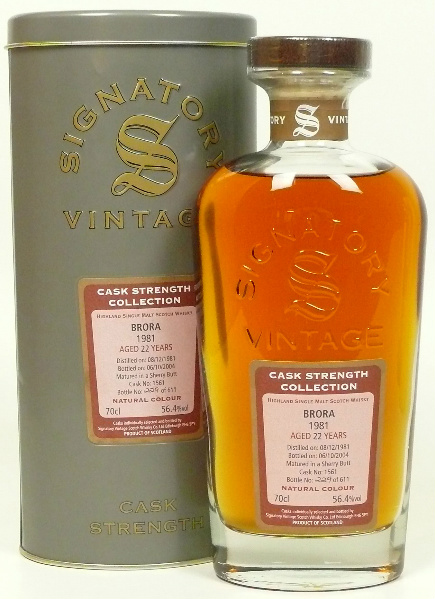 Color: Copper gold.
 Color: Copper gold.
 Color: Straw.
 The year 2015 passed, without even one Cigar review. How is that possible? Did I quit smoking? No way, but I do have to admit I never started smoking either. Cigarettes are not for me. From the start it was always about Cigars. I smoke for taste I used to say and I never smoked a lot. The place I write from, The Netherlands, is not a tropical country, and I do have to find me a spot for smoking and reviewing Cigars somewhere, since I don’t want to smoke inside the house. As long as I don’t have a place for smoking, I’ll have to wait for some nice weather, and especially time. I need to be left alone with my Cigar for as long as it takes, and that is maybe the real problem here.

