 I did some rummaging in my boxes with samples and found another Glen Grant. Well I actually found several of them, but I just chose this one. You know Glen Grant, the place that was the first distillery that was illuminated without burning fuel by themselves. This time we have a Glen Grant bottled in the Old Malt Cask series by Douglas Laing. Again in the new tall bottle, just like the Glenfarclas and the Port Ellen reviewed earlier. We know that there are some stellar Glen Grants issued by Gordon & MacPhail. Yesterday we had a Berry Brothers & Rudd version from 1972 that didn’t impress me very much, lets see if Douglas Laing bottled a better Glen Grant. This time from 1975.
 Color: (Light) gold.
Nose: This is sweet and fruity, apples and warm apple sauce, a profile that suits 70’s Glen Grants and Caperdonich’s. The next whiff was less balanced and shows some mustiness. Almost herbal, as in herbs that were in water too long. It still smells sweet and musty with some hints of cigarette smoke. Seems strange but isn’t bad. Another very strange smell that reminds me of the acid and estery smell of crushed beetles (not Beatles, have you never stepped on a beetle, when you were a kid?). There was definitively something wrong when distilling this, drunken maltman maybe? After some time some spicy wood comes through the sweet and sour sauce and even later hot butter. All in all it’s not thát horrible as it may read. But on the nose definitively not one of their best casks.
Taste: Sweet and sour again and little wood and ash. Very strange sensation in the back of my mouth when swallowing. Minty apple gravy? (if that makes sense?). It an experience this malt is (Yoda intended). It starts thin and volatile when this enters my mouth, and quickly becomes ‘thicker’, with an attack like pepper from Talisker, and turns into pineapple! The finish picks the wood up again, combines it with spice (pepper), almonds and a kind of sour bitterness from the wood itself.
This is one to remember, and is right behind the Signatory Teaninich that seemed to be carbonated.
A Glen Grant that is obviously flawed and seems much younger than it actually is, but the strange bits were indeed an experience, I wouldn’t want to miss. Luckily though, I bought only a 3 cl sample of this, because a whole bottle wouldn’t be funny…
Points: 85
 Color: Copper gold.
 Interesting about Benriach is that a lot of experiments were done there during the seventies (and eighties). Tests with peat, new oak etc. Lot’s of those experiments are released today.
 Enjoyable, recommendable and very fruity. It could have gained triple A status if it would have some added bits that would counterpart the fruit. It is good/great, but lacks some complexity you would have expected of such an old malt.
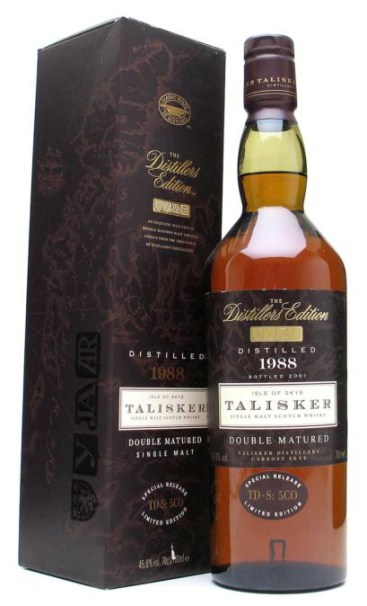 We’re on a roll with those Taliskers, so why not continue the saga with another one. Maybe this less recent Distillers Edition? The Distillers Editions are finished expressions of the ‘normal’ Classic Malt line and was introduced in 1997. Then Cragganmore (Ruby Port), Dalwhinnie (Oloroso Sherry), Glenkinchie (Amontillado Sherry), Lagavulin (Pedro Ximinez Sherry), Oban (Montilla Fino Sherry) and Talisker (Amoroso Sherry) got treated to a happy marriage with a Sherry or Port. All said to be complements to the original style of the distillery, not overpowering it. Due to the success of the new range, expansion was to be expected. In 2006 a Distillers Edition of Caol Ila (already in european oak!) finished in Moscatel and Clynelish finished in Oloroso Sherry was issued. And last but not least in 2008 Royal Lochnagar finished in Muscat was issued. We’ll probably see more expressions released in the near future.
 It’s not mere months the whisky was finished, but probably longer if not a few years. The oak is in the same spot where normally the pepper attack would be. I for one can’t detect the pepper anymore in this, and that’s a bit of a shame. Thick round body with a floral touch, violets maybe. I know that added caramel rounds out a body, but it seems to me the Amoroso does that trick here. Compared to the 10yo, this is more…ehhh round. All the extremes are toned down. Chewy and sweeter than the usual 10yo. Just a tad less balance in the finish.
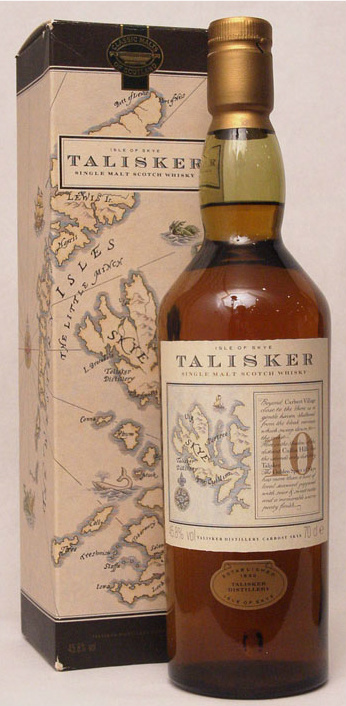 For those of you who have read my
  This profile is great and if you want this, you’ll have to pay some serious cash to buy yourself an old Islay whisky or even Brora. I know, an older expression of the standard 10yo Talisker is getting more pricey lately, but still nowhere near to the prices asked for the aforementioned bottles. Do yourself a favour and get it while you can, and beware, this is dangerously drinkable. This will be empty before you know it. I left myself a 125 ml sample of this, but I almost drank it all writing this! Stay away, just drink milk instead, its good for you, unless you are lactose intolerant I guess.
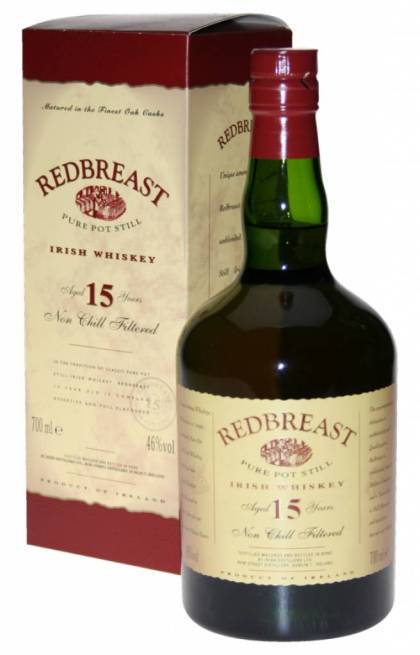 Redbreast ia a triple distilled pure pot-still Irish whisky from the New Middleton distillery from County Cork, owned by Pernod Ricard. This bottle is from a 2005 batch when it was still called “pure”. Due to new rules for whisk(e)y, “pure” was deemed to be a very confusing word, so now it is called a single pot still Irish Whiskey instead.
 Taste: Red fruit and blueberries, blueberry candy. Unique. It’s something we like in 60’s Bowmores (just a 100 times cheaper). Very smooth. Mocha and a hint of caramel or toffee. Some tree sap, and slightly bitter oak, or maybe bitter chocolate. Again, are there some older casks in here? Besides the dark fruits, I guess I am tasting banana and some coconut too. After some oxidation, the woody part is enhanced and the fruityness is a bit more subdued.
 Sadly the Bourbon week is almost over. I had a lot of fun with it and (re)discovered some true gems of American Distilling. I’ll definitively do another Bourbon Week again. So, to close this week off, here is the first edition of the Parker’s Heritage Collection of Heaven Hill. Distilled in 1996 the year of the fire, so we can’t be sure where this is distilled. If it is from before the fire, than it’s from the original distillery in Bardstown. If it is from after the fire it can be sourced from anywhere or even distilled by Heaven Hill distilled in another distillery where they rented time to distill. It’s not from the new plant (the old Bernheim plant in Louisville), since they started to distill there from 2000 onwards.
 Color: Brown
 smells. Also a food-like sourness that seems to be partnered with the gravy and the Hopjes.
 This is one where the word savoring was invented for. Just give this a lot of time, and you’ll thoroughly enjoy this. Just drink this when you have a moment alone for some contemplation. Don’t let it be interrupted by noise or by the feeling you still have to do something. A bedtime dram, when you’re the last one to go to bed. Top, have fun with it!
 In 1987 Jim Beam bought themselves National Distillers, and by doing that, they also acquired Old Grand-Dad. For all the Bourbons that were kept in production, all original recipes were changed to the ‘Jim Beam’ recipe. All but Old Grand-Dad. This recipe survived due to its uniqueness, and is the only other recipe that Jim Beam uses. This Old-Grand-Dad recipe uses a lot more of the, so-called, flavour or small grains i.e. rye and barley.
 Excellent! No wonder that they couldn’t replace this recipe. This is very, very good. At least I like it a lot at this strength. Recommended. I haven’t tasted all of the “Small Batch Collection” yet, but I can’t imagine Jim Beam making anything better than this. Yeah I’m ‘younger public’ now! Another example of the water of life, that preserves youth.
 Now for a whisky from the stables of Jim Beam in Clermont or Boston Kentucky. Yes Jim Beam have two distilleries and use them interchangeably. As you might have read, Jim Beam White is what it all started for me, but that days have gone. No Jim Beam White on my lectern anymore, or is it? Jim Beam is famous, and Jim Beam is famous for using only two recipes, two mash bills for everything, mostly only varying in ageing and proof.
 tiresome in comparison to the
  The ten recipes are called OBSV, OBSK, OBSO, OBSQ, OBSF and OESV, OESK, OESO, OESQ, OESF.
 Now, we have here a Single Barrel (100 Proof), do we know which recipe it is? Yes we do! It’s OBSV (60% Corn mash bill, Rich in Spiciness, Full Body). I’m very curious. I love the concept, and the looks of it. I once had the previous version of the Single Barrel (43% ABV), which I didn’t like too much. Too weak, very light and too floral and girlie for my taste. OK, let’s have a look at this new one and see if its more masculine 😉
 For me this is a work of high quality and more than one step up from the old Single Barrel. It seems to me this is like a sponsored bottle: for the quality you get it’s really dirt cheap, even without the discount I got, so I bought me a case of this. 50%ABV is excellent too. Again kudos, this time for the people at Four Roses. Excellent.
 Master Quill