 Yeah, yeah, I know, this is not a Bourbon. But I did say I would throw in the odd Rye, didn’t I? And why wouldn’t I, since Rye is really America’s first whiskey. What is it precisely? This is a Kentucky Straight Rye Whiskey. Technically a Bourbon is very close to a Rye Whisky.
 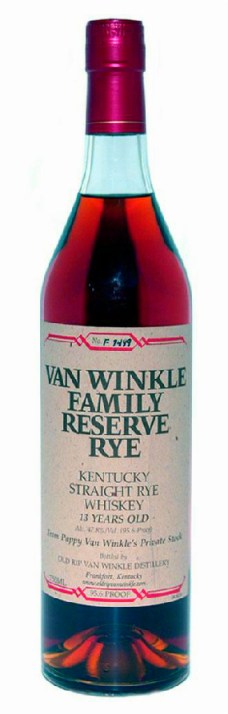 Just a shift in grains in the mash bill. By law its required to be made of a mash of at least 51% rye. The other grains of the mash are usually corn and some malted barley. Rye whiskey is called Straight, when it has been aged for at least two years. Now this 13yo Rye. Well first of all, this isn’t 13yo. Its called 13yo because Julian van Winkle bought the Rye’s in this whisky at 13yo. He nevertheless let the Whiskey age until its 18th year and at that age it was put in stainless steel tanks, to stop its ageing. Where does this come from? Van Winkle isn’t a distillery so they got their whisky from somewhere else. A lot of their Bourbons come form the sadly deceased Stitzel-Weller distillery, but this Rye is supposedly from Medley (Owensboro Kentucky) ánd Cream of Kentucky (Frankfort), and has an unusual high corn content for a straight rye.
Color: Copper
Nose: Fresh. Dusty coconut. Spicy and wood. This could have been a single malt. It’s not the spice from the wood but the spice comes first. Very nice nose, almost luxury. It’s almost like this had some cherry fruityness to it, but that has almost gone. Later on some honey in the nose
Taste: Wow, this is wood in the good way, and glue in the good way. What a fabulous aged Rye! Sometimes a whiff of soap passes by. Rye can give it a very distinct ‘hardness’ to the finished product, but this is about 38% corn. This corn sweetness (Paul McCartney) tames the Rye a bit (John Lennon) and together they create a fabulous harmony, balance, with a perfect bite in the finish.  And that’s not all, the finish also has some honeyed caramel. Honeyed caramel with a bite. What else do you want…
This is an unbelievable fine ‘blend’ of Rye’s. Period.
Points: 88
 For this review I’ll use and oddity of Buffalo Trace, well it’s definitively and oddity for us Europeans. They already bottle a lot of different whiskies that also taste quite different, lot of different mash bills. Here we have a single barrel version of the regular Buffalo Trace. A single cask picked by Binny’s (from the Chicago Bay Area). So the bottle is the same as the regular one, except for an elliptical golden sticker. Issued in 2010.
 ose: Honey, and a lot of it! Even the waxy part is there, honeyed furniture wax. Hints of toasted oak. Fresh sea air and meaty. Like sitting on the porch of your sea-side cabin, and the smell of freshly made meatballs float by. Chocolaty and vaguely spicy. Very balanced. Nothing in this overpowers the rest.
 Yeah this is not bad, not bad at all. This will be no problem to finish, no problem whatsoever. Before finishing this piece, I already poured it four times. Very good standard bottling! Ok,ok, Single Barrel of a standard bottling. A shame really that I don’t have the standard version at hand…
 Here at Master Quill I’ve explored some Scottish Whiskies and I think it’s time to expand a little. There is a lot more out there and I feel it’s time for me to look into what America is capable of. The journey started for me with a Bourbon, as can be read
 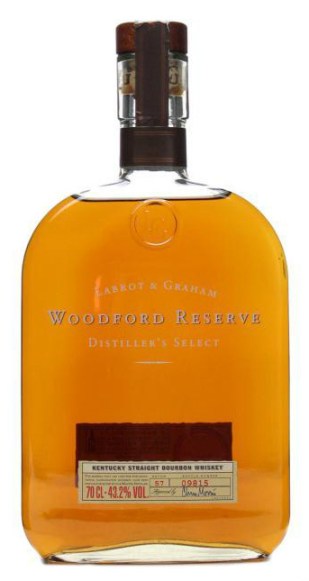 Lets move on to the next candidate. The first Bourbon we will explore is the small batch Kentucky Straight Bourbon Whiskey, Woodford Reserve. This bourbon is made by Brown-Forman, but marketed under the name of the previous owners from long long ago: Labrot & Graham. The Distillery was built near Versailles (Kentucky) in 1812, but distilling activities started as early as 1797. Brown-Forman owned this distillery previously from 1940-1960 and now owns it again from 1996 onwards. The first batches were distilled ‘elsewhere’. Whisky is distilled partly in Scottish Pot Stills and partly from Column Stills from their Early Times plant in Shively (Kentucky). Besides this there are also Woodford versions made for the Kentucky Derby at a slightly higher ABV (45.2%, I don’t know if there are more differences, besides the illustrations on the bottle). There is also a small Masters Collection series and now a new Double Oaked version.
 And even later than that the toast from the cask. This really unwinds slowly. Still its a bit unbalanced, and thin. I would have bottled this at a higher ABV.
 When the moment comes these are really sold out, those boycotters will shoot themselves in the foot, especially when looking at whiskies issued today and what you can get these days for 250 Euro’s.
 Taste: Sweet and ashy and endless depth. Great latent sweetness. Burnt toast. Very nice peat. Clay and milk chocolate. Cow dung (Yummie). Licorice, black and white powder. Just fantastic. Slightly sour wood in the finish but that fazes out, and the fantastic Brora returns to keep on lingering in your mouth. The taste it leaves in your mouth is very nice. Long finish.
 Color: White wine, light gold.
 I once had a similar bottle of Tormore that was even stronger and older (13yo, 63.9%, 85 Points). There were many things wrong with it, like a very metallic taste, but still I had a lot of fun with it, when ‘enjoyed’ at the right moment. I found myself another bottle before it completely vanished of the face of the earth.
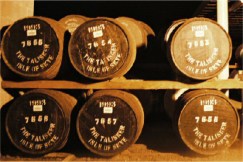 And here is Talisker. Talisker is a favourite of mine, a love affair maybe. It is a unique distillery on a unique island. Talisker is always good. So many big names from the past have slipped, some where good in the 60’s, but not now, some were good in the 70’s, but not now. Talisker isn’t one of them. Just buy any Talisker 10yo and it’s great. Even the worst Taliskers are still good. So the quality is alway delivered. Kudo’s to the people of Talisker. And when Talisker went cheating (Cask sold of to brokers or independent bottlers), Talisker was still very interesting. Just have a look at the different Taliskers issued by Douglas Laing, (as Director’s Tactical). All those casks were probably sold off since they didn’t possess the typical Talisker markers. Peat, pepper and so on. But give these a chance and something extraordinary is revealed to you about the Talisker spirit. And again even the worst Taliskers from them are still good. That’s why I like Talisker very much.
 Strange enough Talisker was never issued as a Rare Malt. But saw the light of day in many forms in a Special Release. As a Normal release we have the 10yo, 18yo and the distillers edition (finished in a Amoroso Sherry cask). And de standard Special releases were the 20yo, 25yo and the 30yo. The 20yo was released in 2002 and 2003, the 25yo was released in 2001 and from 2004-2009. The 30yo was released from 2006 untill 2010. In 2011 there were no Taliskers anymore, just a 34yo from 1975, that cost a pretty penny.
 Taste: Pepper! Animalesk. Sweet and woody (a bit sour). The clay from the nose comes through big time. Ash, almonds and putty. It has some sweetness hidden in the clay, but that disappears quickly. This is some great full-bodied stuff. The finish has some wood in it, slightly bitter and could have been a wee bit more balanced. Water does little for this whisky, so you’d better not.
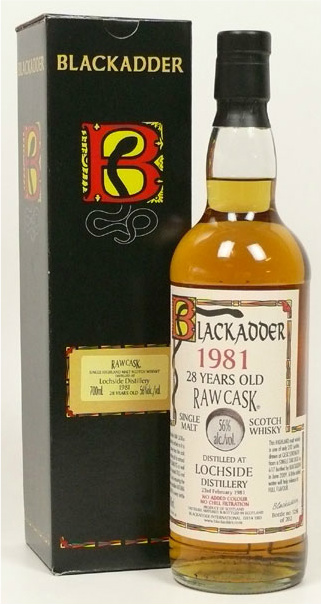 One from the (in)famous Raw Cask series. A lot of ‘stories’ are told about this one. For instance that Blackadder just throw any toasted cask trash they can get their hands on in there during bottling. That would be a shame wouldn’t it? Blackadder are also the people who bring us bottlings from the Aberdeen Distillers series and the Clydesdale series in the dumpy bottles.
 Taste: Wow, full body and spicy, Vanilla with apricot sauce. Nice! Yeah, this is it. Slightly beer like bitterness in the finish ánd black pepper. Alcoholic cherry bon-bon. Blueberry juice and creamy vanilla. Yes this has it all. When the bottle was opened at the Genietschap
  Here is a cigar that’s with me for a long time. I bought this box seven or eight years ago, so this had a good chance to age well. Still, this is a Panatela, usually a cigar people buy to smoke quickly and do not give it a chance to let is age. Hey, but I did! Rafael González is a very small brand, that has always been known for a very good Lonsdale or Corona Extra. Now only this Panatela Extra, a Petit Corona and a Perla are made. All small cigars.
 Cuban Rafael González Panatela Extra (36 x 127mm, Vegueritos, Short Panatela, Box Code ORE JUN 04)
 Taste: Draw was ok, a bit heavy at first. Great smoke that’s a bit sour. Woody and well rounded out, very balanced. Ageing did this cigar well. Mild smoke. Draw now ok. Mocha, milk chocolate mousse. Firm white ash. Easy, uncomplicated smoke. Again the second-hand smoke smells great. Still it’s not overly complex. Ash falls off rather quickly. The whole taste is on the dry side, woody, cedar, it would have been nicer if it had a creamy component.
 Than the last third, and boy what a turn! When the first part of the cigar is very mild and tasty, the last third is extremely strong. It does have its merits but if you are an inexperienced smoker, this part is the part that turns you green! (I’ve seen it happen to someone at work, with this cigar when it was younger). The strength is well countered by a good coffee, but without is it is extremely drying and a bit harsh. Heavy on nicotine. The ash turns brown so you’ll even have a visual aide in recognizing the last third…
 And here is another whisky from my lectern. This time an old (bottled in 1999) Craigellachie from Scott’s Selection. The people who brought us the fabulous Longmorns from 1971. Therefore I always have a soft spot for these guys. This Craigellachie was opened on our
  Color: White wine.
 This should turn out to be a very interesting review. If not for you, than certainly for me. Mr Bladnoch, Raymond Armstrong has a lot of fans, just have a look at the
  After giving the whisky some time to breathe it gets somewhat more balanced and friendlier, some nice spices shine through, with just the right amount of wood. It just doesn’t shed its new-make-and-wood finish.
 Points: 77
 Master Quill