To be honest, there is no Bowmore on the label, but it’s somewhat like the SMWS bottles with codes, everyone knows that in this case, distillery number four is Bowmore and this is the first Bowmore released in this series. Probably a way to market the Whisky or as usual, they weren’t allowed to use the distillery name. This year, the seventeenth Bowmore was released in this series.
 Like with many Gordon & MacPhail bottlings, it is reduced, this time to 45% ABV. I am a fan of cask strength Whiskies, but I learned to appreciate these reduced Whiskies more. Is it age? I’m a bit held back only by the fact that not every Whisky likes to be reduced. Let’s hope it’s not the case with this one.
Color: Full Gold
Nose: Nice peat. Spicy and rather perfumy. Malty and fresh. Almonds and clay, and for such a ‘young’ whisky, the peat smells rather old. Hints of smoke. There’s also some strange ‘smelly meaty sweetness’ happening here, I can’t quite put my finger on. Not bad actually.
Taste: Sweet with cardboard and some peat. No smoke? Tar, sweet licorice and some sour wood. Anis seeds and ash. Not in your face and even milder than the nose predicted. It’s quite sweet actually. It lacks a bit of complexity, that would have fitted the nose.
A decent sherried Islay Whisky, that probably suffered from reduction. Again one I would have loved to taste before reduction, because it is always interesting to try the combination of an Islay Whisky from Sherry casks. It’s also a bit too sweet
Points: 86
 After reviewing one of the most popular official releases by Springbank, the
  Later some mint and furniture wax. Nice throat coating finish.
 Well here is an example of the mother of all Single Malts. No it’s not the oldest distillery in Scotland, nor is it the first in anything. The oldest being Ferintosh at Ryefield (from 1689). The oldest still working distillery is Glenturret (1775). But once there was a time a lot of others added the “Glenlivet” to their own name to benefit from the success, and the known quality of Glenlivet, and who doesn’t know Glenlivet? Started in 1817 and ‘founded’ in 1824 when George Smith was one of the first to obtain a licence for his distilling. All of his illicit distilling neighbours, wanted him dead for it. Traitor!
  In 1845 George leased Minmore farm, which he bought in 1858. Minmore was renamed Glenlivet a year later and is the site of the current distillery. Funnily enough, Cadenheads also state the name “Minmore” on their Glenlivet offerings. George died in 1871. Long live George and to his health we raise the glass with this Berry Brothers & Rudd Glenlivet. Slainthe George.
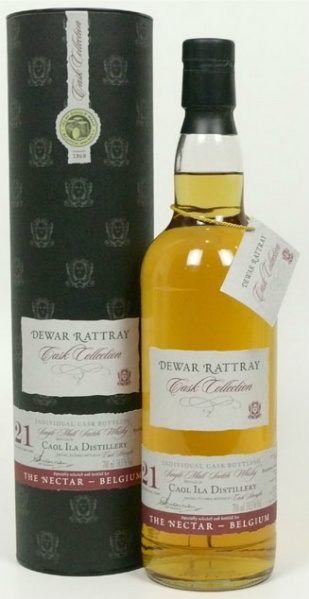 This whisky was distilled on December 12th 1984 and bottled 21 years later on September 6th, 2006, and was bottled for Belgian outfit, The Nectar.
 Time for another Lowlander. Rosebank this time. I reviewed a
  hoping for a resurrection. Who knows. For the time being, lets see if this Rosebank is any better than the Glenkinchie reviewed earlier.
 It’s Islay time! oops, maybe that was from Ardbeg. Well Bowmore is also from Islay and both are in the same time-zone. I see it’s the first Bowmore here, so I choose a potentially good one. Obviously not from a single cask, since no Bourbon Cask (Barrel or Hogshead) can yield 708 bottles.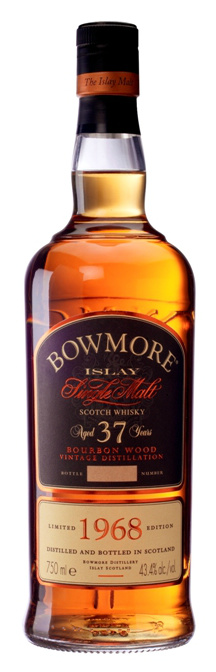
 Instead of expanding into unchartered territory, let’s do something oppositional and do yet another Port Ellen, and another bottle by Douglas Laing. This time from the old series in the normal scotch whisky bottle and not from the new tall bottle. People tend to think this older look contains better whisky. Let’s see if that’s true. By the way ,I read somewhere that in the few months Port Ellen operated during 1983, there weren’t a lot of good casks around, and they filled almost anything they could get their hands on. This Port Ellen looks quite light in color. Is this from a tired butt or a normal refill Fino butt?
 Taste: Peat and rhubarb. Sweet, big, leafy and chewy. Black tea with clean refined sugar. No rubber here and it’s no monster either. The peat is very mild here and the finish is quite simple. Still it seems to be very balanced, just not very complex. It has the dryness and a bit of the spiciness of the oak, but not the bitterness, and that’s a big plus (not a Chevrolet). It has citrus with cardboard in the finish. If tasted blind, I would have thought it to be some odd ten years younger.
 It’s an end of an era, even if it was a tired cask, this is still very typical and good. Really a shame this got closed. In a way it resembles Talisker in it always being decent. This may be no high flyer, but is has a lot of fine moments to give. No I’m not sentimental, this is good in itself. A very nice Islay Whisky. As I’m sipping the last few drops: “Here’s looking at you kid…”
 Color: Copper gold.
 Interesting about Benriach is that a lot of experiments were done there during the seventies (and eighties). Tests with peat, new oak etc. Lot’s of those experiments are released today.
 Enjoyable, recommendable and very fruity. It could have gained triple A status if it would have some added bits that would counterpart the fruit. It is good/great, but lacks some complexity you would have expected of such an old malt.
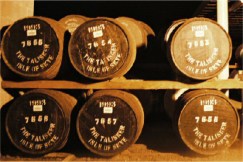 And here is Talisker. Talisker is a favourite of mine, a love affair maybe. It is a unique distillery on a unique island. Talisker is always good. So many big names from the past have slipped, some where good in the 60’s, but not now, some were good in the 70’s, but not now. Talisker isn’t one of them. Just buy any Talisker 10yo and it’s great. Even the worst Taliskers are still good. So the quality is alway delivered. Kudo’s to the people of Talisker. And when Talisker went cheating (Cask sold of to brokers or independent bottlers), Talisker was still very interesting. Just have a look at the different Taliskers issued by Douglas Laing, (as Director’s Tactical). All those casks were probably sold off since they didn’t possess the typical Talisker markers. Peat, pepper and so on. But give these a chance and something extraordinary is revealed to you about the Talisker spirit. And again even the worst Taliskers from them are still good. That’s why I like Talisker very much.
 Strange enough Talisker was never issued as a Rare Malt. But saw the light of day in many forms in a Special Release. As a Normal release we have the 10yo, 18yo and the distillers edition (finished in a Amoroso Sherry cask). And de standard Special releases were the 20yo, 25yo and the 30yo. The 20yo was released in 2002 and 2003, the 25yo was released in 2001 and from 2004-2009. The 30yo was released from 2006 untill 2010. In 2011 there were no Taliskers anymore, just a 34yo from 1975, that cost a pretty penny.
 Taste: Pepper! Animalesk. Sweet and woody (a bit sour). The clay from the nose comes through big time. Ash, almonds and putty. It has some sweetness hidden in the clay, but that disappears quickly. This is some great full-bodied stuff. The finish has some wood in it, slightly bitter and could have been a wee bit more balanced. Water does little for this whisky, so you’d better not.
 Master Quill