Second Dun Bhaegan on these pages, after the Brora 1981. But the first Glen Moray. For a while Glen Moray was owned by the people behind Glenmorangie, you know the distillery with the long-necked stills and the 16 men of Tain? In that period Glenmorangie saw the shortage is good casks and started to experiment a lot with wine-finishes. The ones they did not dare to use, they bestowed onto Glen Moray.  So there are quite a lot of official Wine finishes by Glen Moray themselves. Now Ian MacLeod decided to add their wine finish of their own, or maybe bought it straight from the distillery.
Color: Light Gold.
Nose: Malty and sweet. Vanilla and quite spirity. A slightly winy smell comes in, along with some glue, cardboard and sawdust. Toffee adds to the vanilla. Gypsum. I cannot say this is very balanced. The longer you keep this the more is smells of a combination of solvents. Wait, now some plants come into the mix, just hard to say which ones. Given even some more time, the nose keeps developing. I like that in a malt, just the things you smell aren’t so special in this one. Clean wood and lavas now, and an overpowering kind of toffee.
Taste: Wood, paper, cardboard, but mostly wood. Spicy wood with some detached sweetness. (so not very balanced again). Quite hard and a bit bitter. Urine? After this straight into a finish of almost stale beer, cream and wood again. Sour.
Very simple, not a lot going on, and what is going on is not great for a whisky. It would have a lot of character if it were a Wodka. Still this very nice Wodka scores into the seventies. In a few words: Bitter-sweet wood toffee.
Points: 76
 Well living in the low-countries and doing a Auchentoshan review without pointing at the site of the A toshan man is impossible. So
  For now I will do a short intro to Auchentoshan. officially the first word of Auchentoshan is in 1823 when a guy named Thorne got a licence. But there is reason to believe that Auchentoshan started in 1800 named Duntocher. In the past the Germans didn’t like Auchentoshan too much and bombed the place already in 1941. Smart as the Scottish are they waited for the end of the war, rebuilding Auchentoshan. Just to be sure, they started rebuilding in 1948. In 1984 Stanley P. Morrison buys the place and sells his own company to Suntory ten years later. In 2008 Morrison Bowmore starts with the new packaging we know today. But first this expression by indie bottlers The Cooper’s Choice (actually The Vintage Malt Whisky Co. Ltd.) The people behind Finlaggan.
 In the first weekend of October 2011 I went to the Whisky-Show in London with my friend Erik (both days). We liked the show so much that we went there again this year. Both years we tasted a lot of good whiskies. When we talk things over afterwards we always ask each other what surprised us. Last year we voted
  This Limited Edition 21yo is made out of 6 Bourbon Casks, since they don’t mention Barrels or Hogshead, I guess both are in the mix. For good measure also a Sherry Butt was thrown in. All casks were Refill casks. Casks were hand (or should I say nose and mouth) picked by Douglas Campbell. It’s called a Limited Edition since this is a one-off deal.
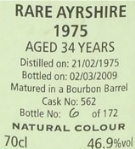
 Yes! Another example from the distillery that took its water from the Penwapple Reservoir, yes say it again, the Penwapple Reservoir. This time one of the many sister casks from the last year of operation, bottled by Signatory.
 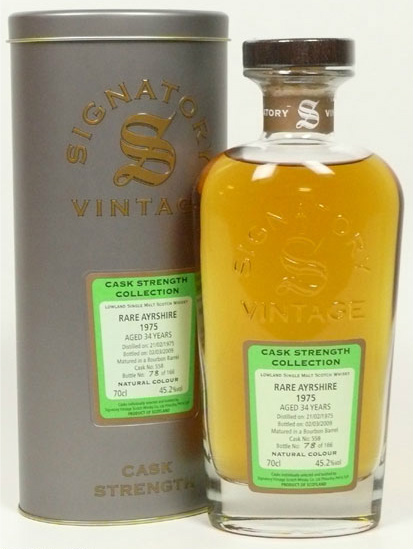 Color: Gold (slightly lighter than barrel #562)
 Ladyburn wasn’t long around. Opened in 1966 and already closed in 1975. It was built by W. Grant & Sons within their Girvan grain distillery complex. Not completely uncommon in those days, since there were more malt distilleries on a grain distillery site. Glen Flagler was added to the Moffat site and Ben Wyvis was added to Invergordon. All three didn’t last long and are pretty scarce these days. These Rare Ayrshire’s are still around, but there will be a time soon, they will not, and prices will soar. So is this worth your money? Lets see…
 Well officially there is no Ladyburn on the label, still it isn’t hard to guess what this must be. Out of the blue Signatory started to bottle a lot of casks from Ladyburn. Which is always nice since the place shut down in 1975 and whiskies from Ladyburn are getting more and more rare.
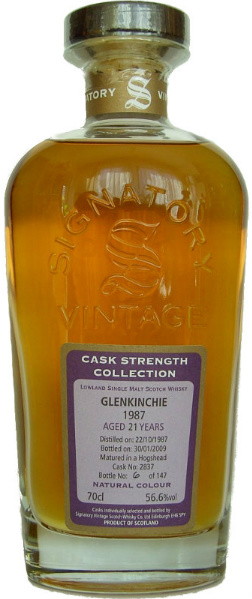 Glenkinchie, a rarely seen Lowland distillery within the ranges of independent bottlers. Founded in 1837, Glenkinchie is foremost known for the closure of Rosebank. When Diageo set up their range of classic malts they chose Glenkinchie over Rosebank. As you might know, Rosebank is known to have a huge following, so this decision wasn’t welcomed at all. Now Rosebank is no more, we’ll have to see if this Glenkinchie is worth your money. Instead of a regular Diageo bottling, let’s try an independent one.
 I did some rummaging in my boxes with samples and found another Glen Grant. Well I actually found several of them, but I just chose this one. You know Glen Grant, the place that was the first distillery that was illuminated without burning fuel by themselves. This time we have a Glen Grant bottled in the Old Malt Cask series by Douglas Laing. Again in the new tall bottle, just like the
  Color: (Light) gold.
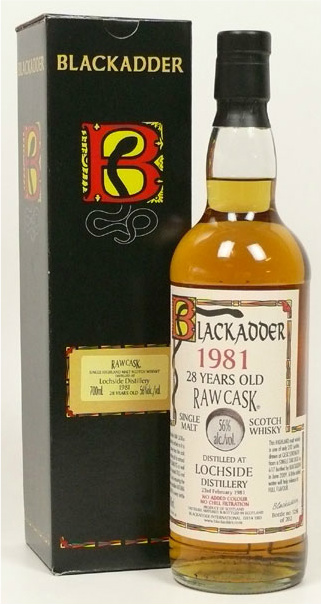 One from the (in)famous Raw Cask series. A lot of ‘stories’ are told about this one. For instance that Blackadder just throw any toasted cask trash they can get their hands on in there during bottling. That would be a shame wouldn’t it? Blackadder are also the people who bring us bottlings from the Aberdeen Distillers series and the Clydesdale series in the dumpy bottles.
 Taste: Wow, full body and spicy, Vanilla with apricot sauce. Nice! Yeah, this is it. Slightly beer like bitterness in the finish ánd black pepper. Alcoholic cherry bon-bon. Blueberry juice and creamy vanilla. Yes this has it all. When the bottle was opened at the Genietschap
  Caves Klug Gewurztraminer 2009, ABV 13%, Bennwhir, Alsace
 Color: White wine.
 Master Quill