Ogier Caves des Papes Châteauneuf-du-Pape Reine Jeanne 2010

Let’s continue with another red wine. This is a Châteauneuf-du-Pape from Ogier Caves des Papes. Not to be confused with the Ogiers from Côtes Roti.

Christophe Ogier had a wine shop established in 1859 called Ogier et Fils. In 1872, his son Etienne took over the company and he passed it over to his grandson Antoine in 1914. In the 1950’s the company joins with Bessac Caves des Papes in Châteauneuf-du-Pape. Their combined estates are all located around Châteauneuf-du-Pape.

This example of Châteauneuf-du-Pape is built around the four well-known grape varieties for the appellation of Châteauneuf-du-Pape. Grenache (versatile, easy to use and adds rich fruit flavors), Syrah (ballsy, adds black and blue fruit flavors, chocolate and pepper), Mourvèdre (spicy, leathery, gives the wine a dark red color) and Cinsault (perfumy and floral). Grenache and Syrah (and Mourvèdre) being the most popular for the region and this type of blended wine. The wine has had some ageing in oak barrels and boasts a hefty 15% ABV.

Color: Dark ruby-red.

Nose: Creamy and very fruity. Red fruits and prunes. Hot butter and warm earth. Vanilla and utterly balanced, otherwise light. It has some sweet-smelling oriental spices, most definitely some ginger and hints of licorice. Small hint of meat(loaf). Great overall perfume.

Taste: Again light, not very tannic, but still a mouth full, and a little bit drying. Licorice. Deep terroir and only slightly acidic. Medium finish with the licorice sustaining. A bit mysterious. Already needs decanting for its full aroma to show, but after some breathing (also in the glass) a very good and aromatic wine.

Very nice and somewhat light Châteauneuf-du-Pape. Today a very inoffensive wine but with a lot of quality to it. Extremely drinkable but not to be taken with heavy foods. Sometimes almost an aperitif wine! I think the wine should be aged further for at least five years. It will improve, but in which way it will develop is hard to predict. Lovely wine, but could have been better with some more body, a little bit more meat on the bone, but the meat this is there is pretty good mind you! Let’s hope it will get more body from the additional ageing. Very nice wine nevertheless.

Points: 87

Thanks Richard for the wine!

Backsberg Sauvignon Blanc 2010

Lets start the summer month of July with a nice and Sunny white wine from South Africa. This Backsberg is made with the Sauvignon Blanc grape variety. Sauvignon Blanc is right behind Chardonnay for the title of most popular white grape variety, and therefore can be found all across the globe. Like the Chardonnay originates from Burgundy France, Sauvignon Blanc originates from Bordeaux France. Thus we have a derby on our hands. Sauvignon Blanc is known to be dry, crisp, elegant and refreshing, but also is used to make the sweet wines from Sauternes. The terroir is, especially with Sauvignon Blanc, very important in how the wine will eventually taste. A very versatile and popular grape variety. Meant to be drank when young, most Sauvignon Blancs are not for (extensive) ageing, unless aged in oak.

Backsberg comes from Paarl. Paarl being the second largest city in the cape region. You just get one guess what is the biggest city in the South-African Cape region. Grandpa Back was a refugee from Lithuania, who eventually got the chance to buy a farm. Part of the farm were wine grapes which more or less started the wine business for Grandpa C. Back. His son S. Back first worked alongside Grandpa C. and concentrated more and more on the wine business of the farm. S. Sold the stock, equipment and the name: Back’s wines (to pay off some debts) and started fresh with the name Backsberg. The first 10 years selling peaches off the farm! Remember that, because the peaches will return! Next in line was M. Back, he made the wine business big again, to the point it is today. The fourth generation of Back is already knocking at the gate: S.

Color: White wine, light.

Nose: Peaches in yoghurt and more peaches in (sweet and creamy) yoghurt. Behind that a mineral note is noticeable, but it is hard to get past the peaches in yoghurt. I somehow have to reset my mind. Second time around, I guess the peaches in yoghurt come forward when the wine is a little bit warmer than it should, now it is colder and it’s more, clean and mineral and with a nice lemony acidity to it. The peaches in yoghurt are still there.

Taste: This is at first pretty sour, but that does not stay, well, it actually does in the sides of your mouth, but right in the middle, a more estery and sweet profile emerges. Perfect balance I would say, but I have to admit that I like my acids in white wine. Not too much, but it is the defining part of the palate. There have to be some good acids to interact with some elegant sweetness to achieve perfect balance. Besides the acids, a light hint of wood and a little bitterness, grapefruit. Finish could have been better, but overall not bad this one!

In fact I liked this one better when it was slightly higher in temperature, so don’t chill this too much. It got more fruity and creamy, and when chilled, it was more clean and…typical. The wine has an ABV of 14%.

Points: 80

Aultmore 36yo 1974/2010 (46%, Mo Òr, Bourbon Hogshead #3740, 264 bottles, 500ml)

Here we have an Aultmore from 1974. The one official bottling in the Rare Malts range was also from 1974. Three years ago Douglas Laing bottled a 1974, and even more recently, two bottlings from The Whisky Agency saw the light of day. There is one more by Adelphi, but more about that one later.

Aultmore was founded in 1896 by Alexander Edward who also founded the Craigellachie distillery with Peter Machie in 1891. In 1896, Mr. Edward also owned the Benrinnes distillery. Mr. Edward sold Aultmore to John Dewar’s and Sons in 1923. John Dewar’s and Sons naturally became part of what is today Diageo, but Diageo sold the whole of John Dewar’s and Sons to Bacardi in 1998. Aultmore was built with two stills and two more stills were added in 1971, so this 1974 Aultmore was already made with four stills.

Color: Full gold

Nose: Estery and full. Seems sweet and has a perfect woody touch. Powdery with vanilla, but also some vegetal sourness creeps in, but only in whiffs, it’s not always there. Malty freshness, and the slightest hint of cow-dung, great! This kind of organics in Whisky is the best, look at all those fantastic Brora’s. I really like the complete profile this nose shows me. A great, but toned down or laid back Whisky. It doesn’t shout from rooftops it’s great, but whispers. People who know, will hear it’s call.

Taste: Woody cannabis, and in this case that’s very nice. Sugary sweet, but the “wood” is the taste giver of this malt. Mind you this is not a woody malt. It’s like somehow there is some fruit in here but it isn’t allowed to get out. Medium, slightly disappointing finish, and probably the reduction could have been skipped, since the Whisky shows some laziness. Could have been fuller, if so I’m shure it would have scored in the 90’s. Nevertheless a great Whisky!

One of my favorite Aultmore’s is also from 1974, a bottling by Adelphi, Cask #3739, yes a sister cask! That one yielded only 101 bottles @ 49.6% ABV. Cask #3740 yielded 264 bottles reduced to 46%, so I’m guessing this was a lot higher in ABV (I can’t imagine Adelphi doing a cask share, but you never know). If memory serves me well, this sister cask also has a lot of yellow fruits, cask #3740 lacks. I have a bottle of Adelphi’s 1974 Aultmore, so in the future, that one will be reviewed on these pages too…

Points: 88

Thanks go out to Dirk for handing me this sample some time ago…

Glen Keith 19yo 1990/2010 (52.1%, Malts of Scotland, Bourbon Barrel #13678, 232 bottles)

Last time around we had a stellar but also antique 1967 Glen Keith bottled by Gordon & MacPhail. This time around we have a more modern expression distilled in 1990 bottled in 2010 by german outfit Malts of Scotland, in a more modern type bottle. Let’s see if a more modern Glen Keith is up to par. We’re now in April 2013 and this should be the month the distillery would be reopened. I have looked around in the media but haven’t found a word about it, so I guess the distillery hasn’t opened yet. I hope I can inform you on the reopening in the next Glen Keith review.

Color: Straw

Nose: Clean wood, overall clean, spicy naked wood or virgin oak as they like to call it. Not a lot of character for something that was 19 years in a barrel. Definitely a refill. a slight hint of vanilla, which can’t be a surprise. Cloves, not very ripe pears and a little bit creamy. Well considering all, clean is the word here, you could almost call this sterile, but I won’t because it isn’t. No faults too. I guess the spirit’s great, but the barrel didn’t do a lot for this Whisky. When warmed up a little, some grassy or hay-like notes appear and it gets slightly perfumy (like soap), mind you it’s not soapy! Maybe we should call this profile ‘honest’.

Taste: Sweet and creamy and actually very drinkable, Small hints of wood which gives the whole some character. Overall creamy, with vanilla and mocha and some ice-cream and clotted cream as well. It has a very confectionery feel to it. The sweetness is sugary, but again there is absolutely nothing wrong with it. It’s quite nice, it’s very simple because there isn’t much to it, but easy drinkable likeable. An easy sipper, and I can imagine people having a lot of fun with this.

Let it breathe to open up. Well its incomparable to the oldies from the sixties and seventies. Those were mostly sherry bottlings to boot. Still this is from a cheap Bourbon Barrel, but it shows us that the spirit is rather good. For a simple refill cask. still it did nothing wrong and makes this a nice sippin’ Whisky. Nice.

Points: 84

Highland Park 12yo 1997/2010 (56.2%, G&M, Reserve for van Wees, Refill Sherry Hogshead #5823, 271 bottles)

In this day and age of battles, battles for oil, battles in politics, and even dance battles, now there are also battles in Whisky. The guys in the picture are Jan Beek (right) and Dennis Mulder (left). They do tastings/battles to see who bottles the best Whisky, the distilleries themselves or the Independent bottlers. Jan represents the independent bottlers and Dennis the official bottlers. Time for my own battle. Well not a battle with axes and swords. Earlier I reviewed an official Highland Park 12yo and scored it a decent 85 points. Here we have a this independent 12yo Highland Park, bottled by Gordon & MacPhail and selected by Van Wees, so mostly sold in the low counties. Let’s see if this Gordon & MacPhail 12yo can beat the official 12yo, and score more than 85 points…

Color: Lively orange brown.

Nose: Extremely sweet, spirity, spicy and woody. Raisins, lots of raisins. This smells exactly like a PX-Sherry. Apart from the thickness of it all, it does smell dryer later on because of the wood and spice. Gravy and meaty, something that fits the Sherry profile too. Definitely some honey and heather in the nose. Which surprises me since the Sherry cask might be very overpowering. Tar and sulphur come late into the mix. I love the coal and tarryness of sherried single cask Highland Parks. Burnt wood. Bonfire from a distance at night. The opposite of elegant I would say. The longer it breathes in the glass the better this gets. It reminds me of some of the better early seventies good sherried Whiskies.

Taste: This is sweet PX-Whisky with a bite. It starts out sweet and quickly turns into spicy wood. Syrupy sweet. But the initial sweetness terns into dryness because of the woody attack. Again coal, tar and even some licorice. Fireworks and a cold freshly half burnt log. Demerara Rum with a lot of smoke. It’s sweet but not quite honeyed. And no heather to be tasted too. Some dark chocolate and cola. Do I really taste a hint of soap?

OK, it’s a 12yo Highland Park all right, but this version has nothing to do with the official 12yo of today or any day for that matter. It’s a beast, but a lovely beast. If you can handle heavy Sherry, than this is one for you (and me). In the end I like this one better than the official 12yo, so this battle is won by Jan Beeks axe. But the whiskies are completely different and both have their moments. One is elegant and light(er), the other a beautiful beast at high strength. Still, I like the older official bottlings of Highland Park.

Points: 87

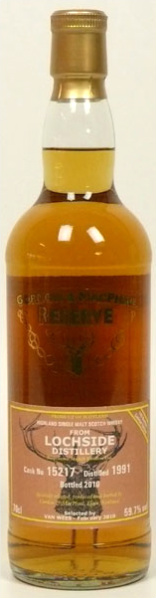
Lochside 18yo 1991/2010 (59.7%, Gordon & MacPhail, Reserve, Refill Bourbon Barrel #15217, 149 bottles)

Here we have one of the many 1991 Lochsides, and one of the many that were issued as a Gordon & MacPhail Reserve. This one was picked by Dutch retailer Van Wees. Gordon & MacPhail code for this one is AJ/JBEC. The spirit was distilled on September 18th, 1991 and eventually bottled on March 8th, 2010. Alas we don’t know exactly the date when Han van Wees tasted it and picked this ;-). Kudos to Gordon & MacPhail for all the information on the bottle and back label.
Color: Gold

Nose: Clean and farmy or organic. The wood is upfront too. Slightly yeasty and estery, which makes it a bit fruity. But the fruit isn’t here in abundance. Actually it is pretty dusty and comes across as dry. Do I detect some fatty peat in here? Small hints of rubber and smoke. This definitively is one to work with, and then the best things are in the details. There are some hidden treasures in this. Some vanilla, cream and petrol. Complex and nicely balanced. The longer I nose this the better it gets. Definitively peat and clay in here. Salty too. I’ve got to stop nosing this, otherwise this will never end…

Taste: Sweet and woody. On the precipice of bitterness. Still the bitterness is controlled by the sweetness. Nice big body, and the ABV helps with this. Creamy vanilla again, but with a bite from the wood. In the depth there is some sugared dried yellow fruits, Apricots are the most recognizable. The sweetness is also aided by some late acidity, that transports the hint of yellow fruit. It seems to me as if someone squeezed some lemon into this. peppery, woody attack. The finish is slightly off-balance, but overall this is a very good malt.

It seems to me you can’t go wrong with these kinds of Lochsides. There are a lot of 1991 bottles around, but they are all different. sure the family resemblance is there, but I’ve tasted more of the 1991 G&M Reserve, and they all are variations of a theme. Even the reduced Connoisseurs Choice are very drinkable summer whiskies. If that is the case I would say that these 1991 Reserve’s are more of your winter dram. Recommended.

Points: 86

Thanks go out to Erik for providing yet another sample.

Tomatin 25yo (43%, OB, 2010)

This is the last of the Mohicans. Tomatin updated the label in 2009 and shortly after, by 2011 replaced it with the excellent 30yo. So now there is a gap between the 18yo and the 30yo. Surely Tomatin will fill this in with something else? What about a new style 25yo? Maybe at a higher proof? Nudge nudge, wink wink Stephen. The reason behind the axing of the 25yo is that they aren’t confident in making a whisky like this in a constant manner anymore. This 25yo is solely matured in Bourbon casks. Shortage of bourbon casks from the first half through the second half of the eighties? Now I know why Macallan has a shortage of good Sherry casks… Having tried a lot of Tomatins recently I was wondering where the (tropical) fruit comes from. Is it from the Sherry casks? No better place than this bottle to find that out…

Tomatin 25yo OBColor: Full Gold.

Nose: Very waxy, and Peter Gabriel’s “Here comes the fruit”. Already some wood and toast. yes there’s the tropical fruit again, but in a different style than the new 30yo. This is darker, less obvious sparkling, happy fruit. No this has some added flavors. It has some smoke, toast and saltiness. Hidden wood. But through this darkness comes the estery and waxy fruit. It’s still the tropical stuff, just more heavy in style, maybe more masculine. After some breathing, the fruit is almost gone and it is more woody (cedar) and estery (and malts with a little smoke).

Taste: Pretty sweet at first with a lot of creamy chocolate, and perfect wood that has an aura of crisp fruits. In the background a little bit of acidity that gives this some liveliness. Passionfruit and mint in the finish. It’s passionfruit ice-cream to be exact. Also a slight hint of dried apricots and pear. Very elegant.

They were right to give this the black label, where the 30yo has a white label. It is a bit a stand-off between a devil (the 25yo) and an angel (the 30yo). This is a well-made, beautiful and very interesting brooding Tomatin. I’m very, very sorry to see this go, but at the same time I’m very happy to see the new 30yo coming. Still, I rather had them both into the fold.

Points: 89

Ledaig 8yo 2001/2010 (50%, Kintra, Single Cask Collection, Bourbon Hogshead #800124, 36 bottles)

We took the peat road last time and when I look outside I can understand why. let’s get off that beaten path and tread not to Islay, but this time to the Isle of Mull. Being Dutch myself, let’s have a look at another indie Dutch bottler Kintra. Erik Molenaar is the boss of this outfit. Did Erik source a tiny Hogshead of Ledaig? “Honey. I shrunk the Hogshead” maybe? Nope, Erik shared a cask with a shop in Maastricht. Slijterij Bams. The share of the shop was 218 bottles, Erik’s share was only 36. Funny enough the label of ‘the other’ bottle states 50.6%. The humor doesn’t stop here. Bams don’t have it on their list anymore. Sold out? But The Kintra version is still available! So I can’t wait to try this. I hear that modern Ledaigs can be pretty good…

Color: White wine.

Nose: Warming. Light peat and grassy. Citrussy (fresh) and muddy. Great combination. Non-offensive. Cold wet black tea leaves. Oily old machine. Very nice nose. Perfumy, smoky and quite elegant for a heavily peated whisky. Almost burnt out fireplace on a freezing cold day or evening. Beauty and beast in one. Sour sweat and I do smell a stew in here.

Taste: Sweet with licorice. Soap. Black and white powder. Succulent grass, but also some hay. Burnt cables and lemon. Alas this isn’t as balanced as the nose, nor is it as likeable. It’s sweet at first with a sort of acidic licorice attack. Lot’s of ash in the finish. The lack of balance is a bit disturbing. There is also a bitterness like earwax and a hint of crushed bugs.

It seems simple, but especially the nose shows great balance. The youth shines through on the palate and seems to me to be less balanced. Here the sweetness and the laid back acidity do not match. The more air the whisky gets, the more the balance loses out on both the nose and the palate. Very strange to get this from, what should be a powerful heavily peated Whisky, at this age. What can I say. Maybe Erik made a wise decision to have such a small cask share? Well, totally bad this is not, it just deteriorates rather quickly with air (I used no water to achieve this).

Points: 82

Glen Scotia 18yo 1992/2010 (46%, Mo Òr, First Fill Sherry Butt #6, 1076 bottles, 500 ml)

Next up Glen Scotia, also a first on these pages. Glen Scotia hails from Campbeltown, once a big place for whisky with regional status (again). Try to imagine a place that has almost 30 distilleries working at one time in the 19th Century. Not so long ago this Glen Scotia was the ‘other one’ from Campbeltown after the well-known Springbank. Today Springbank makes also Longrow and Hazelburn. And from the same owners the recent ‘addition’ that is Glengyle Distillery (Kilkerran). Let’s say that Glen Scotia is the only Campbeltown distillery not owned by the people of Springbank. Owner today is Loch Lomond Distillery Co. and the place is fairly run down. When the distillery was mothballed in 1994, the staff of Springbank restarted intermittent production in 1999, not to lose the regional status of Campbeltown. A status lost eventually, but eventually reinstated.
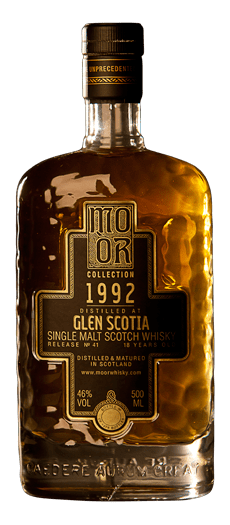
The distillery was founded in 1832 by the Galbraith family. For one reason or another the label on the bottles state 1835. Lots of changes of ownership during the years and even some closures in 1928 and 1984. Since 2000 Loch Lomond has taken over Glen Scotia and runs the distillery with its own staff.
Color: Copper Gold.

Nose: Very musty and dirty. Fruity as in fresh sweet apples mixed with apple compote. A very nice hint of smoke and coal that reminds me of an old steam locomotive. It actually smells like something from the industrial revolution. Old Skool? Lets move on. Mint and still a lot of apple. Lit matchstick. Nice balance and easy. Not very complex. Underneath it all, a sort of sweet wood smell, very laid back.

Taste: Wood and toffee. Caramels and quite a bit of ash and toasted cask. A nice bite and definitely a firm body. Sulphury (of the egg kind) and quite some oaky and milky sourness. Actually I get some more egg notes, especially boiled egg (the white part). Closing in on the finish, it dries out a bit, and is not as big as expected. Here the wood plays a much greater role, than on the nose. Not as balanced as the nose.

Usually you’d expect more color after 18 years in a First Fill Sherry Butt, so this must be a Fino (again) and it kinda goes into that direction.

I was asked to keep an eye out for sulphur in this one. It’s there slightly on the nose (as a burning match). But it is more pronounced on the palate (the bite here comes not only from the wood, but also from the sulphur. Usually there is some sulphur in Sherried Glen Scotia’s. Lots of it in a 1991 Cadenheads offering if I remember correctly. It’s there on the palate and even more so in the finish (late). Is it ruining the balance or the palate? Does it disturb me? No, it’s some kind of good sulphur. it’s somewhat hidden. It’s there but not in the usual obvious way. That happens sometime, that’s why I called it good sulphur. Still, overall there isn’t a lot of sulphur in this one, so don’t worry. And hey, sulphur is good for the skin!

Points: 84

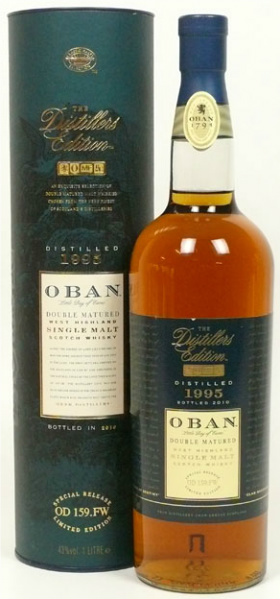
Oban 1995/2010 (43%, OB, OD 159.FW, Distillers Edition, Montilla Fino Finish)

Oban is one of the special Whiskies from Diageo. Not a lot of versions around, very little independents have it, and most of it you’ll find are old bottles, with big prices. It a bit their highland Lagavulin, which also once had few expressions and little seen with independents.

Montilla is a Spanish DO (Denominación de Origen) from the southern part of Córdoba. The Fino used for this finish is commonly a clean, vibrant, straw-colored wine. It has a complex and subtle nose. Delicate notes of predominantly yeast and almonds. Sometimes also tobacco and liquorice. The taste is dry, bitter, smooth and lingering. Also very nice olive oil comes from here.
Color: Orange gold.

Nose: Fresh (air), wood, a little bit creamy. Thick. Slightest hints of tar and laurel liquorice and something sour like a green apple. Dry and perfumed paper. This does have a Fino trait to it (I once had a Fino Glenfarclas and the characteristics are very similar. I also once had a bone dry Fino Sherry from Lustau, which also had the same characteristics). I guess, Whiskies from a Fino cask are easy to recognize.

Taste: Wood is the first up, plywood. Yep, Fino. Little bit of vanilla ice-cream. And a slight pepper bite. It has cardboard combined with sugar, some sort of strange sweetness. I’m not convinced this finish worked well with the Oban distillate. The finish is quite anonymous. Also, it isn’t very balanced. After some breathing I got some organics (yeast and cow-stable) and some late sweetness, which makes it slightly more drinkable, but it doesn’t undo the unbalance.

This is a bit disappointing actually. I expected more from Oban combined with Fino Sherry. Not something I would buy, nor would I order this at a bar. For me it is ‘put together’ or crafted. It isn’t being honest like I found recently with some official Benromachs. Also the Fino finish doesn’t work for me here.

Points: 82