Port Charlotte “An Turas Mor” (46%, OB, American Oak Casks)

In 2000 Murray McDavid bought Bruichladdich for £6.500.000 (from Jim Beam, current owners of Bowmore and Laphroaig). After acquiring the distillery guess what was the first distillate made? Yes! Port Charlotte, not the unpeated Bruichladdich itself. The guys behind Murray McDavid are no fools. We all know Mark and Jim to be very shrewd guys. So the first stuff they wanted to make with their new distillery was peated Whisky. On the 29th of May 2001, the first Port Charlotte was made. The first Bruichladdich under new ownership was somewhat later distilled in July. (2001 which was also the year the first newly bottled Bruichladdich was released; the 10yo I just reviewed, the 15yo and the 20yo). Finally on the 23rd of October 2002 the first Octomore was distilled.
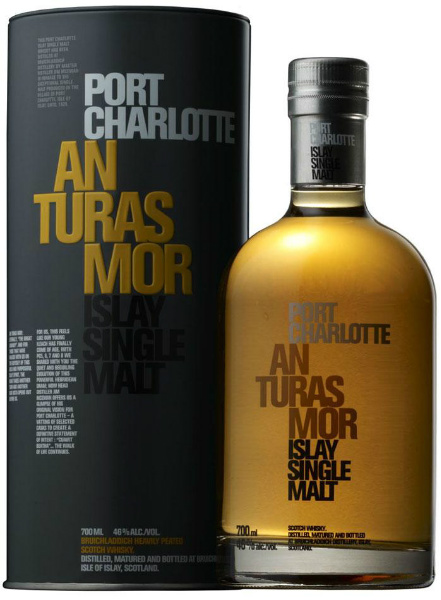
Port Charlotte "An Turas Mor" (46%, OB, American Oak Casks)Color: Pale gold.

Nose: Mild, fatty vegetal peat, with butter and vanilla, pepper and salt. It smells like lavas was one of the plants that makes up the peat. Quite soft and unobtrusive. Some smoke and a tiny hint of burnt plastic and traces of soap. Sappy licorice twig. Wood lying around in the forest. Fresh (air) and un-complex. Dry kippers with hints of tar. Dusty vanilla and some paper. Nice to smell. The nose is worth the price of admission.

Taste: Sweet and peat. Sugar water with slightly bitter peat. Sweet licorice and black and white powder (yes, licorice again). Slightly warming. Licorice and licorice twig. Very tasty (the sweetness helps it along), but not very complex, but who cares when it’s so drinkable. Reduced, brooding peat that resembles coffee a bit. After a decent body, comes alas a sort of weak finish. A finish full of paper, barley, hints of soap and sweet licorice, but I guess we can blame its youth for that.

Lots of young Whisky is noticeable in An Turas Mor, but it shows a lot of potential though. This will become a great peated Islay Whisky when it becomes of age. I feel that Port Charlotte is a sweet Whisky that can be high on aroma, but struggles a bit with its length when it’s young. Highly drinkable, likeable and definitely worth its money. Get it, it’s not as expensive as the PC’s.

Points: 84

Bruichladdich 10yo (46%, OB, 2003)

Earlier I reviewed the most recent, standard range, Bruichladdich from the Dumpy OB era: the Scottish Barley bottling. Today we’ll have a look at the one that started it all for the previous owners. A short recap is in order I guess. In 1994 Bruichladdich was closed (again) since not a lot of Malt Whisky was needed back then. In 2000 Bruichladdich was taken over by a group of people fronted by Mark Reinier (of Murray McDavid), who in turn, asked Jim McEwan to take on the post of master distiller and (progressive) production director. Who would have thought Jim to ever leave the Bowmore building. In 2001 Bruichladdich was reassembled, without making it a computer driven modern distillery and without disturbing the Victorian bits as well. If memory serves me correctly, by 2001, three bottles were released as some sort of core range. A 10yo (this one), a 15yo and a 20yo. So this 2003 bottling, is one of the next batches after that. Yes no NAS bottles back then yet!

Bruichladdich 10yo 2003Color: Light gold.

Nose: Light, sweet barley. Extremely dusty. Paper. Dishwater citrus, but also perfumy wood, otherwise not a lot of wood noticeable. Pretty fruity. Thick sugared yellow fruits. Some pineapple and papaya with a slight hint of mint and cardboard. Somehow it smells sugary with hints of toffee and caramel. No peat.

Taste: Paper and a sweet woody note. Also something metallic. Perfumy too. It tastes almost the same as it smells. A bit hot on entry, but quickly dissipating the heat. Citrus fresh, but not of the dishwater kind. Rhubarb and again some caramel, which moves into toffee towards the finish. Hints of mocha and wood. Some woody bitterness helps the Whisky along. To my amazement, the dishwater component returns.

The current entry-level Bruichladdich is the NAS Scottish Barley and as luck would have it, I still have that one here too! The Scottish Barley has a lot of butter on the nose, but the fruit reminds me of the 10yo (but only the fruit). Definitely a younger Whisky. More raw and closer to new make spirit. It even has a tiny amount of smoke (and a wee bit of peat and oil, since it resembles Springbank a bit), which is nice. Tastewise the NAS is even simpler than the 10yo, more on barley and lacks some of the off notes of the 10yo.

I was never a fan of the 10yo, and after more than ten years, I still don’t like it that much. The Scottish Barley however, reminds me of Springbank, and even though it is simpler, less complex, in this case I prefer the NAS over the 10yo. (The “Yellow Submarine” I had next, was definitely better than both)

Points: 78

Bruichladdich Classic Laddie Scottish Barley (50%, OB, 2014)

In the more recent past when Bruichladdich had different ownership, a lot of bottlings saw the light of day and a lot of bottlings comprised the standard range. Now that the distillery has changed hands and tries to be a fashion accessory, the stanf=dard range is reduced to only two NAS bottlings. Scottish Barley and Islay Barley. If my memory serves me well, all standard bottlings with an age statement have been dropped.

In 2013, this same Whisky was released with a somewhat different “label”. The first release had big lettering for “Scottish Barley”, whereas the 2014 release I’m about to try, has “Classic Laddie” in big lettering. I have tasted the 2013 version and scored that one 85 points. Let’s see if this newer version is equally as good.

Bruichladdich The Classic Laddie Scottish Barley 2014Color: Light gold.

Nose: Well this is a nose that screams Barley. Very young smelling and even has some Bladnoch-butter. Fatty, with a citrussy edge. Hints of new make spirit, and given some time to breathe, a more bread like, coffee and milk chocolate note appears. The whole is quite soft. Wet. fresh wood. Virgin oak. Nevertheless it is also recognizable as a Bruichladdich. It does remind me sometimes of the Cadenhead Bruichladdich 17yo I reviewed earlier.

Taste: Soft paper like wood and an extremely creamy taste. Coffee with a lot of milk. Chocolate milkshake. When the higher ABV flows down my throat a short flash of hotness flies by, but also dissipates quickly. Cream with a hint of ashes. Bourbon and vanilla, but also dark chocolate and a faint fruity note. Cherry liqueur bon-bon? Virgin oak again. Lots of barley (and sugar?) in the finish. Barley, oak and cream are the three words that describe this Whisky best I guess.

As consumers we are compensated. We get less ageing and less complexity, but we get more ABV. 50% to be precise.

Here we go again, another NAS bottling that will split the Whisky world in two. Definitely a young, crude and uncomplex Whisky, but at the same time a nice and designed sophisticated soft taste that a lot of people will like. The Bruichladdich spirit is a good spirit, but this spirit didn’t get a whole lot of time to develop. It’s like a child asked to drive a bus. Some would even say that this isn’t really Single Malt Whisky. If someone had invented this about a 1000 years ago, he or she, may have called it Barley Wine. Not bad, but not my NAS of choice.

Points: 81

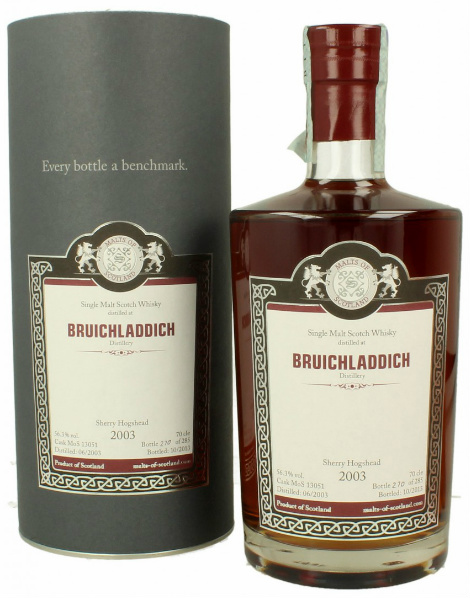
Bruichladdich 10yo 2003/2013 (56.3%, Malts of Scotland, First Fill Sherry Hogshead, MoS 13051, 285 bottles)

Almost two years ago I reviewed a Glen Keith bottled by Paderborner outfit Malts of Scotland. Being an indie with quite a reputation it took me quite a while to review another bottling of theirs. A sample of this very Bruichladdich was bestowed upon me by the former owner of this very cask. MoS renames the cask numbers so we do not know the original cask number. I hate it when Thomas does that, just like Bert does with his Asta Morris bottlings. Something to hide guys? Well nothing more to say really, (I’m a bit distracted by some nice live music by Primus), so let get on with it…

Bruichladdich 10yo 2003/2013 (56.3%, Malts of Scotland, Sherry Hogshead, MoS 13051, 285 bottles)Color: Orange brown.

Nose: Mellow Sherry of the Oloroso kind. Soft wood, dry forest plants like fern and slightly sulphury. Freshly baked bread. Chocolate, brown sugar, honey and fruity acidity from red fruits and berries. Vanillin and a distant bonfire in the woods. Wet earth and mocha. Raisins. Nice and pretty laid back. Mint in the finish (when warm).

Taste: The fruity acidity from the nose. Waxed chocolate sprinkles, cola and some wood. Again some sulphur, but not a lot. Extremely warming. The acidity stays on well into the finish and deep into the finish the sulphur gets more room to play, but still it is not a lot and never overpowering. It’s in the background carrying the aroma along with black tea leaves and a hint of woody bitterness. Not a very long finish though. Reminds me a (more than a) bit of the Bunnahabhain and to a lesser extent of a Bruichladdich I reviewed earlier. A quieter version of both I guess.

I have to say this one needed warming up. Even at room temperature I found it pretty closed, but when I held it in my hand for a while it showed a lot more of itself. Honey in the body and mint in the finish for instance. When I finished it, I poured myself a fresh dram, and again, very closed. This is an example of a closed and dry heavily Sherried expression as opposed to a fruity one. Bottled at the right time. Ready for another strange remark? The empty glass smells better than the full glass…

Points: 85

Thanx Andy!

Cadenhead Creations 20yo ‘Rich Fruity Sherry’ (46%, Batch No. 1, 2013)

Cadenheads CreationsMerry Christmas everybody! In 2013 Cadenheads released a home-made blend called Cadenhead Creations (Rich Fruity Sherry). This first batch had an age statement of 20yo and was bottled in 2013. The blend was made with two casks of Single Malt and two casks of Single Grains. Samples of those casks are pictured here on the right. From left to right: Mortlach 1992 (cask #7848), Bruichladdich 1993 (cask #1648), Cameronbridge 1989 (cask #22804) and Invergordon 1991 (cask #39006). Since then two more Cadenhead Creations were released. A 21yo (black label, silver stripe, Blended Malt made with Ardbeg, Bowmore and Caol Ila) and a 17yo (white label, yellow stripe, another Blended Whisky made with Ardmore, Auchroisk, Caperdonich, Clynelish and Invergordon).

Cadenhead Creations 20yo 'Rich Fruity Sherry' (46%, Batch No. 1, 2013)Color: Full Gold.

Nose: Although it seems that this is a 50/50 mixture of Single Malt and Single Grain, the nose is more on the grainy side. Malty and waxy, paper and cardboard. Very nice wood. Meaty, nutty and spicy. Deeper down some hints of Sherry, not upfront as the label suggests. Fruity (but not sweet) and lots of character.

Taste: Malty and grainy again. The waxiness is here to, but here it is fruity and accompanied with a little bit of sweetness. Sweet paper and cardboard again. Some short, hot or red peppery attacks. Spicy and slightly bitter wood. Aspartame sweetness. The wood upfront and may be too strong. The wood makes it right across the body of the Whisky into the finish. Along the way the wood picks up a little bit of oaky bitterness, with together with the red peppery attack make the finish.

Rich, yes, rich wood. Fruity, well not so much if you ask me, the wood is way more pronounced. Sherry, well if you expect the dark Sherries from the picture above, that´s not the case here. It doesn’t remind me of Oloroso or PX-Sherry casks at all. This blend is about wood in many guises.

Points: 81 (for character)

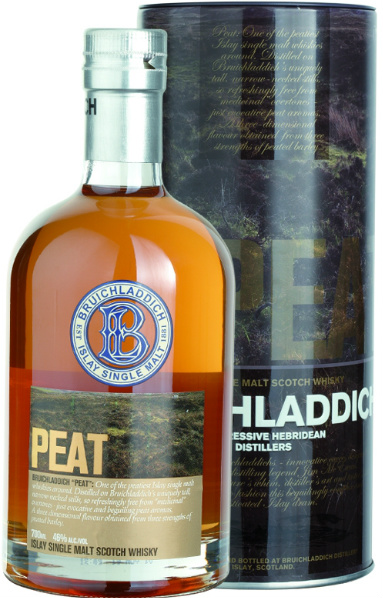
Bruichladdich “Peat” (46%, OB, Bourbon Casks, 2008)

Suddenly I had a craving. Lets try something with peat, so I picked this fairly new, but already discontinued Bruichladdich “Peat”. In everyday life, Whiskies released under the “Bruichladdich” brand name are unpeated. Bruichladdich has other brands for their peated Whiskies, like Port Charlotte and Octomore. This Bruichladdich “Peat” was peated up to a phenol level of 35 ppm, which compared to Octomore is pretty “light”. “Peat” bares no age statement, and will probably be young, but there are several other young Bruichladdichs around that are pretty good. Islay Barley (2006, 2007 come to mind)…

Bruichladdich Peat (46%, OB, Bourbon Casks, 2008)Color: Gold

Nose: Slightly peaty, with dust, elegant wood and vanilla. Very “friendly” smelling. Smoke on top. Young and likeable. Fruity. Distant pear, banana, Galia melon and other (sugared and/or dried) yellow fruits (trail mix). Fruitiness is not upfront. Slightly meaty. I suddenly have a craving for bacon! Nice.

Taste: Young, light and malty. Lots of licorice (in many guises) and some wax combined with old wood. Sugary sweet alcohol. Very toned down and laid back. Nice hints of oak and dry barley. Lots of licorice in the finish, with hints of Marmite in the finish too. Although maybe young and generic, I found it to be a nice addition to the peat-universe. Elegant and relaxed. Salty lips. I like it a lot actually. Imagine this with more complexity and sophistication, now that would be stellar!

Maybe its simple yet it is also very delicious. A nice companion to heavy hitting 10.000 ppm peat bombs. This has 35 ppm and is a very friendly Whisky, that also used to be very friendly on the olde wallet.

Points: 84

Bruichladdich 32yo 1970/2002 (44.2%, OB, First Fill American Oak Casks, 4200 bottles)

Let’s step things up a bit with this legendary Bruichladdich. Bruichladdich was founded in 1881, and the distillery was built by Barnett Harvey with money the family got from an inheritance from his brother. It is not the Barnett family’s first distillery though. In 1881 they also own the well-known distilleries: Yoker and Dundashill. Between 1929 and 1936 the distillery is closed. Much later in 1983 the distillery was closed as many others were, but fortunately it was saved (in the same year) and didn’t get demolished. Next the distillery was again closed between 1995 and 2000. In 2000 the distillery was bought for £6.5 million, by a group of investors. Quite a good investment since this group sold the distillery again for £58 million in 2012. The new owner being Rémy Cointreau.

Color: Full gold.

Nose: Old bottle. Waxy and very full and heaps of character. Vanilla with some nice acidity. There is also a fantastic woody note. Smells a lot like a 1972 Caperdonich (from a Bourbon cask), but fresher, less heavy, but don’t make the mistake thinking this is a light nose. Very drying nose, dusty and powdery and full of fresh air. All written here isn’t released by the Whisky in one go, it is released in layers. This nose alone would score sky-high. Absolutely stunning.

Taste: Fruity vanilla which is transported by a fabulous bed of wood. Sugared yellow fruits, again apricots (I get that a lot lately), but also a nutty part, almonds, but nothing bitter. A hint of toasted cask (sweet wood). Perfect big bold body with a mouthfeel to match. Good finish, it leaves a taste in your mouth that should have gone on forever.

This is a Whisky that fetches a pretty penny at auctions today. I should have bought this when it got out. In today’s market, Whiskies like this would be put in some sort of crystal decanter or another polished over the top packaging and would go for 1000 or 2000  Euro’s easily. Having said that, it’s probably worth the 500 Euro’s it costs today. Go and get it, I’ll vouch for it. I had this at 91 up untill now, but that was a grave error on my part. The new score is…

Points: 92

Bruichladdich 14yo 1991/2005 “Yellow Submarine” (46%, OB, WMD II)

WMD stands for Whisky of Mass Distinction. A name one would find on a Frankie Goes To Hollywood 12″ in the eighties. Two years earlier the first WMD was released (a 19yo from 1984) and had a rocket on the label. This second “weapon” is a Yellow Submarine. Most of us would have thought of the Beatles, but this time it about another submarine. One owned by the Royal Navy of Great Britain.

Islay Fisherman Baker was at sea to check his lobster baskets, when he saw a yellow object floating just under the surface of the water. Which first seemed a buoy seemed to be a 2 metres long radio-controlled mine detector from the Royal Navy. When Fisherman Baker called the coastguard informing them that he spotted a submarine with markings from the Royal Navy, they told him to he was drunk, not very uncommon on such an Island. Still fisherman Baker wouldn’t budge and the coast guard called the Royal Navy, but they denied it’s existence!

Just days later the Royal Navy admitted they had lost HMS Penzance (The Yellow Submarine) in a drill. But just after 6 months they decided to pick the thing up> They sailed out at night, to arrive very early in the morning, not to draw a lot of attention to the operation. But the people of Islay are no fools, so half the Island was present at the beach. 12.000 bottles of Yellow Submarine were made and the Royal Navy got six to commemorate the incident. Later the French manufacturer of the Sub ordered another 1000 bottles of this edition for marketing purposes…

Color: Light Gold.

Nose: Woody and smoky. Quite estery and fruity as well. Clay and wet earth. Chewy (in the nose?). In a way candied and wine-treated (it is ACE’d in Rioja Casks, well that’s very Obvious in the nose). The wine finish takes the nose hostage, never to let go, whatever ransom you’re prepared to pay. Is that a bad thing, no not really it is likeable in the nose. I just hope is does the palate some justice. Creamy milk pudding. Powdery perfumed wood. Fresh.

Taste: a bit harsh and winey from the start, but it seems balanced. Wood and milk chocolate pudding. Creamy. Also a little bit from the wood and a wave of sugary sweetness. The palate is very nice, but also very simple. Probably a good idea to reduce this to 46% ABV, because now we have a very drinkable whisky. Nothing overly special though, with also an unspectacular finish, but it definitely is all right!

Well this most definitely is a Rioja finish. The Rioja is all over the place. It draws all attention to itself. Although wine finishes almost every time ring my alarm bells, this is not bad. Alas the maker doesn’t state what kind of Rioja it was red, white or rosé, although rosé would be pretty uncommon, most probable would be red. Most used grape variety in Rioja is the Temperanillo grape, remember the Temperanillo casks used by Tomatin?

Points: 85

Bruichladdich 1989/2004 (57.9%, Gordon & MacPhail, Reserve, Cask #1957, 275 bottles)

On Monday, July 23 2012 it was announced that Bruichladdich of Islay was sold to Remy Cointreau for £58.000.000 to enrich their high-end portfolio of brands and to confirm their strategy in the luxury spirits segment. If I’m not mistaken it’s their first distillery, and maybe there is more to follow? We’ll see what happens next. In stead of picking one of their numerous official bottlings by the old owners, first a Sherried example from independent bottlers Gordon & MacPhail.
Color: Orange Brown.

Nose: Thick raisiny sherry, and fresh sea air (not salty). I guess some smoke, but peat? No, not yet. Mocha, coffee with tarry toffee. Strangely enough I detect some lime on this nose. Old ladies stationary. Yes, wood also. Altogether it doesn’t promise to be sweet.

Taste: Ok, half sweet. Tarry and thick. Toffee with some ash. Nice body and good balance. The nose and taste seem to match. It has the sourness of oak. There is some peat in the depth, but as with the nose, it has more smoke. Wycam’s cough drops! Very nice not over the top Sherry, but also not all to complex.

Pretty decent independent Bruichladdich. Although the Sherry isn’t too overpowering, the distillery character got lost here. Still it’s a very nice dram, with no obvious flaws but low complexity. Recommended

Points: 87