 Time for another Lowlander. Rosebank this time. I reviewed a Glenkinchie recently. The Distillery Diageo chose to be in their Classic Malts range. The obvious choice for the whisky drinker would have been Rosebank, but Rosebank didn’t make it, got closed and in part, turned into a restaurant. Just like with Brora, a lot of people keep
  hoping for a resurrection. Who knows. For the time being, lets see if this Rosebank is any better than the Glenkinchie reviewed earlier.
Color: Gold
Nose: Extremely fresh with lemons, lemongrass and apple skin in the summer. Leafy, powdery and woody with some caramel thrown into the mix. A sort of garden of Eden. Given some time a more meaty part starts to play a role. And is it the toast from the butts or dare I say that it has a slight hint of peat?
Taste: Sweet (clay) and leafy, woody and powdery. Fits the nose perfectly. Great balance here. Finish stays well constructed, because it doesn’t break down into sour wood, as with a lot of other whiskies like this. It does show some bitterness from the wood though, and vanilla, especially after some breathing.
It’s very good, and very typical for a Lowlander ánd Rosebank, a good Rosebank that is. Compared to the Glenkinchie, I think the jury is in favor of the Glenkinchie…just. Both bottles are good, just a tad different from one another and the Rosebank being the more typical Lowlander and the Glenkinchie having a more interesting composition.
Points: 88
 Convalmore is one of those distilleries that is no more. Thinking of closed distilleries I alway think about Monty Pythons dead parrot sketch: It’s not pinin’! It’s passed on! This distillery is no more! It has ceased to be! It’s expired and gone to meet ‘its maker! It’s a stiff! Bereft of life, it rests in peace! If you hadn’t nailed it to the perch it’d be pushing up the daisies! ‘Its chemical processes are now ‘istory! It’s off the twig! It’s kicked the bucket, it’s shuffled off its mortal coil, run down the curtain and joined the bleedin’ choir invisibile!!
  Convalmore was founded in 1893. A large part of the distillery was destroyed in a fire in 1909. It was rebuilt with an added continuous still to make whisky at a lower cost. This didn’t work so the stills were discontinued in 1916. In 1962 the stills were heated indirectly with steam. Convalmore was mothballed in 1985 and the buildings were sold to William Grant & Sons in 1990, who use them for storing their own malts.
 The beer returns, with the wood, in the finish. Well its safe to say that this one is all about the wood. you don’t hear me say that it’s too much of overpowering. No. it is a woody whisky, but it is one of those that really should be woody. Wood is its strength. The rest of the body is firm enough to counterpart the wood. Again very interesting, but no easy dram. I hate the word, but this may be for connoisseurs only.
 Instead of expanding into unchartered territory, let’s do something oppositional and do yet another Port Ellen, and another bottle by Douglas Laing. This time from the old series in the normal scotch whisky bottle and not from the new tall bottle. People tend to think this older look contains better whisky. Let’s see if that’s true. By the way ,I read somewhere that in the few months Port Ellen operated during 1983, there weren’t a lot of good casks around, and they filled almost anything they could get their hands on. This Port Ellen looks quite light in color. Is this from a tired butt or a normal refill Fino butt?
 Taste: Peat and rhubarb. Sweet, big, leafy and chewy. Black tea with clean refined sugar. No rubber here and it’s no monster either. The peat is very mild here and the finish is quite simple. Still it seems to be very balanced, just not very complex. It has the dryness and a bit of the spiciness of the oak, but not the bitterness, and that’s a big plus (not a Chevrolet). It has citrus with cardboard in the finish. If tasted blind, I would have thought it to be some odd ten years younger.
 It’s an end of an era, even if it was a tired cask, this is still very typical and good. Really a shame this got closed. In a way it resembles Talisker in it always being decent. This may be no high flyer, but is has a lot of fine moments to give. No I’m not sentimental, this is good in itself. A very nice Islay Whisky. As I’m sipping the last few drops: “Here’s looking at you kid…”
 This Port Ellen is from Dutch retailers
 Don’t smoke or eat. Just you with this Port Ellen. It has balance and complexity, but seems so fragile.
 When the moment comes these are really sold out, those boycotters will shoot themselves in the foot, especially when looking at whiskies issued today and what you can get these days for 250 Euro’s.
 Taste: Sweet and ashy and endless depth. Great latent sweetness. Burnt toast. Very nice peat. Clay and milk chocolate. Cow dung (Yummie). Licorice, black and white powder. Just fantastic. Slightly sour wood in the finish but that fazes out, and the fantastic Brora returns to keep on lingering in your mouth. The taste it leaves in your mouth is very nice. Long finish.
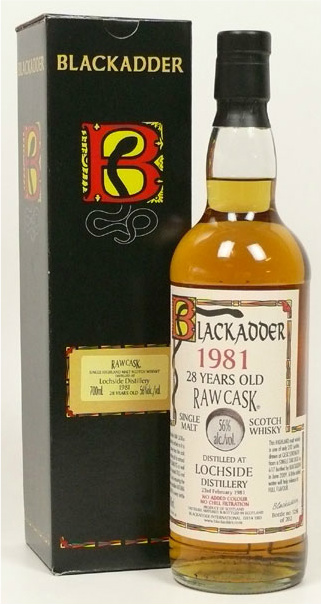 One from the (in)famous Raw Cask series. A lot of ‘stories’ are told about this one. For instance that Blackadder just throw any toasted cask trash they can get their hands on in there during bottling. That would be a shame wouldn’t it? Blackadder are also the people who bring us bottlings from the Aberdeen Distillers series and the Clydesdale series in the dumpy bottles.
 Taste: Wow, full body and spicy, Vanilla with apricot sauce. Nice! Yeah, this is it. Slightly beer like bitterness in the finish ánd black pepper. Alcoholic cherry bon-bon. Blueberry juice and creamy vanilla. Yes this has it all. When the bottle was opened at the Genietschap
 Color: Orange Gold
 Its raining like crazy outside, and I have this Port Ellen on my lectern, so probably no better moment to have a go at this. Seize the day, the moment is now! There may be no tomorrow! Heed the call of the elements!
 Color: White Wine.
 Master Quill