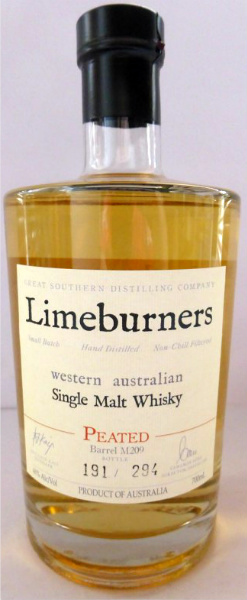
Limeburners Peated Single Malt (48%, Great Southern Distilling Company, Bourbon Barrel M209, 294 bottles)

After the funky mushroom Whisky from France, let’s try another ‘World Whisky”. This time we will look at a peated Limeburners single cask Single Malt Whisky. Limeburners is the brand name for the Single Malt Whisky from The Great Southern Distilling Company from Western Australia. They call themselves a boutique distillery with a focus is on quality. The plan is to source all ingredients locally. Nice touch is that the distillery is powered by the Albany wind farm and the Whisky is reduced with filtered rain water. How’s that for sustainability?

Limeburners M209 aColor: White wine.

Nose: Softly smoky and peaty. Fatty with lots of vanilla. Creamy. Leafy, vegetal and the oak almost smells freshly cut. The peat quickly takes the back-seat and lets the cask drive. The wood drives slowly listening to Lana Del Rey on the car radio. Hints of new make. Judging by the nose alone I would say, bottled slightly too soon and not as peaty as I expected. Given some time to breathe it seems like all of the aromas introduced themselves one by one, and now work together for a more balanced feel. More citrussy too, distinct aroma’s of soft (sugared) lemon. Am I still objective when I pair the soft lemon with lemongrass. Nice, but where has the peat gone? It’s almost a lowlander in style.

Taste: First entry is definitely new make, with its distinct alcoholic and sweet taste. Beer, hops, lots of paper, woody bitterness and again very green, leafy and vegetal. Fresh tree sap. Virgin oak cask? I also get some raspberry hard candy and creamy vanilla. Typical american oak vanillin. The peat only shows itself in some sort of spicy pepperiness. Not bad but nothing special yet too.

The nose already gave it away, but especially in the taste it is noticeable, this is a bit too young. Also the notes of virgin oak are quite “there” so I think at least this cask has some more to give to the next distillate that will enter it.

Points: 75

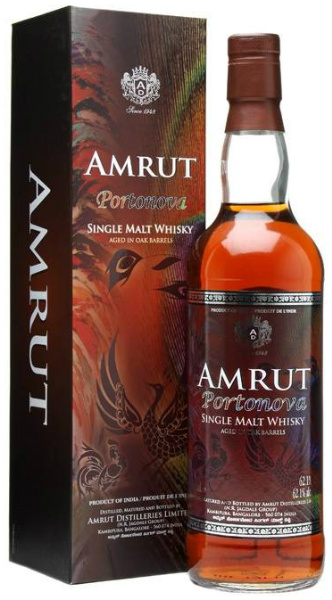
Amrut Portonova (62.1%, OB, Batch 5, 2014)

Ahhh, another Amrut. Nice. I had the pleasure to try some Amruts in the past and was very nicely surprised by the Intermediate Sherry (which I then bought) a Single PX Sherry Cask #2699 (which I then bought) and the Kadhambam (which I have yet to buy). I also tried the “plain” cask strength version, and although pretty nice, I preferred the former ones. Now this Portonova crosses my path. This time a Port finished Amrut, and yes, I have high hopes for this one too…

Amrut Portonova Batch 5Color: Light orange gold. No typical Port pinkishness.

Nose: Although this has a huge ABV, this doesn’t leap out of the glass. Give it some time and some dust and cinnamon emerges. Wow. Cookie spices, dried plums and raisins. Exotic and Christmas in a bottle. Fresh air after rain. Creamy and soft oak. Hot metal. Barley, but different from barley you get from (young) Scottish Whisky. Sweet milk chocolate and red fruit juice. Apart from this all, it has a sweet and deep feel. Exotic spices, curry, cardamom, but where is the Port? I already missed the pink hue, but I also miss its smell. Complex stuff this because there is even a lot more happening in the nose than what I noted here.

Taste: Condensed red fruits. Thick, but initially simpler than the complex nose promised. Obviously quite hot with this high ABV. The wood tastes more like paper and cardboard, than any kind of wood. Not a lot of the wealth of spices shine through on the palate, and that’s a shame. Its more a fruity Whisky with maybe some faint hints of Port. Vanilla comes next. With time if becomes more outspoken and creamy. Nice evolution though. Hints of banana in the aftertaste. Lovely.

First I have to air a disappointment. This would be a stellar malt if the spices from the nose were noticeable so more in the taste as well, without being overpowering of course. Missing the spices on the palate makes the taste of this Whisky a bit simpler than it could have been. Now that we have that out-of-the-way. The whole is still an utterly good Whisky. Very much recommended. An excellent winter warmer I would say. I will have to get me one of these soon.

Points: 88

Buffalo Trace (45%, OB, Circa 2013)

A new month, and maybe it just is time for something different. Different from Single Malt Whisky that is. More than three years ago, I reviewed a Single Barrel version of Buffalo Trace, selected by Binny’s. A barrel that otherwise would have been used for the standard bottling of Buffalo Trace. Up untill now, I even haven’t tried the standard Buffalo Trace bottling, so here it is, maybe long overdue on these pages, so without further ado, straight from Frankfort, Kentucky, USA, here is Buffalo Trace.

Buffalo Trace 45%Color: Orange Gold.

Nose: Yeasty with lots of honey. Hints of bread and some great fresh and sappy oak. Glue and corn. Toasted cask, sweet and spicy and slightly soapy. Hints of red fruits and dried apricots in white chocolate and a tiny hint of cherry liqueur. Next some dried leaves on the pavement (in November). Glue and soap don’t sound very nice, but I can assure you, it all fits together quite nicely. It smells quite modern and fresh, although some old planks from an old grocery shop are there.

Taste: Sweet and toffee. Creamy vanilla. Yes, toffee and caramel, with some prickling wood spice, soon to be countered by the initial sweetness of the Bourbon. However, this sweetness seems to come and go, switching places with a dry oak sensation. Hints of acidic red fruits, and some light candied oranges. It is quite mellow and much simpler than the nose was. I no way would I have guessed this to be 45% ABV. It seems lower, mellower. In the taste there isn’t a lot of evolution and there isn’t a lengthy finish, but it does leave a nice aftertaste. Don’t get me wrong. This is a nice Bourbon, that is easily drinkable. Definitely a very good entry-level Bourbon.

Here I will compare this Buffalo Trace to the Binny’s Single Barrel version I reviewed earlier. On the nose, The Binny’s version seems to me to have more depth and has an addition of florality to it (Lavender, fresh, not lavender soap). It also has more caramel and smells sweeter. Heavier on the fruit too. It simply has more aroma. Much less virgin oak but it does have some paper in stead. The rest of the nose overlaps with the standard version. In the taste it seems more similar to the standard version. Not a lot of difference in age or “thickness”. Just a little bit more added depth and slightly sweeter. The wood has a tiny hint of pine that is quite nice. The wood itself is less of the virgin type, and more of the old grocery shop plank type. It seems to be mellower and it doesn’t have the attack and the glue of the standard version. In the end, the Binny’s version offers a different take on the standard Buffalo Trace, but the quality is there in both.

Points: 82

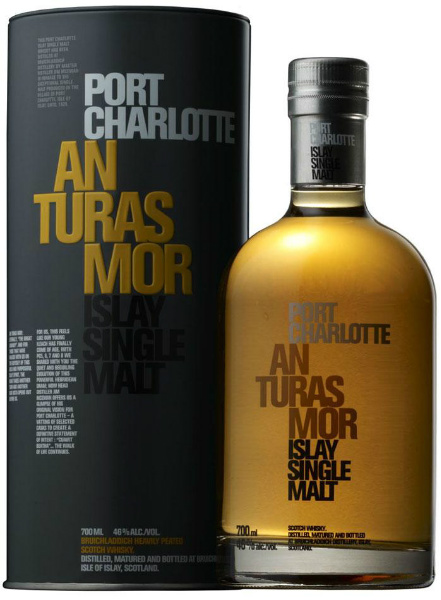
Port Charlotte “An Turas Mor” (46%, OB, American Oak Casks)

In 2000 Murray McDavid bought Bruichladdich for £6.500.000 (from Jim Beam, current owners of Bowmore and Laphroaig). After acquiring the distillery guess what was the first distillate made? Yes! Port Charlotte, not the unpeated Bruichladdich itself. The guys behind Murray McDavid are no fools. We all know Mark and Jim to be very shrewd guys. So the first stuff they wanted to make with their new distillery was peated Whisky. On the 29th of May 2001, the first Port Charlotte was made. The first Bruichladdich under new ownership was somewhat later distilled in July. (2001 which was also the year the first newly bottled Bruichladdich was released; the 10yo I just reviewed, the 15yo and the 20yo). Finally on the 23rd of October 2002 the first Octomore was distilled.

Port Charlotte "An Turas Mor" (46%, OB, American Oak Casks)Color: Pale gold.

Nose: Mild, fatty vegetal peat, with butter and vanilla, pepper and salt. It smells like lavas was one of the plants that makes up the peat. Quite soft and unobtrusive. Some smoke and a tiny hint of burnt plastic and traces of soap. Sappy licorice twig. Wood lying around in the forest. Fresh (air) and un-complex. Dry kippers with hints of tar. Dusty vanilla and some paper. Nice to smell. The nose is worth the price of admission.

Taste: Sweet and peat. Sugar water with slightly bitter peat. Sweet licorice and black and white powder (yes, licorice again). Slightly warming. Licorice and licorice twig. Very tasty (the sweetness helps it along), but not very complex, but who cares when it’s so drinkable. Reduced, brooding peat that resembles coffee a bit. After a decent body, comes alas a sort of weak finish. A finish full of paper, barley, hints of soap and sweet licorice, but I guess we can blame its youth for that.

Lots of young Whisky is noticeable in An Turas Mor, but it shows a lot of potential though. This will become a great peated Islay Whisky when it becomes of age. I feel that Port Charlotte is a sweet Whisky that can be high on aroma, but struggles a bit with its length when it’s young. Highly drinkable, likeable and definitely worth its money. Get it, it’s not as expensive as the PC’s.

Points: 84

Bruichladdich Classic Laddie Scottish Barley (50%, OB, 2014)

In the more recent past when Bruichladdich had different ownership, a lot of bottlings saw the light of day and a lot of bottlings comprised the standard range. Now that the distillery has changed hands and tries to be a fashion accessory, the stanf=dard range is reduced to only two NAS bottlings. Scottish Barley and Islay Barley. If my memory serves me well, all standard bottlings with an age statement have been dropped.

In 2013, this same Whisky was released with a somewhat different “label”. The first release had big lettering for “Scottish Barley”, whereas the 2014 release I’m about to try, has “Classic Laddie” in big lettering. I have tasted the 2013 version and scored that one 85 points. Let’s see if this newer version is equally as good.

Bruichladdich The Classic Laddie Scottish Barley 2014Color: Light gold.

Nose: Well this is a nose that screams Barley. Very young smelling and even has some Bladnoch-butter. Fatty, with a citrussy edge. Hints of new make spirit, and given some time to breathe, a more bread like, coffee and milk chocolate note appears. The whole is quite soft. Wet. fresh wood. Virgin oak. Nevertheless it is also recognizable as a Bruichladdich. It does remind me sometimes of the Cadenhead Bruichladdich 17yo I reviewed earlier.

Taste: Soft paper like wood and an extremely creamy taste. Coffee with a lot of milk. Chocolate milkshake. When the higher ABV flows down my throat a short flash of hotness flies by, but also dissipates quickly. Cream with a hint of ashes. Bourbon and vanilla, but also dark chocolate and a faint fruity note. Cherry liqueur bon-bon? Virgin oak again. Lots of barley (and sugar?) in the finish. Barley, oak and cream are the three words that describe this Whisky best I guess.

As consumers we are compensated. We get less ageing and less complexity, but we get more ABV. 50% to be precise.

Here we go again, another NAS bottling that will split the Whisky world in two. Definitely a young, crude and uncomplex Whisky, but at the same time a nice and designed sophisticated soft taste that a lot of people will like. The Bruichladdich spirit is a good spirit, but this spirit didn’t get a whole lot of time to develop. It’s like a child asked to drive a bus. Some would even say that this isn’t really Single Malt Whisky. If someone had invented this about a 1000 years ago, he or she, may have called it Barley Wine. Not bad, but not my NAS of choice.

Points: 81

Highland Park “Einar” (40%, OB, The Warrior Series, 1 Litre, 2013)

First we had a core range, after that came the special bottlings and since a short while we also have special series. Highland Park had a lot of success releasing Earl Magnus (a 15yo released in 2009), Saint Magnus (a 12yo released in 2010) and Earl Haakon (a 18yo released in 2011), one per year. Thus a series was born. Next series was the warrior series, specially released for travel Retail (airports, boats and so on). In statistical sales figures, travel retail bottlings are treated as a country! That’s how many are sold this way. The warrior series comprises of six different bottlings, all released in 2013: Einar, Harald, Sigurd, Ragnvald, Thorfinn and Svein. Next came not a “series”, but a “collection” called The Valhalla Collection. Thor (16yo, 2012), Loki (15yo, 2013), Freya (15yo, 2014) and Odin (16yo, 2015). Again one per year. Aptly named though, since those bottlings seemed to be snapped up for collections and not so much for drinking purposes. By now Whisky became a commodity for trade and not an alcoholic beverage. Not a lot of reviews exist of these bottlings, so they must be sitting on shelves of collectors, trying to sell the now complete collection of 4 to…other collectors. Yeah, this will work just nicely.

Highland Park EinarColor: Gold.

Nose: Sweet, mocha, vanilla (ice-cream) and a hint of funky Sherry, soft peat and wood. Tiny hint of cask toast and alcohol. Toasted bread and something meaty. Dried. Sweet barley, almost like corn. Sweet funky mud. This one does develop over time. Powdered sugar and a floral soap quality (not much). A likeable and un-complex nose. Not bad at all.

Taste: Sweet and candy like. Sweet, almost artificial, red fruit drops. Sugar water and vanilla. Sugar with a bite. A slightly bitter note of oak at the start of the finish, as well as a small gingery note. Also here is the funkiness I got in the nose, that seems Sherried. Too simple actually, but without off notes as well.

Very sweet and light Highland Park. Typical travel retail bottling. It’s a litre, its 40%, its light. Even a litre of this will be drunk at a fast pace, because to properly taste this you need to take this in big gulps. Not one to ponder over for many hours. A bit too plain and simple, not to say a bit dull. Is it bad then? No not really. It’s somewhat recognizable as a Highland Park and that’s no bad thing. It’s still a decent Whisky, that can only be surpassed by (a lot of) other Whiskies. Nothing to scoff about. Never the less, not something I would buy (I would buy the 18yo (if its a good batch) or even the Dark Origins).

Points: 78

The Glenlivet “Nàdurra Oloroso Matured” (60.7%, OB, First Fill Oloroso Sherry Casks, Batch OL0614)

Back in the lion’s den. Purely by coincidence, I recently reviewed some independent bottlings of Whiskies produced by distilleries of Pernod Ricard, like Braeval and Glenallachie, but also some official bottlings like Strathisla 12yo, Aberlour 16yo and The NAS Glenlivet “Founders Reserve”, but also the nice AS Glenlivet from 1983. Now another Glenlivet, and yet another new NAS bottling. I promise you, I’m not sponsored!

The Glenlivet Founders’ Reserve is the new entry-level Glenlivet that replaces the 12yo in Western European and some other markets except Asia and the US. This NAS Oloroso Nàdurra replaces the nice AS 16yo Nàdurra. I know, that one came from Bourbon casks only. However, the 16yo Nàdurra will be replaced by three new versions that will be called…Nàdurra. The first one of these is this NAS Oloroso version, soon to be followed by a NAS Bourbon version and later a NAS Peated version. Since both Aberlour and The Glenlivet have the same owner, everybody will be comparing this one to the Aberlour A’bunadh.

Glenlivet Nàdurra Oloroso Matured (60.7%, OB, First Fill Oloroso Sherry Casks, Batch OL0614)Color: Dark gold, copper gold. Quite light for first fill Oloroso.
Nose: Lots of vanilla, new wood and a bit sharp on first sniff. A breath of fresh air. Spicy wood and pencil shavings. I get a lot of pencil shavings recently, maybe its me. I don’t get a lot of A’bunadh like first fill Sherry though. Considering the color and also the way this smells, my guess would be that this Oloroso Nàdurra is younger than its sister from Aberlour. A’bunadh is pretty up front dark first fill Oloroso, and this Nàdurra is not. It really does smell like a young whisky with nice notes of wood without being overpowered. Nice, but not complex. The wood also gives off light chocolaty notes and some sweetish vegetal bits. Old bar of soap (from the eighties) and some licorice. For me a lot of these aroma’s come from wood and obviously from the Sherry used, but for me they aren’t typical Oloroso aroma’s you get from an A’bunadh. Wood it is then.

Taste: Sweetish and a bit hot. New wood, tree sap with its light bitterness. Coffee and licorice, a nice combination. Hints of glue. Prior to swallowing a hint of, and here it comes again, pencil shavings. We all have chewed on a pencil some time during our lives haven’t we? Italian laurel licorice. When the wood, a slight hint of bitterness, and the high strength pass, not a very big finish remains. Youth?

A young Whisky that by itself is a study of wood and not of Sherry. It isn’t complex, slightly underdeveloped, and it surely does have its moments. I guess the choice is right to think of this Whisky a bit as a Whisky for…well, not entry-level, by bottling this with a high ABV. Another good decision is probably that it is made to another profile from the A’bunadh which is more about the Sherry itself, whereas this is more about the wooden cask itself. Nice stuff, helped along by the high strength and spicy wood. Younger and really no match for A’bunadh in my opinion, but those who like higher strength Whisky, but found the A’bunadh too much, will disagree. (maybe a comparison to Benromach 10yo 100 proof would have been a better angle…)

Points: 83

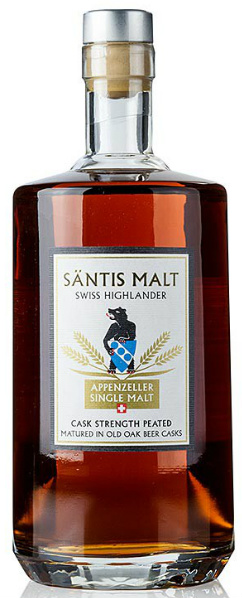
Säntis Malt Edition Dreifaltigkeit (52%, OB, Old Oak Beer Casks)

End of the line, for now. We finish our short trip in Europe in Switzerland to visit the Locher Brewery in Appenzell. Nothing more interesting than the quest to find Whiskies not from Scotland. Earlier I reviewed the entry-level Edition Säntis, which I found reasonable and showed already some potential. This time around we have quite a different Säntis Malt, which is called Edition Dreifaltigkeit. Dreifaltigkeit has been finished in a Sherry cask but also peated malt was used. Sounds good!

Säntis Malt Edition DreifaltigkeitColor: Vibrant orange brown.

Nose: Heaps and heaps of smoke, yet not a lot of peat (for a peated malt). Lots of fruit, black, red, the lot. Nicely thick, highly aromatic. Lots of fruity esters too. Sherried, meaty and fishy. Smoked sausage and a hint of smoked mackerel. You can name any meat or fish that has been smoked, it seems to be all here. When given some time, and air, an odor of stale beer enters the fold. I have the glass before me and at the same time was reading something, and some less than excellent sour whiffs fly by my nose. The initial fruit was stronger than the stale beer nose, but it seems they are trading places now. Just move the Whisky around a bit in your glass and the off note is gone. Dry and chocolaty notes enter late as well as dry horse manure. What a Malt! Great nose, up there with a lot of other great noses like this Longrow. Hope it tastes similarly good and we’ll have a winner here!

Taste: Taste wise it seems a lot simpler at first. First of all, it doesn’t seem to be 52%. I expected more of an alcoholic bite. It has some (bitter) wood, dust and paint. Dry paint residue and definitely some smoke, even in the taste. Sweetish fruits again (Sherry, Cream Oloroso or PX I would say) and just like the nose, a slightly acidic off-note. The off-note changes a bit and can be identified as beerlike towards the finish. Hoppy bitterness in the finish and also a sour note. The finish is long and shows the higher ABV.

The ultimate smoky malt. For me the Beer notes in this malt do not work, but they are well-kept in the background. I understand this is essentially a brewery, so it has ages and ages of history with making Beer, and using Beer casks, but this isn’t a Beer, its Whisky and it is proven over and over again, that Beer casks are not the best casks you can use for ageing Whisky. Having said that, this turned out to be a wonderful uniquely smoky malt. Recommended!

Points: 86

The Glenlivet “Founder’s Reserve” (40%, OB, 2015)

Just like the Berlin wall, old, well-known Whiskies that have been around for ages are coming down. We already see the manifestation of NAS Whiskies, you know the ones without the pretty numbers on the label: 10yo, 12 yo et cetera. It has recently been announced, by Pernod Ricard, that not only the Glenlivet 12yo will be discontinued, but also Aberlour 10yo. George Smith Founder of GlenlivetThis is moving in the wrong direction people! The Glenlivet 12yo has already been replaced with the new Founder’s Reserve, a highly original name taken from the old 10yo expression of The Balvenie. The Glenlivet already dropped the age statement for their highly popular Nadurra range, and are wooing the consumer to stay with Nadurra, by adding new versions. Bourbon, Oloroso and the next step will probably be a peated version. Other recent experiments were the NAS Alpha, and the NAS Guardian’s Chapter. We all know where this is going, don’t we. Lot’s of distillate will be put out as young NAS Whiskies, and the rest will be aged a prolonged amount of time to be bottled as (highly expensive) Whiskies which will still have an age statement. Yes, we should judge a Whisky by its taste and we will, and not by its age statement. Still, the super premium Whiskies will have an age statement, because age sells, people. Another experiment done by The Glenlivet is the release of an 11yo single cask for 300 Euro’s in the Netherlands, called Bochel (Hill). How far can you go? Let’s get back to the beginning, shall we? I already reviewed The Glenlivet 12yo, so we have a clue what that was all about. Now let’s have a look at its replacement. The NAS Founder’s Reserve…

The Glenlivet Founders ReserveColor: Light citrus gold.

Nose: Barley and aged spirit. Raw and yeasty. A big part of the beginning of the nose is made up of new make spirit. Apart from…new make spirit, I have never come across a Whisky that is so upfront and young. Obviously young. The new make note disperses and makes room for plain white oak. Does have some traits of Bourbon casks, but also of virgin oak casks. I hope this is still aged in casks, could be stainless steel with bits of wood thrown in. Sweet barley, yeast and oak. That’s more or less it with this Glenlivet. On top salty and estery. Well this is your wormhole that offers a peek of NAS Whisky. I guess a lot of entry-level, inexpensive Whisky of the future (and you know, the future starts now), will be like this. Perfumy and floral, latex paint with hints of mocha and still a promise of sweetness.

Taste: Sweet water. Sugary. Very, very, un-complex. Not even a lot of wood now. More (oak and pencil) wood in the nose. This is sweet balanced sugar-water with vanilla pudding and…yes, what else? Weak green, vegetal notes. In the background again the specific taste of new make spirit. This is an aged Poiteen! Short finish (obviously) and in my opinion too young, but still interesting…well, not really actually.

A long time ago, this would have been used internally to give the marketing people an insight into production methods and especially how Whisky ages. Who would have thought that today something like this would be actually bottled, and better even, replace the standard 12yo. Do I mean The Founder’s Reserve is bad? No, not at all. I love Single Malt Whisky and this is still is well made modern Single Malt Whisky. It’s just so obviously young and simple. They should have named it Baby Glenlivet. Benromach actually have replaced one of their NAS Whiskies with one with an age statement and calls it their 5yo. I’m curious how that one will compare to this one. I’m curious how these will compare to old 5yo’s (Tomatin, black label) and 8yo (Aberlour, cube bottle), but I’m also curious to see how the public will choose between NAS Whiskies and Whiskies with a low age statement. Interesting times ahead!

Points: 75

Aberlour ‘A’bunadh’ (59.8%, OB, Batch No. 13, 2005)

By now, batch no. 50 is the latest A’Bunadh released and when you are reading this, the number will be even higher. Saying that the A’Bunadh is a pretty popular bottling. Whisky always was intended to age in Oloroso Sherry butts. Today however, in general, there seem to be more Sherry butts available than the consumption of Sherry seems to warrant. Saying? There are some nice NAS Sherried Whiskies around, Glendronach, Benromach, The new Tomatin, but none of those are so heavy as this powerhouse from Aberlour. On average around 4 batches of A’Bunadh are released every year. Furthermore what makes A’Bunadh exiting, from my anoraks point of view, is the batch variation. Most batches are great and definitely worth the money. Sometimes something less interesting pops up like the notorious batch no. 40 from 2012. A few others from the 40’s range, were slightly less than perfect. I hope that’s not a trend. To be sure not to encounter another dud, let’s try an older version of A’Bunadh, with this lucky batch no. 13.

Aberlour ‘A’bunadh’ (59.8%, OB, Batch No. 13, 2005)Color: Copper gold. Not extremely dark.

Nose: Creamy raisins and vanilla. Creamy with a little backbone provided by toasted oak and maybe from the Sherry. Some more wood, typical oak, and some dust. A lot friendlier than I remember batch no. 33 was. pencil shavings. This is a tale about wood, just without the rawness of batch no. 33 (which actually came from the Sherry, not the wood). Creamy, raisiny and sweetish. With wood. That’s it. Not a lot of complexity, but also lacking some red fruits, Oloroso butts can give off. Nevertheless a very nice smelling dram.

Taste: Chocolate, Ferrero Rocher cherries, than wood, fresh oak and pencil shavings (cedar) and some hints of coal. Quite hot (not raw) when sliding down my throat. A classic combination of aroma’s from soft Oloroso. (It lacks the meatiness batch no. 33 had). Nice hints of mocha and whipped cream. Tiny hint of bitterness gives the finish some oomph.

I haven’t tried it myself yet, but I understand this takes water very well. That is an indication of a high quality cask (and Sherry it held), since more recent bottlings can get very hot, very hot indeed when water is added.

OK, why not. With water the whole softens up a bit, and brings the aroma’s closer together. The wood seems to stick out a bit more, which isn’t a problem. It momentarily also enhances the fruity part, and the bitterness of the finish. Toffee, caramel and oak.

Points: 88