And yes another Benriach and another one from Batch 3. After the 1968 Hoggie that scored 89 points and the 1984 peated Butt that scored 88 Points, let’s see if this 1976 peated Hoggie can finally break the barrier and score (well) into the 90’s.
 Color: Full Gold
Nose: Fruity and half waxy (it’s not Caperdonich 1972). The fruits would be Apricots, some peach again and strawberry jam. Creamy and spicy oak, malt and sawdust. A rather calm powdery nose. You know those hard candies made of compressed powder? Cold wet tea leaves. Distant sweets and very fruity. Again the yellow fruits. Apricots and peach minus the perfumy side of peach. There could be peat in this, but left in very minute amounts. After some time, smoke and banana. Peat?
Taste: Thick, spicy and waxy. Distant smoke and hints of black fruits. Sweet, nice balance. Work for it and you’ll be rewarded. Again a great sweet fruity malt. Peat maybe, but not as we know it. It’s not from Islay and this is not heavily peated. Just the right amount of wood (the 1968 had more wood).
Of the three I tried from this third batch, I like this best. Some would say the 1968, but for me this has more of everything. Rounder and better balance. OK, maybe simpler, but much bolder. This time the seventies over the sixties. It all just fits snugly, and the peat is so great in this!
Points: 91
 Color: Orange Gold.
 Well here is an example of the mother of all Single Malts. No it’s not the oldest distillery in Scotland, nor is it the first in anything. The oldest being Ferintosh at Ryefield (from 1689). The oldest still working distillery is Glenturret (1775). But once there was a time a lot of others added the “Glenlivet” to their own name to benefit from the success, and the known quality of Glenlivet, and who doesn’t know Glenlivet? Started in 1817 and ‘founded’ in 1824 when George Smith was one of the first to obtain a licence for his distilling. All of his illicit distilling neighbours, wanted him dead for it. Traitor!
  In 1845 George leased Minmore farm, which he bought in 1858. Minmore was renamed Glenlivet a year later and is the site of the current distillery. Funnily enough, Cadenheads also state the name “Minmore” on their Glenlivet offerings. George died in 1871. Long live George and to his health we raise the glass with this Berry Brothers & Rudd Glenlivet. Slainthe George.
 Balmenach was licensed in 1824, but existed much longer as an illicit farm distillery called Balminoch. Not earlier than 1992 the first official bottling is released, a 12yo Flora and Fauna. Not long after this United Distillers (now: Diageo) sold Balmenach to Inver House Distillers, with wich came an end to the Flora and Fauna bottling.
 Earlier I reviewed a very old independent
  Color: Orange Gold.
 Cardhu is a very special distillery in the portfolio of Diageo, since it is their biggest selling malt (Spain and France mainly), but when talking to other enthusiasts the response isn’t all that…well enthousiastic. There is only talk of old bottles of Cardhu. Since 2006 a special cask reserve is issued, which isn’t welcomed with open arms, but since it sells so well, it must be the ultimate entry-level whisky. Personally I don’t like it.
 Founded in 1811 by the illicit distiller John Cumming, who became legal in 1824. In 1884 the old distillery is replaced. Purchased by John Walker & Sons in 1893. Then in 2002 a small revolution took place. Cardhu, the whisky was silently changed into a vatted malt. (Several single malts blended together). The bottle and the label stayed the same, just the word ‘single’ changed into ‘pure’. Well this didn’t last long, in 2004 the ‘pure malt’ was withdrawn. Luckily in 2005 this 22yo was issued.
 One of the other gems he found there, was a very old 20yo Sestante Mortlach, so the theme for this year soon became Mortlach. I have to admit, I really love a tasting with a single distillery theme, especially when a lot of bottles are brought in. Strange enough that was not the case with Strathisla, but with Mortlach we had 14 of them, and an extensive aftertasting with some other gems. (Laphroaig 10yo unblended bottled in the mid 70’s!).
 The Old Train Line series is probably the series with the most beautiful labels I know. The series is bottled by German bottler Jack Wieber based in Berlin.
 Convalmore is one of those distilleries that is no more. Thinking of closed distilleries I alway think about Monty Pythons dead parrot sketch: It’s not pinin’! It’s passed on! This distillery is no more! It has ceased to be! It’s expired and gone to meet ‘its maker! It’s a stiff! Bereft of life, it rests in peace! If you hadn’t nailed it to the perch it’d be pushing up the daisies! ‘Its chemical processes are now ‘istory! It’s off the twig! It’s kicked the bucket, it’s shuffled off its mortal coil, run down the curtain and joined the bleedin’ choir invisibile!!
  Convalmore was founded in 1893. A large part of the distillery was destroyed in a fire in 1909. It was rebuilt with an added continuous still to make whisky at a lower cost. This didn’t work so the stills were discontinued in 1916. In 1962 the stills were heated indirectly with steam. Convalmore was mothballed in 1985 and the buildings were sold to William Grant & Sons in 1990, who use them for storing their own malts.
 The beer returns, with the wood, in the finish. Well its safe to say that this one is all about the wood. you don’t hear me say that it’s too much of overpowering. No. it is a woody whisky, but it is one of those that really should be woody. Wood is its strength. The rest of the body is firm enough to counterpart the wood. Again very interesting, but no easy dram. I hate the word, but this may be for connoisseurs only.
 I
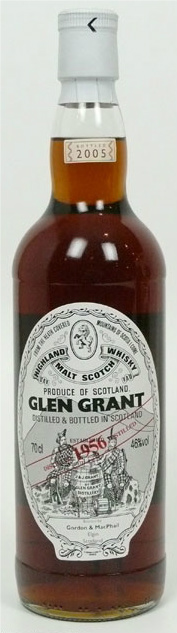
I  just had to write another one about Glen Grant. Do I really have to revert to Gordon & MacPhail to find me a good Glen Grant? There are a lot of great Glen Grants around, but are they bottles of the past maybe? Here I have another Glen Grant that as it turns out ís from Gordon & MacPhail. Will it be good or do Gordon & MacPhail also have some mediocre casks? This one is bottled for La Maison du Whisky who usually pick good casks, so no need to worry, this probably will turn out all right. Besides, this is no 70’s Glen Grant, but a 1956. The year Alfred Hitchcock became American and made
  Glen Grant if you want a good one. Well as I said there are a lot of other good Glen Grants around. We’ll have to keep searchin’ to find us one, but for the time being we’ll have this Gordon & MacPhail 1956, and that’s no punishment! The nose is to die for, that alone is worth almost a 100 points. But the whole I will score…
 Master Quill