 Clynelish is a very popular dram. There are several reasons why. First of all it’s a sister of Brora, which maybe the best malt of all. Second. Clynelish has a unique waxy personality and it’s spirit is always of high quality. It’s very hard to find one that is not up to par.
Color: Full Gold, almost Orange.
Nose: Clean. Paper and wood. Spice and white pepper. Oranges with almonds and toffee. Leafy, waxy and coastal fresh with some added sherry mustiness. Later on some vanilla ice cream, cardboard and dust. It stays spicy throughout. Perfumy and a beautiful balance.
 Taste: Spicy and definitively from a sherry cask. Wood, beer and spice again. Sweet and tarry. Shortbread and gingerlike. Turkish delight and has some traits of a Riesling wine. Full bodied. Slight sour wood and licorice on the finish.
I think it’s a bit of a shame this got bottled so soon. It’s good now, but what would this have been when it wood be several years older. Nothing here suggests its over the top or even near the full potential it could have reached. Nice Clynelish, always worth checking out.
Points: 86
 Glengoyne then. Glengoyne got my interest because they were one of the first to specifically state, ‘unpeated malt’ on their labels. Also, I like the looks of the bottle ánd for still using Golden Promise amongst other barley’s of course. Golden Promise is somewhat of the holy grail of grains, because it is supposed to be very flavoursome. But the yield is not so good, compared to the favorites of today (which make all whiskies taste the same, to come out bluntly). So lets see if this one, and remember this is a fairly priced bottle, makes a golden promise.
 Taste: Toasted wood, but still a lot of yeast. Can’t shake the Sherry here. High proof, so it makes an impression. Although this has bold flavours, the quality of the spirit shines through. Very Ahorn syrupy sweet, and corn sweetness, that’s totally different from the Ahorn. It almost tastes like a wheater! This could be a Weller, with some sherry musty and creamy yeastyness. It’s a picture with thick broad strokes. It is thick.
 Convalmore is one of those distilleries that is no more. Thinking of closed distilleries I alway think about Monty Pythons dead parrot sketch: It’s not pinin’! It’s passed on! This distillery is no more! It has ceased to be! It’s expired and gone to meet ‘its maker! It’s a stiff! Bereft of life, it rests in peace! If you hadn’t nailed it to the perch it’d be pushing up the daisies! ‘Its chemical processes are now ‘istory! It’s off the twig! It’s kicked the bucket, it’s shuffled off its mortal coil, run down the curtain and joined the bleedin’ choir invisibile!!
  Convalmore was founded in 1893. A large part of the distillery was destroyed in a fire in 1909. It was rebuilt with an added continuous still to make whisky at a lower cost. This didn’t work so the stills were discontinued in 1916. In 1962 the stills were heated indirectly with steam. Convalmore was mothballed in 1985 and the buildings were sold to William Grant & Sons in 1990, who use them for storing their own malts.
 The beer returns, with the wood, in the finish. Well its safe to say that this one is all about the wood. you don’t hear me say that it’s too much of overpowering. No. it is a woody whisky, but it is one of those that really should be woody. Wood is its strength. The rest of the body is firm enough to counterpart the wood. Again very interesting, but no easy dram. I hate the word, but this may be for connoisseurs only.
 Instead of expanding into unchartered territory, let’s do something oppositional and do yet another Port Ellen, and another bottle by Douglas Laing. This time from the old series in the normal scotch whisky bottle and not from the new tall bottle. People tend to think this older look contains better whisky. Let’s see if that’s true. By the way ,I read somewhere that in the few months Port Ellen operated during 1983, there weren’t a lot of good casks around, and they filled almost anything they could get their hands on. This Port Ellen looks quite light in color. Is this from a tired butt or a normal refill Fino butt?
 Taste: Peat and rhubarb. Sweet, big, leafy and chewy. Black tea with clean refined sugar. No rubber here and it’s no monster either. The peat is very mild here and the finish is quite simple. Still it seems to be very balanced, just not very complex. It has the dryness and a bit of the spiciness of the oak, but not the bitterness, and that’s a big plus (not a Chevrolet). It has citrus with cardboard in the finish. If tasted blind, I would have thought it to be some odd ten years younger.
 It’s an end of an era, even if it was a tired cask, this is still very typical and good. Really a shame this got closed. In a way it resembles Talisker in it always being decent. This may be no high flyer, but is has a lot of fine moments to give. No I’m not sentimental, this is good in itself. A very nice Islay Whisky. As I’m sipping the last few drops: “Here’s looking at you kid…”
 This Port Ellen is from Dutch retailers
 Don’t smoke or eat. Just you with this Port Ellen. It has balance and complexity, but seems so fragile.
 I
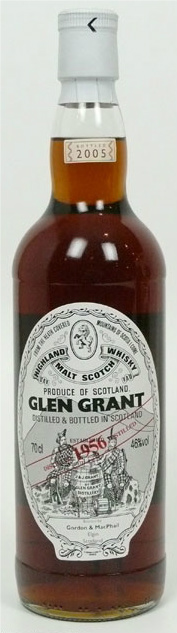
I  just had to write another one about Glen Grant. Do I really have to revert to Gordon & MacPhail to find me a good Glen Grant? There are a lot of great Glen Grants around, but are they bottles of the past maybe? Here I have another Glen Grant that as it turns out ís from Gordon & MacPhail. Will it be good or do Gordon & MacPhail also have some mediocre casks? This one is bottled for La Maison du Whisky who usually pick good casks, so no need to worry, this probably will turn out all right. Besides, this is no 70’s Glen Grant, but a 1956. The year Alfred Hitchcock became American and made
  Glen Grant if you want a good one. Well as I said there are a lot of other good Glen Grants around. We’ll have to keep searchin’ to find us one, but for the time being we’ll have this Gordon & MacPhail 1956, and that’s no punishment! The nose is to die for, that alone is worth almost a 100 points. But the whole I will score…
 I did some rummaging in my boxes with samples and found another Glen Grant. Well I actually found several of them, but I just chose this one. You know Glen Grant, the place that was the first distillery that was illuminated without burning fuel by themselves. This time we have a Glen Grant bottled in the Old Malt Cask series by Douglas Laing. Again in the new tall bottle, just like the
  Color: (Light) gold.
 Color: Copper gold.
 Interesting about Benriach is that a lot of experiments were done there during the seventies (and eighties). Tests with peat, new oak etc. Lot’s of those experiments are released today.
 Enjoyable, recommendable and very fruity. It could have gained triple A status if it would have some added bits that would counterpart the fruit. It is good/great, but lacks some complexity you would have expected of such an old malt.
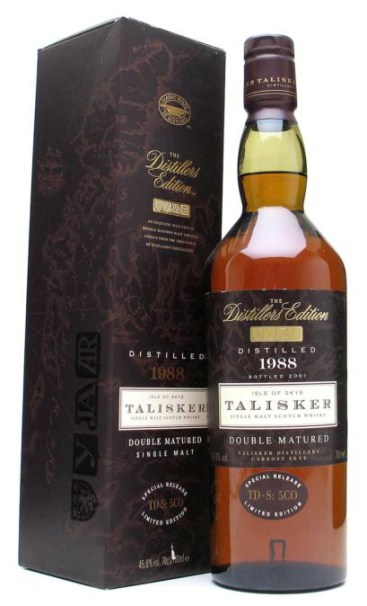 We’re on a roll with those Taliskers, so why not continue the saga with another one. Maybe this less recent Distillers Edition? The Distillers Editions are finished expressions of the ‘normal’ Classic Malt line and was introduced in 1997. Then Cragganmore (Ruby Port), Dalwhinnie (Oloroso Sherry), Glenkinchie (Amontillado Sherry), Lagavulin (Pedro Ximinez Sherry), Oban (Montilla Fino Sherry) and Talisker (Amoroso Sherry) got treated to a happy marriage with a Sherry or Port. All said to be complements to the original style of the distillery, not overpowering it. Due to the success of the new range, expansion was to be expected. In 2006 a Distillers Edition of Caol Ila (already in european oak!) finished in Moscatel and Clynelish finished in Oloroso Sherry was issued. And last but not least in 2008 Royal Lochnagar finished in Muscat was issued. We’ll probably see more expressions released in the near future.
 It’s not mere months the whisky was finished, but probably longer if not a few years. The oak is in the same spot where normally the pepper attack would be. I for one can’t detect the pepper anymore in this, and that’s a bit of a shame. Thick round body with a floral touch, violets maybe. I know that added caramel rounds out a body, but it seems to me the Amoroso does that trick here. Compared to the 10yo, this is more…ehhh round. All the extremes are toned down. Chewy and sweeter than the usual 10yo. Just a tad less balance in the finish.
 Master Quill