By special request a Talisker 10yo. Alas I don’t have a recent one open, so I’ll have to review an older expression that was bottled some ten years ago. I think this was from 2002 (L15R00029697), but it could be even some years older than that. Lot’s of names to distinguish the looks of the bottle, but this one should be the Map label (in Cream map box and a Brown glass bottle). Just have a look at the picture.
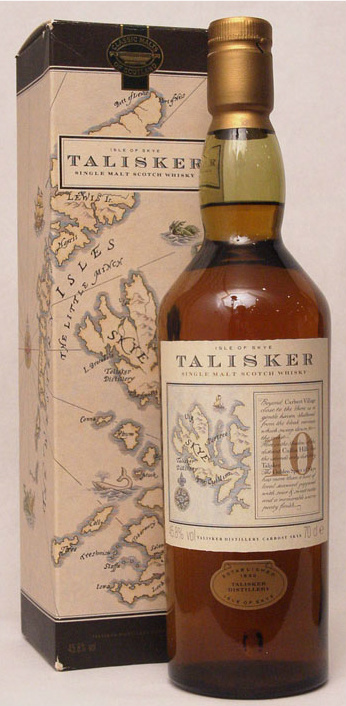 For those of you who have read my review of the 25yo from 2006, I don’t have to mention again how great I think Talisker is and how they are keeping the usual suspects on a high level of quality. Also consider the amount of Talisker they make these days!
Talisker saw the light of day in 1830. For a long time even, Talisker was triple distilled, but they stopped doing that in 1928. Like any good distillery they also had a big fire (1960). Talisker returned to form just two years later with exact copies of the destroyed equipment, mainly the five stills. In 1972 the malting closes. After that once in a while some equipment is replaced, but nothing major.
Color: Gold
Nose: Yeah, this is the good peat! Very elegant and classy! After that creamy and toffeelike. Fern, clay, plants on wet soil. Hints of orange skin, no tangerine skin. Warming nose and given some time it even gets salty which really is rather silly in a description of the nose. This really is what I like.
Taste: Sweet, pepper attack, pepper as in black-and-white power or licorice. Hint of apple instead of citrus. Again elegant and balanced, and really no wood to speak of. The pepper attack stays on the tongue for a while and get some toffee in. So nice. This really shows you it’s the base of the 25yo’s to be. Its nice, but shows you the potential in growth. Such a shame there isn’t a cask strength version of this. That really would have been something.
 This profile is great and if you want this, you’ll have to pay some serious cash to buy yourself an old Islay whisky or even Brora. I know, an older expression of the standard 10yo Talisker is getting more pricey lately, but still nowhere near to the prices asked for the aforementioned bottles. Do yourself a favour and get it while you can, and beware, this is dangerously drinkable. This will be empty before you know it. I left myself a 125 ml sample of this, but I almost drank it all writing this! Stay away, just drink milk instead, its good for you, unless you are lactose intolerant I guess.
Points: 88
 When the moment comes these are really sold out, those boycotters will shoot themselves in the foot, especially when looking at whiskies issued today and what you can get these days for 250 Euro’s.
 Taste: Sweet and ashy and endless depth. Great latent sweetness. Burnt toast. Very nice peat. Clay and milk chocolate. Cow dung (Yummie). Licorice, black and white powder. Just fantastic. Slightly sour wood in the finish but that fazes out, and the fantastic Brora returns to keep on lingering in your mouth. The taste it leaves in your mouth is very nice. Long finish.
 Color: White wine, light gold.
 I once had a similar bottle of Tormore that was even stronger and older (13yo, 63.9%, 85 Points). There were many things wrong with it, like a very metallic taste, but still I had a lot of fun with it, when ‘enjoyed’ at the right moment. I found myself another bottle before it completely vanished of the face of the earth.
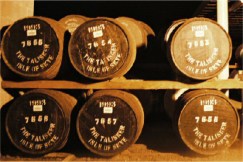 And here is Talisker. Talisker is a favourite of mine, a love affair maybe. It is a unique distillery on a unique island. Talisker is always good. So many big names from the past have slipped, some where good in the 60’s, but not now, some were good in the 70’s, but not now. Talisker isn’t one of them. Just buy any Talisker 10yo and it’s great. Even the worst Taliskers are still good. So the quality is alway delivered. Kudo’s to the people of Talisker. And when Talisker went cheating (Cask sold of to brokers or independent bottlers), Talisker was still very interesting. Just have a look at the different Taliskers issued by Douglas Laing, (as Director’s Tactical). All those casks were probably sold off since they didn’t possess the typical Talisker markers. Peat, pepper and so on. But give these a chance and something extraordinary is revealed to you about the Talisker spirit. And again even the worst Taliskers from them are still good. That’s why I like Talisker very much.
 Strange enough Talisker was never issued as a Rare Malt. But saw the light of day in many forms in a Special Release. As a Normal release we have the 10yo, 18yo and the distillers edition (finished in a Amoroso Sherry cask). And de standard Special releases were the 20yo, 25yo and the 30yo. The 20yo was released in 2002 and 2003, the 25yo was released in 2001 and from 2004-2009. The 30yo was released from 2006 untill 2010. In 2011 there were no Taliskers anymore, just a 34yo from 1975, that cost a pretty penny.
 Taste: Pepper! Animalesk. Sweet and woody (a bit sour). The clay from the nose comes through big time. Ash, almonds and putty. It has some sweetness hidden in the clay, but that disappears quickly. This is some great full-bodied stuff. The finish has some wood in it, slightly bitter and could have been a wee bit more balanced. Water does little for this whisky, so you’d better not.
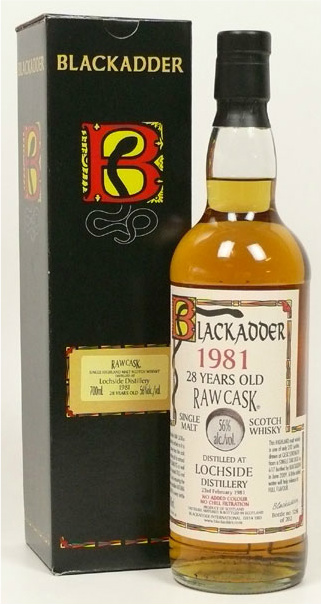 One from the (in)famous Raw Cask series. A lot of ‘stories’ are told about this one. For instance that Blackadder just throw any toasted cask trash they can get their hands on in there during bottling. That would be a shame wouldn’t it? Blackadder are also the people who bring us bottlings from the Aberdeen Distillers series and the Clydesdale series in the dumpy bottles.
 Taste: Wow, full body and spicy, Vanilla with apricot sauce. Nice! Yeah, this is it. Slightly beer like bitterness in the finish ánd black pepper. Alcoholic cherry bon-bon. Blueberry juice and creamy vanilla. Yes this has it all. When the bottle was opened at the Genietschap
  And here is another whisky from my lectern. This time an old (bottled in 1999) Craigellachie from Scott’s Selection. The people who brought us the fabulous Longmorns from 1971. Therefore I always have a soft spot for these guys. This Craigellachie was opened on our
  Color: White wine.
 This should turn out to be a very interesting review. If not for you, than certainly for me. Mr Bladnoch, Raymond Armstrong has a lot of fans, just have a look at the
  After giving the whisky some time to breathe it gets somewhat more balanced and friendlier, some nice spices shine through, with just the right amount of wood. It just doesn’t shed its new-make-and-wood finish.
 Points: 77
 And here’s yet another Speysider and not just any Speysider but an example of Speyside’s finest distillery…probably. Just consider the statement for a moment (maybe not if you’re called Luc). There’s also Macallan, Longmorn and Strathisla in Speyside. I know there are others, but I didn’t want to make this list too long. Glenfarclas isn’t mentioned on the label, but let me tell you this is a Glenfarclas, and a very old one too. I have tasted several very old Glenfarclas, and sometimes they tend to be very woody, but that’s also because there are a lot of very old Glenfarclas around, and 42yo is a long time to spend in a cask. I’m 42 now and I wouldn’t want to spend my whole life in a cask.
 To the whisky then. Glenfarclas is still a family owned operation that started legally in 1836. In 1965 it was bought by John and George Grant. Since then there were a lot of Georges and John Grants. Very popular names indeed in that family (and The Beatles for that matter). Sometimes they have extra letters for identification purposes.
  Next time I’ll be up at Glenfarclas, I’m dying to meet Ringo S. Grant! Good to see a still family owned distillery surviving competing with the big conglomerates like Diageo. There are several more like Bladnoch for instance. Power to them!
 And here’s already the second Strathisla by Gordon & MacPhail. This one has bottlecode SC999 and Gordon & MacPhail used these bottles roughly between 1981 and 1987. But if I would have a guess, this seems to be closer to 1981 than 1987. And thus this would be a late fifties distillate! (And the previous 15yo Strathisla, one from the mid seventies). That’s quite a difference and will probably be evident in the taste and smell. Also note that this 25yo is notably darker. Like the 15yo, this bottle was also bought for a
  Just have a go at this standard G&M, 25yo Strathisla, and find yourself a sweater made from those fabulous looking Strathisla sheep!
 Color: Orange Gold
 Master Quill