Springbank 15yo (46%, OB, Circa 2003)

So the Springbank 10yo is always a nice dram and really affordable to boot. Springbank 15yo is usually quite a different dram, never simply only an older version of the 10yo. We already know there always is quite some batch variation with Springbank, and we love that. Not every consecutive 15yo is similar to the previous one, and now the 15yo is not a mere step up of the 10yo. Apart from the taste of it, probably the reason a lot of anoraks love Springbank. So without further ado lets finish off this rotten year 2015 (at least for me it was) and aim for a better year in 2016. So I’ll see you again next year, in good health. Slainthe!

Springbank 15yo (circa 2003)Color: Orange gold.

Nose: Funky Sherry, right from the bat, mixed with fresh air. Something completely different from the 10yo. More fruity with fruity acidity from all kinds of different fruits. Apply acidity as well as acidity from dark fruits. Dry and dusty. Lean and sharp, as opposed to the fatty vanilla from the 10yo. It’s not just an older version of the 10yo. Small hints of peat as well as (only) a small hint of the clay and wax from the 10yo at first, but these aroma’s, as well as the sweetness, develop a lot over time, so give it time to grow. Wonderful stuff.

Taste: Sweetish, red fruits, cloying syrup. A bit Port like. Toasted cask. Peatier than the 10yo, but the peat is well hidden behind the Sherry notes. Definitely a lot drier and fruitier from the 10yo. Alas, just like the 10yo, this has not the longest of finishes and the aftertaste is not particularly big as well. Lovely development towards more fatty peat and oil and sweet tar and a hint of licorice and sugared black tea. Extremely well made and balanced.

I remember when this was released, it wasn’t a very popular bottling. Sure it deviated quite a bit from the usual Campbeltown profile. Even today the 15yo isn’t the most popular Springbank. People seem to dish out more for the old 10yo than for this old 15yo. I’m just happy it is here and it is different from the 10yo. I love both, but for me the Sherry brings something new to the Springbank table, and therefore will score this slightly higher (and because I like it more).

Points: 86
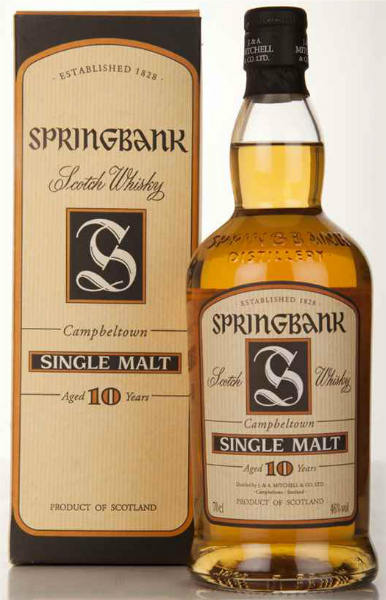
Springbank 10yo (46%, OB, Circa 2003)

So I guess you managed to survive Christmas, congratulations! Christmas is over, but the year is not. There are still a few days left before this year is over, so I dug up two Springbank Whiskies from some twelve years ago. It’s not long ago since I reviewed a more recent 10yo from 2010, so its nice to see how this older version “behaves”. Yes, I said two Springbanks, so the last review on these pages for this year 2015 will be its brother (or sister), the 15yo, from the same time as this 10yo.

Springbank 10yo (circa 2003)Color: Gold

Nose: Oily and fatty. Typical Springbank. Warm barley.  Creamy sweetness. Vegetal. Lots of vanilla, vanilla sugar, vanilla pudding. Nice soft wood. Warm sugar-water. Amazing how sweet this actually smells. Dusty and powdery, but again think creamy and vanilla. Sure it shows its typical Campbeltown profile, but believe me, this is nowhere near the complexity of the current 10yo. Almonds and slightly acidic crushed beetle (with a hint of banana and paper), combined with more and more dusty and dry oak. Tiny hint of smoke and maybe some freshly cut muddy peat, but in fact it is hardly peaty at all. Seems a bit simpler compared to more recent offerings of the same age.

Taste: Sweet it is. Oily, nutty and slightly industrial. Lots of clay. Sweet toffee. Chewy. Very big aroma. Typical Campbeltown. Sugared fruits and again quite a lot of wax (and clay). Warming with noticeable peat this time. After a while a citrussy and fresh note appears. Lemon curd, not sharp lemon by itself. Lemon captured in sugar. After the big and sweet body, I didn’t see the rather weak finish coming. The nose still oozes aroma of wax, clay and wood, then you sip it, and it is big and sweet, and then it starts to leave the building rather quickly. The aftertaste is slightly off with oaky acidity.

It different from the 2010 10yo, but both are great. If you can get this one for not too much money, I would say pick it up. It’s good and very educational compared to more recent bottlings. Where every other distillery try to manage some kind of consistency, Springbank is not that anal about it. The Campbeltown profile is pretty specific, so I don’t think its customers are seeking consistency, but rather welcome the evolution over the years as well as the batch variation that is clearly the with all of Springbank’s products. One of the Whisky nerds favorite distillery, and you are probably one of them, and just like me, proud of it.

Points: 85

Caol Ila 13yo 1990/2003 (55.6%, Gordon & MacPhail, Reserve, Cask #1114, 283 bottles, JC/GF)

I got up this morning seeing that it is a nice and sunny day, just with a chill in the air. Ice on the windscreen, and couldn’t be bothered de-icing the car, so I did the school run on foot. Luckily no wind so it wasn’t so bad. Walking towards the winder I did pick up the inspiration to review some Islay Whisky. Yeah! Rummaging a bit in the sample bank I dug up two Islay babies, that will together well, or make for interesting comparison. Once not so readily available, today impossible to miss. Caol Ila is the name and peat is the game. I love Caol Ila because it ages really well. So lets educate myself and have a look at a younger example of Caol Ila. This 1990 Caol Ila was bottled by Gordon & MacPhail in 2003. The outturn was 283 bottles at cask strength, and considering the color and wood management policies at G&M, I would be surprised if this wasn’t matured in a remade Bourbon Hogshead although a Fino or Manzanilla Sherry hogshead is also possible. Two of its sister casks were also bottled in 2003: #1115 (JC/AEG) and # 1116 (JC/CEB). More sister casks exist. In 2011/2012 at least three more were bottled: #1120 (for La Maison Du Whisky, France), #1121 and #1122 (both for Van Wees, The Netherlands).

Caol Ila 13yo 1990/2003 (55.6%, Gordon & MacPhail, Reserve, Cask #1114, 283 bottles)Color: White wine.

Nose: Dry and smoky peat, with an underlying sweetness. So it’s not the fatty peat you sometimes get. This is drier and a wee bit more spicy. Cow organics in cold weather. With hints of hay and quite some buttery and lemony notes as well as hints of shiny aromatic apple skin (not acidic). Some flowery elements were present in the peat, lavender as well as there is some crushed beetle (sounds strange doesn’t it?). Vanilla and more creamy, fresh buttery notes. The wood smells a bit meaty and well aged, so not young and sappy. Hints of cured meat. Smells a bit toned down and maybe older than it actually is. Very well-balanced. More about fresh and fruity notes than heavy peat. Accessible. Garden bonfire burning off old branches combined with powdered vanilla and powdered coffee creamer. It’s not really a big Whisky, but a well constructed one. Wonderful nose, especially by the wonderful vanilla and floral nose. I would say Fino Sherry hogshead. made from American oak.

Taste: More peat and quite sweet, which works quite well this time. There is enough going around to balance the sugary sweetness out. Burned leaves and a lot of vanilla and clotted cream, custard, pudding. These notes are quite big and it takes a while for those to pass, to let a more paper and (spicy) wood note through. Distinct hints of soap. It breaks down a bit in the finish, with a creamy note that goes down my throat, but in the same time a more acidic wood note stays behind in the roof of my mouth, the soap also has some staying power under my tongue. These flaws are easily forgivable, looking at the whole. Good Caol Ila.

This went under the radar a bit when it came out, as well as its sister casks, but what a treat this is. Definitely American oak and probably Sherry that aged under flor instead of Bourbon. All aroma’s work together well. I wish I had more of this, but at least I had the experience of a whole bottle of this. Worth seeking out at auctions, but a lot of it was probably drunk back then.

Points: 87

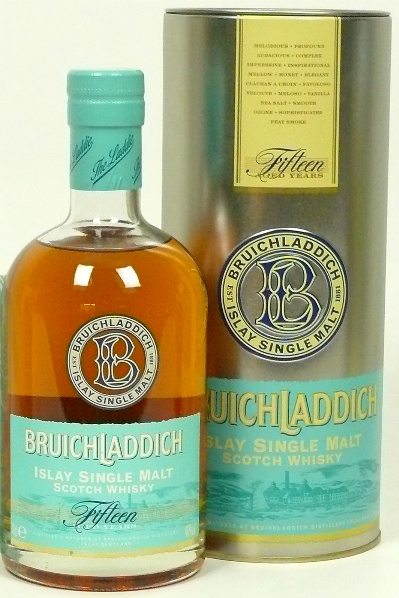
Bruichladdich 15yo (46%, OB, First Edition, 2003)

Earlier I reviewed the Bruichladdich 10yo. That was one from the first batches to be released, right after the distillery was sold to Mark Reinier & Co. The first releases were that 10yo, the 15yo I’m about to review and a 20yo. Ten years ago that is how a standard range looked. Age was everything back then. Today we’re not that far removed from an age, where age statements seem to be only for people with Lamborghini’s. Real ones, and I don’t mean the tractors too. It’s all about demand people. The 10yo I mentioned before didn’t float my boat, so I’m not sure what to expect with this 15yo. Let’s have a go shall we?

Bruichladdich 15yo (46%, OB, 2003)Color: Medium gold.

Nose: Reminds me of the 2003 10yo with just some more of everything, in fact, this one doesn’t want to stay in your glass! Fresh citrussy barley. Hint of peat and a little bit of smoke. Smells quite sweet for such a Malt. Garden bonfire. The sweetness is fatty and oily, or you can call these aroma’s well-integrated.  The more I smell this, and the more air it gets, the better it becomes. By now it’s already way better than it’s 10yo brother (or sister). Nice succulent wood, again integrated with the sweetness. Hints of vanilla, not much, and fresh, some distant fruitiness. I spoke too soon. The vanilla part grows bigger with more air and becomes creamy. Sweet yoghurt with peach. Lovely. Great balance and quite appetizing. I hope it tastes as good.

Taste: Quite sweet and very creamy with a woody, bitter edge to it. Again the sweet yoghurt with peach and toffee. Reminds me a bit of the great Bourbon casked Whiskies from the seventies. Great entry and a similarly great body. Not a lot of development though, but with something that tastes this great, who cares? Towards the end of the body the slightly peated toffee sweetness takes a step back and lets the wood through. It’s there, without taking over, barely though. You felt it coming: “but”. The flaw is in the finish. It breaks down a bit and is slightly shorter than the nose and the great body suggested. A wee bit too much reduced? Yes I know, its 46% ABV., but that doesn’t matter. This is how reduction with water, sometimes alters the finish. The aftertaste moves in to the territory of soap and stale beer and a minute amount of hops, but that sounds worse than it actually is, so don’t worry. Not a lot is left in the aftertaste, and there is only one remedy for that. Take another sip so it all starts all over again.

Points: 85

Evan Williams 10yo 2003/2013 (43.3%, OB, Single Barrel #654)

Whisk(e)y certainly is a very global thing. Just read back a few posts and we have already been in Speyside, Scotland, Bangalore, India, and for this review we’ll cross another big Pond to have a look at a Bourbon called Evan Williams Vintage 2003 from Kentucky. This is a single barrel bottling. The barrel was filled on the eleventh of february 2003 and bottled on the last day of July 2013. Evan Williams himself, was a character who at the time of choosing the name, was supposedly the first person to distil Whiskey in Louisville Kentucky. In the end we may never know who was the first since not a lot is known from that time. Evan Williams Straight Bourbon Whiskey is made by Heaven Hill Distillery in Louisville, Kentucky, but bottled in Bardstown, Kentucky. Today the range consists of a Black Label, a Bottled in Bond (White Label) a 1783 (small batch) and we will have a look at this 2003 vintage single barrel. In the past also a special 23yo was released.

Evan Williams Vintage 2003Color: Light orange gold.

Nose: Nicely sweet and toffeed. Good wood notes. Nutty and organic. Very spicy, balanced with quite some vanilla from the virgin oak. Pencil shavings, sawdust and quite a lot of honey and hot bees wax. It also carries hints of grass and cherries. Smells strict and modern.

Taste: Initially light and vegetal. Dry leaves, soft oak, but quickly followed by a nice mixture of wood and sweetness, with a hint of licorice. Very appetizing and likeable. Short finish, and the its way to light too. The watery finish drowns the plethora of aroma’s that are still there. Bummer. Luckily it does leave a pleasantly sweet, sawdust and honeyed aftertaste.

What baffles me the most is the strangely low ABV for a super premium bottling Bourbon, especially since there are quite a few other expressions of Evan Williams around that are also low proof. Maybe this is Heaven Hills low proof Bourbon brand? This is a very nice Bourbon, but still seems to be marketed as an easy drinking Bourbon for the masses despite its super premium status. I would like to see a single barrel bottling like this, (with this mashbill and ageing plan), to be bottled at barrel strength. Not necessarily replacing this reduced version though. I would like to see it as an addition.  I’m hoping that cask strength vintage Evan Williams can be really a stunner. Sure Heaven Hill has other brands, but I like the taste and the flavor profile of the Evan Williams and would like to try it at cask strength. Please?

Points: 84

Bruichladdich 10yo (46%, OB, 2003)

Earlier I reviewed the most recent, standard range, Bruichladdich from the Dumpy OB era: the Scottish Barley bottling. Today we’ll have a look at the one that started it all for the previous owners. A short recap is in order I guess. In 1994 Bruichladdich was closed (again) since not a lot of Malt Whisky was needed back then. In 2000 Bruichladdich was taken over by a group of people fronted by Mark Reinier (of Murray McDavid), who in turn, asked Jim McEwan to take on the post of master distiller and (progressive) production director. Who would have thought Jim to ever leave the Bowmore building. In 2001 Bruichladdich was reassembled, without making it a computer driven modern distillery and without disturbing the Victorian bits as well. If memory serves me correctly, by 2001, three bottles were released as some sort of core range. A 10yo (this one), a 15yo and a 20yo. So this 2003 bottling, is one of the next batches after that. Yes no NAS bottles back then yet!

Bruichladdich 10yo 2003Color: Light gold.

Nose: Light, sweet barley. Extremely dusty. Paper. Dishwater citrus, but also perfumy wood, otherwise not a lot of wood noticeable. Pretty fruity. Thick sugared yellow fruits. Some pineapple and papaya with a slight hint of mint and cardboard. Somehow it smells sugary with hints of toffee and caramel. No peat.

Taste: Paper and a sweet woody note. Also something metallic. Perfumy too. It tastes almost the same as it smells. A bit hot on entry, but quickly dissipating the heat. Citrus fresh, but not of the dishwater kind. Rhubarb and again some caramel, which moves into toffee towards the finish. Hints of mocha and wood. Some woody bitterness helps the Whisky along. To my amazement, the dishwater component returns.

The current entry-level Bruichladdich is the NAS Scottish Barley and as luck would have it, I still have that one here too! The Scottish Barley has a lot of butter on the nose, but the fruit reminds me of the 10yo (but only the fruit). Definitely a younger Whisky. More raw and closer to new make spirit. It even has a tiny amount of smoke (and a wee bit of peat and oil, since it resembles Springbank a bit), which is nice. Tastewise the NAS is even simpler than the 10yo, more on barley and lacks some of the off notes of the 10yo.

I was never a fan of the 10yo, and after more than ten years, I still don’t like it that much. The Scottish Barley however, reminds me of Springbank, and even though it is simpler, less complex, in this case I prefer the NAS over the 10yo. (The “Yellow Submarine” I had next, was definitely better than both)

Points: 78

Linkwood 13yo 1990/2003 (43%, Jack Wiebers Whisky World, Castle Collection, Cask #1922, 120 bottles)

This time we will have a look at a Linkwood from the rather obscure Castle Collection by one of Germany’s finest: Jack Wiebers Whisky World. Not a lot of pictures can be found of any bottle from this series. I still have the Linkwood bottle, but it is rather empty, so not so nice for a picture. Alas no true picture of this particular Linkwood. Most Whiskies for this series were reduced to 43%, although the odd cask strength version does exist. Besides reduction it doesn’t seem to me, that the whole cask was bottled. Usually only around 105 to 120 bottles are bottled per bottling. Yes I did that on purpose. It’s rather hot today.

Castle CollectionColor: Light gold.

Nose: Spicy oak and vanilla. We know already what that means don’t we? Next aroma is quite meaty. Diluted gravy combined with a salty caramel or toffee note, Just like the previous Linkwood this has some sort of herbal smelling wood. This also has a freshness that borders on ozone. Have you ever been in an ozone cleaned pool? Right after that the Whisky becomes more floral and retains its freshness. Creamy, powdery, not spectacular but at least very decent and reliable.

Taste: Light, very light, slightly alcoholic and fatty. Still meaty though and right after that some water diluted licorice. The wood turns slightly acidic and even a bit bitter. A kind of bitterness that is not welcome every time around, if you ask me, especially when combined with a floral note. But hey, that’s Whisky. It’s spirit aged in wood, and sometimes the wood impairs wonderful flavours to the spirit and sometimes not so great. Vanilla and watered down, molten vanilla ice cream and flower-water. Spicy and herbal again. Simple, so not a big body on this one. Short finish too. For me a bit too light and weak, but I’m not convinced it would be better after less reduction, or even at cask strength.

This Linkwood is pretty simple and straightforward and it is sold that way in a reasonably priced series and reduced to 43% ABV, to cut the cost even more. Not great, even with this nice nose, but not bad either. I imagine this to be emptied in one evening over a game of poker. It beats a lot of overpriced NAS bottlings of today though.

Points: 78

Clynelish 14yo 1989/2003 (50%, Douglas Laing, Old Malt Cask, 6 Month Rum Finish, DL REF 3850, 312 bottles)

I’ve been reviewing more Rums lately, which is fun to do. back to Whisky for now, but I won’t have to let go of Rum altogether. To continue the Rum theme, my previous review was of a Teeling Blended Whiskey, finished in Rum casks. The Rum completely took over the Whiskey. Here is another Whisky, Scottish this time, that was finished in a Rum cask. Alas we don’t know where the Rum cask came from, nor do we know what kind of Rum it once held.

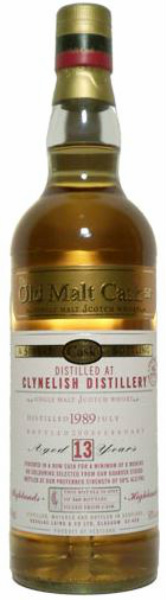
The title is correct, the picture is wrong. I found an old sample of this Clynelish on my attic, but it seems Whiskies were drunk in 2003 and not collected. I couldn’t even find one in an auction. No picture to be found of this particular 14yo rum finished Clynelish. All I could find was this picture of its 13yo sister bottling, also finished for 6 months in a Rum cask. For a brief time Fred Laing reserved the red lettering on OMC bottles for younger Whiskies in a time when  Douglas Laing was bottling almost only stellar and old bottlings. For one reason or another the red lettering, and the red tube, was soon abandoned. The bottle in the picture was bottled in February 2003, and the 14yo, I’ll be reviewing soon, later in that same year. It is therefore entirely possible the 14yo doesn’t even have red lettering.

Clynelish 14yo 1989/2003 (50%, Douglas Laing, Old Malt Cask, 6 Month Rum Finish, DL REF 3850, 312 bottles)Color: Light citrussy gold.

Nose: Wood and yes, it has some light golden Rum on the nose. This time the Rum didn’t overshadow the Whisky. You still can recognize a Single Malt Whisky in this. Flowery and soapy and hints of rhubarb. Soft young wood, leafy and fruity. Papaya, maracuja and a tiny hint of banana. In a blind tasting I would have said this was a Tomatin. Typical Bourbon cask notes and with tropical fruits, what else could it have been? Nice nose. Floral and fruity, but also damp earth and raisins. Hot butter. Sometimes whiffs of a Pinot Gris fly by. I like this. Well balanced and even though a lot can be picked up, the balance is so great and the aroma’s are so well-integrated it doesn’t even seem complex. The aroma’s show themselves in layers, but when an aroma is replaced by the next, it isn’t gone for good, everything comes back as a boomerang. Given some time a more burned note appears that wasn’t there before. I have always liked Rum finishes, maybe that’s where the interest in Rum comes from.

Taste: Recognizable as a Clynelish, with added yellow, tropical and red fruits. Quite hot, it bites back a bit. Sweet and more yellow fruits. Pineapple and white grapes, hints of unripe peach and unripe banana. After the initial sweetness, notes of paper and wood. Cheap wood, plywood maybe. This is less balanced than the nose is and the finish leaves a slightly bitter taste in your mouth. Burned wood and grape seeds. Nice stuff, just don’t expect a sweet Rum in this one.

Back in those times, it seems that Rum finishes were more common than today. Wine finishes were hardly available, and those that were around were not particularly good. Look around today, lots of finishes in casks that previously contained a Wine in all its guises. Rum finishes are still not done very often, apart from some Benriachs I guess. Speaking of which…

Points: 86

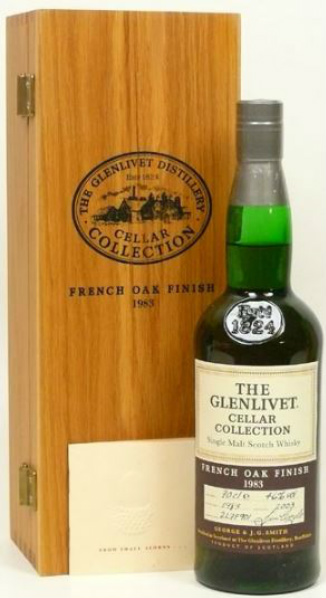
The Glenlivet 1983/2003 (46%, OB, Cellar Collection, French Oak Finish, 2L7F901)

The Glenlivet “Founder’s Reserve” I just reviewed, was actually quite simple and a bit disappointing. It is a very, very young Whisky, which in my opinion doesn’t show how good a Glenlivet can be. I rummaged a bit through my personal archive and unearthed another Glenlivet to review. So lets forget about the new one for a moment and let’s see how an old Glenlivet will do. Here we have a Glenlivet that has some 20 years behind its belt. 17 years in Bourbon and Sherry casks and a further 3 years in lightly toasted French Limousin oak casks. Not all casks were used for this bottling (quality control), so only 8.000 bottles were produced. A true limited edition! This review will probably show that this was 20 years well spent, time nobody seems to have these days since demand skyrocketed. We are told not to judge a bottle by its NAS, but in the old days the same people told us we hád to judge the Whisky by its AS (Age Statement) or Vintage. So without further ado, I give you a Glenlivet from their Cellar Collection, a 1983 French Oak Finish bottled in 2003, when age was still a benchmark.

The Glenlivet 1983/2003 (46%, OB, Cellar Collection, French Oak Finish, 2L7F901)Color: Amber gold.

Nose: Surprisingly fresh but also Sherried and certainly dusty. Elegant with silky wood notes, and some added depth of toasted wood and (partly burnt) caramel and slightly too sweet toffee. Lots of aroma. Flour. Funny enough, and I’m most probably not objective here, there is a silky wood note that seems to lie on top of the nose, not as much integrated as the deeper woody notes. Very nice to nose a Whisky that has several kinds of different wood aroma’s. With the toast comes candied fruits, adding to the depth of the Whisky. Vanilla and Ice-cream notes from American oak, so most definitely a mixture of Bourbon and Sherry casks.

Taste: Creamy Sherry and yes, lots of vanilla. Distant sweet Moscatel Wine. Very smooth. Even though this has seen two or three kinds of wood it is not overpowered by it. Sometimes the wood is hardy noticeable. In the back of your mouth some nice and sweet aroma’s form, but only if the Whisky is tasted with big gulps. Dusty on the palate as well, and alas, alas, a rather short finish.

I’m not sure what the French oak finish brings to the blend of Bourbon and Sherry casked Whisky. Sometimes you do get an un-integrated silky wooden note that lies on top. So maybe it is obvious what the finish did for this Whisky. I’m amazed this turns out to be 46% ABV. It seems more like 40 or 43% ABV. Maybe this should have been bottled with a higher ABV? Good stuff nevertheless. On paper one of the more complex Glenlivet’s from the Cellar Collection, but my mouth tells me otherwise. The aroma’s of this bottling are silky and deep and for some may lack a bit of fruity zest. Highly drinkable though and something you can enjoy properly.

For reasons only science can wholly explain, I followed the Glenlivet up with the Blackadder Lochside I reviewed earlier, and although the Glenlivet is also good, the Lochside blows it right out of the water, so when spending money at auctions I would know what to do!

Points: 86

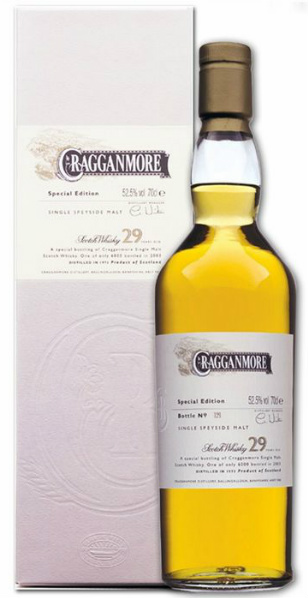
Cragganmore 29yo 1973/2003 “Special Edition” (52.5%, OB, 6000 bottles)

Cragganmore, and an old Cragganmore it is. Last year Diageo released a 25yo Special Release from 1988. That one costs a pretty penny, and is almost sold out by now. Nevertheless these days people throw themselves at anything that looks or feels like a super-duper premium bottling. However, the short row of special editions of Cragganmore was started back in 2003, by this 29yo from 1973. Yes a distillate from the seventies, and distillates from the seventies are usually even harder to come by. Nevertheless, this 1973 Cragganmore is still not very hard to get ánd even at a lower price than the aforementioned 1988 special release. What is happening here? Is the 1988 way better or has everybody simply forgotten about the 1973?

Cragganmore 29yo 1973/2003 Special Edition (52.5%, OB, 6000 bottles)Color: Gold.

Nose: Waxy and floral but rather closed. Quite light, delicate and vibrant. Old smoke and toast. Distant yellow fruits with a hint of tar. Nice combination. Steam age Whisky. Hints of barley and (floral) soap, but also hints of wood (old furniture) and even a tiny hint of pencil shavings. Hints of soft white pepper and some discernible sweetness. Dusty, fruity and slightly waxy, but I have to say it again, very closed.

Taste: Tropical fruits and quite sweet, like other bottlings from the seventies. Just remember Caperdonich and Tomatin. Cannabis and dish-water. Old papers and slightly cardboardy, which in this case isn’t a bad thing. Nice combination of cream and tired oak. It definitely tastes better than it smells. Don’t get me wrong, it smells good (albeit closed), but it tastes better. The finish is announced by some oaky bitterness, which fits the fruity waxiness perfectly. And old gent of a dram. Old and brittle but lots of stories to tell. You never know with old stuff like this, but to me, this seems to be exclusively from old Bourbon casks.

I am not Mr. Water. I hardly use water when tasting Malt prefer movement. Just let it move around in my glass, airing, oxidizing of you prefer, maybe warming it up in my hand a bit. That does the trick for me. However, if I encounter a closed Malt, then, and only then, water can be a nice experiment. I’m such an anorak, that I don’t even use a pipette, but I use a syringe. (Smaller droplets giving me more control). I know it’s sad, but I do have a life, so don’t worry about me. Well after some droplets and some more droplets, water didn’t open up the nose a lot. I did get more floral and toasty. It did do wonders for the taste. It got better, with more cannabis, more pencil shavings and more yellow sugared fruits. The toasty bit crept in here too. Lovely stuff, a bit brittle (apart from the body), so be carefull. So in this case, do try some water. Yes it needs some work, but it’s also quite an experience.

I haven’t tried all of the other special releases of Cragganmore but I can’t imagine them to be better than this one. Sure, age doesn’t matter (or so they say) and distillates of the seventies don’t have to be better than more recent distillates. However, this 1973 does come across as a very old Whisky, meaning it does smell and taste like something that can’t be made like this anymore. To “prove” or “un-prove” my point here is a review of a more modern Cragganmore, that did manage to fetch a higher score…

Points: 87