Glen Grant came to life in 1840, and is being famous for being the first distillery with electric lights! (in 1861 already). But after that it’s very quiet. Apart from distilling not much happening here. In 1961 a descendant of the original founder made a deal with Armando Giovinetti which made Glen Grant the most sold Single Malt in Italy and as far as I know that maybe even true today. Half of what Glen Grant makes went to Italy. Since 2006 Campari is the owner of Glen Grant, so its even became Italian! The Italians love their whiskies young and the Glen Grant 5yo seems to be very popular over there, together with a version without an age statement.
 Color: Copper gold.
Nose: At first fresh and sea like, but that quickly transforms into wax, wood and spice. A dab of dried yellow fruits, but not much. Definitively a 70’s nose, a bit like Caperdonichs from 1972. Probably no coincidence that Caperdonich was founded as Glen Grant 2. Altogether dryer and more cold tea like. Yep, more spicy and some light mocha and raisins. Also a slightly floral and perfumy side to it (and some tar). So after some time in the glass, it distances itself from the typical Caperdonich nose.
Taste: Initially full-bodied, spicy yet not overly woody. Some wax and ash, but that’s also gone very soon. Also some distant tar and a little bit of coal. Yeah that’s the stuff you get from an old malt. Some sourness from the oak. You wouldn’t have said that it was reduced. In the middle and in the finish though, it ís a bit thin, and reducing probably wasn’t a good idea. The wood comes very late and is the main part of the finish.
It’s a decent Glen Grant, but nothing stellar. When I come to think of it I don’t even think its very balanced. I see this going for up to 250 Euro’s at Whiskyauction, and I can think of hundreds of other bottles for that kind of cash, that would outperform this Glen Grant. A nice piece of history from the seventies, but nothing more.
Points: 86
 Interesting about Benriach is that a lot of experiments were done there during the seventies (and eighties). Tests with peat, new oak etc. Lot’s of those experiments are released today.
 Enjoyable, recommendable and very fruity. It could have gained triple A status if it would have some added bits that would counterpart the fruit. It is good/great, but lacks some complexity you would have expected of such an old malt.
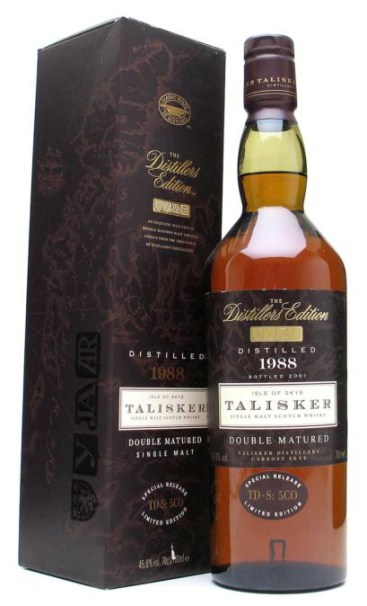 We’re on a roll with those Taliskers, so why not continue the saga with another one. Maybe this less recent Distillers Edition? The Distillers Editions are finished expressions of the ‘normal’ Classic Malt line and was introduced in 1997. Then Cragganmore (Ruby Port), Dalwhinnie (Oloroso Sherry), Glenkinchie (Amontillado Sherry), Lagavulin (Pedro Ximinez Sherry), Oban (Montilla Fino Sherry) and Talisker (Amoroso Sherry) got treated to a happy marriage with a Sherry or Port. All said to be complements to the original style of the distillery, not overpowering it. Due to the success of the new range, expansion was to be expected. In 2006 a Distillers Edition of Caol Ila (already in european oak!) finished in Moscatel and Clynelish finished in Oloroso Sherry was issued. And last but not least in 2008 Royal Lochnagar finished in Muscat was issued. We’ll probably see more expressions released in the near future.
 It’s not mere months the whisky was finished, but probably longer if not a few years. The oak is in the same spot where normally the pepper attack would be. I for one can’t detect the pepper anymore in this, and that’s a bit of a shame. Thick round body with a floral touch, violets maybe. I know that added caramel rounds out a body, but it seems to me the Amoroso does that trick here. Compared to the 10yo, this is more…ehhh round. All the extremes are toned down. Chewy and sweeter than the usual 10yo. Just a tad less balance in the finish.
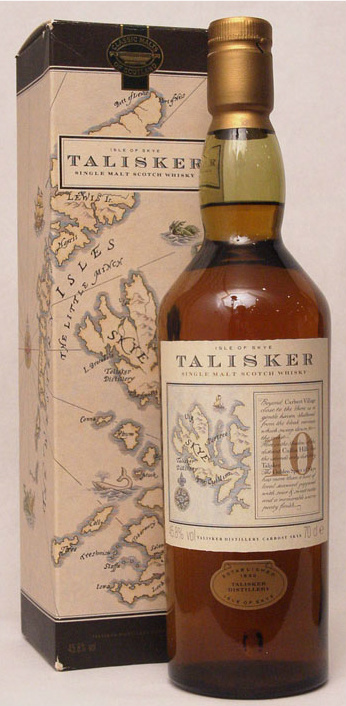 For those of you who have read my
  This profile is great and if you want this, you’ll have to pay some serious cash to buy yourself an old Islay whisky or even Brora. I know, an older expression of the standard 10yo Talisker is getting more pricey lately, but still nowhere near to the prices asked for the aforementioned bottles. Do yourself a favour and get it while you can, and beware, this is dangerously drinkable. This will be empty before you know it. I left myself a 125 ml sample of this, but I almost drank it all writing this! Stay away, just drink milk instead, its good for you, unless you are lactose intolerant I guess.
 When the moment comes these are really sold out, those boycotters will shoot themselves in the foot, especially when looking at whiskies issued today and what you can get these days for 250 Euro’s.
 Taste: Sweet and ashy and endless depth. Great latent sweetness. Burnt toast. Very nice peat. Clay and milk chocolate. Cow dung (Yummie). Licorice, black and white powder. Just fantastic. Slightly sour wood in the finish but that fazes out, and the fantastic Brora returns to keep on lingering in your mouth. The taste it leaves in your mouth is very nice. Long finish.
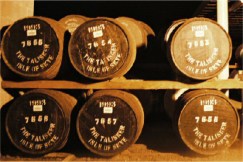 And here is Talisker. Talisker is a favourite of mine, a love affair maybe. It is a unique distillery on a unique island. Talisker is always good. So many big names from the past have slipped, some where good in the 60’s, but not now, some were good in the 70’s, but not now. Talisker isn’t one of them. Just buy any Talisker 10yo and it’s great. Even the worst Taliskers are still good. So the quality is alway delivered. Kudo’s to the people of Talisker. And when Talisker went cheating (Cask sold of to brokers or independent bottlers), Talisker was still very interesting. Just have a look at the different Taliskers issued by Douglas Laing, (as Director’s Tactical). All those casks were probably sold off since they didn’t possess the typical Talisker markers. Peat, pepper and so on. But give these a chance and something extraordinary is revealed to you about the Talisker spirit. And again even the worst Taliskers from them are still good. That’s why I like Talisker very much.
 Strange enough Talisker was never issued as a Rare Malt. But saw the light of day in many forms in a Special Release. As a Normal release we have the 10yo, 18yo and the distillers edition (finished in a Amoroso Sherry cask). And de standard Special releases were the 20yo, 25yo and the 30yo. The 20yo was released in 2002 and 2003, the 25yo was released in 2001 and from 2004-2009. The 30yo was released from 2006 untill 2010. In 2011 there were no Taliskers anymore, just a 34yo from 1975, that cost a pretty penny.
 Taste: Pepper! Animalesk. Sweet and woody (a bit sour). The clay from the nose comes through big time. Ash, almonds and putty. It has some sweetness hidden in the clay, but that disappears quickly. This is some great full-bodied stuff. The finish has some wood in it, slightly bitter and could have been a wee bit more balanced. Water does little for this whisky, so you’d better not.
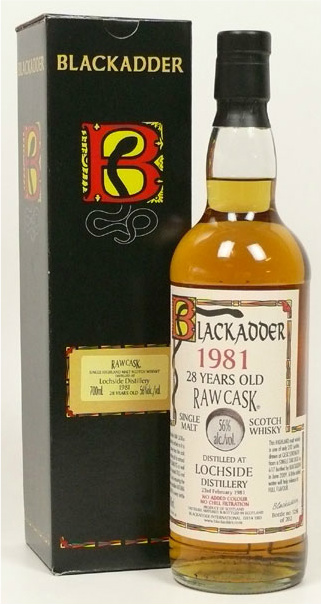 One from the (in)famous Raw Cask series. A lot of ‘stories’ are told about this one. For instance that Blackadder just throw any toasted cask trash they can get their hands on in there during bottling. That would be a shame wouldn’t it? Blackadder are also the people who bring us bottlings from the Aberdeen Distillers series and the Clydesdale series in the dumpy bottles.
 Taste: Wow, full body and spicy, Vanilla with apricot sauce. Nice! Yeah, this is it. Slightly beer like bitterness in the finish ánd black pepper. Alcoholic cherry bon-bon. Blueberry juice and creamy vanilla. Yes this has it all. When the bottle was opened at the Genietschap
  And here is another whisky from my lectern. This time an old (bottled in 1999) Craigellachie from Scott’s Selection. The people who brought us the fabulous Longmorns from 1971. Therefore I always have a soft spot for these guys. This Craigellachie was opened on our
  Color: White wine.
 This should turn out to be a very interesting review. If not for you, than certainly for me. Mr Bladnoch, Raymond Armstrong has a lot of fans, just have a look at the
  After giving the whisky some time to breathe it gets somewhat more balanced and friendlier, some nice spices shine through, with just the right amount of wood. It just doesn’t shed its new-make-and-wood finish.
 Points: 77
 And here’s yet another Speysider and not just any Speysider but an example of Speyside’s finest distillery…probably. Just consider the statement for a moment (maybe not if you’re called Luc). There’s also Macallan, Longmorn and Strathisla in Speyside. I know there are others, but I didn’t want to make this list too long. Glenfarclas isn’t mentioned on the label, but let me tell you this is a Glenfarclas, and a very old one too. I have tasted several very old Glenfarclas, and sometimes they tend to be very woody, but that’s also because there are a lot of very old Glenfarclas around, and 42yo is a long time to spend in a cask. I’m 42 now and I wouldn’t want to spend my whole life in a cask.
 To the whisky then. Glenfarclas is still a family owned operation that started legally in 1836. In 1965 it was bought by John and George Grant. Since then there were a lot of Georges and John Grants. Very popular names indeed in that family (and The Beatles for that matter). Sometimes they have extra letters for identification purposes.
  Next time I’ll be up at Glenfarclas, I’m dying to meet Ringo S. Grant! Good to see a still family owned distillery surviving competing with the big conglomerates like Diageo. There are several more like Bladnoch for instance. Power to them!
