Lets start the summer month of July with a nice and Sunny white wine from South Africa. This Backsberg is made with the Sauvignon Blanc grape variety. Sauvignon Blanc is right behind Chardonnay for the title of most popular white grape variety, and therefore can be found all across the globe. Like the Chardonnay originates from Burgundy France, Sauvignon Blanc originates from Bordeaux France. Thus we have a derby on our hands. Sauvignon Blanc is known to be dry, crisp, elegant and refreshing, but also is used to make the sweet wines from Sauternes. The terroir is, especially with Sauvignon Blanc, very important in how the wine will eventually taste. A very versatile and popular grape variety. Meant to be drank when young, most Sauvignon Blancs are not for (extensive) ageing, unless aged in oak.
 Backsberg comes from Paarl. Paarl being the second largest city in the cape region. You just get one guess what is the biggest city in the South-African Cape region. Grandpa Back was a refugee from Lithuania, who eventually got the chance to buy a farm. Part of the farm were wine grapes which more or less started the wine business for Grandpa C. Back. His son S. Back first worked alongside Grandpa C. and concentrated more and more on the wine business of the farm. S. Sold the stock, equipment and the name: Back’s wines (to pay off some debts) and started fresh with the name Backsberg. The first 10 years selling peaches off the farm! Remember that, because the peaches will return! Next in line was M. Back, he made the wine business big again, to the point it is today. The fourth generation of Back is already knocking at the gate: S.
 Color: White wine, light.
Nose: Peaches in yoghurt and more peaches in (sweet and creamy) yoghurt. Behind that a mineral note is noticeable, but it is hard to get past the peaches in yoghurt. I somehow have to reset my mind. Second time around, I guess the peaches in yoghurt come forward when the wine is a little bit warmer than it should, now it is colder and it’s more, clean and mineral and with a nice lemony acidity to it. The peaches in yoghurt are still there.
Taste: This is at first pretty sour, but that does not stay, well, it actually does in the sides of your mouth, but right in the middle, a more estery and sweet profile emerges. Perfect balance I would say, but I have to admit that I like my acids in white wine. Not too much, but it is the defining part of the palate. There have to be some good acids to interact with some elegant sweetness to achieve perfect balance. Besides the acids, a light hint of wood and a little bitterness, grapefruit. Finish could have been better, but overall not bad this one!
In fact I liked this one better when it was slightly higher in temperature, so don’t chill this too much. It got more fruity and creamy, and when chilled, it was more clean and…typical. The wine has an ABV of 14%.
Points: 80
 Domaine de Biéville, located in Viviers, was founded in the 70’s by Jean-Jacques Moreau. The Domaine comprises of one piece of 65 ha, and its orientation is south /south-west. It has a mild climate. Today his son
  Color: White wine
 Color: White wine
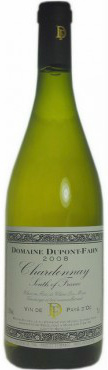
 While we’re at it, why not try another gem (hopefully) by Michel Dupont-Fahn. This time his Chardonnay from…Languedoc! For those of you who are alarmed, don’t worry, this Chardonnay is well made into the Burgundy style (whatever that is).
 Color: White wine
 Grüner Veltliner is a white wine grape variety that stems from Savagnin and further down the line, Rotgopfler and Pinot Noir. Despite of the name Veltliner, the grape isn’t related to Roter Veltliner and Frühroter Veltliner. Most Grüner Veltliners are planted in Austria and to a lesser extent, Slovakia and the Czech republic, but more recently also in the United States and Australia. One-third of all the grapes planted in Austria is Grüner Veltliner. In Slovakia one-fifth and in the Czech republic “only” one-ninth of the planted grape varieties is Grüner Veltliner. Most Grüner Veltliners age well and accompany food excellently.
 Especially in the Wachau wine region on of the following terms can be found:
 Color: Straw
 Here in Holland the Asparagus season has started and nothing goes better with that, than a nice fresh white wine. This Berger Riesling was ogling at me for quite some time, since all Austrian wines have the Austrian flag on top, it is easily recognizable.
 This Riesling (12.5% ABV), is wine from
  They are on a stony soil dating from prehistoric times. From these parts you can have a dry, minerally Riesling or Grüner Veltliner. Second on the south of the Krems Valley on the south bank of the Danube, small vintners in ancient villages make local wines in their own old-fashioned way. Third, to the east of Krems, towards Rohrendorf and Gedersdorf, there is löss in the vineyards which is noticeable in the wine, its softer and more lavish in style. The best wines from this region are called reserves.
 Color: White wine.
 Here is another bottle from Fattoria La Vialla that found its way into my castle. Click
 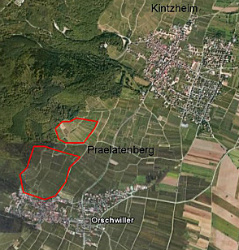 Above Praeatenberg towers the Koenigsbourg castle, built in the 12th century. The altitude of Praelatenberg slopes ranges from 250 to 350 metres and has an east-south-east orientation with a size of 18.7 Ha. The granite bedrock that underlies all Alsace vineyards is very close to the surface. The soil is heavy, covered with loose schist, and is rich with silicium. Dotted with stones rich with iron, quartz and other minerals. This helps the warming of the ground and lets water through easily.
 Color: Straw Yellow.
 The wine is a Bianco di Toscana and is 11,5% ABV from Subbiano Italy. Even the bottling date is on the bottle: 16 november 2011. The grapes for this wine are: 50% Trebbiano Toscano, 20% Pinot Nero, 15% Sauvignon Blanc and 15% Vermentino.
  It’s a white wine with a pink hue over it, that comes from the Pinot Nero and carbonates slightly.
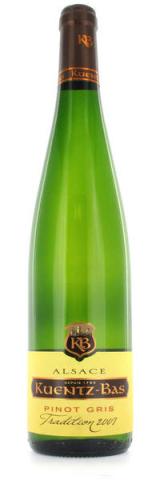 Kuentz-Bas Pinot Gris Tradition 2007, ABV 13%, Husseren Les Châteaux, Alsace
 Master Quill